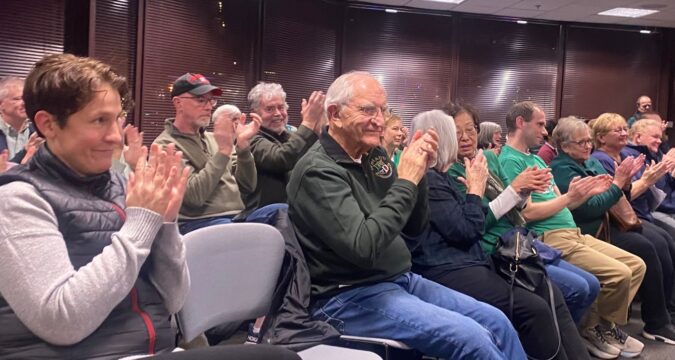
Naperville’s Historic Preservation Commission voted unanimously Thursday to recommend landmark status for the First Congregational Church of Naperville, drawing applause from a crowd of nearly 50 people.
Founded in 1833, two years after Naperville was established, First Congregational is the oldest church in DuPage County and the oldest Congregational church in northern Illinois. Its past and current members include people who have made significant contributions to the city and have been active in social justice causes.
Among the church’s influential members include Henry and Thankful Goodrich, who donated land for a forest preserve in DuPage County now known as Goodrich Woods, and James L. Nichols I, who bequested the funds to build the city’s first library.
Church member Vicki Keller proposed seeking city landmark status to the congregation last year. Seeing other city buildings, like the old Nichols Library and Beidelman Furniture, receiving the designation inspired her, she has said.
“Vicki Keller is very persuasive,” said Diana Lorenz, when asked why they are seeking the standing for the limestone church built in 1906.
Diana Lorenz, a member of the First Congregational Church’s Landmarking Task Force, told the Historic Preservation Commission on Thursday, Dec. 4, 2025, that, among other things, President Barack Obama spoke at the Naperville church when he was running for the Illinois Senate in 2004. (Carolyn Stein/Naperville Sun)
“We look down the street and we looked at what happened to another place of worship and it’s now demolished and in its place are going in row houses,” said Lorenz, who sits on the church’s landmarking task force. “All of us in the community have a very strong attachment to the building and we just felt it was time.”
In order for it to receive city landmark status, the building must be at least 50 years old and meet at least one additional criteria:
Owned or occupied by a person of historical significance in local, state or national history;
Have a direct connection to an important event in local, state or national history;
Embodies the distinguishing characteristics of an architectural period, style, method of construction or use of indigenous materials;
Represents the notable work of a builder, designer or architect whose individual work has substantially influenced the development of the community;
Included on the National Register of Historic Places.
Commissioners determined the church met all the criteria other than the last one (the building is located in the city’s federal historic district), and recommended the Naperville City Council award the designation.
Supporters of the church’s landmarking efforts flooded the meeting, with many wearing green to signal their support. Donald R. Zaininger, 82, told the commission he had attended the church for as long as he can remember.
“It is both a religious home and a place of great joy for children. I remember playing hide-and-go-seek upstairs during potluck dinners,” Zaininger said. “I would hope you would grant us this status so that whatever the congregation evolves into can still be a beacon for this community for moving forward.”
Donald R. Zaininger, member of the First Congregational Church of Naperville, tells the Historic Preservation Commission Thursday about how he grew up attending the church. (Carolyn Stein/Naperville Sun)
One woman said she was inspired to show up to support the effort after reading about the church’s activism legacy in the Naperville Sun.
“I’m an activist myself and I think this is so important,” Mary Ann Curtis said.
That activism legacy extends from the founding of the church to present day. Two charter members, Israel and Avice Blodgett, were outspoken abolitionists.
Since then, church members have participated in a number of social movements, including initiating a city-wide recycling program in the 1980s that was later transformed into Naperville Recycling and forming the Say No to Coal consortium, which wants Naperville to find clean energy sources for the city’s electricity supply.
The building itself is also significant. The Gothic Revival-style structure at the corner of Benton Avenue and Center Street is built of limestone quarried from Joliet and features pointed arch windows and doors.
First Congregational Church of Naperville, seen here on Nov. 19, 2025, is the oldest church in DuPage County. Limestone used for the building was quarried in Joliet. (Carolyn Stein/Naperville Sun)
While it replaced an earlier First Congregational church, four of the original stained glass windows were moved to the new building. Those four windows also honor multiple families, including the Nichols family.
Merritt Josiah Morehouse, a prominent Chicago-based architect, was the designer. His other work includes renovations to the Will-O-Way Manor (where Mesón Sabika is located), the “Heatherton” in Naperville (home of writer John S. Goodwin) and the Burge Farm in Newton County, Georgia, which served as his wife’s family’s plantation and is on the National Register of Historic Places.
“Yes, the Gothic Revival architecture is outstanding. The Joliet limestone is beautiful and outstanding,” said Bill Simon, president of Naperville Preservation. “But the real story here that is so wonderful to learn about is the story of the people.”
When asked by Commissioner James Wills about where congregants see the church in 50 years, church members were adamant their organization would still be going strong.
“We had people in the ’90s who didn’t want to be in an old, crummy building and they took a big piece of our pledge money where they were going to build a mega church,” church member Diane Diamond said. “And those of us who loved this location because it served the center of the town, we stuck it out. We paid the bills. We got people to join us. We kept the faith.”
cstein@chicagotribune.com


