Hazel McNally laughed as a prosecutor described how she brutally murdered her infant twins.
She “laughed uproariously” as witnesses and lawyers sniped, she “snickered” at grieving family and had a “twinkle of merriment return to her eyes” as her husband described how she would pelt him with plates and shoes, according to a Chicago Tribune report.
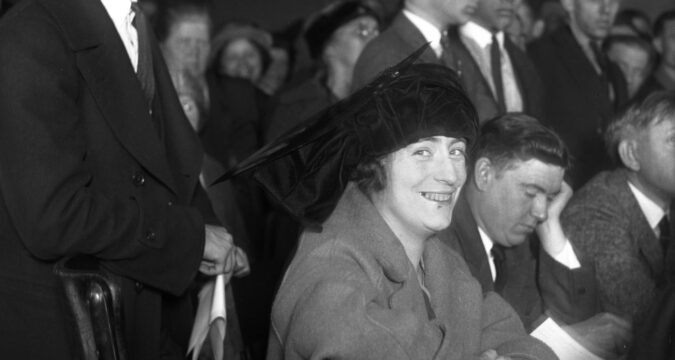
“While Frank McNally, her 55 year old husband accuser, sat with glum face, alternately glaring at a witness and glancing away towards a nearby window, Mrs. McNally, just 26 and jauntily dressed, snickered behind her gloved hand as his son, Lloyd, told how tenderly the ‘father’ had carried one of the ‘dummy twins,’” the Oct. 19, 1922, Tribune said.
For three days in 1922, Hammond hosted a murder trial that captivated and confused the nation. Autoworker Frank McNally had accused his wife of killing their children — Laurene Hazel McNally and her twin brother, Lauren Frank McNally — and disposing of their bodies.
The mother’s defense? The babies she nursed, walked around Hammond in a stroller, took to Chicago on shopping trips and kept under a veil in a darkened room for ill-defined health reasons were actually two doll heads she attached to baby clothes and stuffed with straw.
“‘Doll Murder’ Dazes Court” a Tribune headline blared. The Los Angeles Times’ front page begged “Twins, Dolls, or Hoax?” as the New York Times tucked its coverage inside under “Amusements.” Locally, papers dubbed it the “Twin-Doll Mystery,” the “Phantom Twins” or, in alliteration from the South Bend Tribune, “The Sensational ‘Sawdust Babies’ Affair.”
Frank McNally sits during his wife’s trial in October 1922, where he accused Hazel McNally of murdering their twin babies and replacing them with dolls. (Chicago Tribune historical photo)
Monday would have been Lauren and Laurene McNally’s 104rd birthday, if they existed.
Tribune reports and records from the Indiana State Library and South Bend Historical Society showed how the case played out.
Hazel McNally claimed the babies had always been dolls, sometimes saying it was a test to see if Frank would be a good father, sometimes saying it was a scheme concocted with her husband to make his ex-wife jealous, and sometimes saying a “mother mania” made her claim dolls, random babies and, in one case, a dog as her own children.
Frank McNally said the dolls appeared a few months after the babies’ birth. He said Hazel McNally told him passing off dolls as their children would keep up appearances during the twins’ long hospital stays, but over the months he slowly, horrifyingly realized his babies were never coming home.
As police tore up the McNallys’ former backyard for bodies, the courts called friends, neighbors and family to testify whether Lauren and Laurene were babies or dolls.
“Here’s where it gets weird,” Kristie Erickson, the South Bend Historical Society’s deputy executive director, told the Tribune in a recent interview: No one could agree.
From housekeeper to wife
Hazel Hills met Frank McNally in November 1920, answering a Tribune ad for a housekeeper. She was 24 with a 7-year-old from a previous marriage. He was a divorced grandfather in his 50s. They married on April 23, 1921.
Hazel seemed to blend well with Frank’s family, becoming particularly close to her similar-aged daughter-in-law Cleora McNally. During one of their swimming trips to Lake Michigan that summer, Hazel had a confession. “At that time she told me she was to become a mother and that it was distasteful to her,” Cleora testified.
Hazel McNally, 26, is seen while on trial in October 1922 for the murder of her twin babies, who she said were just dolls. Her husband, Frank McNally, disagreed. (Chicago Tribune historical photo)
Any pregnancy would presumably have been over by September, when Hazel McNally put an ad in the Lake County Times looking to “adopt an infant at once.”
It’s possible Hazel McNally had a miscarriage or that she had an abortion, which was illegal in Indiana before 1973 and since 2023. But her lawyer objected to Hazel McNally’s doctor testifying about whether she had been pregnant, instead presenting a statement from a doctor in Wisconsin saying Hazel McNally had been unable to have children since an operation in 1919.
Amid this mystery, the twins were or weren’t born on Dec. 8, 1921. They were too sickly for visitors, Hazel said. She kept them in a darkened room under a veil, saying the midwife had used too much boric acid on their eyes. Applying some boric acid was a common practice after birth at the time. Mary Griffiths, a nurse Frank McNally had hired, said she later discovered no midwife had been called.
The diapers were never soiled, Griffiths said. Hazel McNally explained the children had such tender skin that she lined their diapers with cotton. “She would wrap the cotton in newspaper and hand it to me to burn,” the Lake County Times quoted Griffiths. “I never had any reason to doubt her so I never examined any of the cotton.”
But Griffiths also testified she helped Hazel McNally pump full bottles, lactation that was more likely if Hazel McNally had been pregnant and was still producing prolactin. Griffiths also testified she saw Hazel McNally wipe blood from the boy’s nose.
“Dolls don’t bleed,” Griffiths snapped at Hazel McNally’s lawyer.
The Hammond home and yard of Frank McNally, who claimed that his wife, Hazel McNally, killed their twin babies. A search was made on the property for the bodies of the missing twins in 1922. Editors note: This historic print shows handpainting and crop marks. (Underwood & Underwood)
In late January 1922, Frank McNally said, his wife took Lauren to a hospital in Chicago for a “leaking valve of the heart” and took his sister, Laurene, four weeks later. “She said it had some trouble I didn’t know anything about,” Frank McNally testified. “When she came back she had the two dummies.”
Hazel, Frank said, cajoled, browbeat and at points physically abused him into pretending the dolls were their children, parading the phantoms in a baby buggy.
That spring, suspicious neighbor Agnes Schermer snuck into the darkened, closed-off nursery and lifted the veil over the crib. Glassy, lifeless eyes met her gaze.
“I didn’t know whether the baby was sick or dead, and I put the cover back quick,” Schermer testified. “Later I told Mrs. McNally they were saying in the neighborhood she was carrying dummies around. I had to laugh when I saw her pushing them in the carriage after that.”
The couple retired the buggy and changed the story to say the twins were with Hazel McNally’s parents. Hazel McNally said she smashed the dolls. She and her husband separated that September. In early October, Hazel McNally said her husband begged her to take him back. Frank McNally said his wife hit him with a mop.
While she was in jail awaiting trial for assault, Frank McNally swore out the murder charges.
Reasonable doubt
After three days of swirling, contradictory stories, Judge Henry Cleveland dismissed the case.
He found prosecutors had raised reasonable doubt as to whether the twins had lived, but hadn’t proved they died. No corpus, no delicti. The courtroom crowd of mostly women cheered. Hazel McNally fainted. Frank McNally quietly snuck out the back.
Hazel McNally, left, shakes the hand of Judge Henry C. Cleveland while thanking him for throwing out her murder case, while her mother, Emily Hills, right, and her attorney, Sam Schwartz, second from left, watch in a Hammond courtroom on Oct. 20, 1922. McNally was sitting on a table after fainting when she heard the news of the case being thrown out. (Chicago Tribune historical photo)
Frank McNally died of pneumonia in February 1923, swearing to the end that his wife got away with murder by concocting a story too ridiculous to doubt. They never divorced; his death certificate lists Hazel McNally as his widow. Today, he rests in an unmarked grave in South Bend’s Highland Cemetery.
No record of Hazel McNally’s final days could be located. “Did she change her name back to her maiden name, or take another name entirely, or move away? I don’t know,” Erickson said. “She vanishes into the wind.”
The last known photograph of “Doll Mother” Hazel McNally appeared in the November 1922 issue of the trade journal Toys & Novelties. She sits smiling with two dolls she bought at a Hammond department store after the trial. They were perfect matches, she claimed, for her dear departed twins and perfect product placement, the dollmakers hoped, for New York-based Fleischaker & Baum’s Effanbee line.
“We’ll say it’s a triumph for American made dolls, for when they are produced so close to life that they fool the father and the neighbors, it’s going some,” the toy journal said.
Paul Dailing is a freelancer writer and creator of the Chicago Corruption Walking Tour. You can find more at www.pauldailing.com.
Have an idea for Vintage Chicago Tribune? Share it with Marianne Mather at mmather@chicagotribune.com and Kori Rumore at krumore@chicagotribune.com.
https://www.chicagotribune.com/2025/12/07/sawdust-babies-murder-vintage-chicago-tribune/


