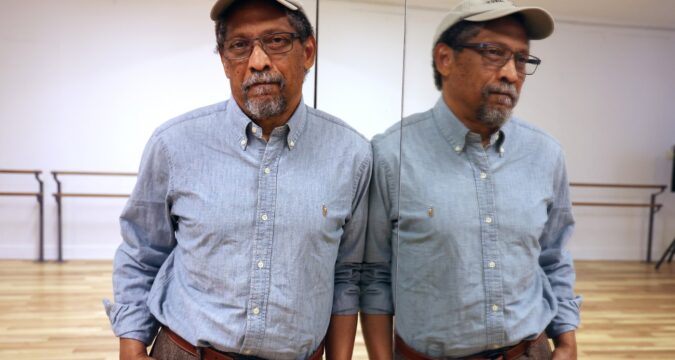
At the recent convention for the National Council of Teachers of English, I had the pleasure of seeing Percival Everett in conversation with incoming NCTE president and Stanford University professor Antero Garcia.
I have long considered Everett — author most recently of the award-winning Huck Finn retelling “James” — a “genius,” saying as much in this very newspaper in June 2017, having believed this to be true for several years before that public declaration.
I have always been curious about “genius,” working in a field in which such things are identifiable, while being confident I am not one. I thought maybe hearing a conversation with someone whose work I considered genius would give me some insights into the subject.
It is clear from the conversation that Percival Everett would put little stock in the idea of “genius.” He was funny and laconic, perhaps a little grumpy — remarking how tired he was of reading publicly from “James” — but also warm and human. I learned he never goes online. He drafts his novels longhand with pencil in an “embarrassing” notebook, the kind of thing associated with a grade-school girl.
Never going online and handwriting manuscripts are off the table for me in terms of how I make my way in the writing profession, so if these are the keys to genius, I’m out of luck.
Listening closely over the 40 minutes or so, I tried to piece together something concrete I could take away, a real-world practice of genius. I think I may have noticed something anyone could put to use, regardless of our pursuits.
The first intriguing nugget came when Garcia asked about the origins of “James,” and Everett admitted there was no good story, that the idea came to him in a moment after hitting an errant tennis shot. He wondered if anyone had ever written “The Adventures of Huckleberry Finn” from the point of view of Jim.
In the same portion of the conversation, Everett downplayed his own work ethic, declaring that he’d never uttered the sentence, “I can’t because I have to work,” when asked if he wanted to do something like go to the movies. This suggests that a key part of genius is just waiting around for the brilliance to arrive, but it struck me that Everett was allowing life to unfold without the pressure of production. It is a philosophy of anti-optimization.
At the same time, Everett’s work requires a kind of immersive attention. He read Huck Finn more than a dozen times (overkill, according to Everett), and spent many hours contemplating the fact that we have no accurate record of what enslaved persons would have spoken like, a notion that became the keystone to the novel’s exploration of language as a source of power and also a way to deceive.
His approach appears to use distraction and attention in combination, opening up the receptors to the world. He recalled wondering to a friend why he kept finding himself walking around caves, and the friend replied, “You’re working on a novel,” which must be referring to his 2020 novel, “Telephone,” in which the main character is a geologist.
This capacity for simultaneously detaching from all the surface-level things clamoring for attention, while also being able to focus on small points of interest — language, caves — that grow into interesting storytelling problems to solve seemed like a good way to produce unique, meaningful literature.
In the end, we’re talking about a practice of sensitivity to life and experience, a willingness to be present and explore and think to see what it reveals through this deliberation.
Honestly, it seems very worthy of emulation.
John Warner is the author of books including “More Than Words: How to Think About Writing in the Age of AI.” You can find him at biblioracle.com.
Book recommendations from the Biblioracle
John Warner tells you what to read based on the last five books you’ve read.
1. “Summer of Our Discontent” by Thomas Chatterton Williams
2. “The Wide Wide Sea” by Hampton Sides
3. “Between the World and Me” by Ta-Nehisi Coates
4. “Charley’s Web” by Joy Fielding
5. “The Women” by Kristin Hannah
— William S., St. Charles
For William, I’m recommending the first in what is going to be a trilogy from Colson Whitehead, “Harlem Shuffle.”
1. “Atonement” by Ian McEwan
2. “More Than Words: How to Think About Writing in the Age of AI” by John Warner
3. “Empire Falls” by Richard Russo
4. “Olive, Again” by Elizabeth Strout
5. “The Stranger” by Albert Camus
— Neil T., Chicago
Jennifer Haigh is one of the most reliably satisfying novelists working today. “Heat and Light” is the specific pick.
1. “Isola” by Allegra Goodman
2. “The Correspondent” by Virginia Evans
3. “The Fire Next Time” by James Baldwin
4. “Cursed Daughters” by Oyinkan Braithwaite
5. “Audition” by Katie Kitamura
— Ileana P., Chicago
I think Ileana stands a good chance of being entertained by Hannah Pittard’s “If You Love It, Let It Kill You.”
Get a reading from the Biblioracle
Send a list of the last five books you’ve read and your hometown to biblioracle@gmail.com.
https://www.chicagotribune.com/2025/12/06/biblioracle-percival-everett/


