For years, in parts of Chile, people rained from the sky.
During the Pinochet regime from 1973 to 1990, the bodies of the country’s “disappeared” were loaded into burlap sacks, weighted down, and thrown from aircraft into lakes or remote mountains. When poet Raúl Zurita — himself often in Pinochet’s crosshairs — learned of these death flights years later, he poured his horror into “INRI,” a long-form poem.
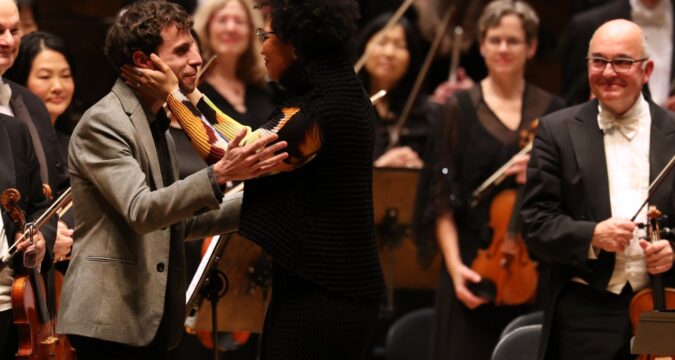
At the Chicago Symphony this week, Zurita’s verses become “Song of the Reappeared,” a 20-minute work for soprano and orchestra by Matt Aucoin. (It is the orchestra’s only premiere of the season, ungenerously scheduled in an inter-holiday week.) Singing the premiere was Julia Bullock, whose fluency in 21st century, Spanish-language works made it to the world’s largest operatic stage last year, with the Met’s “El Niño.” Petr Popelka conducted elegantly and attentively.
Aucoin — a quadruple threat of composer, conductor, pianist and writer — bolted onto the scene over a decade ago to breathless plaudits in The New Yorker and New York Times, the latter hailing him as “opera’s great 25-year-old hope.” At the time, he had staked a presence in Chicago as the CSO’s Solti Conducting Fellow and the composer of a family opera for Lyric.
At the time, Aucoin’s music struck me as unapologetically cerebral, with intermittent bursts of vulnerability. “Song of the Reappeared” and subsequent opuses (see: his opera “Eurydice,” helping reopen the Met in 2021) have mostly reaffirmed those first impressions. Syncopations upon syncopations make sifting sands out of the first movement; at the end, Bullock’s vocal line itself plummets to her low, throaty register.
Heartache comes in the inner movement — a call-and-response between Bullock and Scott Hostetler on English horn, the orchestra’s eternal wanderer — before shuddering with pent-up energy at its middle. A furious, mixed-meter marionette dance blazes across the last movement.
The work gains emotional immediacy — if not always emotional specificity — as it goes on. And Bullock’s voice, shaded enough as to sound nearly mezzo-like, also gained mettle as it went on, after a first movement mostly subsumed by the orchestra. Some weaning from the score likely would have helped with projection; Bullock was still reliant on it on Thursday.
But then, Aucoin gives the singer much to digest. Not exactly an economical composer, he quotes swaths of “INRI’s” text wholesale. It unfolds less as a strophic song — though words and images recur — than a stream-of-consciousness flow state.
Whatever legwork the CSO put into rehearsal for Aucoin’s work showed, and glowed, on Thursday. This was among the more assured premieres the CSO has played in recent seasons, sounding confident and clean.
Thank Petr Popelka for that. A for mer orchestral bassist, the 39-year-old chief of the Vienna Symphony only began conducting professionally before the pandemic. However, like another precocious low-string-player-turned-conductor, Popelka’s ascent has been meteoric in tough seasons for the industry, making his CSO debut last March.
One sees why the young Czech conductor’s career has been so charmed. In this sophomore CSO appearance, he managed to leave an indelible mark on two warhorses: Brahms’ Symphony No. 3 and Richard Strauss’s “Till Eulenspiegel’s Merry Pranks.”
Ignoring dusty concert convention, he ran headlong into Brahms to start the concert, then placed Aucoin’s piece and “Till Eulenspiegel” on the second half. Had the concert ended at intermission, it would have been worth the price of entry. This was Brahms as it should always sound, like a song sung to oneself in quiet moments.
That singing quality never faltered. The second movement was placid on the surface but flowing steadily underneath — faster than usual, perhaps, but ultra-legato, like an uninterrupted current. The third movement took on the introspection of memoir, Mark Almond’s tender, watercolored solo its most intimate confession. Phrases tapered, then grew from one another.
In the symphony’s windup beginning, Popelka’s arms pulled apart, as though against an invisible resistance band. Yet that harmonic tension never felt heavy, the CSO leaning more into brilliance than brawn here and in the fourth movement.
But if we’re talking brilliance, “Till Eulenspiegel” seizes that glittering crown. Popelka wrapped the radiance of Fritz Reiner’s Strauss recordings — the brass were in fantastic form — around a lither, fleeter frame. The prankster’s silliest episodes landed with special humor on Thursday: concertmaster Robert Chen’s shimmy down the violin, and clarinetist John Bruce Yeh’s yelps and shrieks in “Till’s” penultimate episode.
Conductor Petr Popelka leads the Chicago Symphony Orchestra at Symphony Center in Chicago, Dec. 4, 2025. (Chris Sweda/Chicago Tribune)
Popelka has a developed and specific podium vocabulary, which also happens to be gorgeous to watch. He conveyed different emotional casts to repeated sections — more fragile here, resolute there—without losing tempo. He also conveyed impulses differently, depending on what he wanted — a slight bounce on his heels for milder pulses, sharper beats for accents like zaps of electricity.
Yet another yardstick for any artist is how effectively they recover from a stumble. One hopes, of course, not to encounter that particular test in performance. But we’re human. Popelka made some error that scrunched the declarations opening “Till Eulenspiegel” — a dropped beat or two, or maybe a misplaced cue. Luckily, the orchestra played along so convincingly that many in the audience were probably none the wiser.
Even accounting for the blip, Thursday’s concert was handily in the top three strongest guest conductor outings I’ve heard at the CSO since the shutdown. Lace your snowboots — the trek is worth it.
“Till Eulenspiegel & Bullock Sings Aucoin,” 7:30 p.m. Dec. 6 and 3 p.m. Dec. 7 at Symphony Center, 220 S. Michigan Ave., tickets $39-$225, cso.org.
Hannah Edgar is a freelance critic.
https://www.chicagotribune.com/2025/12/05/review-bullock-aucoin-cso/


