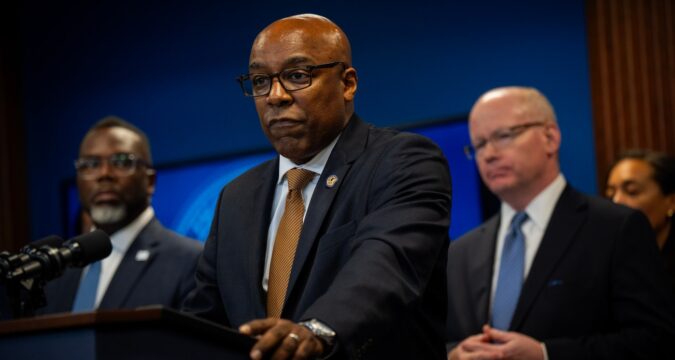
Illinois reached a settlement Monday of at least $120 million with Monsanto Co., the largest producer of now-banned PCBs, to address longstanding contamination across the state.
Illinois Attorney General Kwame Raoul sued Monsanto in 2022 over its denial of the health and environmental harms of the hazardous synthetic chemical, known as polychlorinated biphenyls. The lawsuit alleged Monsanto knowingly concealed the dangers of PCBs and continued to produce and distribute it for decades.
Under the agreement, the state will receive $80 million by March 31, which will be disbursed to Chicago and nine surrounding cities of Evanston, Lake Forest, North Chicago, Zion, Beach Park, Glencoe, Lake Bluff, Winnetka and Winthrop Harbor.
Illinois joins Washington, Ohio, Oregon and Virginia in winning damages from Monsanto to fund massive statewide PCB cleanups.
“I’m pleased that this settlement will hold Monsanto accountable for producing and disposing of a dangerous toxic chemical that continues to impact Illinois’ natural resources,” Raoul said in a statement.
The attorney general’s office did not return requests for comment Tuesday.
Monsanto, now owned by German-based Bayer, was the leading producer in the United States of hazardous materials like PCBs, as well as the maker of the controversial herbicide Roundup. The company made products including paints, caulks and lubricants for industrial electrical equipment.
On Monday, President Donald Trump’s administration urged the U.S. Supreme Court to take up Bayer’s bid to end thousands of lawsuits claiming its Roundup weedkiller causes cancer, according to a Reuters report.
From 1960 to 1970 alone, Monsanto sold nearly 50 million pounds of commercial PCB mixtures to customers in Illinois, according to the statement from the attorney general’s office.
PCBs are considered “forever chemicals” as they don’t break down easily and can remain in the water, soil and air for decades, according to Erik Olson, the senior strategic director of health for the Natural Resource Defense Council.
Since 1979, PCBs have been banned by the U.S. Environmental Protection Agency, which found that overexposure to the synthetic material is likely carcinogenic and linked to cancers like non-Hodgkins lymphoma as well as reproductive and neurological issues.
PCBs can also “bioaccumulate,” meaning the toxins will build up in the tissues of animals that humans eat, Olson explained.
“That’s something that obviously is a worry, because as people eat something like a fish that’s been in that environment that’s loaded with PCBs, the fish will actually concentrate the PCBs in their tissues,” Olson said. “And if people eat that, then they’re exposed to a big wallop of PCBs.”
Roundup weed-killing products are offered for sale at a home improvement store on May 14, 2019, in Chicago. (Scott Olson/Getty)
The suit alleged that Monsanto unlawfully discharged massive amounts of PCBs from its Krummrich Plant in Sauget in southern Illinois into the surrounding environment, including sewers that allowed the toxic waste to enter the Mississippi River.
PCB waste was also dumped into Sauget landfills, leaching into surrounding soil, water and groundwater, according to the suit. PCB contamination then extended statewide, including Cook County, through waterways like the Mississippi and Illinois rivers.
This settlement marks a major environmental justice win for Illinoisans who have been affected by decades of unlawful contamination in their communities, Raoul said in the statement.
Related Articles
Illinois trees and plants suffering widespread damage from renewed use of decades-old weedkillers on farms, studies show
Forever chemicals: They’re in your drinking water and likely your food. Read the Tribune investigation
However, Sauget is not one of the cities listed to receive funds from the settlement despite bearing a heavy burden from Monsanto’s activities.
Sauget, a town of a couple of hundred people and two EPA Superfund sites, has been left with groundwater considered too contaminated to be used for drinking water or even for industrial use due to Monsanto’s PCB dumping practices, according to the suit.
Additional legal action will determine the remaining sums that Monsanto owes Illinois, ranging from $40 million to $200 million.
In total, the state could be awarded up to $280 million to finance cleanups in affected Illinois communities.
Beyond PCBs, Olson and other environmental health experts hope the Illinois settlement provides momentum toward holding companies accountable for manufacturing other forever chemicals like per- and polyfluoroalkyl substances, or PFAS, that also threaten the health of communities across the country.
“Myself and others that are looking at this (settlement) are seeing the possibility of widespread liability,” Olson said. “And the PCB settlements are just sort of an initial indication of what we could start seeing because of the PFAS contamination. So stay tuned.”
Christiana Freitag is a freelancer.
https://www.chicagotribune.com/2025/12/02/illinois-monsanto-pcbs-contamination/


