
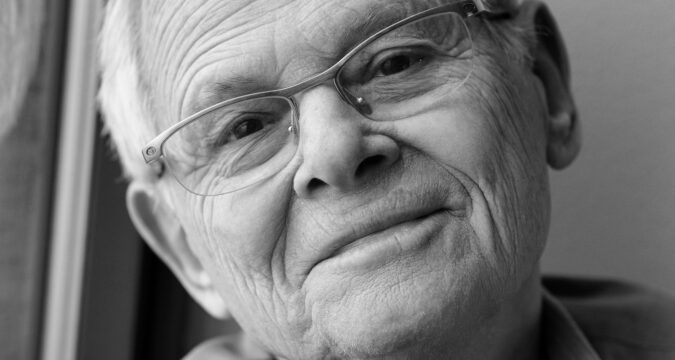
In person and in conversation, Steve Schapiro was not the sort of guy you might imagine hanging around with David Bowie, shooting the breeze with Mia Farrow, walking country roads with Dr. Martin Luther King Jr. or hanging around with New York City heroin addicts.
But that was Schapiro, a lifelong photographer, a great and admired one, and as such a witness to many of the biggest stories and most interesting people of the last half century.
He died three years ago in Chicago, where he had lived for some years, but he comes alive in a new documentary, the appropriately titled “Steve Schapiro: Being Everywhere.”
It is a wonderful film, 72 minutes long, making its local premiere over the weekend at the Gene Siskel Film Center.
Its screenings will be embellished by question and answer sessions with the film’s director, Maura Smith, a filmmaker of such works as “Towing,” with Sue Lyon and Chicago’s own Joe Mantegna. She was, more importantly, married to Schapiro from 1982 until his 2022 death. Her relationship with Schapiro elevates this movie above the usual documentary fare and gives it a rare intimacy, personal punch and offers a delightful portrait of an artist and humanist.
As she says, her aim was “to capture his charm and creativity and, equally important, to show how we can’t always tell how our lives are being shaped — those moments in life that are influencing us but we don’t realize it. It was important to me that Steve’s story was told in his own words.”
It’s quite a story, which began in 1934 in Brooklyn, where he was born and raised and first picked up a camera at a summer camp. As he told me some years ago, “I was nine years old, and I loved clouds and took pictures of them, and then, watching the photos come to life in the dark room, found that there was magic in photography.”
He discovered and was deeply influenced by the work of legendary French street photographer Henri Cartier-Bresson and studied with W. Eugene Smith, a revered American-born photojournalist. After attending Amherst College and graduating from Bard College, Schapiro began his freelance career in the 1960s.
This was what many consider the golden age of photojournalism, with dozens of high-circulation publications ravenous for photos. Schapiro’s work was in most of them, such as Life, Time, Look, Newsweek, Rolling Stone, Vanity Fair, Sports Illustrated, Paris Match and others. It was his portrait of Mia Farrow that was chosen as the cover shot for the first issue of People.
He visited and shot action on 400-some movie sets, from “The Great Gatsby” (where he captured Farrow), to “Midnight Cowboy” (his photo became the film’s poster), “The Godfather,” “Taxi Driver,” “Risky Business” and “Ferris Bueller’s Day Off.” It is a very long list.
He and Bowie bonded over their mutual admiration for silent film star Buster Keaton and worked together over decades. He and actor Chevy Chase became so close that Chase asked the Schapiros to be godparents to his daughter.
Name a movie star, he was with them. Presidents? You bet.
It is easy to get the sense that Schapiro was, as he described himself, “a fly on the wall,” but one who aimed for more. As he says in the film, “It is all about emotion, design and information. If you can get all three of those in a photo, you’re doing OK.”
But it was not all tinseltown denizens. He was there with artist Andy Warhol and his collection of weirdos. He was with writer James Baldwin. He really was everywhere and his story of being at the Lorraine Motel in the wake of Dr. Martin Luther King Jr.’s 1968 assassination will chill you for keeps.
In many of the interview sessions with Schapiro, most filmed in the couple’s stunningly white lakefront apartment here, he is wearing dark glasses. This was no affectation but rather the result of his decades behind the lens. “My left eye has trouble staying open after a lifetime of shooting,” he says matter-of-factly.
That is a high price to pay, but there is no complaint here. Smith has made an affectionate (even loving) portrait of her late husband, her film relatively unburdened, as are some of those talking-head-filled documentaries that remove us from their subjects. Though he is obviously becoming frail due to the cancer that would kill him and the strains of age (he was 87 when he died), he is sharp in his memories and thoughtfully philosophical in measuring his life.
For all his star-studded work — shooting Barbra Streisand, Robert De Niro, Orson Welles, Salvador Dali, Mae West, Satchel Paige, Ray Charles, Frank Sinatra, Ike and Tina Turner (together), Samuel Beckett, Truman Capote, Arthur Miller, Richard Pryor, Sophia Loren and more — Schapiro remained a man committed to social justice and civil rights. As he told me, “There was such an emotional flow to these events that it gave me the chance to do pictures that captured the spirit of an event or a person. Emotions are what really interest me.”
I got to know the Schapiros a bit when he moved here in 2007, after decades in California, telling me, “My wife is from Chicago and has 33 first cousins, and they all live here. This is a great city, a much easier place to live than New York or Los Angeles.”
He seemed to lack any self-promotional genes when we talked in 2014 about a modest exhibition of 20 of his portraits at the then relatively new Ed Paschke Art Center in the Jefferson Park neighborhood.
“Steve Schapiro: Being Everywhere” has been a hit on the film festival circuit, winning awards, gathering praise. Those lucky enough to have known Schapiro will enjoy and even learn a few new things seeing him again. Those who have never heard of him will be amazed and never able to forget him.
rkogan@chicagotribune.com
“Steve Schapiro: Being Everywhere” screens Dec. 5-10 at the Gene Siskel Film Center, 164 N. State St.; www.siskelfilmcenter.org


