
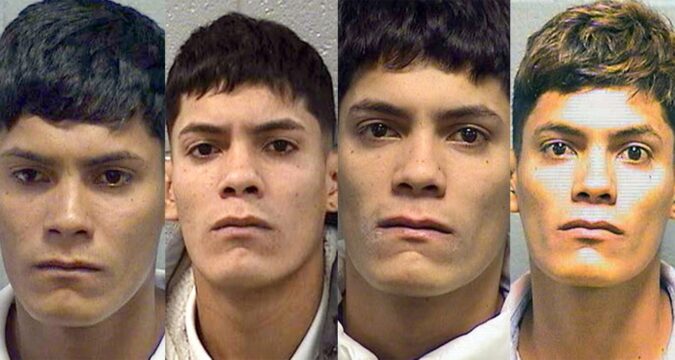
For one day in September, Jose Coronado Meza became the Trump administration’s poster child for why Chicago needed to be flooded with federal agents.
Coronado Meza had been ordered deported. But the Biden administration let him live in Chicago, where he got arrested for murder. Democrats’ “sanctuary” ways had coddled a would-be killer. Or so the argument went.
But a deeper look at the case offers a window into the erratic nature of immigration enforcement — even in eras when administrations tout crackdowns. The case shows how someone like Coronado Meza can slip through the cracks of both Democratic and Republican administrations, once the facts get separated from the bluster and politics.
Democratic policies for sure helped him stay on the streets despite a string of arrests, the Tribune found, such as ignoring a formal request to hold him for immigration agents.
But so did choices made by the Trump administration in its first five months before the killing, including not seeking a warrant that could have forced local cops to hold him.
In an immigration enforcement system that has long struggled to match ambition to reality, Coronado Meza was the kind of person easily lost in the nuance. His rap sheet before the killing listed arrests for an illegal gun and shoplifting, but no convictions. That wouldn’t necessarily prompt agents’ immediate attention in the heat of President Donald Trump’s crackdown. But it wouldn’t necessarily be ignored under a more moderate Biden.
With Operation Midway Blitz having come and gone, Coronado Meza’s case could easily be forgotten amid the military-style raids and roving sweeps, the regular shrieks of protesters’ whistles, and the viral videos of agents using such heavy-handed tactics that one judge said it “shocks the conscience.”
He pleaded not guilty in October and declined to comment through his public defender in a case that’s early into what’s typically a long, under-the-radar journey through the Cook County courts.
At the same time, the Tribune found that Coronado Meza’s path, from a border crosser to an accused killer, illustrates real-life consequences of decades of contrasting priorities from place to place and administration to administration — and how increasingly polarizing views may be exploited for political gain at the risk of public safety.
The detainer debate
According to the Department of Homeland Security, Coronado Meza first crossed the United States border in September 2023. The then-23-year-old had followed a well-traveled path of other Venezuelans fleeing poverty and violence in an increasingly authoritarian country.
But he didn’t stay long. By then, with cities like Chicago already deluged with migrants, tightened border rules under President Joe Biden led to Coronado Meza being immediately deported.
A month later, Coronado Meza crossed the border again. U.S. Immigration and Customs Enforcement agents locked him in a Georgia jail, pending another deportation. It’s unclear why ICE didn’t quickly deport him again. DHS didn’t respond to questions about his case. But by then, strained diplomatic relations had limited deportation flights to Venezuela.
DHS said he was released 5½ months into his stay — in April 2024 — at a time ICE was relieving overcrowding. He got to live in the United States while awaiting deportation.
The Rio Grande near a fence at the U.S.-Mexico border on July 12, 2023, in El Paso, Texas. Jose Coronado Meza first crossed the Texas border near Laredo in September 2023. The then-23-year-old had followed a well-traveled path of other Venezuelans fleeing poverty and violence. (Armando L. Sanchez/Chicago Tribune)
DHS declined to say any more about his immigration case, and ICE isn’t required under law to open its case files. But what happened next can be deduced through raw case data ICE has released to the Deportation Data Project. The data doesn’t list names, but DHS publicized enough details on Coronado Meza’s entry and detention that only one case matches him in the raw data.
Based on those database entries, and a collection of local arrest and jail records obtained by the Tribune, a picture emerges of how Coronado Meza made his way from Georgia to Chicago and — within three months — ended up in Cook County Jail, accused of shoplifting from the JCPenney at Ford City Mall.
In an earlier political era, it could have resulted in him being immediately held for ICE.
That’s because widely used police databases alert ICE to arrests of immigrants on its radar. ICE can then send special requests, called detainers, to ask local cops to hold them until a federal agent can retrieve them. In Barack Obama’s first term as president, with the help of local police and prosecutors, record levels of people were deported using this system.
But that spurred a backlash in places like Chicago, which had long welcomed tens of thousands of largely law-abiding undocumented immigrants who’d built lives in the wide chasm between the nation’s strict immigration laws and what the government actually enforced. Advocates complained the crackdown was too harsh, wasted local resources and actually made the streets more dangerous by scaring remaining immigrants from helping local police stop and solve crime.
So in 2011, under Obama’s first term, Cook County commissioners ordered the jail to ignore ICE detainers — something courts had ruled that local governments could do. And Illinois lawmakers expanded that stance in 2017 to any jail or prison in the state.
That fueled conservatives’ complaints that Illinois lets even undocumented killers back on the streets after serving time, instead of holding them to be deported, in a nation where polling has shown most people support deporting criminals but letting others with jobs stay.
An Immigration and Customs Enforcement official speaks to a busload of immigrants after leaving the Broadview processing facility on their way to O’Hare International Airport to be deported to Mexico on Jan 27, 2009. In Barack Obama’s first term as president, with the help of local police and prosecutors, record levels of people were deported using the detainer system. (Alex Garcia/Chicago Tribune)
So when ICE got pinged on Coronado Meza’s misdemeanor theft arrest in July 2024 — three months after he’d been released from ICE custody — the agency labeled its response as “prosecutorial discretion,” meaning it didn’t issue a detainer.
It used the label again, in December 2024, after being pinged on another arrest of Coronado Meza — accused then of stuffing $1,000 worth of clothes in a suitcase and running from police outside a Kohl’s on Touhy Avenue in Lincolnwood.
His fate was left to the Cook County courts. He was released after five days in jail, after his first shoplifting charge was dropped, while his second case remained pending.
Less than three weeks later, on Jan. 4, he was back in police custody, for a third jail stay. Chicago police said they caught him in the back seat of an SUV with a handgun that had a defaced serial number, and that he admitted was his.
ICE was pinged again on an arrest, but this time as Trump readied to take back the presidency, after promising mass deportations that would get “the criminals out” and “do that fast.”
Worst of worst?
A day into Coronado Meza’s stay on the gun charge — and 15 days before Trump’s second inauguration — ICE’s dataset recorded sending its first detainer for Coronado Meza.
For sure, the detainer was still worthless under Illinois law. But it did show that ICE, even before Trump took over, now believed Coronado Meza needed to be kept off the streets. As the undocumented immigrant sat in the county’s massive Little Village jail complex, Trump was sworn into power Jan. 20, vowing to jump-start deportations and stop “sanctuary and protection for dangerous criminals.”
If the bellicose statements were to be believed, it could again have suggested the end of Coronado Meza’s stay in Chicago.
Phil McGraw, left, known as Dr. Phil, in an image from a video he posted to his X account, walks with “border czar” Tom Homan on Jan. 26, 2025, during an embed with federal immigration agents in Chicago. (Dr. Phil)
After all, Trump immigration officials had often defined criminals as anyone arrested, regardless of whether they’d been convicted. And, within a week of Trump’s second inauguration, new border czar Tom Homan came to town with TV personality “Dr. Phil” McGraw and an alphabet soup of federal law enforcement — from the FBI to ATF — to help launch “enhanced targeted operations.”
The stated goal was to hunt “the worst of the worst” — defined as roughly 300 undocumented immigrants convicted of a crime, from murder to drunken driving. But the on-the-ground reality showed how difficult that could be. Arrest figures could be boosted significantly by detaining anyone undocumented whom agents happened to stumble across, so-called “collateral” arrests that were dissuaded under Biden but embraced under Trump.
And if Trump’s new DHS took over and had made Coronado Meza a priority arrest, he wouldn’t have been hard to find, at least until Feb. 6. That’s when he was released from jail, after both his remaining cases were dropped over what court records say were witness and evidence issues.
ICE could have waited outside the jail gates and arrested him, like they’ve done under Trump in some cases in other sanctuary jurisdictions in Pennsylvania and Maryland. But that ties up agents’ time — tracking court dockets and staking out jail exits — for an agency taking orders from a White House bent on boosting deportation figures. DHS did not respond to questions about what it did, if anything, to look for him — but records show that Coronado Meza left the jail on Feb. 6 for six months of freedom.
During that time, federal agents appeared to target some undocumented immigrants, using tools available even in sanctuary states like Illinois.
While Illinois has tried to make it harder — being one of the rare states to block ICE access to drivers’ license data — federal agents still have datasets of immigrants they’ve encountered, such as through asylum applications and hearing records, and can buy bulk data on everything from utility payments to property records. Agents can use all of it to help track down someone, said Scott Shuchart, a Trump critic who had served in DHS under Obama, Biden and part of Trump’s first administration.
“It’s like, ‘Oh, we know this guy. We know where he was living six months ago. Looks like he moved. Let’s check his sister. Yep, she has a car registered at a new address. Let’s check there. He’s not there. Looks like his brother has moved to a different town.’ They know stuff. People are in the system. They already either have information or tools to get at information.”
‘Numbers game’
Not all immigration violations rise to the level of a federal crime. But some do, such as sneaking across the border to enter, or showing back up after being deported. The latter is a felony, and a crime that DHS said Coronado Meza had committed back in 2023.
To legal experts, that means DHS could have pursued a federal criminal charge, which would have led a federal judge to issue an arrest warrant for him. It could have been the one tool to put him in federal handcuffs before the killing.
The names of those sought on judicial warrants are put into nationwide police databases, checked by cops during interactions as routine as traffic stops. Jails check them too, before releasing detainees. And unlike detainers, sanctuary jurisdictions must honor judicial warrants.
Local police statements and records show that Coronado Meza’s name was run through police databases both before he was released from the county jail Feb. 6 — 2½ weeks after Trump’s inauguration — and during a routine traffic stop on June 19, which was five months into Trump’s presidency, and three days before the killing.
If a federal judicial warrant had been in the system, local agencies would have been forced to hold him and turn him over to federal agents.
But the Tribune could find no record of ICE seeking a criminal arrest warrant for Coronado Meza. And that doesn’t surprise those familiar with the tactics of ICE. They say the agency is historically leery of doing the extra work to get judicial warrants.
“It takes time to go present a case to a judge and get a warrant, right?” said University of Chicago law professor Nicole Hallett, who directs the Immigrants’ Rights Clinic. “And in the past, and even more so now, ICE is playing a numbers game. …They’re just trying to find undocumented immigrants where they can and put them in removal proceedings. And so they’re probably not going to take the time and effort that it requires to go get a judicial warrant in every single case.”
With no federal arrest warrant in the police databases, that meant that Chicago Heights police had no reason to hold Coronado Meza on June 19 — his last-known contact with police before the killing.
Court records show officers stopped him for running a stop sign, then found he lacked a license and had illegal marijuana. He was hauled down to the station, booked and then was released with paperwork on when to show up to court on the latest charges.
A day later, on June 20, ICE’s internal dataset — in the case that matches Coronado Meza’s details — recorded it had been pinged about an arrest but that it didn’t take any action, noting the subject was “not in custody.”
Cook County prosecutors allege that — three days after that stop, and two days after ICE’s notation in its dataset — Coronado Meza and two acquaintances walked into his girlfriend’s third-floor apartment in a South Shore complex, where they confronted a native Venezuelan named Gregori Arias.
The building at 7500 S. South Shore Drive following a large-scale raid by federal agents in 2025. Cook County prosecutors allege that Jose Coronado Meza killed a man on the third floor in June. Three months after the killing, the South Shore complex was raided by federal agents. (Antonio Perez/Chicago Tribune)
Unlike Coronado Meza, Arias’ name didn’t appear in any Chicago arrest logs or Cook County case dockets. An undocumented friend of Arias told the Tribune that Arias had been a kind, cheerful guy working as a barber and Uber driver.
In that apartment June 22, prosecutors allege, one of Coronado Meza’s acquaintances shot Arias in his chest, claiming Arias had done something to get the other acquaintance shot.
According to the charging documents, a wounded Arias cried out for help while denying he’d done anything to get anyone shot. Then Coronado Meza “walked up to the victim, who was lying face up on the ground, pressed his handgun to the left side of the victim’s head and executed him.”
Arias’ friend told the Tribune that he hadn’t seen Arias in months before the homicide but can’t believe his friend deserved to die.
“He was a good person. You never would’ve expected what happened to him to happen to him,” he said.
A press release
Coronado Meza remained free until July 6 when — according to court records — Chicago officers came upon him near sunrise in the middle of a Garfield Park street drinking alcohol and blocking traffic. Officers said they found a loaded 9 mm gun in his pocket and ammunition in his bag.
He was jailed for a fourth time in a year, a county judge deciding he was too much of a risk to release before trial on the new gun charge.
As he sat in jail, Chicago detectives pieced together what had happened in the South Shore apartment, according to prosecutors, leading to him being charged Sept. 9 with murder. That happened to be the same day the Trump administration launched Operation Midway Blitz, vowing again to “target the worst of the worst” in what became one of Chicago’s most controversial law enforcement operations.
In the back-and-forth war for public opinion over Midway Blitz, Coronado Meza’s case played a bit part. After CWB Chicago and then conservative-leaning outlet Breitbart reported on Arias’ killing and Coronado Meza’s arrest, DHS’ press office cited the case of the “sick, depraved criminal alien” as one more time Democrats allowed someone “to roam free on American streets” and commit a violent crime instead of deporting him.
A week later, the South Shore apartment complex where Arias had been killed in June became the scene of arguably the most sensational and controversial raid of the blitz. Agents — some dangling from a helicopter rope or scaling a fence — burst into the long-neglected mid-rise before sunrise to haul out residents inside, immigrants and citizens alike, in a military-style assault quickly celebrated by DHS in a slick social media post.
A person who was present during the September raid shares a video on Oct. 6, 2025, of the event at 7500 S. South Shore Drive in Chicago. (Antonio Perez/Chicago Tribune)
DHS didn’t release lists of who they arrested, nor mention the complex was the scene of the homicide.
Then, as quickly as DHS turned its focus on the case, DHS moved on.
The agency has since not responded to a detailed list of questions sent by the Tribune about the case and DHS’ broader tactics and priorities in hunting people, including the use of judicial arrest warrants. The agency’s only response on the case appears to be its Sept. 22 press release.
In that release, issued 13 days after he was charged with murder, DHS announced it had sent a detainer request to Cook County Jail for Coronado Meza. The agency said it did so “to ensure he is not released into American neighborhoods” while also acknowledging — paradoxically — that “Illinois is a sanctuary state that does not cooperate with ICE.”
DHS Assistant Secretary Tricia McLaughlin vowed in the release that the Trump administration would “not allow sanctuary politicians to put the lives of Americans at risk.”
“]
https://www.chicagotribune.com/2025/12/02/immigrant-murder-detainer-warrant-hunt-politics/


