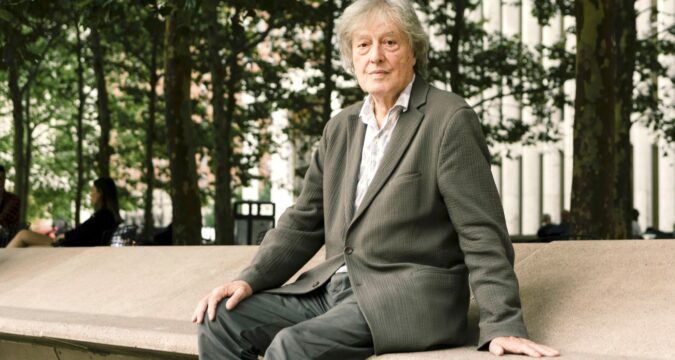
I have been struggling to write a tribute to Tom Stoppard, the living playwright I admired more than any other in my professional life as a theater critic.
Why was he my favorite? Whereas most playwrights offer us their personal view of the world, often communicated with the moral or political certainty they feel, Stoppard simply concentrated on making sure we learned that the world was more complicated than we knew when we first sat down in our seats. This has always been what I have most wanted from seeing a show. I believe it to be the theater’s great value proposition.
In plays like “Arcadia,” “Rosencrantz and Guildenstern are Dead,” “The Coast of Utopia,” “Travesties,” “Night and Day,” and many more, not to mention the screenplay to “Shakespeare in Love,” Stoppard reminded us that biology is connected to psychology is connected to neuroscience is connected to family is connected to venture capital is connected to God is connected to sex is connected to rock ‘n’ roll is connected to philosophy is connected to mathematics is connected to love. Human consciousness, he kept on writing, embodies all those things and more.
Stoppard also reminded us that we are hard-wired to be selfish and survivalist. We just learn to cloak it well. Stoppard saw through all those virtue-signaling Facebook posts and those promotions of ourselves disguised as tributes to others. He would no doubt have been amused by those that have been occurring in the wake of his own death Saturday, at the age of 88.
He saw a lot of other stuff before others did, too.
In his flawed but nonetheless stunning 2015 play “The Hard Problem,” an exploration of how science has no more credibility when it comes to defining human consciousness than religiosity (that was the hard problem), he noted the problem of Darwinian billionaires meddling in science, replacing the traditional academic checks and balances either with personal whims or data points that can be mined for profit. That certainly came true in 2025.
He also understood the transactional basis of most sexual and romantic relationships better than any other playwright.
I remember, back in 2011, watching the extraordinary, then-unknown, then-Chicago actress Carrie Coon, who I was convinced was on the cusp of stardom, in “The Real Thing” opposite Sean Fortunato. Coon was embodying Annie, an aggressive, unfaithful, brilliant, dangerously desirable young woman — “one whom a man can never be sure won’t one day get up and leave,” I wrote, thinking in my head that Coon’s leaving Chicago theater also was inevitable and feeling, well, dissed. In the play, the character asks her guy (who happens to be a playwright) this question: “You won’t let it wear away what you feel about me?” (“it” being her infidelity).
The man’s answer? “No. It will either go on or it will flip into its opposite.”
Annie, who has ice in her veins, then comes back with this retort: “You have to find a part of yourself where I’m not important, or you won’t be worth loving.”
What a gut-wrenching, diabolical line! Who has not been there in a romantic relationship, whatever one’s gender?
Then there is Stoppard’s exquisite, unique-among-playwrights understanding of the random, the main determinant of the trajectory of our lives.
Across the decades, his plays reflected his fascination with how our love lives, careers, wealth or lack thereof, happiness, success, whatever, usually are due to random sets of circumstances, however much we convince ourselves they were consequential of our own talent or (if bad) the machinations of others.
In “Rock ‘n’ Roll,” for example, the entire fortunes of Pink Floyd, and their famously talented but perpetually “zonked out” front man Syd Barrett, hinge on a spontaneous decision made by the rest of the band just not to pick the irritating Barrett up at a street corner in Notting Hill, London, as they had done every other day. This day, they keep on driving and Barrett falls into anonymity and the members of Floyd lose their artistic, experimental souls and become like every other band — merely rich pushers of junk spectacle.
Who has not been there when it comes to friendship? Who has not lost friends like that, whom we never knew we needed?
I came to this understanding that Stoppard was different, early. In high school, around 1980 or so, I acted in one of Stoppard’s earliest plays, “The Real Inspector Hound,” a soupçon of a comedy but also a withering parody of the murder-mystery pablum that dominated the theaters in the city where I grew up, Manchester in Northern England. Studying drama at university and being socialistically inclined at the time, I was attracted to the work of the likes of David Hare, Howard Brenton and Caryl Churchill, all highly skilled, highly educated, left-leaning writers engaged in critiques of Thatcher conservatism, writing elite, moralistic plays about the social costs of trickle-down economics and pleading for audiences to gain a better understanding of the costs of late-stage capitalism — precursors all to the arrival of Tony Blair and his New Labour government one one side of the Atlantic and President Bill Clinton’s administration on the other, an era that proved cynicism and self-interest had not left politics.
Stoppard was among those writers, but also never part of that crew. On the contrary, he gave them a side-eye.
It took me a long time to understand why.
It didn’t come clear to me until “Rock ‘n’ Roll.” In that play, Stoppard, channeling George Bernard Shaw, presented two most sympathetic, highly articulate characters with opposite points of view. One, a Cambridge University professor, was an old communist, clinging to his beliefs from his cozy perch, even as one of his old Czech students goes back to his homeland to try and save the revolution, only to find himself imprisoned by the Soviets.
Max, the communist professor, says he would never vote for a centrist or soft-left candidate, for fear they would merely confuse people and change nothing; he was comfy enough not to ever want to compromise. But his Czech student, more familiar with prison than the faculty lounge, has a richer understanding of how the world goes: “When we were reformers,” he says in the play, “the Soviets invaded. Now the Soviets are reformers. They’ve discovered a deep respect for Czechoslovakia’s right to govern itself. (President Václav) Havel can see the joke. It’s his business.”
Stoppard always saw the joke, too. But the line also suggested that this Czech-born, British-educated writer, a man who never went back to the country of his birth until after the fall of the Berlin Wall, a man who spent his years writing “Rosencrantz and Guildenstern Are Dead” while others were living under Soviet oppression, was haunted by guilt.
Brandon Uranowitz, Caissie Levy, Faye Castelow and David Krumholtz in Tom Stoppard’s “Leopoldstadt” at the Longacre Theater in New York on Sept. 13, 2022. (Sara Krulwich/The New York Times)
How much guilt he made all too clear in his final play, “Leopoldstadt.”
Most playwrights just die, like most of us, with plans half-finished and final stories unwritten.
Stoppard was smarter than that. He said in advance that “Leopoldstadt” would be his final work, and, indeed, so it was. It was his version of “The Tempest.”
What was his culminating statement after this lifetime of work?
It was more of a question, really: Was his mother’s deliberate erasure of his own identity justified or an immoral act?
Tom Stoppard was born Tomá Sträussler to Jewish parents in the Moravia region of Czechoslovakia, a family who got out just in time. His mother married an Englishman, then she changed her son’s name and brought him up as British. She wanted him to survive and prosper; no question that she achieved that goal. But what of those Middle European Jews who were destroyed amid the antisemitic tumult of the 20th century? What did Stoppard owe them? Anything?
It turned out that he felt he did. In his last play, he took up their cause as his own. Gone were the clever structural tricks, the intricate plotting, the intellectual paradoxes. Like Yorick in “Hamlet,” he was no longer interested in being a figure of infinite jest, of most excellent fancy.
“The work is suffused with survivor’s guilt,” I wrote when I reviewed the play on Broadway in 2022. “It had many in the audience dialing back in their own family trees to figure out who had suffered and even died for them. I looked around in the dark, and I swear I saw it happening. I was doing it myself.”
And so I was, landing first on my father but ranging beyond.
This, of course, was why Stoppard was never part of that most homogenous group of playwriting peers. His identity was different. His history was different. His sense of what theater should do, should be, was different. And in the end, he explained to all of us why.
Chris Jones is a Tribune critic.
cjones5@chicagotribune.com
https://www.chicagotribune.com/2025/12/01/tom-stoppard-appreciation/


