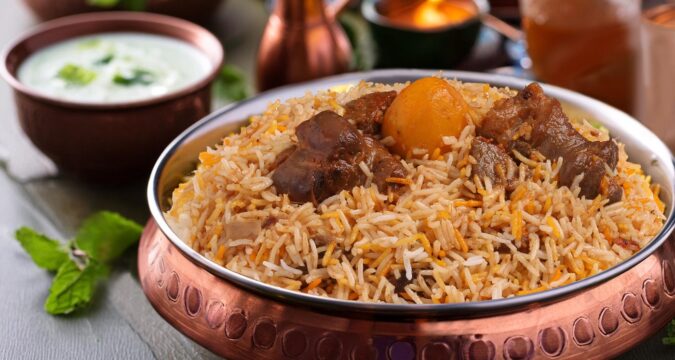
Back in 1991, when I was a 16-year-old junior at Glenbard South High School in suburban Glen Ellyn, my mother suggested to our family that we have biryani for Thanksgiving instead of turkey.
Her reasoning was sound: Thanksgiving is a national holiday about gratitude celebrated with feast foods. America is a nation of immigrants, and we have made the country stronger by contributing the gifts of our various cultures to the greater whole.
As Ismaili Muslims from South Asia, it was natural for our family to celebrate Thanksgiving because our faith views gratitude as a core value. In Sura 93 of the Holy Quran, we are taught to “constantly recount the favors of your Lord.”
Turkey was the feast food of some cultural groups; biryani was the feast food of ours. Eating biryani on Thanksgiving was a way to embrace both our faith and our nation.
As my mom served the meal that year, I remember her inquiring about the foods that were gracing the tables of my friends, who included a Nigerian evangelical, a Cuban Jew, an Indian Hindu, a Swedish Lutheran and a Mormon.
My mother was implicitly advocating a certain way of thinking about diversity, one that early 20th century American philosophers such as Alain Locke and Horace Kallen called cultural pluralism. The central tenet of cultural pluralism is that the nation is enriched when diverse ethnic, racial and religious groups retain their cultures and share them with the society. Instead of a melting pot where people dissolve their differences, it’s a potluck supper where diverse people are encouraged to bring distinctive dishes inspired by their diverse identities to a common table.
America’s Founding Fathers embraced the same idea and actually celebrated Thanksgiving with a variety of dishes coming from around the world. While it wasn’t a potluck, it was an eclectic feast. As food historian Victoria Flexner writes in the November issue of The Atlantic, Thomas Jefferson, John Adams, George Washington and other delegates to the Continental Congress in Philadelphia likely had a Thanksgiving that included pepper pot soup from the West Indies, potato dishes from Peru, turkey prepared the Old World way with onions, garlic, bacon and herbs, and fruit sprinkled with spices from Indonesia, Sri Lanka and the Caribbean.
Great Americans have long known that diverse cultures are the secret to America’s strength. Chicago is one of the cities where that declaration has been made most boldly.
Consider the Heald Square Monument, also known as the Three Patriots Monument, at Wacker Drive and Wabash Avenue, where George Washington stands next to Robert Morris and his Jewish friend Haym Salomon. A bronze plaque describes the monument as a “Symbol of American tolerance and unity and of the cooperation of people of all races and creeds in the upbuilding of the United States.”
An etching in marble features these words from Washington’s 1790 letter to the Hebrew Congregation of Newport, Rhode Island: “The government of the United States, which gives to bigotry no sanction, to persecution no assistance, requires only that they who live under its protection should demean themselves as good citizens.”
A woman photographs the Three Patriots Monument, also known as the Heald Square Monument, on Wacker Drive in Chicago on Nov. 13, 2025. (Terrence Antonio James/Chicago Tribune)
When President Abraham Lincoln gave his “Electric Cord” speech in Chicago in 1858, he noted the number of immigrants in the crowd: “German, Irish, French, and Scandinavian.” He did not demand to see their papers. He did not send armed men to their workplaces. He did not threaten their children in schools or child care centers.
Instead, he said that if those immigrants were moved by the words of the Declaration of Independence — “We hold these truths to be self-evident, that all men are created equal” — then “they have a right to claim it as though they were blood of the blood, and flesh of the flesh of the men who wrote that Declaration.”
There has been an unmistakable chill in Chicago this fall. Family, friends, co-workers, neighbors — people who contribute essential dishes to the proud feast that is our city — have been snatched off our streets with performances of cruelty. Women who wear hijabs, men who wear yarmulkes, friends who speak Spanish, people with dark skin, are afraid to leave their homes or go to work.
The absence of their contributions makes our city poorer — in culture, in dollars, in spirit.
But Chicagoans know the principles we stand on. We know that this country was built on cultural pluralism and interfaith cooperation. We know that decent governments do not aid bigotry or persecution, that good citizenship is determined by how much you care and what you contribute, and that an electric cord connects the principles of the Declaration of Independence to all the people who believe in those principles, and those people to one another.
This Thanksgiving, let us be grateful for the range of dishes on our tables, from turkey to biryani. Let us give thanks for a nation with inspiring ideals. And let us appreciate living in a city where people have the will to build a reality worthy of those ideals.
Eboo Patel is founder and president of Interfaith America, a Chicago-based organization advancing pluralism.
Submit a letter, of no more than 400 words, to the editor here or email letters@chicagotribune.com.
https://www.chicagotribune.com/2025/11/27/opinion-thanksgiving-potluck-pluralism-immigrants/


