It’s a cold and dreary November day and those flashing insects that lit up my yard in July are long gone. Or are they?
Lightning bugs or fireflies are still alive this time of year, and thanks to fallen leaves they will be flying again next summer.
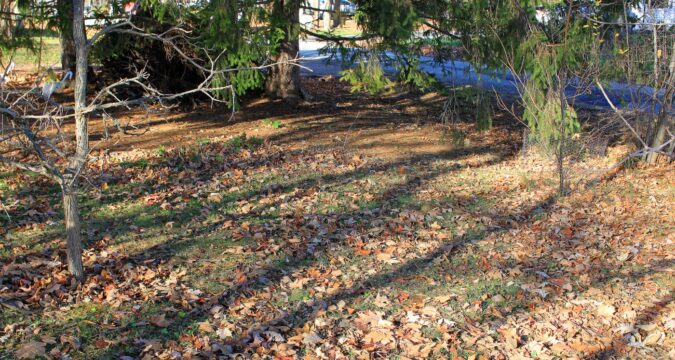
Now they are spending their time as larvae in leaf litter, underground or in other protected places. Rake or mulch the leaves and the larvae get destroyed, and maybe you’ll see more snails and slugs next spring. That’s because firefly larvae eat those garden pests.
Luna moths are big beautiful green creatures that wow us in summer; now they are living as larvae in leaf litter, too.
That’s why the Xerces Society says, “Leaves are habitat, not trash.”
“A layer of leaves is vital insulation from the cold for the many animals that hide within (or in the soil beneath),” writes Justin Wheeler, Scott Hoffman Black and Deborah Seiler in a Xerces Society article.
Mourning cloak butterfly spends winter as an adult in leaf litter and other protected areas. (U.S. Fish and Wildlife Service)
In the past, we’ve been told that leaving the leaves on the turf will smother the lawn. But a thin layer of leaves is actually healthy for grass, according to the Xerces Society. Leaves add nutrition and retain moisture, which is good for the soil.
To be sure, a huge pile of leaves covered by mounds of snow all winter in one spot is not good for the lawn, but that doesn’t mean you need to destroy all the leaves. You can be judicious about where they are and how thick the pile is.
Take a walk in a natural area where no leaves are removed, and you’ll notice that each spring, the native wildflowers emerge as always to brighten the forest floor.
Some people wonder if they should shred their leaves atop the lawn, but that practice may destroy eggs, caterpillars and larvae within the leaves.
My neighborhood is awash with noisy leaf blowers this time of year. Even at the end of November, not all the leaves have fallen from the trees, so there are more waiting to be dealt with. The leaves get blown to the side of the front yard, where they are picked up by a noisy vacuum attached to a truck.
Some neighbors have kept their leaves on the lawn. We’ve done that for years, and though we have a small yard, our lawn is just fine in spring.
Expecting everyone to follow the “leave the leaves” is unrealistic, but if some leaves are still falling or waiting on your yard, perhaps you can decide to let them be.
Max Ferlauto, a Maryland entomologist, recently studied the impacts of leaf removal on insects and soil health. He compared suburban yards with leaves on their lawns in winter with yards where the leaves had been removed. He discovered that the emergence of butterflies and moths in spring was reduced by 45% in the yards that had no leaves.
Perhaps you dislike insects and just don’t want any on your lawn. Well, consider this: No matter what you do, there will still be some sort of insects lingering in various life cycles in your yard. You can’t get rid of all of them, and you wouldn’t want to.
“We actually want these insects … and all the benefits they provide, such as food sources for birds and their role in soil health,” Ferlauto says. Insect populations overall are declining worldwide, and we need them.
On a recent sunny November day, a mourning cloak butterfly flew past me in my neighborhood. This butterfly species actually spends the winter as an adult, either in leaf litter or other protected places. What a joy to see this handsome insect with the hope it found a protected place, perhaps in someone’s leaf litter to spend winter.
I’m thankful for fallen leaves on a dreary November day, because that means I can watch insects come to life in spring to pollinate flowers and vegetable gardens and to feed birds.
Sheryl DeVore has worked as a full-time and freelance reporter, editor and photographer for the Chicago Tribune and its subsidiaries. She’s the author of several books on nature and the environment. Send story ideas and thoughts to sheryldevorewriter@gmail.com.
https://www.chicagotribune.com/2025/11/24/outdoors-column-fallen-leave/


