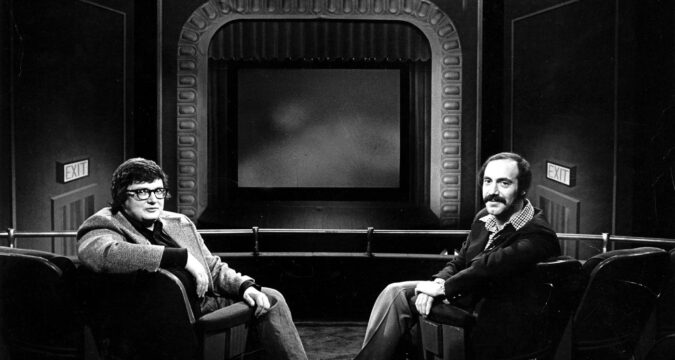
People who turned to the television listings in the Nov. 26, 1975, edition of the Tribune bore witness to history being made. Among the evening programs, competing with the second half-hour of “Tony Orlando and Dawn” and a repeat of “Ironside,” appeared a new show airing on WTTW, Chicago’s public television station.
Those who went a step further and turned the dial at 7:30 p.m. to Channel 11 caught the opening of this new show with a long title, “Opening Soon … At a Theater Near You.” Billy Joel’s “Root Beer Rag” played under a series of stills from Hollywood classics, including “The Jazz Singer” and “Ben-Hur.”
Over the next 28 minutes two men seated in director’s chairs, a fake theater proscenium behind them, read from pages on the clipboards in their laps. They were the film critics for two of the city’s three big newspapers, Gene Siskel from the Chicago Tribune and Roger Ebert from the Chicago Sun-Times.
The Yale-educated, 29-year-old Siskel had started on the neighborhoods beat at the Tribune before becoming the film critic in 1969. By the time “Opening Soon” premiered, he had begun reviewing movies regularly on Channel 2, the CBS affiliate. Of the two, Siskel appeared more at ease before the television cameras.
His counterpart on “Opening Soon,” 33-year-old Roger Ebert, had provided some on-air commentary for a series of Ingmar Bergman films shown on WTTW, but he was clearly more comfortable with the written word. Earlier that year, his work for the Sun-Times, where he’d been since 1967, had been acknowledged with nothing less than a Pulitzer Prize, the first awarded for film criticism.
During that first televised pairing, Siskel and Ebert discussed the recently concluded Chicago International Film Festival. Among the highlights from the festival was “One Flew Over the Cuckoo’s Nest.” Between clips from the film, the two shared their admiration for the performances by Jack Nicholson and Louise Fletcher and lightly criticized the direction of Milos Forman. What followed was a long animated segment from another festival entry, “Self Service” by Bruno Bozzetto, and a conversation about festival award winners, which included Rainer Werner Fassbinder’s “Fist-Right of Freedom,” or “Fox and His Friends.”
Gene Siskel, left, and Roger Ebert, right, confer with “At the Movies” executive producer Joe Antelo at a taping of the show on July 11, 1985. (Bill Hogan/Chicago Tribune)
“Opening Soon” then switched to films currently in Chicago theaters, only one of which, “Dog Day Afternoon” — loved by both critics — became a classic. The concluding segment, titled “Dog of the Month,” warned moviegoers about films deemed a waste of time and money. Siskel picked Ken Russell’s “Lisztomania,” and Ebert, noting that his choice might upset some, selected “Mahogany,” a film shot and partially set in Chicago.
In 1975, Nov. 26 was the Wednesday before Thanksgiving. By premiering “Opening Soon … At a Theater Near You” on that evening, WTTW ensured the number of viewers would be limited. The episode unfolded at a leisurely pace. The conversation between the two critics came off as disengaged. Only Ebert’s checkered jacket and Siskel’s flared shirt collar popped.
Although the execution faltered, the concept remained strong. Two of the city’s finest critics watching clips and debating in real time the strengths and weaknesses of movies currently in theaters — who wouldn’t want to watch that? And few at WTTW doubted that Siskel and Ebert were the right men for the show despite their enervated performances. They simply needed an approach that allowed them to play to their strengths. After a few months’ hiatus, WTTW decided to try again, this time with a different producer, Thea Flaum.
As detailed in the oral history compiled by Josh Schollmeyer, which first appeared in The Chicagoan, and more recently in Matt Singer’s “Opposable Thumbs: How Siskel & Ebert Changed Movies Forever,” Flaum persuaded the two critics to meet her for lunch at the long-gone Oxford Pub on Lincoln Avenue. There she convinced them that she could improve their on-screen presence and, more importantly, that the two of them, despite their rivalry in print, had the ability to create a show that could become a hit on public television and, perhaps, cross over into commercial broadcasting.
An advertisement for the movie “Fargo” that ran in the Tribune on May 5, 1996, boasted that critics Gene Siskel and Roger Ebert had given the film “two thumbs up, way up!” (Chicago Tribune)
“These are two men who never would have chosen each other for friends,” Flaum told the Tribune in 1999. “They have no natural affinity for each other. But TV forced them to find a way to work together.”
When the show returned, gone were the director’s chairs and clipboards, replaced by theater seats and a teleprompter. The set, designed by the late Michael Loewenstein, used forced perspective to create the illusion that the two critics were watching the film clips from a theater’s balcony rather than a sound stage. The illusion proved so effective that many viewers became convinced the show was shot at their neighborhood theater.
That was the intended effect. Eventually retitled “Sneak Previews,” which fit better within the narrow columns of printed television listings, the show sought to capture the experience of seeing a movie with your friends and then debating its merits. That latter part marked the most meaningful change. Siskel and Ebert now engaged each other directly.
Though they often agreed on whether a movie was good or bad, they disagreed in ways that made the show memorable and a hit. “They offered opinions in sharp, concise, often funny and often argumentative fashion. In short, they were a television version of all moviegoers, just smarter and more knowledgeable,” the Tribune wrote in 1999.
Each critic brought passion and a distinct critical perspective to the show as well as a great deal of wit (today we might call it snark), revealing how talking about art, even mass-produced art like the movies, can be intellectually and emotionally enriching.
“There is little doubt that Siskel and Ebert spiced up their natural combativeness for public appearances and for print interviews, which are peppered with sniping: Ebert about Siskel’s baldness, Siskel about Ebert’s heft,” the Tribune wrote in 1999. This photo is from 1986 in Los Angeles. (Douglas C. Pizac/AP Photo)
Viewers responded to the changes. The show soon appeared on public television stations across the United States and went from one show a month to one a week.
The expanded number of episodes allowed for occasional explorations of certain topics and themes. Some of the best early episodes of “Sneak Previews” criticized depictions of violence against women, particularly in horror movies, and celebrated empathetic depictions of members of what are now referred to as LGBTQ+ communities. Siskel and Ebert called out bigotry and stereotypes in mass-market movies while championing films made by women and people of color. And they encouraged viewers to broaden their appreciation and understanding of the art form by seeking out foreign films, documentaries and independent productions.
The show became the most popular program on public television and in 1982, as Flaum had predicted, the pair made the leap to commercial television and syndication, first with Tribune Media Co. and later with Buena Vista Television.
“For more than a quarter of a century, their thumbs up/thumbs down TV mantra would make studio chiefs and big stars quake and could propel obscure films to box-office success,” the Tribune opined. “It was the most concise and powerful judgement in the history of movies. That the two of them did this from the Midwest — and not from, as before, the coasts — made their success that much more amazing.”
Roger Ebert, left, and Gene Siskel speak at an event where Erie Street at McClurg Court was renamed in their honor on Feb. 1, 1995. Siskel is holding a roll of quarters he used to feed the parking meters. (Chris Walker/Chicago Tribune)
After Siskel’s death in 1999, Ebert continued the show with other partners, including fellow Sun-Times critic Richard Roeper. Illness forced Ebert to step away from the show in 2006, and he passed away in 2013.
Shortly before the move to syndication, the pair appeared on “Late Night With David Letterman.” Asked to explain their appeal, Ebert replied: “I think we’re film lovers. We’re fans. We like films. We like to see good films, we’re disappointed when we see bad ones, and we talk about them to each other I think the way a lot of people talk about movies to each other.”
Siskel added: “This is the thing I heard; I mean, I was in New York over the weekend, and people said, ‘You’re fans. That’s what we like. You sound the way we sound when we talk about films.’ That doesn’t mean we can’t talk about a serious concept or serious films. It’s just that we do it from a point of view of loving the work, appreciating it, and not taking cheap shots.”
By the time of that interview, it was clear that Siskel and Ebert, these two rival Chicago critics working together, had forever changed how people across the country experienced and understood the movies.
Have an idea for Vintage Chicago Tribune? Share it with Marianne Mather at mmather@chicagotribune.com and Kori Rumore at krumore@chicagotribune.com.
https://www.chicagotribune.com/2025/11/23/vintage-tribune-siskel-ebert/


