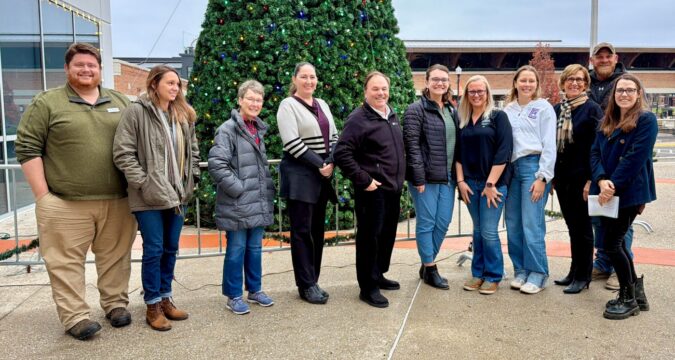
Porter County Farm Bureau President Bob Wichlinski sent out a tractor beam and harvested a crop of agricultural educators planning to revive Ag Day after years of dormancy.
“We haven’t had an Ag Day for years in Porter County,” he said Friday during an AgEd summit at the Porter County Administration Building, and he wants to restart it.
Wichlinski gathered people representing a diverse group of organizations involved in ag education, including the Porter County Soil and Water Conservation District, the county’s only ag teacher, Shirley Heinze Land Trust, Purdue Extension, Porter County Agricultural Society and Keystone Cooperative.
“Agriculture, we can’t live without it,” Wichlinski said.
The Agriculture Council of America is the principal sponsor of Ag Day nationally and has provided a template for local groups to follow, he said. “The program’s already been done. We just have to figure out to to do it in Porter County.”
Local organizers can show flexibility – including switching the tentative date for Porter County to St. Patrick’s Day instead of March 24, when students will be out of school.
Brad Metzger, representing Keystone Cooperative in Malden, is a first-year 4-H parent. He also worked on the “Co-op Classic,” a major ag ed event.
“It was a big deal. It wasn’t just a trade show,” he said. “I know some young kids got out of school, came down there and spent the day” on Aug. 19, Metzger said. “We had some big speakers just kind of giving an overview of farming.”
The event drew over 1,400 attendees.
“It was our first year. We learned from it. We’re trying to figure it out,” he said. “We got a lot of positive feedback from it,” and now he’s hoping to do it again in 2027 after a similar event in 2026 in southern Indiana.
“It was a mini Farm Progress Show,” said Cheri Birky, representing the Porter County Agricultural Society, more commonly known as the Fair Board.
“Anybody agriculture was there,” Wichlinski said.
Wichlinski is excited about the Ag Day revival but wants to start small and build on it in future years.
But what form should the event take? And where should it be held?
To attract students to join 4-H, teaching them about farming begins in second grade. If they join 4-H in third grade, they can be celebrated as 10-year members, a big deal, when they turn 18 and age out of the organization.
“It’s amazing how many kids didn’t understand where their eggs came from,” said Jen Myers, 4-H youth development educator with Purdue Extension. “There’s a lot of opportunity.”
Nicky Witkowski, a Purdue Extension educator, has a heavy horticulture focus.
Several years ago, she got a grant for a fruit garden in the Hammond schools, developing a curriculum for middle and high school students. Architecture students designed the garden, for example. Now she’s working with the health department on perhaps replicating this experience in Portage, she said.
Farming is far more advanced than it used to be, including using drones. Witkowski talked with students in grades 2-5 about applicator drones and other technology for precision farming. Coding is needed for these, so that’s a possible career path for students in the agriculture field.
She also wants people to know the difference between field corn, popcorn and sweet corn.
Michelle Benson, Porter County Soil & Water Conservation District director, has programs that focus on adults as well as children.
Among the programs are those helping women who might not be well-versed in farming, especially if they inherited a farm.
Her agency is aided by a board of farmers who help manage what the district does. “Naturally, if you’re a farmer, you’re going to listen more to the guy next door than a guy who pulls up in a suit,” Benson said.
Shirley Heinze Land Trust Conservancy Director Land Trust Conservation Director Alicia Pellegrino said one of the nonprofit’s latest initiatives is working to preserve farmland in Northwest Indiana and promoting opportunities for conservation practices on farmland. There’s a lot of farmland under lease in northern Porter County, she said.
At Meadowbrook Nature Preserve, there are opportunities to see farming practices on a smaller scale, including raised beds near the entrance.
The trick in the next 120 days is to grow an Ag Day program that will be nurtured by all this expertise and be fruitful for the participants, officials said.
Doug Ross is a freelance reporter for the Post-Tribune.


