Here’s a look back at what happened in the Chicago area on Nov. 22, according to the Tribune’s archives.
Is an important event missing from this date? Email us.
Weather records (from the National Weather Service, Chicago)
High temperature: 69 degrees (1913)
Low temperature: 4 degrees (1880)
Precipitation: 1.37 inches (2010)
Snowfall: 2.2 inches (1989)
Notre Dame’s Fighting Irish won the first college football game ever played at Soldier Field on Nov. 22, 1924, but the Tribune noted the defeated Northwestern Wildcats kept the score close. “The wonder team of South Bend, which visits gridirons far and near and leaves nothing but desolation in its path, was forced to entertain the 35,000 fans present with its most cunning tricks to gain a 13 to 6 decision,” Tribune reporter Wallace Abbey wrote. (Chicago Tribune)
1924: The first college football game was played at Municipal Grant Park Stadium (Soldier Field). Notre Dame beat Northwestern 13-6.
1925: The Chicago Bears signed three-time All-American Harold Edward “Red” Grange.
The floor of the Democratic National Convention at the International Amphitheatre on Aug. 27, 1968, in Chicago. (William Kelly/Chicago Tribune)
1934: The International Amphitheatre, a sprawling exposition center at 42nd and Halsted streets in the Canaryville neighborhood, opened. The $1.5 million structure was designed to host the 35th annual International Live Stock Exposition, which was the first event held there.
The building — which hosted the 1968 Democratic National Convention, the Chicago Bulls, the Beatles’ first Chicago show and the Ringling Bros. and Barnum & Bailey Circus — was closed in 1999.
Percy Julian, 48, director of the Glidden Plant Co. in Chicago, works in his laboratory on Aug. 1, 1947. (AP)
1950: Chemist Percy Lavon Julian was only the third African American in the United States to hold a Ph.D. in chemistry. But after his family moved into a spacious house on North East Avenue in Oak Park, they began to get messages from someone who didn’t want them there.
Vintage Chicago Tribune: Inventions and innovations by Black Chicagoans
While the home was being renovated, arsonists broke in, splashed gasoline on the walls and floors of its 15 rooms, then tossed a kerosene torch through a porch window.
Firefighters saved the house. But racism was a daily fact of life for Julian.
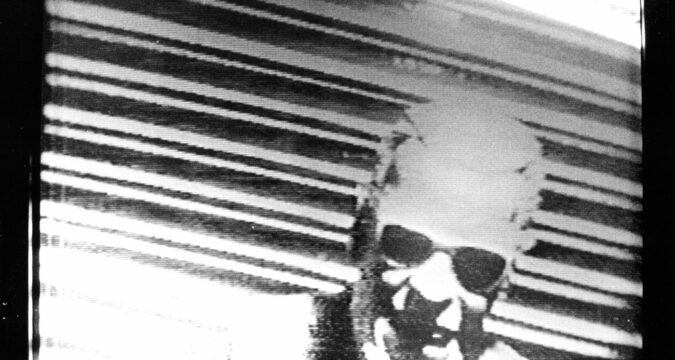
The person who wore a Max Headroom mask and hijacked the television signals for WTTW-TV (Ch. 11) and WGN-TV (Ch. 9) on Nov. 22, 1987, has never been identified. (Chicago Tribune)
1987: Viewers watching “Doctor Who” on WTTW-TV experienced one of the oddest things ever to cross Chicago televisions — a 90-second hijacking of the airwaves, featuring a person dressed as TV character Max Headroom. The character swayed back and forth while saying a number of barely audible words.
Among the words that could be heard were “Chuck Swirsky” (a former WGN sportscaster), “TV studio,” “great newspaper” and “but it’s dirty.” “Max” picked up a can of Pepsi (the real Max Headroom advertised Coca-Cola) and threw it away, then picked up another can and threw it away.
The bizarre skit ended with “Max” pulling down his pants and getting paddled with a flyswatter.
Two hours earlier, the “Max” character made an unauthorized 28-second appearance in the middle of a newscast on WGN-TV, but was zapped by an alert engineer before the imposter could do anything offensive.
Television engineers speculated that the stations had been victimized by a practical joker with an expensive transmitter. They said it would take extremely high-powered equipment to squeeze out the microwave signals that carry the programs from the stations’ Northwest Side studios to downtown skyscrapers, where they are retransmitted to television sets throughout the Chicago area.
Some thought the impostor returned a few days later on WMAQ-TV (Ch. 5), but it was a joke perpetrated by sports anchor Mark Giangreco.
Want more vintage Chicago?
Subscribe to the free Vintage Chicago Tribune newsletter, join our Chicagoland history Facebook group, stay current with Today in Chicago History and follow us on Instagram for more from Chicago’s past.
Have an idea for Vintage Chicago Tribune? Share it with Kori Rumore and Marianne Mather at krumore@chicagotribune.com and mmather@chicagotribune.com
https://www.chicagotribune.com/2025/11/22/chicago-history-november-22/


