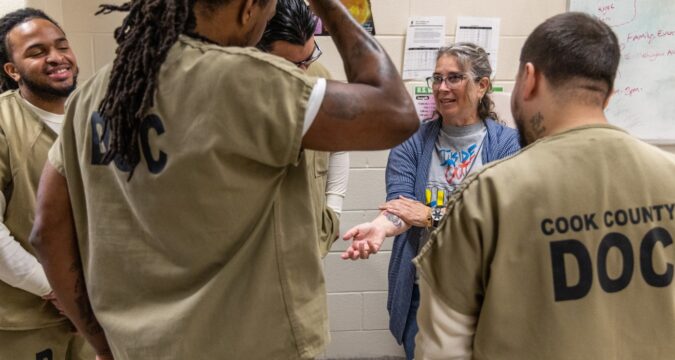
While college students were just getting started on their semester studies this fall, five young men were celebrating the successful completion of a DePaul University statistics class held at Cook County Jail. Sugary treats and soda were on hand in the cinder-block classroom at the jail, to celebrate the work of the men in the Department of Corrections beige.
For 15 weeks this summer, Yosef Mendelsohn, senior professional lecturer at DePaul’s College of Computing and Digital Media, taught the data analysis course where, upon completion, the students received four academic credits.
For nearly a decade, DePaul students have learned beside Cook County Jail detainees as part of the Inside-Out Prison Exchange Program, which brings together college faculty outside of prison with students on the inside. But this class was new to the university, adding to its jail programming with a class purely for detainees. Three days a week, Mendelsohn taught the introductory course to participants in the pilot class who needed GEDs, a record of good behavior, and a prerequisite math class to join.
“Why stats?” Mendelsohn said. “I believe it’s so vital … to be able to interpret statements people make to you, and not just take them at face value without thinking critically.”
Mendelsohn wanted to offer a class often considered challenging to many. He wanted to show students who were incarcerated what it takes to understand it. He said every citizen should learn basic statistics. The teaching experience made him reflect on humanity.
“When you talk to these kids … you’re constantly hearing stories about how they’re belittled, underestimated, written off,” Mendelsohn said. “You take being numerate, having a healthy skepticism about facts, and show them they have the tools, the mental capacity to get this stuff … it’s in them and if you can get through this, you can get through almost any course that anyone can throw at you.”
And get through it, they did.
The students earned a certificate and words of encouragement from Mendelsohn and teaching assistant Emma Blair, a senior at DePaul University majoring in community psychology. Blair helmed the study halls and got to know the individuals on the inside. At the ceremony in October, the pair shared their appreciation in getting to know the students — one of whom sometimes dozed off in sessions due to his night job, while another doodled to focus his attention, and another worked ahead because he grabbed concepts quickly.
DePaul University professor Yosef Mendelsohn, right, awards detainee Carlos Martinez, 30, with a certificate of completion during a graduation ceremony for detainees’ full university-level data analysis and statistics course on Oct. 24, 2025, at Cook County Jail in Chicago. (Dominic Di Palermo/Chicago Tribune)
For Everardo Olmos, 29, also known as “Lawlo,” the most difficult lesson in the class was interpreting the data in Z scores — a statistical measurement that describes a value’s relationship to the mean of a group of values.
“I liked math until they decided to throw the alphabet into it,” Olmos said, adding he was always good at math but hated the repetition in it. But with Mendelsohn’s help, his dislike is a bit less pronounced now that he better understands how statistics factor into real life, like running a clothing store business. Films like “Moneyball” and “21” are clearer as is the Monty Hall paradox (of “Let’s Make a Deal” fame) — a probability puzzle where a contestant is given a choice of three doors with a prize.
Allanté Anderson, 38, was always into math in school as a youth, but he never showed his work, so he wouldn’t get credit. “They think you’re cheating if you don’t show the work. You got to show the work the way they tell you to show it,” he said. Now, having taken Mendelsohn’s class, he smiles because he finally understands the greater-than and less-than signs. “That’s one thing I never could get, no matter how many times they told me,” he said.
Roy Molina, 22, was in honors or AP math before his incarceration, so he saw the stats course as a good refresher. He has aspirations to use the credits he’s accumulated inside when he gets out. Molina is interested in architecture, Anderson in criminal law.
“When you come in here, you realize that it could have been anybody in certain circumstances,” Blair said. “It has nothing to do with who somebody is as an individual. It’s their environment.”
With so much material to cover, Mendelsohn knew it would take longer than DePaul’s 10-week quarter system to teach. He lectured for two and a half hours a week across three sessions, amounting to 15 weeks. Students didn’t have the opportunity to study outside of lectures with calculators and pens, or to do research.
Christina Rivers, the Illinois coordinator of the Inside-Out Prison Exchange Program, gave thanks to Mendelsohn and school deans for pioneering the course and setting a standard. As someone who’s been terrified of math since second grade, she’s grateful for instructors like Mendelsohn who demystify the subject.
“Every time I come into these spaces, there’s so much genius in the room — we know this. But so many people on the outside don’t know this,” she said. “Everybody here is so exceptional. I also want to say, you’re not the exception … there’s so many more people in these spaces that are exceptional. St. Vincent de Paul ministered to people in prison. This is the most rewarding way of carrying out the mission.”
DePaul University teaching assistant Emma Blair talks with her students during a graduation ceremony for the university-level data analysis and statistics course on Oct. 24, 2025, at Cook County Jail in Chicago. (Dominic Di Palermo/Chicago Tribune)
Mindy Kalchman, professor emerita at DePaul in mathematics, is a veteran of the Inside-Out Prison Exchange Program. She’s taught her course, Doing Math With Agency, for three years in the jail. Her class was the prerequisite for the statistics class. It focuses on doing math in one’s own way, rather than following the textbook model. She sees Mendelsohn’s statistics course as an extension of hers.
“If you think about doing a problem in your own way, you’re wrong because it’s not what the teacher or textbook told you to do. I saw that lack of agency in doing math as a common barrier to success,” Kalchman said. “The idea was to develop a course where everybody could do it (math) according to what’s meaningful to them. Math is done collaboratively. It’s OK to not get it the first time; mathematicians are always stuck. I was trying to replicate how mathematicians learn to collaborate, to communicate, to ask questions, to be wrong, they learn to be proud of what they know, and they learn that it’s OK to do it how I understand it.”
Mendelsohn is hoping to motivate other faculty to take on projects like this. He’s considering teaching a web design computer science class next. With the statistics class as a model and motivator for students and incarcerated individuals, he’s looking forward to increasing public awareness about those inside —reminding the outside of the untapped potential therein.
“I talk to people on the outside about this and their view of what a jail looks like is so constructed and remedial,” Blair said. “It should be the standard that people are humanized, and that people have access to education … I think education is one of those things that is so tied into restorative justice, because good education is empowerment and teaching yourself that ‘I am capable’ does so much for people, so much more than any type of punishment, in my opinion.”
https://www.chicagotribune.com/2025/11/22/cook-county-jail-detainees-depaul-university/


