Hunger hit Chicago and its suburbs especially hard these past
few weeks.
And it’s only going to get worse.
During the first half of November, unpaid federal workers, SNAP recipients cut off from benefits, and immigrants too scared to venture out to work swelled the already long lines of desperate people seeking assistance at food pantries across Chicago and northern Illinois.
The Greater Chicago Food Depository and the Northern Illinois
Food Bank, two nonprofit organizations that supply food to
local pantries, rushed to meet a rapid surge in demand.
“Food insecurity has been an issue for a long time,” said Man-
Yee Lee, director of communications at the Greater Chicago Food Depository.
The recent government shutdown, she said, “exacerbated the
problem, showing everyone what happens when you switch off
a vital resource like SNAP (the federal government’s
Supplemental Nutrition Assistance Program), which is a critical
lifeline for 1.9 million people in Illinois.”
The crisis of the past few weeks, she added, also served as a
preview of far worse things to come.
Written into the recently passed federal “Big Beautiful Bill” are new eligibility restrictions on SNAP, she said, and an expectation for states to shoulder some of the cost of the program.
“It is going to get harder” for low-income people to receive
benefits, beginning in December, Lee said. “A lot of people are
at risk of being kicked off the program.”
The shutdown was temporary, Lee said. The new changes are
not.
“We’re talking about hundreds of thousands of people
potentially losing benefits. We are very concerned about what
that is going to do to our network of 840 food pantries,
kitchens and shelters across Cook County,” Lee said.
Similarly, the Northern Illinois Food Bank, which distributes
food to pantries and shelters across 13 counties in northern
Illinois, is equally concerned about the coming crisis.
“Now that SNAP is reactivated, there’s this misconception that
the need will not be as great,” said Colleen Ahearn, chief
philanthropy officer at the NIFB. But even before the recent
crisis, the food bank was dealing with a $3-$4 million cut in federal funding, she said.
Now, because of coming cuts to SNAP, she added, “We’re
anticipating need to continue to increase.”
The Food Depository, which stocks pantries across Chicago and
Cook County suburbs, saw a 38% increase in visits to sponsored food pantries, compared to the first week of October, Lee said.
The organization responded by opening six temporary Saturday
emergency distribution sites in areas where there is a high
concentration of SNAP recipients.
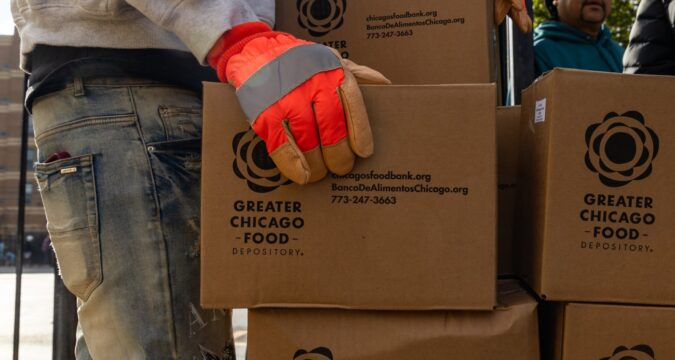
On Nov. 1, it handed out 1,700 boxes of peanut butter, soup, canned fruit and other staples in two hours, Lee said.
More than a quarter of the boxes went to first-time visitors.
A week later, Lee said, “We expanded the response to 10
locations and serviced more than 2,500 within two hours.”
Even after the shutdown ended, the demand continued as
SNAP recipients waited for their cards to reload. On Nov. 15,
the depository gave out 300 to 600 emergency food boxes at each of its nine temporary sites.
Each box, Lee said, represents a household in need.
Likewise, the food bank, which services many Chicago area suburbs, saw visitorship rise by 26% across its network of 300
pantries during the first two weeks of November, compared to
the previous month. As of Nov. 17, there was a nearly 400%
jump in searches on the bank’s online food finders site, Ahearn
said.
The bank also saw a 190% increase in November on its online
order service, Ahearn said.
Emergency mobile popup sites at Elgin Community College and
Joliet Junior College were inundated, she said.
“We were prepared to give out 750 boxes” but some 1,000
people showed up in Elgin, Ahearn said.
“When we ran out of food boxes, we provided gift cards. When
we ran out of those, we had to turn people away,” she said.
The need, she added, is not unprecedented, but the gap to fill it
is.
Ahearn said there was a similar spike in inquiries and visits
during COVID but, back then, the food bank also saw an
increase in government funding to meet that demand.
“Now, we’re seeing a decrease in resources” and a jump in
need, she said.
The bank is seeking more private donations and grants to fill
the gap, she said.
At the Food Depository, Lee said, retailers, manufacturers and
growers are taking on bigger roles, donating food that has been
discontinued, has minor cosmetic imperfections, is nearing “sell
by” dates or has underweight packaging.
“We rescue the food that these suppliers might otherwise
throw away,” she said.
Additional food comes from the USDA and donations from the
public.
In fiscal year 2025, Lee said, “we collected 46.5 million pounds
of food” to help feed the “1 in 5 families in the metro Chicago
area that are facing food insecurity.”
As we head into the holidays, a time when hunger seems
harsher and the haves may be more inclined to think of the
have nots, Lee said, “We believe food is a basic human right.”
Get help
If you need food and you live in Cook County, go to the Greater
Chicago Food Depository’s website to find a pantry near you.
If you live in Will, DuPage, Kankakee, Kane, Lake, Kendall, McHenry, Grundy, Stephenson, Ogle, Boone, Dekalb or Winnebago counties, go to the Northern Illinois Food Bank’s website to find a pantry near you.
Give help
If you are blessed and want to help, go to either website and
make a donation, sign up for monthly automatic donations,
become a volunteer or, the next time you’re at the
supermarket, buy two and donate the second.
Donna Vickroy is an award-winning reporter, editor and columnist who worked for the Daily Southtown for 38 years. She can be reached at donnavickroy4@gmail.com.
https://www.chicagotribune.com/2025/11/21/chicago-areas-hunger-crisis-far-from-over/


