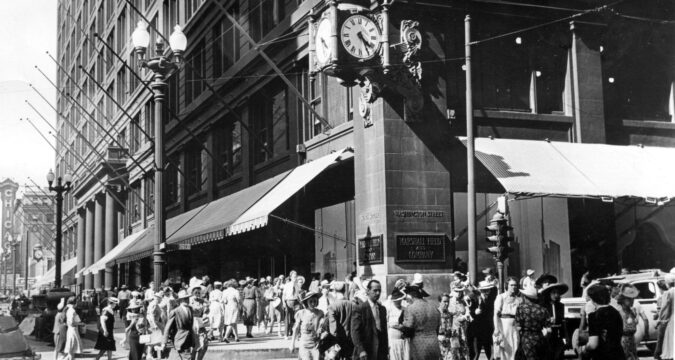
Marshall Field’s has returned to State Street for the holiday season. It’s been almost 20 years since the brand was just about discarded from its longtime emporium on State Street by the new owner, Macy’s.
This year, however, the retailer is capitalizing on nostalgia to bring shoppers back to the multilevel destination at 111 N. State St. in downtown Chicago. The building’s windows are aglow with animated elves who highlight what the classic department store was known for: iconic clocks, Frango mints, the mosaic Tiffany dome, Uncle Mistletoe and Aunt Holly, and elegant dinners shared with family. The cherished wood-paneled restaurant on the seventh floor is now known as the Marshall Field’s Walnut Room and Field’s fans will recognize the giant green shopping bag at the base of the Great Tree.
Many might wonder, “What took them (Macy’s) so long?” to revive the brand at the flagship. The merchant had been frequented by generations of Chicagoans.
Visitors take pictures in front of the Great Tree at the Marshall Field’s Walnut Room on the seventh floor of the Macy’s State Street department store on Nov. 6, 2025, in Chicago. (John J. Kim/Chicago Tribune)
Marshall Field’s started out in 1852 as P. Palmer & Co. (as in real estate mogul and hotelier Potter Palmer). An 1854 advertisement for the dry goods store at 137 Lake St. boasted it could “sell goods cheaper than any other establishment in the city.”
In 1865, Palmer brought on younger wholesalers Marshall Field and Levi Leiter, who together purchased an interest in Palmer’s store. That’s when it became known as Field, Palmer & Leiter. After Palmer stepped back from the business in 1867, it was called Field, Leiter & Co.
One year later, the duo opened their first State Street store — inside a building owned by Palmer. When Leiter departed in 1881, it finally became Marshall Field & Co.
Here are highlights from the Chicago retailer’s reign.
Oct. 12, 1868
Marshall Field, circa 1900. (Library of Congress).
Marshall Field opened their first State Street store.
“The attendance of wealth, beauty and fashion which assembled last evening to take the benefit of the grand opening was something unparalleled in Chicago’s history, and the event was one long to be remembered,” the Tribune reported. “One would have thought that the opening last night was an adjourned meeting of the ‘Charity Ball,’ judging from the long lines of carriages, filled with the cream of the avenues.”
Palmer was praised for his idea of widening State Street and constructing a building fronted by Corinthian columns, clad in balconies of marble and richly decorated.
Oct. 11, 1871
The First National Bank building stands in ruins at State and Washington streets after the Great Chicago Fire in 1871. The Field, Leiter & Co. store, which became Marshall Field & Co., lay in ruins. (Marshall Field & Co.)
The elaborate building was destroyed during the Great Chicago Fire, yet a Tribune editorial noted Field and Leiter were ready to “recommence business” just one day after the conflagration was extinguished thanks to inventory that was saved.
A temporary retail store opened on Nov. 6, 1871, in a horse car barn at State and 20th streets.
Another fire on Nov. 14, 1877, destroyed the Singer Building at State and Washington streets, which meant the retailers were forced to rebuild again on the same site. A new complex of buildings arose in the decades ahead.
Nov. 26, 1897
Fireworks fill the sky behind the famous Marshall Field’s clock on Jan. 1, 1980. (Arthur Walker/Chicago Tribune)
An “immense clock, with four great dials” was erected at the corner of Field’s building at State and Washington streets. Covered with ornamental ironwork, it became a landmark at the busy intersection. Another was soon added at State and Randolph streets.
Sept. 30, 1907
Christmas is in the making as decorators working from a three-story scaffold trim the Christmas tree in Marshall Field’s & Co. State Street store on Nov. 20, 1966. (William Yates/Chicago Tribune)
The new State Street store opened one year after Field’s death in New York. He contracted pneumonia during a winter game of golf and is now buried in Graceland Cemetery.
The South Grill Room (which became known as the Walnut Room in 1937) was opened to the public, and the first Great Tree — which was a live evergreen — was decorated and placed there for the first time during the holidays.
The Tiffany dome inside Macy’s on State Street in Chicago on Dec. 14, 2022. (Chris Sweda/Chicago Tribune)
Opulence abounded inside with elaborate interior decorations, merchandise and window displays. But the best piece was above the customers’ heads.
“The new Mosaic Dome of Tiffany Favrile Glass will be unveiled to the public,” an advertisement proclaimed. “This is the largest single piece of glass mosaic in the world, and the first dome ever built of iridescent glass. It is, we believe, destined to become famous among architects, decorators and other artists throughout the world.”
1914
Helen Alexander, of Northwestern University, is at Marshall Field & Co. on Aug. 29, 1928. (Chicago Herald and Examiner)
With the addition of the North Wabash Avenue building to the Field’s complex, the State Street store became the largest department store in the city — occupying a full city block. The Narcissus Fountain Tea Room was on the new building’s seventh floor.
July 1929
Candy makers on Marshall Field’s 13th floor at the State Street store in Chicago make Frangos in Field’s kitchen, circa the early 1900s. (Chicago Tribune archive)
When Field’s acquired Seattle-based chain Frederick and Nelson Co., it also acquired the Frango mint. The mint was originally called Franco, an acronym of the department store’s name.
The mints, which were renamed Frango in 1934 after the rise of Spanish dictator Francisco Franco, were minted on the 13th floor of the State Street store for nearly 70 years until the candy kitchen closed in 1999. Minneapolis-based Dayton Hudson, which bought Field’s in 1990, outsourced production of Frangos to a Pennsylvania company over the objections of civic leaders and longtime customers alike.
The popular Frango mint chocolates by Marshall Field’s. (James F. Quinn/Chicago Tribune)
Federated Department Stores bought the parent of Field’s in 2005 and converted the Chicago-area stores to Macy’s. In 2007, Macy’s struck a deal with Chicago-based Cupid Candies, returning some production of Frangos to the city.
The chocolate brand was bought by Garrett Brands, owner of Garrett Popcorn Shops, in 2017.
1946
Freddie Fieldmouse and Uncle Mistletoe are on State Street to introduce children to the holiday spirit as stores began to decorate their windows, including Marshall Field’s, on Nov. 13, 1978. (Ovie Carter/Chicago Tribune)
Almost a decade after Montgomery Ward created Rudolph the Red-Nosed Reindeer, Field’s introduced Uncle Mistletoe — its toy department ambassador. The so-called “puppet assistant to Santa Claus” with bushy eyebrows and a top hat was an immediate hit.
By 1948, Uncle Mistletoe had his own TV show and daily drew crowds of 250,000 fans, who visited him and his wife, Aunt Holly, at Cloud Cottage on the store’s eighth floor.
1975
Thousands of people jam the Loop on Nov. 25, 1976, to view the Christmas decorations in the store windows, including Marshall Fields & Co. shown here, along State Street in Chicago. (John Bartley/Chicago Tribune)
Holiday shoppers had a new place inside Field’s to recharge: Crystal Palace ice cream parlor.
“The once-drab, third-floor waiting room has been transformed into a pretty, cheerful Gay ’90s parlor, decked out in soft rose pinks and moss greens, glass chandeliers, an apothecary-like entrance, painted Victorian mirrors, hanging plants, potted palms and stained glass arches,” the Tribune reported. “There’s a soda bar with wirebacked chairs, hot pink seats and piped-in period music.”
March 10, 2004
People walk past the Street Street store for Marshall Field’s on the day it was sold, June 6, 2004, in downtown Chicago. (Nuccio DiNuzzo/Chicago Tribune)
For the second time in less than a year, Field’s was searching for a new owner. Ownership changes had been frequent since BATUS took Field’s over in 1982.
Target Corp. announced it was putting Chicago retailing icon Marshall Field’s up for sale.
Field’s was sold to May Department Stores Co. in June 2004, for $3.24 billion. Then, May’s was acquired by Federated Department Stores Inc. — the parent company of Macy’s — in 2005.
Sept. 9, 2006
All 40 Marshall Field’s awnings at the State Street store are replaced on Aug. 29, 2006, with the Macy’s logo. (Nancy Stone/Chicago Tribune)
On Sept. 20, 2005, Federated announced it would retire the Field’s name and rebrand all Field’s stores as Macy’s.
Marianne Nathan, of Oak Park, joins others in protest of Marshall Field’s name change to Macy’s at the corner of State and Washington streets in Chicago on Sept. 9, 2008. The protest came at the two-year anniversary of the name change. (José M. Osorio/Chicago Tribune)
The State Street location officially became Macy’s a year later. But, just like the Sears Tower, many locals still call it Field’s.
Want more vintage Chicago?
Become a Tribune subscriber: It’s just $1 for a 1-year digital subscription.
Thanks for reading!
Subscribe to the free Vintage Chicago Tribune newsletter, join our Chicagoland history Facebook group, stay current with Today in Chicago History and follow us on Instagram for more from Chicago’s past.
Have an idea for Vintage Chicago Tribune? Share it with Kori Rumore at krumore@chicagotribune.com.


