“Jesus died for somebody’s sins, but not mine.”
Has there ever been a gutsier opening salvo in rock n’ roll? That’s how Patti Smith began her show Monday night at the Chicago Theater, the line coming out slow and sinewy, and it’s how she started her career 50 years ago this fall. Those bracing first words on “Horses,” her debut album, released Nov. 10, 1975, never did sound like a lyric. It was a declaration of intent, or as Smith writes in her new memoir, “Bread of Angels,” a way of “signaling accountability for my choices in life and art.”
Whatever it was, it was iconic.
We should all be cringing these days at the overuse of “iconic” to describe anything merely good, yet it’s hard to overstate how actually iconic everything about “Horses” became after 1975. Robert Mapplethorpe’s black-and-white cover. Smith’s androgynous appearance. The way she raises her chin on that album cover, as if daring her listeners. Those soft creeping pianos. The shambolic Beat-like impulsiveness of the songs. Iconic, iconic, iconic. Maybe even totemic. It represented not just the arrival of a new band but a startling approach to life itself. It was the first commercial LP from the fledgling punk scene at CBGB’s in New York, soon to deliver the Ramones, Television, Talking Heads and Blondie. At the Chicago Theater, Smith and her band — which still has two veterans from those days, longtime guitarist Lenny Kaye and drummer Jay Dee Daugherty — tore into “Horses” from top to bottom, and 50 years on, it’s still alternately vivid and elliptical.
Smith turns 79 next month.
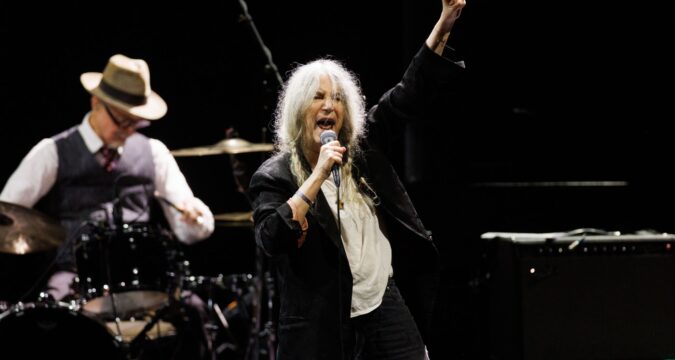
Her famously raven hair is now a frizzy flood of white. Her voice is still scratchy and bellowing and strong. Her stage uniform hasn’t changed much: white shirt, black jeans, dark coat, dark boots. A half century ago, in the cryptic liner notes for “Horses,” Smith called for “new risks etched forever in a cold system of wax,” and added: “As for me, I am totally ready to go.” All these years later, she also sounds just as ready to go, as if she never tired of the challenge she built for herself. She seems eager to suggest new depths in “Horses,” particularly showing it off as a door from the last gasp of ‘60s psychedelia to early literary punk. Introducing “Break It Up,” she explained how its inspiration was a dream about Jim Morrison. For the mournful “Elegie,” she described being cornered once by Jimi Hendrix, who told her a sweet, nonsensical tale of music creating world peace. She later recorded “Horses” at Hendrix’s Electric Lady Studios, making “Elgie” a memorial.
Smith comes across now, well, more hippie than punk.
Not that it’s a distinction with a lot of cultural currency these days. Besides, Smith was only ever really a punk in the sense that she was once young and performatively abrasive and pushed against gender norms. After all, what do you call “Birdland”? When she recreates its long poetry break in “Horses,” she reads verses from a book, finally dropping it to the stage and continuing from memory, her voice and anger surging higher and snapping.
It’s more of an incantation than a song.
Singer Patti Smith performs at the Chicago Theatre on Nov. 17, 2025. (Armando L. Sanchez/Chicago Tribune)
Patti Smith performs at the Chicago Theatre on Nov. 17, 2025. (Armando L. Sanchez/Chicago Tribune)
She wants to honor the riskiness of 1975 without becoming a nostalgia act in 2025. The closest the show came to sentimental was when she left the stage for a breather and Kaye & Co. played a poignant medley of songs by Television, their CBGB cousins. She’s closer to Neil Young in that way, or Bruce Springsteen, who gifted her biggest hit, “Because the Night.” Unlike them, however, you can hear the DNA of “Horses” all over several generations of indie acts; a number of its songs on Monday night — the ferocious gallop of “Land,“ the howl of “Free Money” — sounded ageless.
At the same time, to hear “Horses” performed live now is to be reminded that Patti Smith was cherrypicking the glam and beat and attitude of rock performance to find a new framework for poetry itself. Bob Dylan brought poetry to rock, but Patti Smith stayed a poet. In fact, it’s such an odd career for a benchmark rock star, it’s no stretch to say her music may be less remembered one day than her terrific books, especially “Just Kids,” her 2010 National Book Award-winning memoir about her friendship with Mapplethorpe.
At the Chicago Theater, she complicated that picture further.
She reminded us that this New York hipster legend is really a born Chicagoan, a “sickly little girl” who lived for a time in Logan Square and was born in a blizzard, her father dangling out of a taxi to help the driver avoid oncoming cars and reach the hospital in a whiteout. She explained this, then, because she’s Patti Smith, she dedicated “Pissing in a River” to Lake Michigan. Just because.
cborrelli@chicagotribune.com
https://www.chicagotribune.com/2025/11/18/review-patti-smith/


