Helping people without a high school diploma earn their GED certificate 20 years ago, the downtown Waukegan-based Urban Muslim Minority Alliance (UMMA) soon moved into providing food and teaching individuals the technology needed to use their education.
Since its beginnings, Hamaas Ibrahim, UMMA’s executive director, said the organization has found ways to help people find meaningful work, get healthy food, find appropriate housing and is now starting to further grow from its roots.
From learning how to seek employment, Ibrahim said the UMMA started to help with job placement, provided rental assistance to refugees and started offering affordable housing for families.
UMMA closed its food pantry on Grand Avenue, where it gave people prepackaged containers of groceries and opened the Harvest Market in August of 2024, at the intersection of 10th Street and McAlister Avenue, where patrons used shopping carts to select items they wanted.
Above the UMMA-owned market are four large apartments. Ibrahim said they are affordable units for families — a type of housing not readily available for people who need a reasonably priced place to live. The organization already had some affordable houses in the area.
UMMA took another step toward both building its services and meeting the needs of many of the people it serves when it purchased a former Catholic school adjacent to the expanded market. It will house the organization’s downtown operations and become an adult community center.
This onetime store is now part of the Harvest, expanding UMMA’s growing presence on 10th Street in Waukegan. (Steve Sadin/For the Lake County News-Sun
“The area is a food desert on the border of Waukegan and North Chicago, and people need a lot of resources in that specific area,” Ibrahim said. “The more resources we can put there, the more those resources are readily available for the community.”
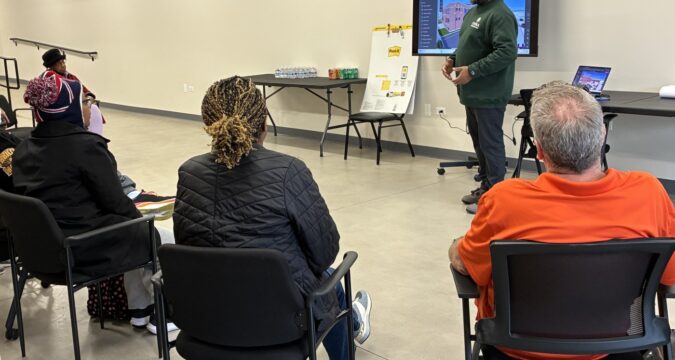
UMMA conducted a town hall on Thursday at the expanded Harvest Market at the corner of 10th and McAlister in Waukegan to learn what people in the community want to see as the renovation of the approximately 25,000-square-foot former school is completed.
With an ambitious agenda to help bring services to an area where residents in need can walk or take public transportation to receive them, Ibrahim said UMMA hopes to increase its presence beyond the property it now owns.
“Our goal is to eventually buy the block,” Ibrahim said. “We’re not trying to move anyone, but if something becomes available, we may make them an offer.”
The former gym at a one-time Catholic school on 10th Street in Waukegan will be part of the adult community center UMMA is creating. (Steve Sadin/For the Lake County News-Sun
Now in the process of obtaining the necessary approvals from the city of Waukegan to start construction next year, Ibrahim said the community center will be completed in several phases with a goal of completing it in 2028. He hopes the first phase will be done in 2027.
Where classrooms and other school facilities once were, the three-level building is gutted to the studs. Ibrahim said it gives UMMA a “blank canvas” to create a community center meeting the needs of those in the area. The gym remains intact, where a variety of activities are possible.
UMMA’s administrative offices, now downtown on Washington Street, will occupy the second level. Ibrahim said it will be part of the first phase, along with services already offered and a fitness center.
“There won’t be weights and exercise equipment,” Ibrahim said. “It will be more for yoga, stretching and adult exercises. There will be classrooms where there can be (simultaneous) virtual classes online as well. We want to hear what the community wants.”
Fresh produce is one of the many choices patrons of UMMA’s Harvest Market can select. It is part of UMMA’s growing presence on 10th Street, which separates Waukegan and North Chicago. (Steve Sadin/For the Lake County News-Sun)
Other possibilities include a studio for podcasts. Ibrahim said UMMA will start its own podcast and make the space available for others in the community. He also sees using some of the space to help people develop skills with the trades like plumbing, electrical and carpentry.
While plans for the first phase are currently clear, Ibrahim said the second and third phases will be developed as the community’s needs are determined. The gym will be part of the second and third phases, as well as a kitchen for cooking classes and the building trade training.
“We’d like to have cooking classes to teach people how to make healthy meals,” he said.
Scott Hezner, an architect helping design the community center and bring it to fruition, said flexibility is an important part of the planning. As needs and wants are determined, the space can be adjusted.
Striped to its studs, the first level of UMMA’s adult community center on 10th Street in Waukegan is a blank canvas to help meet the neighborhood’s needs. (Steve Sadin/For the Lake County News-Sun
“This is a plan for flexible programming,” Hezner said. “You are the dreamers,” he added, speaking to the community members. “UMMA is the synthesizer of the dream.”
One woman in the crowd said she was very concerned about the homeless people in the community. She suggested showers and a place for the homeless to check in on a daily basis.
Marie W. Hall, a senior director at the Northern Illinois Recovery Community Organization (NIRCO), said at the meeting that many of the issues homeless people face stem from issues arising from substance abuse.
“Tenth Street has people in trouble because of this issue,” Hall said. “This is something we have realized we need to help the community.”
Waukegan Mayor Sam Cunningham was at the meeting as a community member and not in an official capacity. He said there are organizations like PADS that do a good job working with the homeless, just as NIRCO does with those in recovery.
“UMMA has created a niche and is expanding on it,” Cunningham said. “The community has (people) with needs and UMMA is helping to meet some of those needs. They’re using this building to help them meet those needs.”
Meanwhile, UMMA acquired a one-time store closed for years between the Harvest Market and the soon-to-be community center. Ibrahim said the organization is now using it for storage and a meeting room. It is incorporated into the market, and shares a wall with the community center.
Ibrahim said it is vital for the expanding market. It is now serving approximately 450 families a week — it spiked to 700 briefly when SNAP benefits were in limbo — and is open Mondays through Fridays. A year ago, it had 300 to 350 patrons a week.
The market is now open from 2 to 6 p.m. on Mondays and Tuesdays, as well as from 10 a.m. to 2 p.m. on Wednesdays through Fridays. Wednesdays are reserved for seniors. Initially people could take 15 items. That has grown to 25.
https://www.chicagotribune.com/2025/11/17/urban-muslim-minority-alliance-2/


