Category: News

Top Russian Military Intelligence Official Shot & Wounded In Moscow Apartment
Top Russian Military Intelligence Official Shot & Wounded In Moscow Apartment
A top Russian military intelligence general has been shot in a Moscow apartment building on Friday, but has reportedly survived the attack and was transported to a local hospital. But his wounds are reportedly severe.
The attack by an unknown gunman has all the hallmarks of an assassination attempt in connection to the Ukraine war, especially given the victim is a high level Russian intelligence official. Vladimir Alekseyev is the deputy head of Moscow’s GRU military intelligence, and has long been sanctioned in the West for his alleged role in cyberattacks and allegations that he was behind the alleged 2018 Novichok nerve agent attack in Britain.
Lt. Gen. Alekseyev was shot several times by an “unidentified individual” before that person fled the scene. The highly decorated general, who has also heavily involved in Russia’s Syria campaign of the last decade, has been first deputy head of Russia’s military intelligence since 2011.
Russian Foreign Minister Sergei Lavrov soon after accused Ukraine of being behind the “terrorist act” and alleged it is trying “disrupt the negotiation process” toward forging peace. According to further details:
According to the Investigative Committee of the Russian Federation, the attack took place on the 24th floor of a building on Volokolamskoye Highway.
Petrenko said that the unknown assailant shot the general several times and then fled the scene. As a result of the shooting, Alekseyev was wounded and hospitalized.
Based on the scant information presented by Russia’s Investigative Committee, it seems the assassin was easily able to gain access to the building, and that the top general’s apartment was broken into.
Ukraine has remained silent on the shooting of Gen. Alekseyev – despite Kiev having in the past claimed responsibility for some other attacks. For example, to review another couple of recent assassinations of top generals:
In December, Lt. Gen. Fanil Sarvarov, head of the Operational Training Directorate of the Russian Armed Forces’ General Staff, was killed when a car bomb detonated.
In April, another senior officer, Lt. Gen. Yaroslav Moskalik—deputy head of the General Staff’s main operational department—was assassinated by an explosive device planted in his vehicle outside his apartment building just beyond Moscow.
Meanwhile an Azov commander is vowing that “retribution will find everyone”…
Lieutenant General Vladimir Alekseyev, First Deputy Chief of the GRU of the Russian General Staff, who was shot in Moscow this morning, was the senior Russian representative at the negotiations in Mariupol in May 2022, during the withdrawal of the Mariupol garrison from Azovstal.… pic.twitter.com/WjgcG73INh
— Denys Prokopenko (@D_Redis) February 6, 2026
These covert hits has unnerved Russia’s command ranks, given they take place deep inside Russia, and even in high-secured neighborhoods which residents might otherwise think are same or immune from the events of the Ukraine war.
As for Alekseyev, it’s possible he could succumb to the gunshot wounds, as Russian media has indicated he remains in critical condition in an intensive care wing.
Tyler Durden
Fri, 02/06/2026 – 11:00
Why Is The Deep State Targeting DNI Tulsi Gabbard With Such Ferocity?
Why Is The Deep State Targeting DNI Tulsi Gabbard With Such Ferocity?
Authored by Sundance via The Conservative Treehouse,
Each day more and more people are starting to realize/notice there are elements of the United States intelligence apparatus that are targeting Director of National Intelligence, Tulsi Gabbard. The need for control is a reaction to fear, and Tulsi Gabbard has the DC Intelligence Community very worried.
What you will read below is something that was written back in 2024 about the potential for the Office of the Director of National Intelligence (ODNI), if President Trump were to win the election. Subsequently, he did win; and while we are not saying this is the exact ODNI script that is being followed, we are certainly not disputing that either.
Read the roadmap below –Written in 2024– compare it to current events and decide for yourself if this is something that rings a bell and may explain the IC apoplexy.
The ODNI was created as an outcome of the 9-11 Commission recommendations. In the era shortly after 9/11, the DC national security apparatus was constructed to preserve continuity of government and simultaneously view all Americans as potential threats.
The Department of Homeland Security (DHS) and the Office of the Director of National Intelligence (ODNI) were created specifically for this purpose.
Washington DC created the modern national security apparatus immediately and hurriedly after 9/11/01. DHS came along in 2002, and within the Intelligence Reform and Terrorism Prevention Act of 2004 the ODNI was formed.
When Barack Obama and Eric Holder arrived a few years later, those newly formed institutions were viewed as opportunities to create a very specific national security apparatus that would focus almost exclusively against their political opposition.
Here is the weird part. The ODNI was formed in 2004, with the intent for the office to be the pivot point of a national security radar. The DNI was intended to provide information to domestic agencies about foreign terror networks that would prevent something like 9-11 from happening again. However, the Office of the Director of National Intelligence has never, not for one day, operated on this intent. This is why they are such a critical position from my perspective.
The office was new, not established yet as a functioning silo, when Barack Obama and Eric Holder arrived in 2009. They quickly dispatched an idiot, James Clapper, into the operation so they could weaponize around the offices’ fulcrum point.
Prior to the DNI office existing, the CIA radar would sweep externally and then report to the Office of the President. The DNI was intended to take external radar sweep (CIA) and make it a full 360° circle, adding a sweep inside the USA that would be handled by the Dept of Homeland Security.
The DHS sweep and the CIA sweep would then be combined into a central collection hub called the ODNI. Everyone with responsibility for “national security” could access the ODNI material. Essentially and presumably, post 9-11 nothing like jihadists practicing to fly airplanes would be missed again; at least that was the intent.
The weird part is that because the DNI was immediately weaponized, the office has never functioned to the purpose of its intent.
No one truly knows what the office possibilities consist of because no one has ever seen anyone try to functionally control the hub. If you think I’m joking about the intent of Obama and John Brennan using the DNI watch this video. This is before Brennan became CIA Director, this is when Brennan was helping Barack Obama put the pillars into place.
For the intents of this outline the takeaway is how the DNI office has never been used for good. In a strategic way, that can be used to our advantage if you are talking about leveraging silos against each other.
Example: The DNI can assemble material from any silo. Meaning the DNI can reach into any IC silo and extract anything they want. Under the original authorities given to the DNI, this authority exists. So, let’s spread the wings on this office and do exactly what it is permitted to do, only this time extract for the purpose of showing the President what is happening in every silo.
In essence, the DNI *CAN BE* deployed like a super strong cross-silo inspector general’s office. Force the other IC silos to comply with the demands of the DNI. This has never been done. But the DNI has this unique power.
The DNI can make the FBI, DOJ, DOJ-NSD, DoD, DoS and CIA provide anything and everything they demand. Instead of the other silos using blocks and threats against the office of the President, use the authority of the DNI to get them without confrontation. Then use the DNI to declassify the documents (if requested by potus), instead of the originating silo.
Can you see how the DNI office can be repurposed to be a seriously strong weapon in the toolbox of the President, against the schemes of those inside the various IC silos.
The DNI becomes much more important than the CIA Director, NSA Director, FBI Director, Attorney General, etc, because the DNI can just show up and say, “give me this.” That’s the functional purpose of the DNI office that has never been exerted; let’s flippin’ use it.
Let’s use the office of the DNI as the central information hub that takes information from inside the corrupt silos, then provides that information to the President who puts sunlight upon it. Each corrupt silo penetrated with disinfectant. This could begin a process to pull down the shadow operations and let the American public see what has been happening inside our IC apparatus.
To accomplish this approach the National Security Advisor to the President (NSA) [currently Marco Rubio], would be the person who tells the DNI what they are looking for. How does the NSA know what to look for? Because the National Security Advisor is the head of the National Security Council (NSC).
Let the NSC monitor the silos with specific intent, perhaps with assistance from open-source research, then provide Trump’s NatSec Advisor with details on what appears to be happening and where. With the approval of the President, the NSA [Rubio], then turns to the DNI [Gabbard] and says, “POTUS wants this, go get this.”
Raw, unfiltered, unredacted information. The silo administrators end up in a fight with the ODNI, not the office of President Trump. President Trump then uses the power of his office to support the demands of the DNI.
Under this approach the DNI has a lot more power; yet funnily, it’s power they already have – yet have never utilized.
Does any of that track with what we are currently experiencing?
With DNI Tulsi Gabbard putting strategic pressure from the inside, and We The People putting accountability pressure from the outside, this Deep State intelligence nut just might begin to crack.
In fact, I might even argue that cracking is exactly what we are starting to see.
Tyler Durden
Fri, 02/06/2026 – 10:40
https://www.zerohedge.com/political/why-deep-state-targeting-dni-tulsi-gabbard-such-ferocity
EEUU detiene a implicado en ataque a su consulado en Libia en 2012
Por ERIC TUCKER
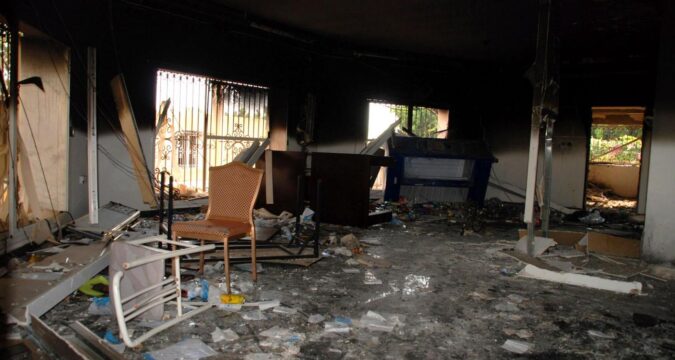
WASHINGTON (AP) — Un participante en el ataque de 2012 al complejo estadounidense en Bengasi, Libia ha sido detenido y será procesado por sus muertes, afirmó el viernes la secretaria de Justicia Pam Bondi.
Zubayr Al-Bakoush, acusado por el ataque que mató a cuatro estadounidenses, aterrizó en la Base Conjunta Andrews en Maryland a las 3 a.m., indicó Bondi en conferencia de prensa.
“Nunca hemos dejado de buscar justicia por ese crimen contra nuestra nación”, expresó Bondi.
La fiscal federal Jeanine Pirro señaló que una acusación de ocho cargos imputaba a Al-Bakoush por crímenes que incluían los asesinatos del embajador Chris Stevens y del empleado del Departamento de Estado Sean Smith. No estaba claro si Al-Bakoush tenía un abogado que lo representara.
El ataque de 2012 surgió inmediatamente como un tema político divisivo, ya que los republicanos criticaron al presidente Barack Obama y a la entonces secretaria de Estado Hillary Clinton sobre la seguridad en la instalación y la narrativa de la administración sobre quién era responsable y por qué.
Un informe final de un panel del Congreso liderado por republicanos culpó a la administración Obama por deficiencias de seguridad y una respuesta lenta a los ataques. Sin embargo, el informe no encontró irregularidades por parte de Clinton.
Clinton desestimó el informe como simple repetición de investigaciones anteriores, diciendo que era “hora de pasar la página”. Otros demócratas denunciaron el informe como pura teoría de conspiración.
La noche del 11 de septiembre de 2012, al menos 20 militantes armados con AK-47 y lanzagranadas irrumpieron en la puerta del complejo consular y prendieron fuego a los edificios.
El incendio provocó la muerte de Stevens y Smith. Otros miembros del personal del Departamento de Estado escaparon a una instalación cercana conocida como el anexo.
Un gran grupo se reunió para un ataque al anexo. Ese ataque, que incluyó un bombardeo de mortero de precisión, resultó en la muerte de los guardias de seguridad Tyrone Woods y Glen Doherty.
Un militante libio sospechoso de ser el cerebro de los ataques, Ahmed Abu Khattala, fue capturado por fuerzas especiales de Estados Unidos en 2014 y fue llevado a Washington para ser procesado. Fue condenado y está cumpliendo una sentencia de prisión. Sus abogados argumentaron que las pruebas eran inconclusas y que fue señalado por sus creencias musulmanas ultraconservadoras.
___________________________________
Esta historia fue traducida del inglés por un editor de AP con ayuda de una herramienta de inteligencia artificial generativa.
AP Explica: El espectáculo de medio tiempo de Bad Bunny en el Super Bowl
Por MARIA SHERMAN
NUEVA YORK (AP) — Hay escenarios, y luego está el espectáculo de medio tiempo del Super Bowl.
El domingo, recién acontecida su histórica victoria en los Grammy por su carta de amor a Puerto Rico, “Debí tirar más fotos”, Bad Bunny volverá a sorprender al público con una actuación que se perfila como un momento emblemático para la cultura latina.
Pero, ¿qué se puede esperar de su presentación?
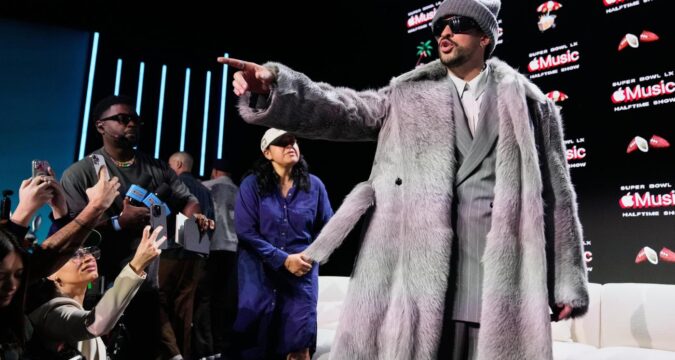
Zane Lowe de Apple Music mencionó que la actuación de Bad Bunny en el medio tiempo del Super Bowl dura 13 minutos durante una entrevista con la superastro el jueves. Históricamente, los espectáculos suelen durar entre 12 y 15 minutos.
En la misma conversación, Bad Bunny ofreció pocos detalles sobre lo que los espectadores verán el domingo.
“Va a ser una gran fiesta”, dijo, evitando juguetonamente preguntas sobre invitados sorpresa y otros detalles. “Lo que la gente puede esperar de mí… Quiero llevar al escenario, por supuesto, mucha de mi cultura. Pero realmente no quiero dar ningún spoiler. Va a ser divertido”.
También existe un adelanto de un minuto y medio del espectáculo de medio tiempo publicado el mes pasado que estableció un tono jovial para su actuación. En él, Bad Bunny se acerca a un árbol de Flamboyán, explicaremos más sobre el árbol más adelante, y comienza a reproducir en su celular en su sencillo “Baile inolvidable”.
La canción es salsa moderna, interpretada con los estudiantes del Libre de Música San Juan. Es un sencillo destacado de “Debí tirar más fotos”, un álbum que fusiona la tradición folclórica en géneros locales boricuas como la bomba, plena, salsa y música jíbara con estilos contemporáneos como el reggaetón, trap y pop.
En el clip, Bad Bunny se mueve mientras es acompañado por diferentes bailarines de diversos géneros, razas y edades: entre ellos, una bailarina de salsa tradicional con un vestido rojo, un bombero, un vaquero y un viejito con una pava (el sombrero de paja característico de Puerto Rico). Es representativo del atractivo internacional de Bad Bunny; actualmente es el artista más escuchado a nivel mundial en Spotify.
¿Bad Bunny actuará completamente en español?
Toda la música de Bad Bunny está grabada en español, por lo que parece una apuesta segura. Si incluyera inglés en su presentación, probablemente aparecería en una interjección hablada o se presentaría en texto.
En octubre, Bad Bunny fue anfitrión de “Saturday Night Live” y dijo algunas frases en español durante su monólogo de apertura. Al concluir, bromeó en inglés: “Si no entendiste lo que acabo de decir, tienes cuatro meses para aprender”, una referencia al Super Bowl y sus críticos.
El jueves, bromeó diciendo que los fanáticos no necesitaban realmente aprender español para disfrutar de su presentación, pero deberían estar preparados para bailar.
¿Qué símbolos podrían aparecer en escena?
No hay forma de saberlo con certeza, pero aquí hay algunas conjeturas fundamentadas.
Banderas puertorriqueñas: En su canción “La mudanza”, Bad Bunny canta, “Aquí mataron gente por sacar la bandera / Por eso es que ahora yo la llevo donde quiera”. Parece ser una referencia a la Ley 53 de 1948, conocida como la Ley de la Mordaza, una resolución de la Asamblea Legislativa de Puerto Rico que intentó suprimir el movimiento independentista en la isla y criminalizó la exhibición de la bandera puertorriqueña. Fue derogada en 1952. Es también una de las muchas razones por las que los puertorriqueños son conocidos por ondear su bandera con orgullo por su isla.
Es casi seguro que la bandera de Puerto Rico aparecerá de alguna forma en el escenario del Super Bowl. Pero sus colores son dignos de mención. Si se muestra en rojo, blanco y azul, esa es la bandera actual de Puerto Rico y lo ha sido desde 1952. Si hay banderas que presentan azul claro, eso refleja el movimiento independentista puertorriqueño. Una versión en blanco y negro de la bandera se ha convertido en sinónimo de la lucha y resiliencia puertorriqueña. Y si hay una bandera que se asemeja más a la bandera de la República Dominicana, esa es conocida como El Grito de Lares, un símbolo de la revolución de Lares, la primera revuelta breve contra el dominio español en Puerto Rico en el siglo XIX.
Expresiones puertorriqueñas: Puede haber algunas expresiones puertorriqueñas pronunciadas en el escenario, más allá de las que se encuentran en la música de Bad Bunny. Eso podría ser cualquier cosa desde “¡Wepa!”, que se usa en momentos de emoción, no muy diferente a exclamar “¡Guau!”. Ganó popularidad después del lanzamiento de la canción de salsa de Alfonso Vélez de 1974 “El Jolgorio (Wepa Wepa Wepa)”. O “Acho, PR es otra cosa”, una frase que se convirtió en un canto de los fanáticos durante la actuación de Bad Bunny de “Voy a llevarte pa’ PR” durante su residencia. Se traduce como “Rayos, PR es otra cosa”.
Casita: En la residencia de Bad Bunny en Puerto Rico el verano pasado, actuó en dos escenarios. Uno fue construido para parecerse a una casita, para el pari de marquesina, una fiesta en casa. Estas estructuras son sinónimas de Puerto Rico y el Caribe en general.
Pavas: Un símbolo que probablemente es familiar para los fanáticos de Bad Bunny en todas partes, una pava es un sombrero de paja tradicionalmente usado por jíbaros, o agricultores rurales puertorriqueños. Se ha convertido en un símbolo de orgullo para la isla. El cantante incluso usó una versión de cuero del sombrero en la alfombra roja la Met Gala 2025.
Árbol de Flamboyán: El segundo de los dos escenarios en la residencia de Bad Bunny se centró en mostrar la belleza natural de la isla con sus árboles de flamboyán y plátano. Los primeros son una característica común en el arte puertorriqueño por sus flores, que se ven en tonos brillantes de rojo, naranja y amarillo. La imagen del árbol evoca a Puerto Rico casi tan inmediatamente como el sonido de sus residentes nocturnos nacionales, el coquí (una rana con un canto distintivo que solo se escucha por la noche).
El Sapo Concho: No debe confundirse con el coquí, el sapo concho es el sapo crestado puertorriqueño en peligro de extinción que Bad Bunny ha utilizado una versión animada en sus visuales para “Debí tirar más fotos”.
Instrumentos tradicionales puertorriqueños: Debido a que gran parte de la música de Bad Bunny se basa en la bomba y la plena, es probable que algunos de esos instrumentos tradicionales estén en el escenario. Esté atento a un cuatro (una pequeña guitarra de cuatro cuerdas), güiro/güira (un instrumento de percusión hecho de una calabaza hueca), palitos (también un instrumento de percusión que se asemeja a dos palos largos de madera), cencerro (campana de vaca) y maracas. Para las canciones de bomba, específicamente, puede haber un barril y para la plena, una pandereta.
¿Habrá invitados especiales durante el espectáculo de medio tiempo?
Es imposible predecirlo, pero sería sorprendente si Bad Bunny no estuviera acompañado por otros artistas, particularmente otros gigantes de la música latina, y probablemente, otros artistas puertorriqueños. La banda Chuwi acompañó a Benito en todas las noches de su residencia en San Juan; no sería descabellado verlos en el escenario para su colaboración, “Weltita”.
Otros posibles invitados, si la residencia es un referente, podrían incluir a Marc Anthony, Ricky Martin, Jennifer Lopez, Young Miko, Wisin y Yandel, Gilberto Santa Rosa y Alfonso Vélez. Pero la lista sigue y sigue.
¿Será una actuación política?
Eso está en el ojo del espectador. Pero hay un precedente histórico para ello en el Super Bowl. En 2020, la NFL pidió a Jennifer Lopez que omitiera un segmento que presentaba a niños en jaulas durante su actuación de medio tiempo, una crítica a las políticas de inmigración de Estados Unidos. Ella se negó. Bad Bunny fue un artista invitado durante ese espectáculo de medio tiempo, que fue encabezado por Lopez y Shakira.
El año pasado, el set de Kendrick Lamar fue una confrontación artística de la historia estadounidense y las dinámicas raciales a través de la metáfora. En él, el actor Samuel L. Jackson, vestido como el Tío Sam, se quejaba de que su interpretación era “demasiado ruidosa, demasiado imprudente, demasiado ghetto” y recordaba a Lamar “jugar el juego”.
Bad Bunny nunca ha evitado los mensajes políticos. Ha criticado al presidente Donald Trump por todo, desde su respuesta a un huracán en su natal Puerto Rico hasta su trato a los inmigrantes. En los Grammy del domingo, dijo “ICE fuera” al aceptar su primer premio televisado de la noche. Su última gira omitió el territorio continental de Estados Unidos; en una entrevista dijo que, en parte, temía que sus fans pudieran ser objetivo de agentes de inmigración.
Trump, un republicano, ha dicho que no planea asistir al Super Bowl de este año, a diferencia del año pasado, y ha calificado a Bad Bunny como una “terrible elección”.
___
Esta historia fue traducida del inglés por un editor de AP con la ayuda de una herramienta de inteligencia artificial generativa.
UMich Sentiment Rebound Continued In February As Inflation Angst Plummets
UMich Sentiment Rebound Continued In February As Inflation Angst Plummets
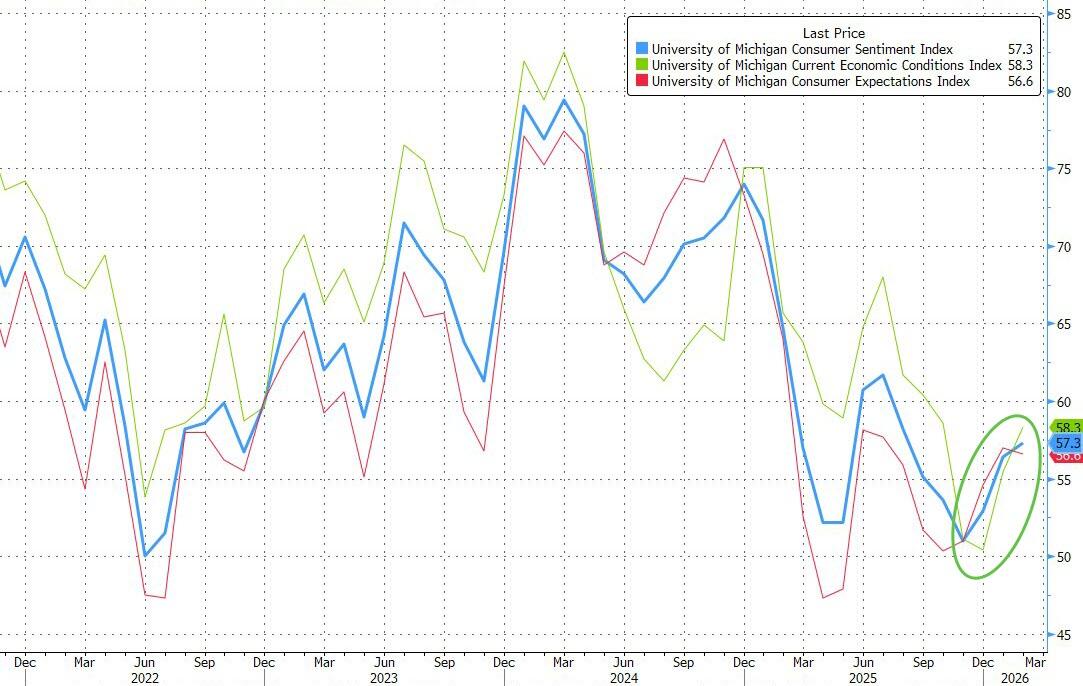
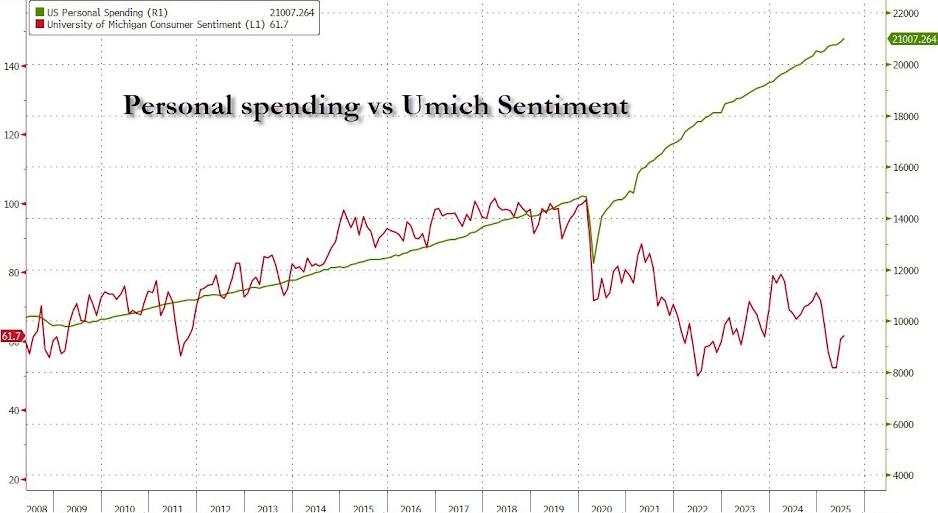
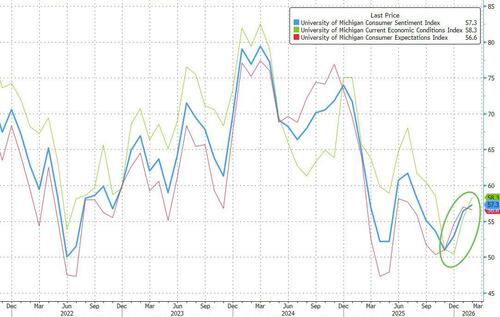
After January’s big bounce from record lows (as Democrats began to see that the world is not the worst its ever been… and inflation is not going to explode), UMich sentiment was expected to re-dip again in February led by a drop in Current Conditions.
But February’s preliminary data showed a continued rebound in sentiment (which is quite shocking given that it comes after the Davos/Greenland debacle) with a surge in Current Conditions dominating a small dip in Expectations to bring the headline sentiment to its highest since August 2025…
Source: Bloomberg
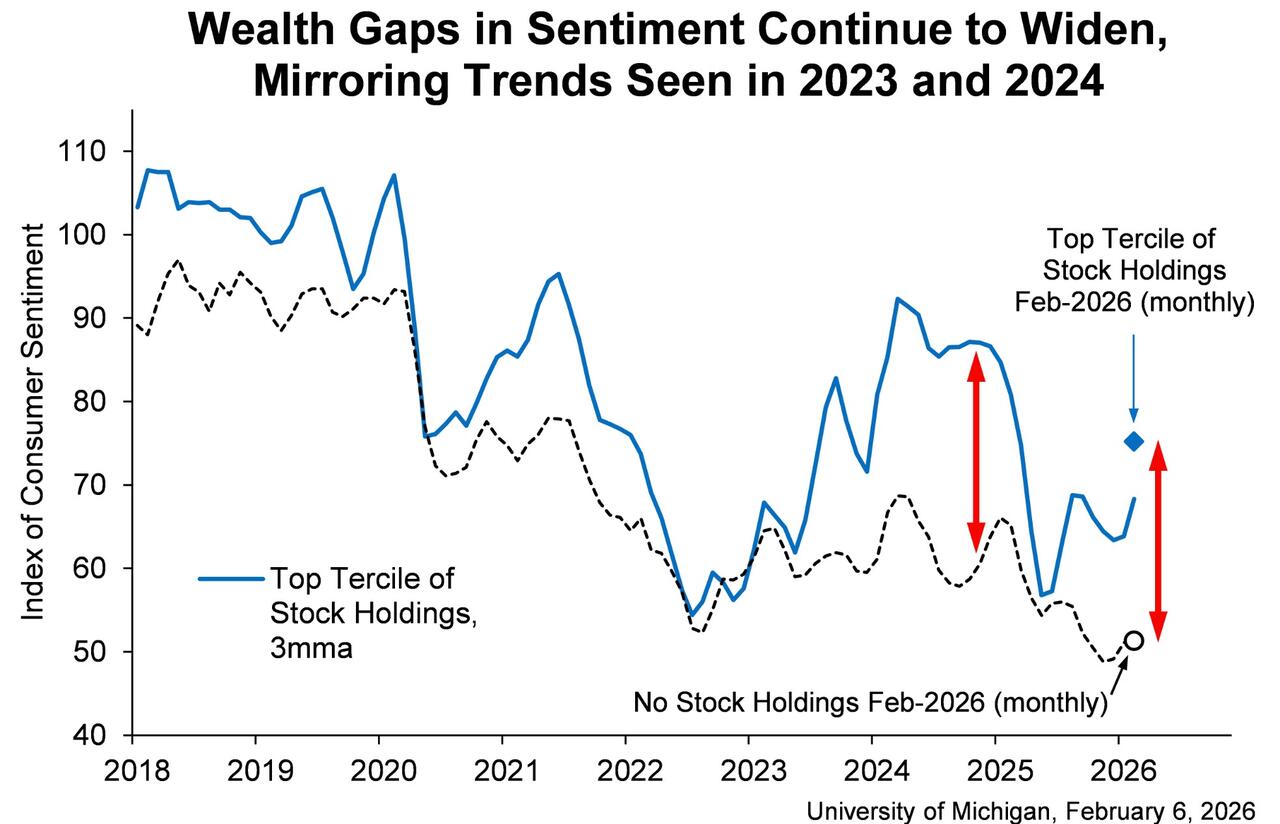
“Sentiment surged for consumers with the largest stock portfolios,” said Director of Surveys, Joanne Hsu’s, “while it stagnated and remained at dismal levels for consumers without stock holdings.”
On net, modest increases in current personal finances and buying conditions for durables were offset by a small decline in long-run business conditions.
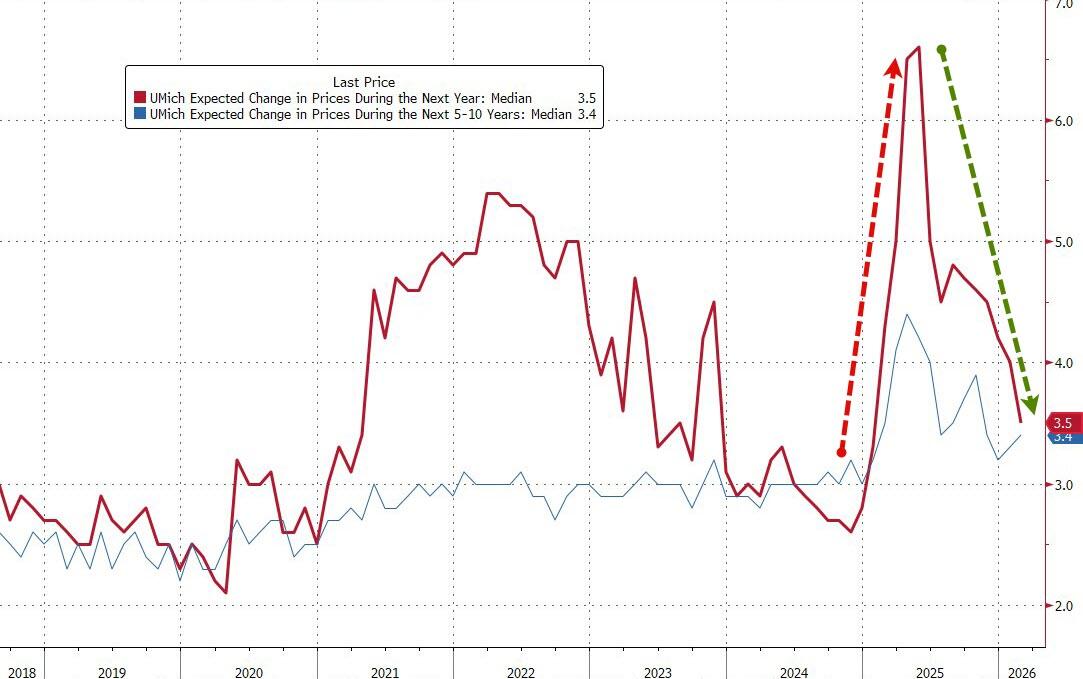
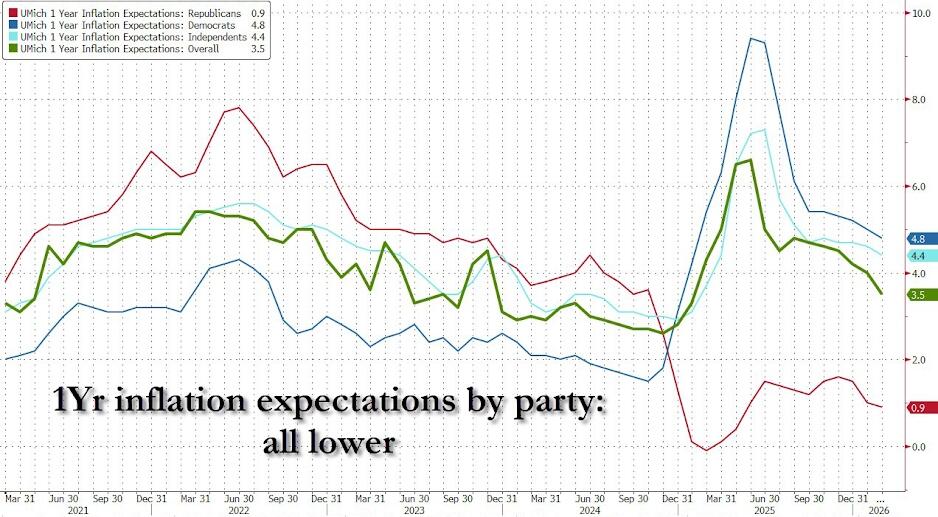
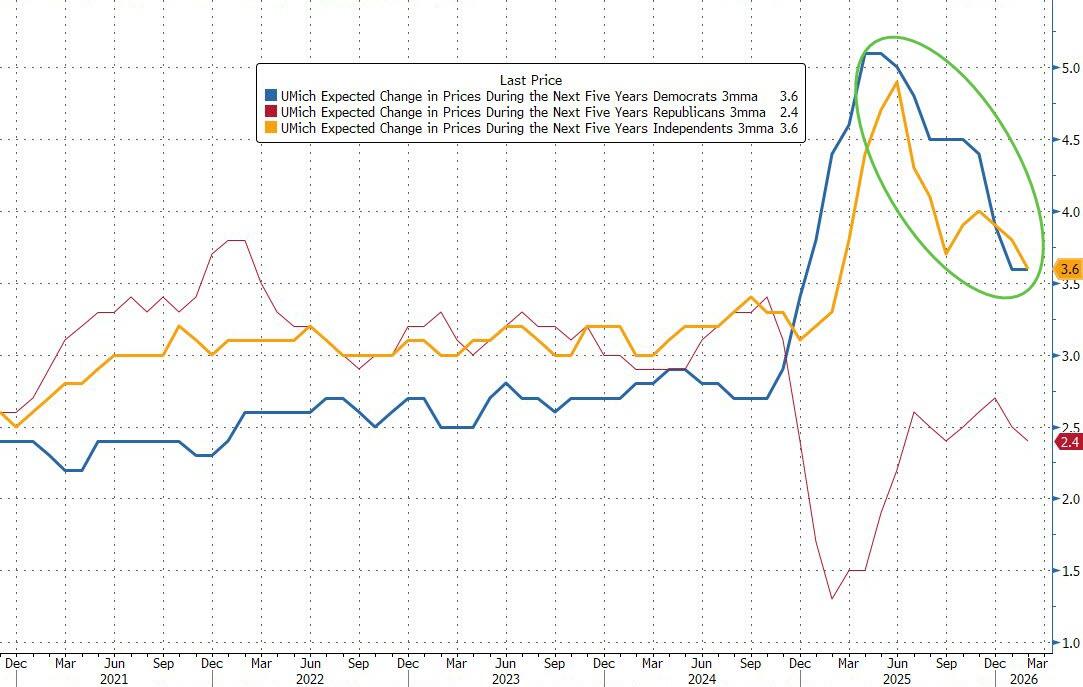
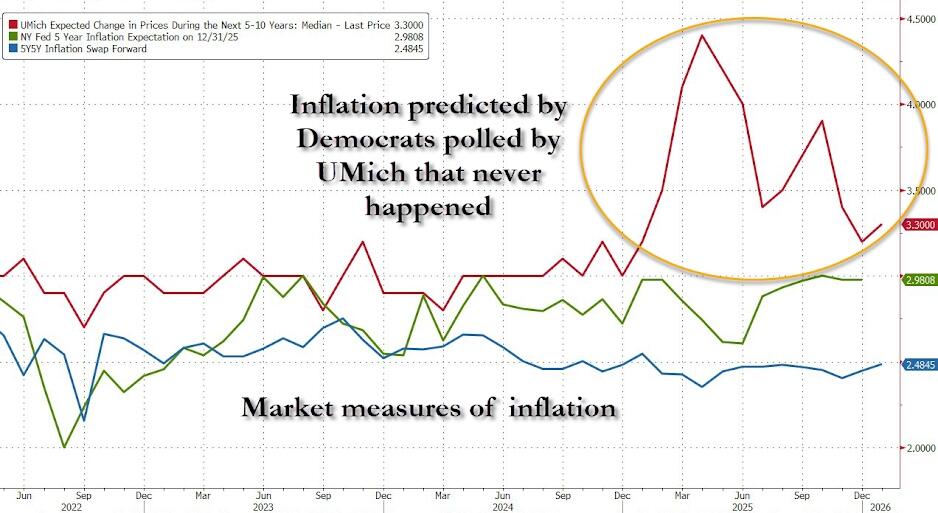
Inflation expectations for the next 12 months plummeted to 13-month lows (which medium term expectations rose modestly)…
Source: Bloomberg
…as Democrats and Independents come to their senses…
Source: Bloomberg
It appears mainstream media propaganda about Trump’s tariffs worked on some… (is this where the term ‘useful idiots’ comes from?)
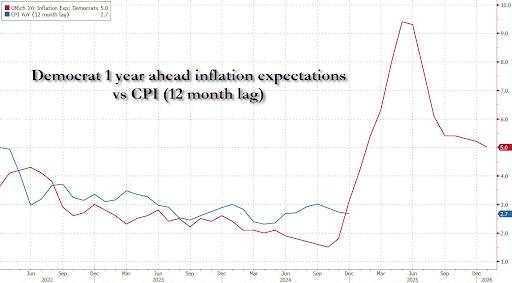
But, according to Democrats’ prior panic, inflation is about to go vertical right about now…
…we wait with bated breadth.
Of course, UMich’s reliability has been in question for a while now…
Finally, if you had any doubt that this survey was utterly biased, here is Hsu’s concluding comment:
“While sentiment is currently the highest since August 2025, recent monthly increases have been small—well under the margin of error—and the overall level of sentiment remains very low from a historical perspective.”
Translated: don’t believe this drop in inflation fears (to 13 month lows) and rise in sentiment (to 6 month highs)… Trump’s still OrangeManBad, remember!!
Tyler Durden
Fri, 02/06/2026 – 10:10
Antigua división de la USAID renace como organización filantrópica independiente
Por THALIA BEATY
WASHINGTON (AP) — Una división de la Agencia de los Estados Unidos para el Desarrollo Internacional (USAID, por sus siglas en inglés) eliminada el año pasado por los recortes del presidente Donald Trump renació el jueves como una organización independiente sin fines de lucro, lo que permitirá que su trabajo internacional continúe en una nueva forma.
Esta reencarnación de las Operaciones de Innovación para el Desarrollo (DIV, por sus siglas en inglés) de la USAID como el fondo sin fines de lucro DIV Fund se realiza gracias a los 48 millones de dólares aportados por dos donantes privados. Es un inusual caso de continuación después de que el gobierno de Trump congelara toda la financiación extranjera el año pasado y permitiera que el Departamento de Eficiencia Gubernamental de Elon Musk desmantelara la agencia, que entregó ayuda exterior de Estados Unidos durante 60 años.
De esa destrucción, que costó decenas de miles de empleos y causó la muerte de personas en todo el mundo, se hicieron muchos esfuerzos privados para preservar décadas de datos y conocimientos que albergaba la USAID, ayudar a los beneficiarios a mantener programas vitales en funcionamiento y reimaginar cómo podría funcionar el desarrollo internacional.
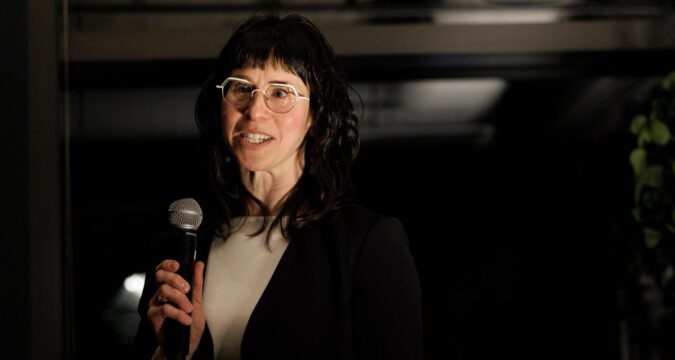
Pero pocos de esos esfuerzos han logrado atraer el tipo de financiación filantrópica que ha conseguido el DIV Fund. Financiadores, beneficiarios anteriores y personal del fondo se reunieron en el ático de paredes de vidrio de un grupo de expertos en Washington al atardecer del jueves para marcar el nuevo capítulo. El ambiente era resuelto y optimista, habiendo encontrado una manera de continuar donde muchos esfuerzos en el desarrollo internacional se han descarrilado.
“La pérdida del apoyo del gobierno de Estados Unidos es un gran golpe”, afirmó Michael Kremer, director científico del DIV Fund y economista galardonado con el Premio Nobel. “Es maravilloso que los financiadores privados hayan intervenido para ayudar a llenar parte de ese vacío, pero solo se llena parte del vacío”.
Algunos de los líderes de la nueva organización sin fines de lucro también contribuyeron a canalizar 110 millones de dólares de donaciones filantrópicas privadas el año pasado a proyectos que perdieron financiación de la USAID. Ahora, el DIV Fund tiene como objetivo otorgar 25 millones de dólares anualmente, lo que representa un poco más de la mitad del presupuesto que tenía cuando era una división de la USAID.
Relaciones con donantes y un enfoque de nicho ayudan a impulsar la recaudación de fondos
Su éxito en la recaudación de fondos tiene un par de ingredientes.
En primer lugar, el fondo sin fines de lucro DIV Fund actúa como un centro de investigación y desarrollo para identificar intervenciones muy asequibles y eficientes, y luego apoyar su expansión a escala. Como tal, su presupuesto es muy pequeño en comparación con programas de tratamiento o prevención del VIH o de respuesta a la hambruna, por ejemplo.
Luego, mientras eran una división en USAID, las DIV ya habían obtenido financiación filantrópica externa que incluía una subvención de 45 millones de dólares de Coefficient Giving, una fundación con sede en San Francisco que ahora es uno de los principales financiadores de la organización sin fines de lucro. El otro financiador es anónimo.
Finalmente, Kremer dijo que los programas que identifican generalmente obtienen financiación de gobiernos locales o generan ingresos, en lugar de depender de la financiación a largo plazo de países donantes como Estados Unidos. Ese camino hacia la sostenibilidad es aún más importante ante los grandes recortes a la asistencia exterior de distintos países donantes históricos.
Nuevas posibilidades fuera de la USAID
De la cantidad total que el DIV Fund ha recaudado hasta ahora, se han asignado 20 millones de dólares a antiguos beneficiarios, dejando 28 millones de dólares para futuras subvenciones. El fondo tendrá una convocatoria abierta para solicitudes este año, un proceso al que están dedicados porque genera muchas ideas nuevas.
Dentro de la USAID, las DIV a veces influían en otros departamentos y obtenían apoyo adicional para proyectos que habían respaldado. Ahora, en el exterior, el DIV Fund planea trabajar con grandes donantes como el Banco Mundial y otros países para adoptar sus recomendaciones y desarrollar sus propios fondos de investigación similares.
Otis Reid, director ejecutivo de Salud Global y Bienestar en Coefficient Giving, dijo que a medida que se reduce la cantidad total de asistencia exterior oficial, es aún más importante que lo que queda se use de la mejor manera.
“Realmente importa mucho si ese dinero se destina a cosas que son altamente efectivas, moderadamente efectivas o inefectivas”, señaló. “Y creo que el DIV puede desempeñar un papel realmente crucial en mover las cosas de la parte inefectiva a la muy efectiva del espectro”.
Muchos programas que las DIV han apoyado están validados a través de ensayos controlados aleatorios, un tipo específico de diseño de investigación. Kathryn Oliver, profesora en la Escuela de Higiene y Medicina Tropical de Londres que estudia cómo la evidencia documenta la creación de políticas, dijo que, si bien estos ensayos son valiosos para responder a tipos específicos de preguntas, no pueden proporcionar a los responsables de políticas toda la información que necesitan.
“Es el diseño de investigación más robusto para responder preguntas sobre la efectividad de las intervenciones en comparación con el tratamiento habitual, definitivamente”, dijo, refiriéndose a los ensayos. “Pero no es el diseño más robusto para responder a cualquier otro tipo de preguntas”, como si las poblaciones lo encuentran aceptable o cómo se compara con otros enfoques.
La futura relación con el gobierno de Estados Unidos es incierta
Como una nueva organización sin fines de lucro, el DIV Fund está abierto a trabajar con el gobierno de Estados Unidos, dijo la cofundadora Sasha Gallant.
El secretario de Estado, Marco Rubio, ha caracterizado a la USAID como corrupta, costosa e ineficaz y afirmó que la ayuda exterior hacía que los gobiernos y las grandes organizaciones sin fines de lucro dependieran permanentemente de Estados Unidos. Si bien se recortaron o recuperaron cantidades importantes de financiación de ayuda exterior en 2025, el Congreso asignó recientemente 50.000 millones de dólares a varios programas de asistencia exterior, significativamente más de lo que la administración había solicitado.
Los DIV habían ganado previamente apoyo bipartidista, en parte debido al alto retorno de inversión que ofrecen sus programas, lo que también puede ser una métrica muy satisfactoria para los financiadores filantrópicos.
El DIV Fund no reemplazará la financiación para grandes programas que ya están respaldados por evidencia extensa o que pueden ser costosos pero valiosos, como las respuestas humanitarias. Pero Gallant dijo que el fondo espera firmemente que los países donantes continúen financiando estos otros tipos de programas.
“Definitivamente, deberíamos estar entregando en masa las cosas que mejoran los medios de vida de las personas, salvan sus vidas y mantienen a los niños en la escuela”, dijo.
___
La cobertura de The Associated Press de temas de filantropía y organizaciones sin fines de lucro recibe apoyo a través de la colaboración de la AP con The Conversation US, con financiación de Lilly Endowment Inc. La AP es la única responsable de este contenido. Encuentra los estándares de la AP para trabajar con organizaciones filantrópicas, una lista de las fundaciones y las áreas de cobertura que financian en AP.org.
___
Esta historia fue traducida del inglés por un editor de AP con la ayuda de una herramienta de inteligencia artificial generativa.

There is Olympic gold in the air up there, but many of these daredevils aren’t huge fans
LIVIGNO, Italy — Ask freestyle skier Colby Stevenson if he likes big air, the most high-flying event in a sport full of them, and his answer is short and to the point.
“No,’ he said. ”I have no real use for it.”
Related Articles
Minions will get their Olympic moment as Spanish figure skater gets final approval for his music
Lindsey Vonn tests injured left knee in Olympic downhill training — and pumps her fist after successful run
Merino wool or Mongolian cashmere? Fashion is a competitor in any Olympics, but especially in Milan.
US Olympic hockey history has been given an outsized boost from a tiny, proud Minnesota town
Pope, an avid athlete, extols physical and spiritual benefits of sport in Olympic message
Which makes him pretty much like a lot of his action-sports brethren — all of them adremaline junkies — who will grace the 50-meter-high hill (165 feet) built on a scaffolding at the Winter Olympics in Livigno over the next two weeks.
The one key exception: Stevenson is the defending Olympic champion.
“I felt like I was going to war that morning,” Stevenson said of what goes down as the crowning athletic achievement of his career. “I was trying a trick I had never done and I was just like, ’I’m either going to land this, or go away in an ambulance.’”
The Olympics added this event to the snowboard program in 2018, then the freestyle skiing schedule four years after that. The thought was that asking a few hundred athletes to hurl themselves up to 20 meters (65 feet) in the air, then try to land after completing somewhere between three and six spins and flips, would make for great viewing in person and on TV. Which it does.
It’s also dangerous, and the stakes were brought into stark focus during training Wednesday night when one of Canada’s greatest snowboarders, Mark McMorris, had to be carried off the mountain on a stretcher after a nasty fall. Canadian officials said McMorris wasn’t badly injured and they were evaluating him to see if he’d be able to compete in qualifying Thursday night.
McMorris has three Olympic bronze medals, but they are in big air’s more stylistic and arguably less-dangerous cousin, slopestyle.
Last month in an interview with The Associated Press, McMorris was asked what the point of big air really was: “It’s an event that, you see it, and you just go ’Wow!” he said.
Slopestyle qualifiers automatically on the start list for big air, too
United States’ Alex Hall practices during a slopestyle training session at the 2026 Winter Olympics in Livigno, Italy, on Feb. 4, 2026. (AP Photo/Abbie Parr)
Because the number of athletes at the snowpark was getting out of hand, organizers decided they would place anyone who qualified for slopestyle — which incorporates big jumps into a longer, more technical contest — into the big air event as well. The AP’s informal survey of about a dozen riders in the leadup to the Games all ended with the same conclusion: They got into the sport for slopestyle; doing big air is part of the deal.
“Look for people approaching things in different ways, people thinking outside the box, and then look for individuality,” said freeskier Alex Hall, when asked what people should appreciate about his sport.
It’s more possible in slopestyle. Hall’s winning run in China four years ago goes down as one of the most original in the sport’s history — a daring mix of jumps off the sides of the kickers, instead of straight-on, and vertebrae-testing twists that changed direction in midair.
“Everyone’s going to be trying things differently, and just appreciate that,” he said.
Air vs. style: The never-ending debate in action sports
The debate surrounding big air infiltrates pretty much every corner of a sport that wrestles with the need to “go big” vs. the innate desire of these athletes to show they are more than acrobats on snow.
Eileen Gu, the freeski star who won gold in big air and silver in slopestyle at the last Olympics, said, “Yeah, slopestyle,” when asked which event she preferred. She wasn’t surprised to have so much company.
“I’ve only competed in big air twice at a World Cup level,” Gu said. “As far as the reason I’d expect that to be the answer is that slopestyle embodies the essence of the sport. It offers the opportunity for an individual to highlight a multiplicity of skills.”
While slopestyle is art on a canvas, big air is theatre in the round, its surge underpinned by the idea that you can build a hill almost anywhere and bring the high-flying flips off the mountain and into the city. Fenway Park and the Rose Bowl have hosted big air contests. In 2018, when the event debuted at the Olympics in South Korea, organizers brought the snowboarders off the mountain, closer to the main Olympic cluster.
Double cork? Blindside? Goofy? A glossary of snowboarding terms for the Winter Olympics.
More notably, Beijing four years ago held big air on the site of a reclaimed steel mill. Skiers and snowboarders flew in front of a tableau of skyscrapers and an out-of-commission smokestack. It was a Chinese example of urban renewal; the property also served as the headquarters for the country’s Olympic organizing committee.
Not this time
There was no such plan for these games. Livigno is five hours from Milan by train and bus. Instead, workers built the massive scaffolding adjacent to the slopestyle course and the halfpipe. Skiers and snowboarders use an elevator to get to the top, snap on their gear and hold their breath.
About the only technical requirement in this event is that they spin in different directions on at least two of their three jumps. Other than that, stomp a good landing and may the most spins win.
Ollie Martin, the 17-year-old U.S. snowboarder who became the first rider to land jumps with 2,160 degrees of spin in both directions, could end up bringing one of those massive tricks to the big air final, set for Saturday.
Truth be told, he said he’d be just as happy getting oohs and ahhs for what he does on the slopestyle course. He has been on podiums in both events over the past two winters. Does he like big air?
“I do,” he said. “Just less than slopestyle.”
https://www.chicagotribune.com/2026/02/06/olympics-big-air-daredevils/
Trump shares a racist video that depicts the Obamas as primates
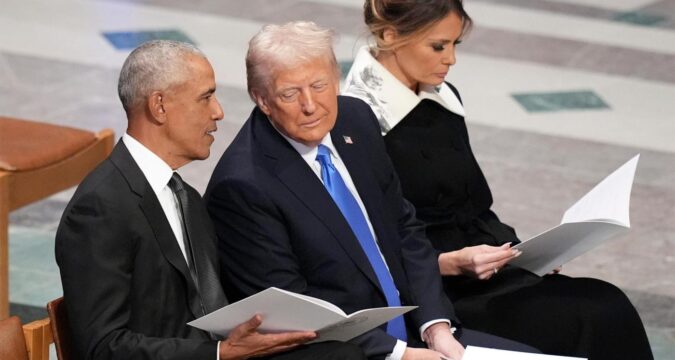
WASHINGTON — President Donald Trump used his social media account to share a video about election conspiracy theories that includes a racist depiction of former President Barack Obama and his wife, Michelle Obama, as primates in a jungle.
The Republican president’s Thursday night post immediately drew backlash for its treatment of the nation’s first Black president and first lady. It was part of a flurry of social media activity that amplified Trump’s false claims that the 2020 election was stolen from him, despite courts around the country and a Trump attorney general from his first term finding no evidence of fraud that could have affected the outcome.
White House press secretary Karoline Leavitt rejected criticism of the post that depicted the Obamas, who are Democrats. An Obama spokesperson did not immediately respond to a request for comment Friday.
Nearly all of the 62-second clip, which was among dozens of Truth Social posts from Trump overnight, appears to be from a conservative video alleging deliberate tampering with voting machines in battleground states as the 2020 presidential votes were tallied. At the 60-second mark is a quick scene of two primates, with the Obamas’ smiling faces imposed on them.
Those frames were taken from a longer video, previously circulated by an influential conservative meme maker. It shows Trump as “King of the Jungle” and depicts a range of Democratic leaders as animals, including Joe Biden, who is white, as a primate eating a banana.
“This is from an internet meme video depicting President Trump as the King of the Jungle and Democrats as characters from the Lion King,” Leavitt said by text, referring to Disney’s 1994 feature film. “Please stop the fake outrage and report on something today that actually matters to the American public.”
Trump did not comment on the video in his post.
The group Republicans Against Trump, a frequent social media critic of the president, criticized the post and its “racist image.”
“There’s no bottom,” the group wrote.
Trump and the official White House social media accounts frequently repost memes and artificial intelligence-generated videos. As Leavitt did Friday, Trump aides typically dismiss critiques and cast the images as humorous.
Trump also has a long history of intensely personal criticism of the Obamas and of using incendiary, sometimes racist, rhetoric.
In his 2024 campaign, Trump said immigrants were “poisoning the blood of our country,” language similar to what Adolf Hitler said to dehumanize Jews in Nazi Germany.
During his first White House term, Trump referred to a swath of developing nations that are majority Black as “shithole countries.” He initially denied using the slur but admitted in December 2025 that he did say it.
When Obama was in the White House, Trump advanced the false claims that the 44th president, who was born in Hawaii, was born in Kenya and was constitutionally ineligible to serve. Trump, in interviews that helped endear him to many conservative voters, repeatedly demanded that Obama produce birth records and prove he was a “natural-born citizen” as required to become president.
Obama eventually released his Hawaii records. Trump finally acknowledged during his 2016 campaign, after having won the Republican nomination, that Obama was born in Hawaii. But he immediately said, falsely, that his Democratic rival Hillary Clinton started those birtherism attacks on Obama.
https://www.chicagotribune.com/2026/02/06/trump-obama-racist-video/

Ukraine Claims Putin Is Transferring Occupied Farmland Into State Hands
Ukraine Claims Putin Is Transferring Occupied Farmland Into State Hands
Russia has begun transferring privately owned farmland in the occupied Luhansk region to Russian state hands, the Ukrainian National Resistance Center claims, according to an article by UNN, cited by Portfolio.
According to Ukrainians, the Russian authorities are now, within the framework of a complicated legal process, first officially classifying the Luhansk farmland as “abandoned” and then transferring it to the Russian state.
Russian occupiers are simply stealing the property of Ukrainian people who have fled the war, according to Ukraine.
“They are working to permanently dispossess people fleeing war, and the forced displacement is essentially a form of land grabbing disguised as legal,” the report said.
Ukraine has long been one of Europe’s strongest agricultural economies, but much of the fighting is taking place on land where the country’s agricultural activities took place.
Donetsk Oblast and Luhansk Oblast make up Donbas, a territory largely occupied now by Russia and which U.S. President Trump has asked Ukraine to give up.
Luhansk Oblast is considered particularly good farmland, but the region underwent significant industrialization during Soviet times, and since 2014, a lot of bombs, mines, ammunition and contamination have been deposited in the soil.
Tyler Durden
Fri, 02/06/2026 – 09:50
Zelenskyy afirma que fuerza aérea ucraniana debe mejorar ante ataques con drones rusos
Por KAMILA HRABCHUK
KIEV, Ucrania (AP) — El presidente ucraniano Volodymyr Zelenskyy afirmó el viernes que considera el desempeño de la fuerza aérea en algunas partes del país como “insatisfactorio” y que se están tomando medidas para mejorar la respuesta a los ataques de drones rusos en áreas civiles.
Los repetidos asaltos aéreos rusos se han centrado en los últimos meses en la red eléctrica de Ucrania, provocando apagones y alterando el suministro de calefacción y agua para las familias durante un invierno extremadamente frío.
Con la guerra a punto de entrar en su quinto año a finales de este mes tras la invasión total de Rusia a su vecino, no hay señales de un avance en los esfuerzos de paz liderados por Estados Unidos tras las últimas conversaciones de esta semana. Se planean más reuniones entre las delegaciones rusas y ucranianas “en un futuro cercano, probablemente en Estados Unidos”, dijo Zelenskyy.
Zelenskyy comentó que había discutido con su ministro de defensa y el comandante de la fuerza aérea qué nuevas medidas de defensa aérea necesita Ucrania para contrarrestar los ataques rusos. No detalló qué se haría.
Rusia disparó 328 drones y siete misiles contra Ucrania durante la noche y en la madrugada, según la fuerza aérea, que afirmó que las defensas aéreas derribaron 297 drones.
Una persona murió y otras dos resultaron heridas en un ataque ruso nocturno utilizando drones y potentes bombas planeadoras en la región central de Dnipropetrovsk, según el jefe de la administración militar regional, Oleksandr Hanzha.
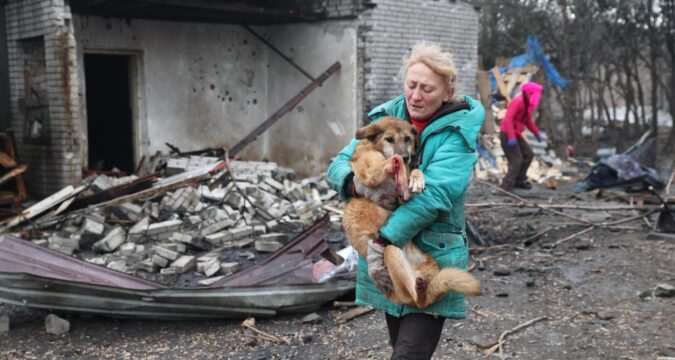
Un ataque aéreo ruso en la región sureña de Zaporiyia durante las primeras horas del día hirió a ocho personas y dañó 18 bloques de apartamentos, según el jefe de la administración militar regional, Ivan Fedorov.
Un refugio para perros en la capital regional también fue alcanzado, matando a 13 perros, dijo la secretaria del concejo municipal de Zaporizhzhia, Rehina Kharchenko.
Algunos perros fueron llevados de urgencia a una clínica veterinaria, pero no pudieron ser salvados, comentó. Otros siete animales resultaron heridos y están recibiendo tratamiento.
En medio de condiciones heladas en Kiev, más de 1.200 edificios residenciales en diferentes distritos de la capital no han tenido calefacción durante días debido al bombardeo ruso de la red eléctrica, según Zelenskyy.
El Ministerio de Defensa del Reino Unido dijo el viernes que la red eléctrica de Ucrania “está experimentando su crisis más aguda del invierno”.
El Ministerio de Defensa de Rusia afirmó que las defensas aéreas derribaron 38 drones ucranianos durante la noche, incluidos 26 sobre la región de Bryansk.
El gobernador de Bryansk, Alexander Bogomaz, dijo que el ataque cortó brevemente la electricidad a varias aldeas de la región.
Otro ataque nocturno ucraniano dañó instalaciones eléctricas en la ciudad rusa de Belgorod, interrumpiendo la distribución de electricidad, indicó el gobernador Vyacheslav Gladkov.
Informes locales indicaron que misiles ucranianos alcanzaron una planta de energía y una subestación eléctrica, cortando la electricidad en partes de la ciudad.
Los combates intensos también han continuado en la línea del frente a pesar de las temperaturas gélidas.
El comandante en jefe de Ucrania, el coronel general Oleksandr Syrskyi, declaró que la línea del frente ahora mide aproximadamente 1.200 kilómetros (750 millas) de longitud a lo largo de las partes oriental y sur de Ucrania.
Las crecientes mejoras tecnológicas en los drones de ambos lados significan que la llamada “zona de muerte”, donde las tropas están en mayor peligro, ahora tiene hasta 20 kilómetros (12 millas) de profundidad, dijo a los periodistas el jueves en comentarios embargados hasta el viernes.
___________________________________
Esta historia fue traducida del inglés por un editor de AP con ayuda de una herramienta de inteligencia artificial generativa.