Category: News
Under Beijing’s Wing: Iran’s Arsenal
Under Beijing’s Wing: Iran’s Arsenal
Authored by Zineb Riboua via Beyond the Ideological,
In 2015, the Joint Comprehensive Plan of Action (JCPOA) was sold to the American public and to the world as the definitive answer to Iran’s nuclear threat. The agreement placed extensive restrictions on uranium enrichment, centrifuge capacity, and stockpile levels, but said almost nothing about the one thing that would actually deliver a nuclear warhead to its target: ballistic missiles. Nothing about cruise missiles either. No limits on the development, testing, production, or deployment of the very weapons systems that transform a nuclear device from a dangerous secret in a bunker into a weapon that can destroy a city. A bomb is only as threatening as your ability to deliver it, and the JCPOA left Iran’s ability to deliver it completely unconstrained.
For Iran, this distinction matters more than it does for almost any other country on earth.
Decades of international sanctions have left Tehran with one of the weakest air forces in the region, an aging fleet incapable of penetrating the air defenses of Israel or any major Gulf state. Iran cannot deliver a nuclear weapon by aircraft. It cannot do so by sea with any reliability. The ballistic missile is the only component that gives the rest of the nuclear program strategic value.
What makes this failure even more consequential is who stepped in to exploit it.
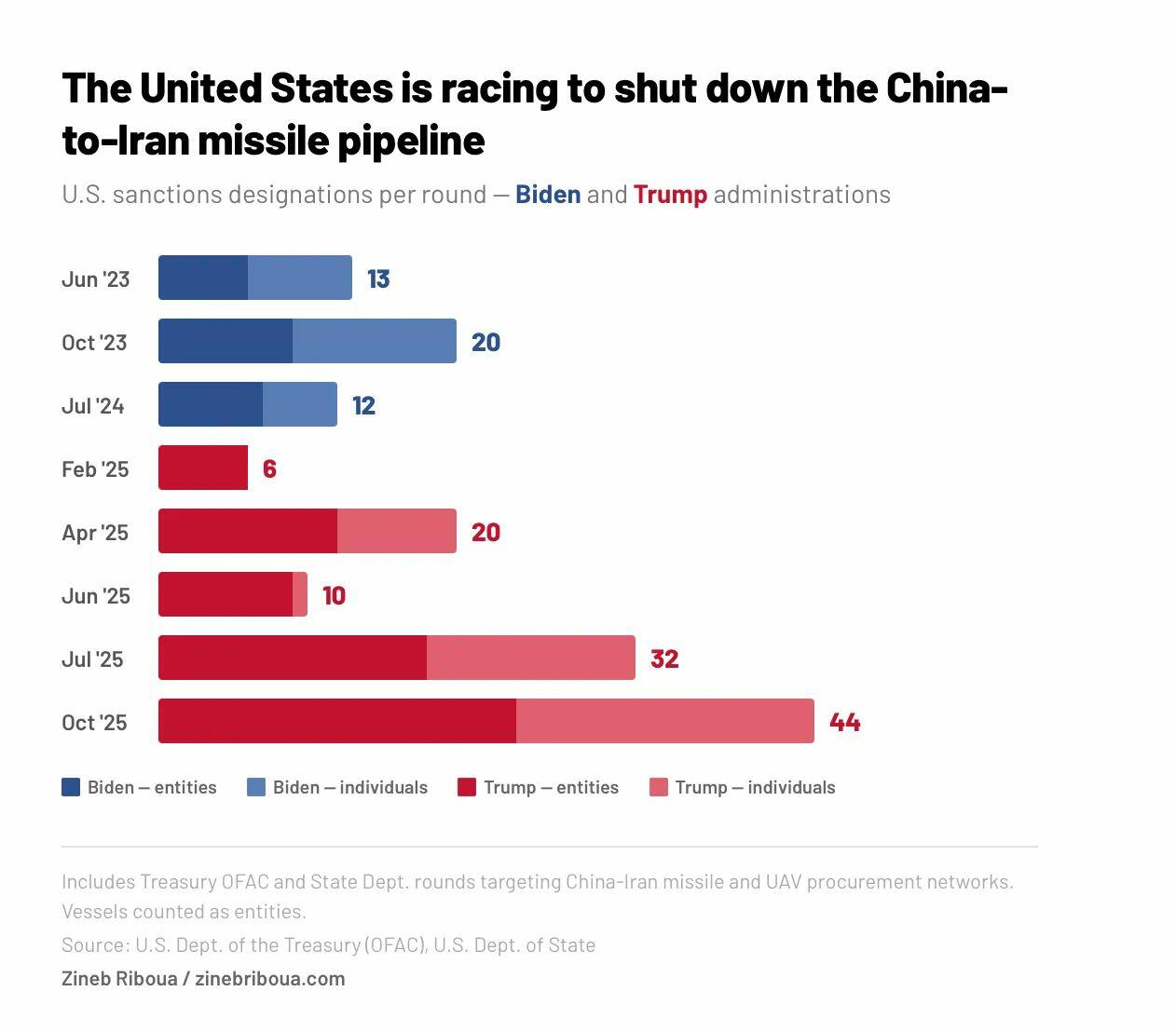
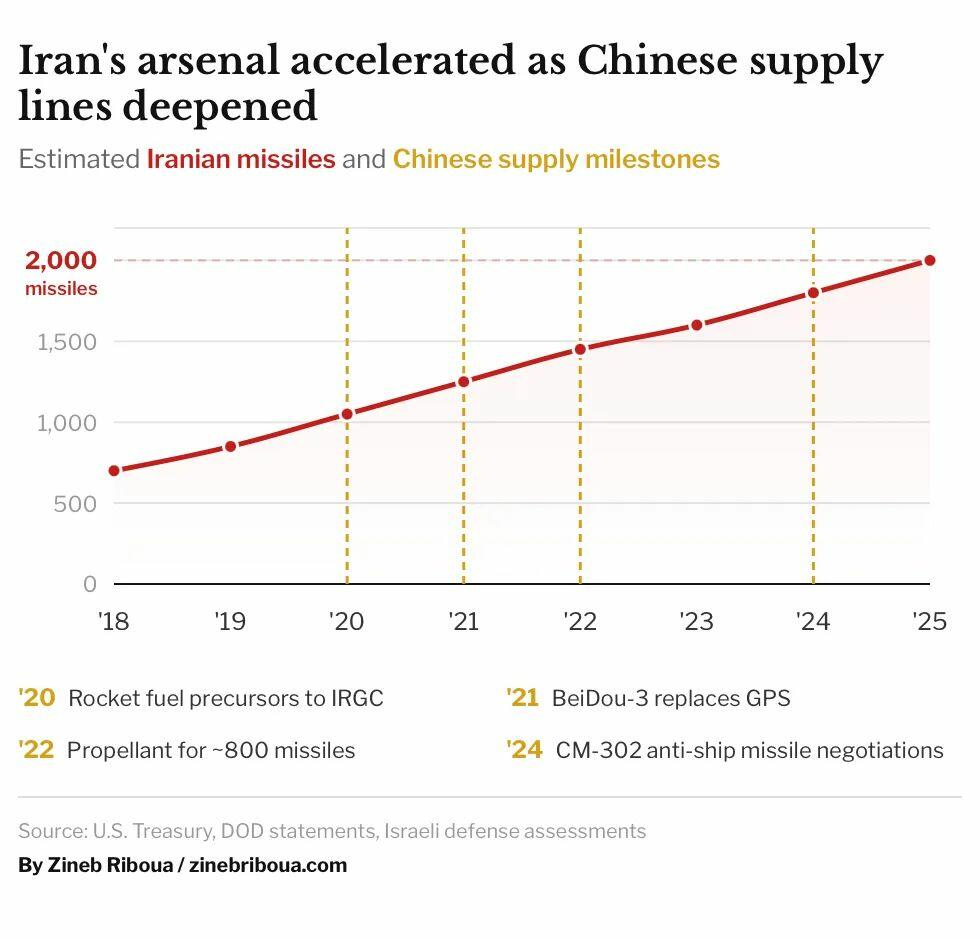
Over the past two years, China has emerged as the principal external supplier of Iran’s ballistic missile program, providing everything from chemical precursors for solid rocket fuel to satellite guidance through its BeiDou-3 navigation network, which replaced American GPS across Iran’s entire military architecture. The U.S. Treasury Department sanctioned several Chinese entities for supplying the IRGC with chemicals used in missile fuel production.
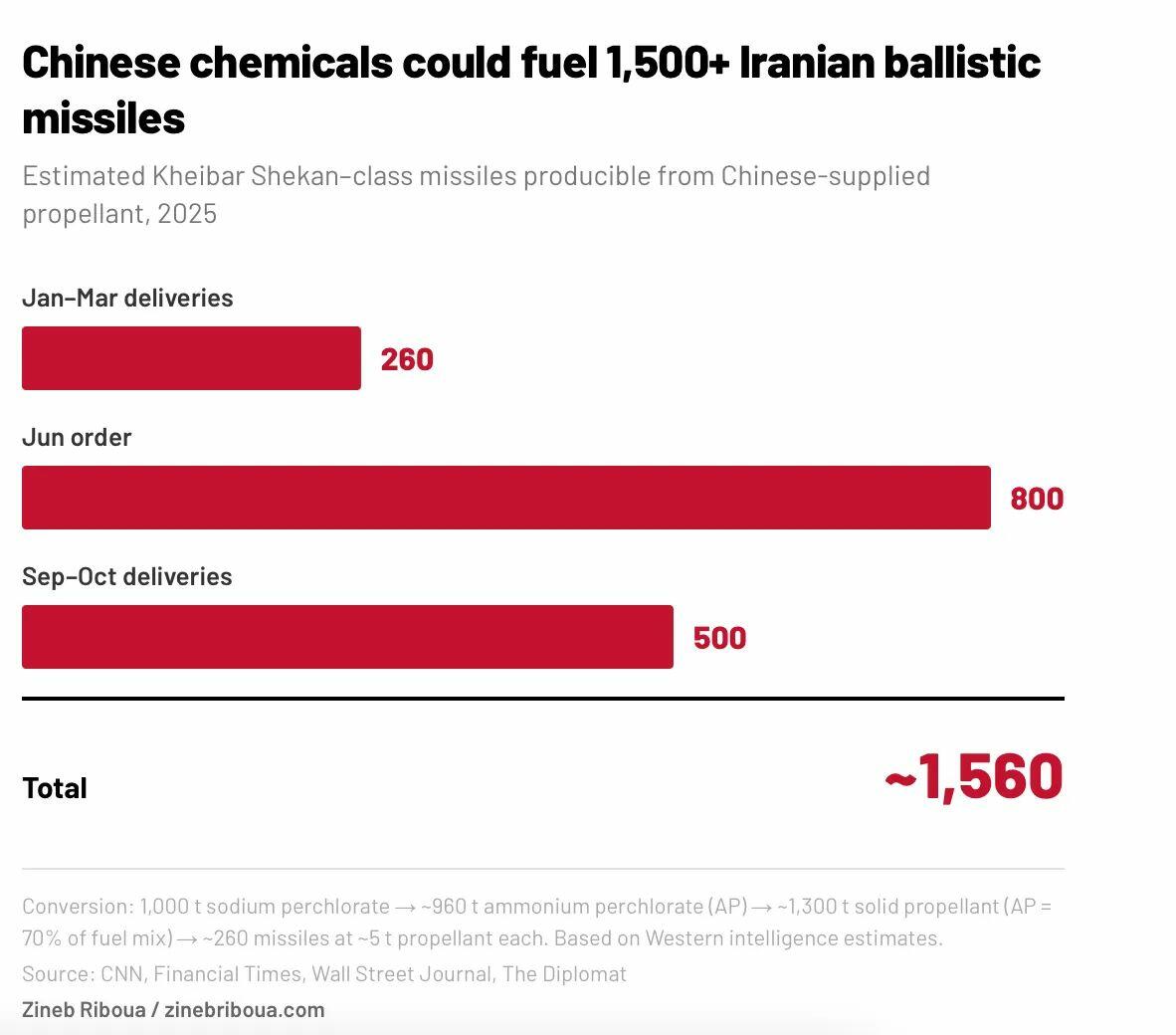
Intelligence revealed Iranian cargo ships unloading shipments of sodium perchlorate at Bandar Abbas, a substance that bypasses existing monitoring mechanisms, in quantities sufficient to produce propellant for approximately 800 new missiles in a single delivery.
Beijing had also been negotiating the sale of CM-302 supersonic anti-ship missiles to Tehran, a system designed to sink aircraft carriers. In December 2025, American special forces raided a merchant vessel in the Indian Ocean carrying Chinese military cargo bound for the Revolutionary Guards.
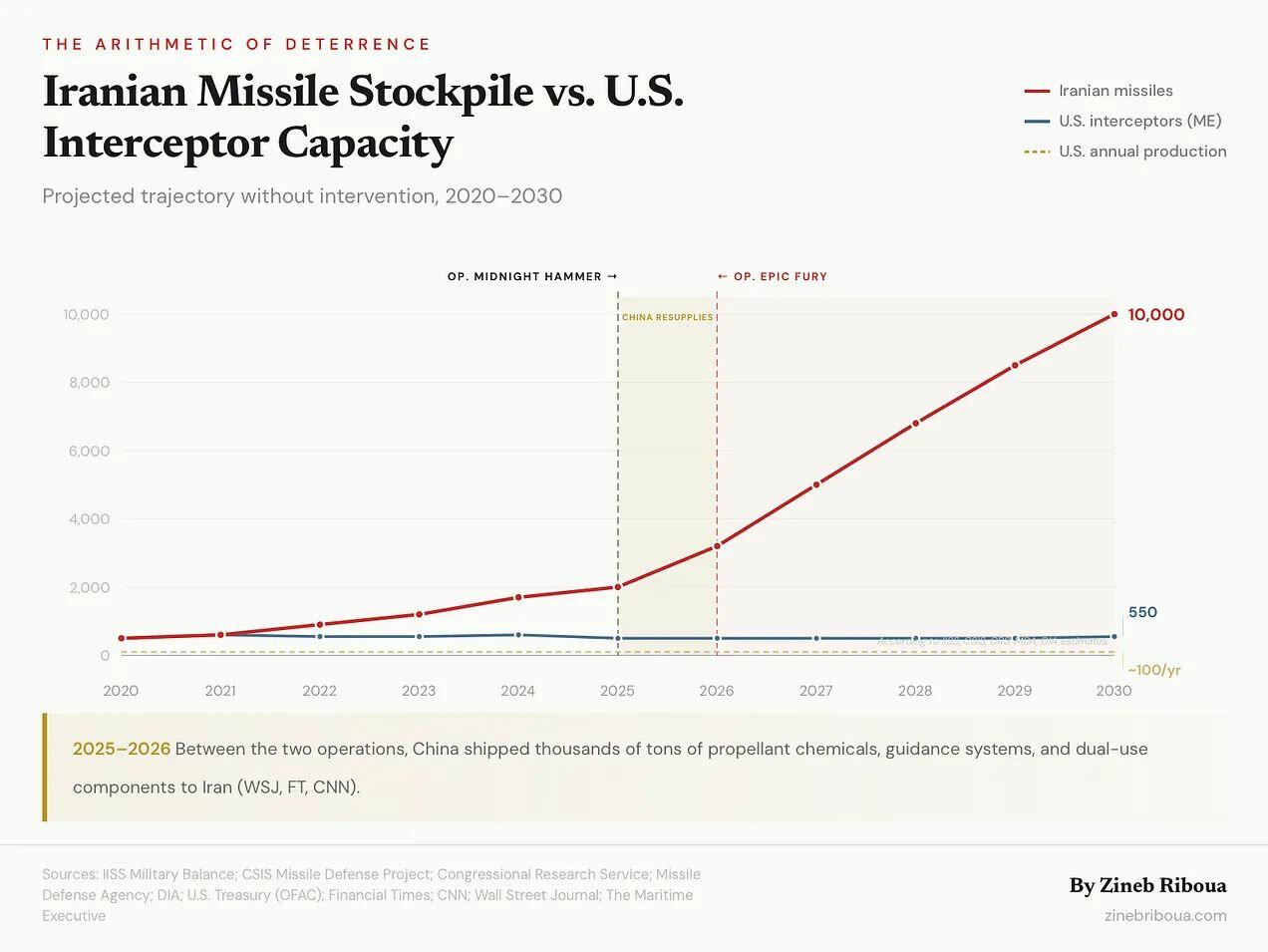
By the time Operation Epic Fury launched, Iran possessed the largest ballistic missile arsenal in the Middle East, an estimated 2,000 missiles of varying ranges dispersed across hardened underground facilities, rebuilt and resupplied in large part by Chinese industrial networks.
The Deferral
But let’s take a step back and look at what happened:
The Obama administration’s decision to exclude missiles from the 2015 JCPOA agreement represented a calculated concession, and more fundamentally, an act of deliberate deferral. In fact, both China and Russia categorically refused to include missile restrictions in the multilateral negotiations, and Tehran declared its indigenous missile development a non-negotiable sovereign right.
Naturally, the Obama team, determined to secure a landmark diplomatic achievement before leaving office, separated the nuclear file from the missile file entirely, treating them as two distinct problems when they formed two halves of the same threat.
Obama especially framed the deal in aspirational terms, saying it provided “an opportunity to move in a new direction,” but the direction left the missile program entirely unaddressed. In the language of UN Security Council Resolution 2231, the provisions on missiles merely “called upon” Iran not to conduct certain activities, far weaker than the binding prohibition in the prior Resolution 1929, which had explicitly prohibited Iran from pursuing ballistic missile technology capable of delivering nuclear warheads.
The administration even watered down the enforcement language of that earlier resolution to get the deal through, reasoning that missiles could be addressed later. That word, “later,” defined the entire approach. Iran tested ballistic missiles within weeks of the JCPOA entering into force, and no mechanism existed to stop it.
Free from constraint, Iran used the decade that followed to transform its missile program from a crude deterrent into a sophisticated, mass-produced strategic arsenal. It perfected guidance systems, extended ranges to cover all of the Middle East and parts of Europe, transitioned from liquid to solid-fuel propulsion, and constructed hardened underground launch facilities designed to withstand aerial bombardment. The interesting part? None of this violated a single provision of the deal.
And the missiles served a purpose beyond delivery: Iran aimed to amass such an overwhelming conventional arsenal that military action against its nuclear program would become prohibitively costly. Secretary of State Marco Rubio put today the math in stark terms: “They can build 100 ballistic missiles a month. We build 6 or 7 interceptors a month.” Each interceptor costs between $1 million and $15 million, while each Iranian missile costs between $200,000 and $500,000.
But the missiles did not stop at Israel’s borders. In the opening hours of Operation Epic Fury, Iranian retaliatory strikes slammed into civilian areas across Abu Dhabi, Dubai, and Manama; debris from intercepted projectiles rained near Kuwait International Airport. In the UAE alone, three people were killed and at least 58 wounded. Iran, in this sense, was (and still is) holding Arab capitals hostage, using its missile arsenal as a coercive instrument to punish the Gulf states for daring to deepen their alignment with Washington and/or Jerusalem.
The cruelest irony is that Riyadh and Abu Dhabi saw this coming. Neither was consulted as a stakeholder during the JCPOA negotiations, and both warned — publicly and repeatedly — that any deal leaving Iran’s missile program untouched would one day endanger their populations. They were dismissed as alarmist. Iranian warheads landing on Gulf Arab soil have now settled the argument.
The Reversal
Rubio’s articulation of the objectives behind Epic Fury collapsed a distinction that three decades of American diplomacy had fought to preserve. “The objectives of this operation are to destroy their ballistic missile capability and make sure they can’t rebuild, and make sure that they can’t hide behind that to have a nuclear program,” he said. One sentence fused what the JCPOA had deliberately kept apart, the nuclear file and the missile file, and redefined what an acceptable Iran looks like.
The urgency is real. Israeli defense planners had tracked how Chinese components, machine tools, and technical guidance were accelerating Iranian production lines, and their projections pointed toward catastrophe: 5,000 missiles by 2027, potentially 10,000 by the end of the decade. Every warhead carried a Chinese fingerprint, from solid-fuel propellant chemistry to the precision guidance systems that turned inaccurate rockets into weapons capable of striking downtown Abu Dhabi. Beijing was not merely trading with Tehran.
The Chinese government was industrializing Iran’s capacity to hold the Middle East at gunpoint. Whatever Beijing’s full calculus, the military consequences of that investment are legible on at least three levels.
First, every interceptor the United States fires over the Middle East represents one fewer available for the Western Pacific. THAAD batteries, Patriot systems, and SM-3 carrying naval vessels all draw from the same overstretched production lines. By accelerating Iran’s missile output, China imposed a war of attrition on American munitions without deploying a single soldier.
Second, Every Iranian salvo also forces the United States to reveal electronic warfare capabilities, radar signatures, and interceptor performance data in real combat conditions, giving Chinese military intelligence a live laboratory to study American defense systems without ever confronting them directly.
Third, if the United States proved unable to shield its Arab partners from sustained bombardment, every ally watching from Tokyo to Manila to Taipei would draw the same conclusion: Washington’s promises have material limits.
The drain on American readiness had already begun.
During the twelve-day war in 2025, the United States burned through roughly 150 THAAD interceptors, munitions that take years to produce and that feed the same queue supporting Pacific deterrence.
Only a few dozen replacements followed. Iran was rebuilding faster than America could reload. Left unchecked, the math led to a devastating fork: accept Iranian nuclear breakout behind a missile shield too thick to penetrate, or fight a war in the Middle East with stockpiles earmarked for the Taiwan Strait. Beijing had engineered precisely this dilemma. Operation Epic Fury represented the decision to prevent that choice from ever arriving. By destroying the missiles, the United States turned years of Chinese strategic investment and billions in transferred technology to ash.
Subscribe to Beyond the Ideological
Tyler Durden
Wed, 03/04/2026 – 22:20
https://www.zerohedge.com/geopolitical/under-beijings-wing-irans-arsenal
O’Higgins toma ventaja 1-0 ante Tolima en 3ra fase preliminar de Copa Libertadores
Por JOSÉ MANUEL VALLADARES
BOGOTÁ (AP) — Un tanto de Francisco González en el descuento del primer tiempo le permitió a O’Higgins superar el miércoles 1-0 a Deportes Tolima en el partido de ida de la tercera fase preliminar de la Copa Libertadores.
El equipo chileno se adelantó en la serie con un disparo de González dentro del área, frente a un conjunto colombiano que jugó con uno menos desde los 37 minutos por la expulsión de Kelvin Flórez.
O’Higgins también terminó con 10 jugadores por la tarjeta roja que vio Felipe Ogaz a los 81.
En el otro encuentro de la jornada, Sporting Cristal ganó a domicilio 1-0 a Carabobo.
Los ocho equipos que disputan esta ronda ya aseguraron al menos participar en la Copa Sudamericana si no logran acceder a la fase de grupos de la Libertadores. La próxima semana se conocerá a los cuatro clasificados a la siguiente etapa.
Este jueves se cierra la tanda de ida de la fase 3 con el enfrentamiento entre el debutante Juventud de Las Piedras e Independiente Medellín.
El sorteo de la fase de grupos se realizará el 19 de marzo. El calendario de seis fechas comenzará la semana entre el 7 y el 9 de abril. Se extenderá hasta la última semana de mayo.
La final de la Copa Libertadores 2026 está prevista para el 28 de noviembre en Montevideo.
En el estadio El Teniente, de Rancagua, O’Higgins tomó ventaja con el gol de González cuando se jugaba el octavo minuto de prolongación de la primera parte.
El extremo de O’Higgins, que también había marcado en la fase anterior en el triunfo como local frente a Bahía, controló un centro de Luis Pavez y definió ante el arquero Neto Volpi.
El disparo de González fue el único tiro al arco de los anfitriones en el período inicial.
En un primer tiempo accidentado, el volante de Tolima Edwar López dejó la cancha por lesión apenas a los cinco minutos.
Kelvin Flórez, quien reemplazó a López, fue expulsado por una falta imprudente sobre Alan Robledo en la lucha por un balón dividido.
Robledo abandonó la cancha en camilla por la herida en la cabeza que le produjo la infracción y fue sustituido por Nicolás Garrido.
Con la superioridad numérica, O’Higgins controló las acciones en el complemento y tuvo sus mejores ocasiones en los pies de Bryan Rabello y Juan Leiva.
A nueve minutos del final, Ogaz recibió la segunda amonestación por una falta contra Jersson González en un ataque prometedor.
Tolima, que viene de dejar en el camino en penales a Deportivo Táchira, adelantó sus líneas en el tramo final, pero no inquietó la portería defendida por Omar Carabalí.
En Valencia, Sporting Cristal se adelantó en la llave con un triunfo 1-0 sobre Carabobo.
El cuadro peruano, que superó en la segunda fase a 2 de Mayo, anotó el único tanto del compromiso a los 14 minutos con un penal transformado por Yoshimar Yotún.
A los 23, los visitantes tuvieron la ocasión de ampliar el resultado con un tanto de Felipe Vizeu, pero fue invalidado tras la revisión en el videoarbitraje por una mano previa de Cristiano da Silva.
Carabobo dominó el trámite en el segundo tiempo, pero no pudo batir al arquero Diego Enríquez, que finalizó con cinco atajadas.
_____
Deportes AP: https://apnews.com/hub/deportes
Basketball and local scores for the Southland, Aurora, Elgin, Naperville and Lake County
High school and local college results and highlights from the Southland, Aurora, Elgin, Naperville and Lake County coverage areas.
Email Daily Southtown results to southtownsports@gmail.com, Beacon-News, Courier-News and Naperville Sun results to tribwestsports@gmail.com and News-Sun results to newssunsports@gmail.com.
FRIDAY’S EVENTS
HIGH SCHOOLS
BOYS BASKETBALL
CLASS 4A SECTIONAL CHAMPIONSHIPS
BOLINGBROOK
Benet (33-1) vs. Bolingbrook (25-7), 7 p.m.
JOLIET WEST
Homewood-Flossmoor (29-3) vs. Marist (29-5), 7 p.m.
CLASS 3A SECTIONAL CHAMPIONSHIPS
DE LA SALLE
Hyde Park (24-9) vs. De La Salle (18-16), 7 p.m.
DEERFIELD
Lake Forest (16-16) vs. Deerfield (22-11), 7 p.m.
HILLCREST
Leo (26-6) vs. Hillcrest (22-8), 6 p.m.
WOODSTOCK NORTH
Kaneland (33-0) vs. Crystal Lake South (27-7), 7 p.m.
CLASS 2A SECTIONAL CHAMPIONSHIP
SENECA
Bishop McNamara (28-5) vs. Yorkville Christian (23-10), 7 p.m.
CLASS 1A SECTIONAL CHAMPIONSHIP
AMBOY
Ottawa Marquette (25-8) vs. Indian Creek (26-6), 7 p.m.
LOCAL COLLEGES
MEN’S BASKETBALL
NCAA DIVISION III TOURNAMENT
First Round
At Wisconsin La Crosse
Aurora University vs. Claremont Mudd-Scripps (Calif.), 4:20 p.m.
SATURDAY’S EVENT
WEDNESDAY’S RESULTS
HIGH SCHOOLS
BOYS BASKETBALL
CLASS 4A SECTIONAL SEMIFINALS
BOLINGBROOK
Bolingbrook 68, Neuqua Valley 53
Neuqua (32-2): Cole Kelly 17 points. Mason Martin 13 points. Danny Mikuta 11 points.
JOLIET WEST
Marist 59, Lockport 33
CLASS 3A SECTIONAL SEMIFINALS
DE LA SALLE
De La Salle 59, King 55
DEERFIELD
Deerfield 65, Wauconda 56
Deerfield (22-11): Jake Pollack 23 points. Evan Nagler 18 points. Tommy Donahue 16 points.
Wauconda (26-8): Alex Ortega 20 points. Tony Salemi 16 points.
HINSDALE SOUTH
Wheaton Academy 46, Providence 40
CLASS 2A SECTIONAL SEMIFINALS
MENDOTA
Johnsburg 51, Aurora Christian 47
SENECA
Yorkville Christian 50, Pontiac 44
Yorkville Christian (23-10): Jayden Riley 28 points. Jordan Purvis 11 points.
CLASS 1A SECTIONAL SEMIFINAL
AMBOY
Indian Creek 58, Streator Woodland 43
Indian Creek (26-6): Isaac Willis 19 points. Logan Schrader 15 points. Parker Murry 15 points.
LOCAL COLLEGES
SOFTBALL
Moraine Valley 8, Joliet Junior College 4
TUESDAY’S RESULTS
HIGH SCHOOLS
BOYS BASKETBALL
CLASS 4A SECTIONAL SEMIFINALS
BOLINGBROOK
Benet 67, Yorkville 30
Benet (33-1): Edvardas Stasys 19 points. Colin Stack 12 points. Jayden Wright 12 points.
Yorkville (16-13): Brayden Porter 12 points.
FREMD
Fremd 74, Stevenson 65
Stevenson (21-11): Rocco Pagliocca 23 points, 6 rebounds. Donny Williams 23 points, 6 assists. Quinton Frakes 12 points, 8 rebounds.
JOLIET WEST
Homewood-Flossmoor 64, Brother Rice 54
MOUNT CARMEL
Curie 64, St. Laurence 57
ROCKTON HONONEGAH
Rockford Auburn 84, Warren 76
Warren (30-4): Braylon Edwards 34 points. Avonn King 24 points. Jaxson Davis 9 points.
Rockford Guilford 65, Waukegan 57
Waukegan (24-8): Rico Love 22 points. Carter Newsome 17 points. Simereon Carter 11 points.
CLASS 3A SECTIONAL SEMIFINALS
DEERFIELD
Lake Forest 59, St. Viator 55 (OT)
Lake Forest (16-16): Dominic Mordini 28 points.
HILLCREST
Hillcrest 62, Thornton 49
Leo 68, Morgan Park 38
Leo (26-6): Jeremiah Echols 23 points. Brian Kizer 21 points.
Morgan Park (19-8): Jacque Lewis 13 points.
HINSDALE SOUTH
Wheaton St. Francis 52, Lemont 44
Lemont (19-13): Ryan Crane 12 points. Zane Schneider 12 points. Luke Glotzbach 12 points.
WOODSTOCK NORTH
Kaneland 64, Rockford East 44
CLASS 1A SECTIONAL SEMIFINAL
AMBOY
Ottawa Marquette 54, Hinckley-Big Rock 51
Hinckley-Big Rock (23-9): Marshall Ledbetter 21 points. Luke Badal 19 points.
LOCAL COLLEGES
SOFTBALL
SPACE COAST SPRING GAMES (Fla.)
Hannibal-LaGrange (Mo.) 11, Judson 4
St. Francis (Ind.) 4, Judson 0
NEWS AND NOTES
Newcomer of the year Maxwell Marius of Governors State and St. Francis’ Joffrey Nunnally were named to the all-conference team in CCAC men’s basketball. Governors State also produced the defensive player of the year in Vincent Mayes and coach of the year in Tony Bates. … St. Xavier’s Jazmyn Casas (player) and St. Francis’ Emily Boyle (pitcher) were named softball players of the week by the CCAC. … North Central College’s Payton Diaz (baseball) was chosen hitter of the week by the CCIW.
Compiled by Josh Krockey.
Tanker Hit By “Large Explosion” In Waters Off Kuwait, Causing Oil Spill
Tanker Hit By “Large Explosion” In Waters Off Kuwait, Causing Oil Spill
In the most dramatic escalation yet involving shipping in the Persian Gulf, the United Kingdom Maritime Trade Operations (UKMTO), a British naval authority responsible for monitoring shipping safety in high-risk areas, said it received a report that around 1040pm UTC, a “large explosion” took place 30 nautical miles south east off Mubarak Al Kebeer, on the coast of Kuwait. The report notes that “there is oil in the water coming from a cargo tank” which could have a disastrous environmental impact, especially if its reaches the desalinization plants that keep much of the Gulf population alive, literally.
The tanker, which was at anchor in the Khor al-Zubair lightering zone – a critical area for loading Iraqi heavy fuel oil exports – began taking on water following the blast. Oil was seen leaking from a damaged cargo tank into the surrounding waters, prompting concerns over potential environmental impacts. Despite the severity, no fires were reported, and all crew members remained safe and accounted for. Kuwait’s interior ministry later clarified that the incident took place outside the country’s territorial waters, at least 60 kilometers from the port
BREAKING A tanker was hit by a “large explosion” in the waters off Kuwait, causing an oil spill, British maritime security agency UKMTO said Thursday pic.twitter.com/i8mLJVn9bs
— AFP News Agency (@AFP) March 5, 2026
The targeted area off Kuwait is particularly significant as it lies within Iraq’s primary oil export corridor, a zone previously considered outside the main conflict perimeter. Iraq, not directly involved in the US-Iran war, has already reduced oil production due to storage shortages and loading delays caused by the broader disruptions. No group or nation has claimed responsibility for the Kuwait incident, but analysts suggest it could be linked to Iranian proxies or other actors exploiting the chaos.
The report, which was sourced to the Master of a tanker at anchor, comes as the fifth day of the conflict draw to a close, but no near end is in sight after Israel and the US hit Iran in joint strikes on several key sites on Saturday, February 28. Iran has retaliated by striking sites across the Middle East, and hitting several ships in the gulf as part of its blockade of the Straits of Hormuz.
UKMTO WARNING INCIDENT 014-026
Click here to view the full warning ⤵️ https://t.co/ygKSBOCLZi#MaritimeSecurity #MarSec pic.twitter.com/RPZXtz6RU7
— UKMTO Operations Centre (@UK_MTO) March 5, 2026
UKMTO said vessels are advised to transit with caution and report any suspicious activity to the maritime operation.
This incident is hardly isolated, and is part of a widening conflict in the Middle East. The Persian Gulf has become increasingly volatile since the outbreak of hostilities between the United States and Iran, with multiple attacks on commercial and military vessels reported in recent days. For instance, prior to the explosion, a US submarine sank an Iranian frigate near Sri Lanka, an Iranian corvette was set ablaze at Bandar Abbas, and Qatar’s LNG terminals suffered outages. These events have stranded hundreds of ships, including oil tankers, outside the Strait of Hormuz—a chokepoint for about 20% of global oil supplies.
Other recent maritime attacks in the region include a seafarer killed in an explosion off Oman on March 1 and a Russian-flagged LNG tanker sinking in the Mediterranean, blamed by Moscow on Ukrainian sea drones. These incidents underscore the expanding scope of the conflict, turning once-safe waters into high-risk zones for global trade.
The attack has immediate ramifications for energy markets. With Iraqi exports potentially hampered, oil prices could face upward pressure, exacerbating the disruptions already pricing in closures rather than mere interruptions. Shipping insurers and commodity traders are on high alert, as the Gulf’s transformation into a “hunting ground” without clear boundaries threatens further escalations.
Environmentally, the oil spill poses risks to marine life and coastal ecosystems in the Persian Gulf, a region already vulnerable to pollution from decades of oil activities. Cleanup efforts will likely be complicated by the ongoing security threats.
As investigations continue, the international community watches closely, with calls for enhanced maritime security to protect vital trade routes. This event serves as a stark reminder of how regional conflicts can ripple into global economic and environmental challenges.
Tyler Durden
Wed, 03/04/2026 – 22:09
https://www.zerohedge.com/military/tanker-hit-large-explosion-waters-kuwait-causing-oil-spill
China-Linked Bulk Carrier Exits Strait Of Hormuz Without Incident
China-Linked Bulk Carrier Exits Strait Of Hormuz Without Incident
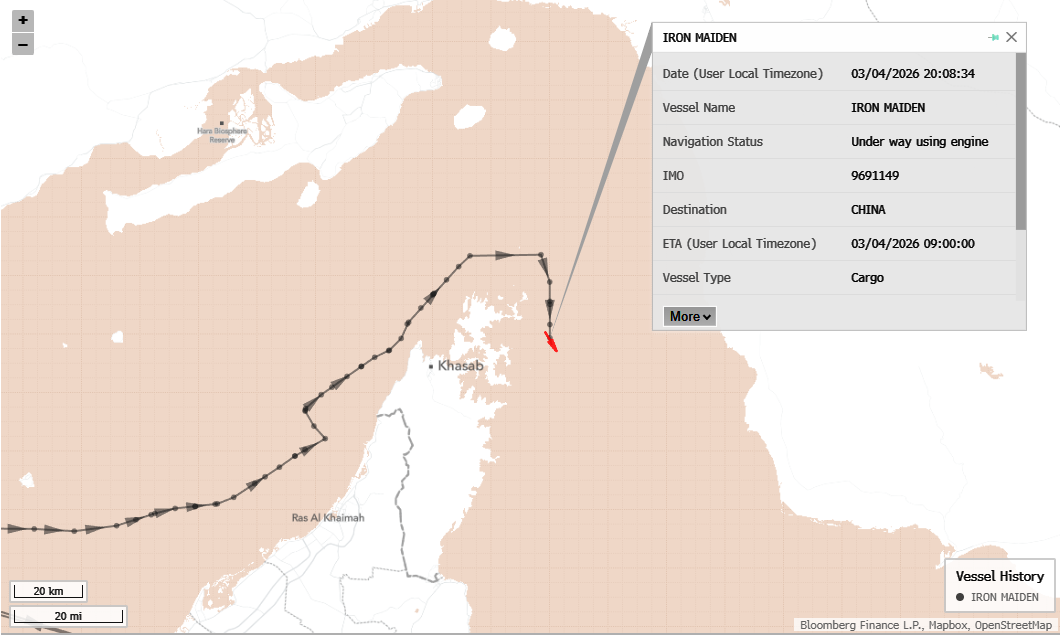
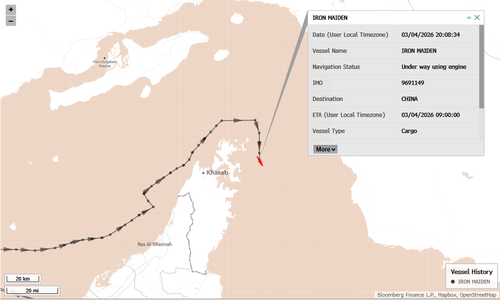
Maritime tracking data shows a China-linked bulk carrier exiting the Strait of Hormuz without incident, a notable development that comes just hours after a report stated Tehran would permit Chinese vessels to transit the critical maritime chokepoint, despite much of the narrow waterway being paralyzed.
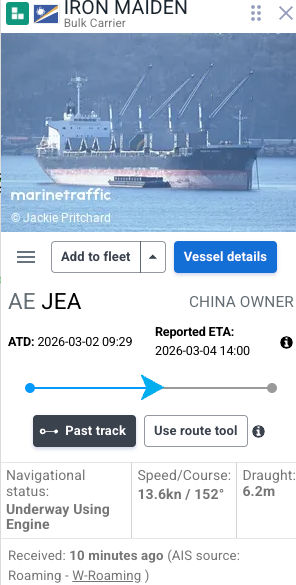
Bloomberg data shows the bulk carrier Iron Maiden has successfully transited the narrowest part of the waterway without incident.
MarineTraffic data indicates the ship has a “China Owner” and has a port call in China.
Earlier, New Delhi Television reported:
Iran has said it will allow only Chinese vessels to pass through the Strait of Hormuz as an expression of gratitude for Beijing’s stance toward Tehran since the war in the Middle East began, sources have said. This is significant because the Strait, which provides Persian Gulf ports access to the open sea, is a key chokepoint that Iran has blocked since the conflict in the region began, threatening global supply chains.
Tanker traffic through the Strait of Hormuz on Wednesday had plunged around 90% compared with levels seen just before Operation Epic Fury began on Saturday, according to MarineTraffic.
Tanker traffic through Strait of Hormuz down by 90%
Analysis of vessel activity indicates tanker transits are now around 90% lower than last week. Matt Wright, Principal Freight Analyst at Kpler, explains: “Unlike several other vessel segments where movements have largely… pic.twitter.com/JIhFoAkQKO
— MarineTraffic (@MarineTraffic) March 4, 2026
Iran has so far targeted ten vessels in or around the Strait. A senior IRGC official said earlier this week that the Strait is closed and that IRGC forces will fire on any ships attempting to pass.
“The Strait (of Hormuz) is closed. If anyone tries to pass, the heroes of the Revolutionary Guards and the regular navy will set those ships ablaze,” Ebrahim Jabari, a senior adviser to the Guards commander-in-chief, said in remarks published by local media.
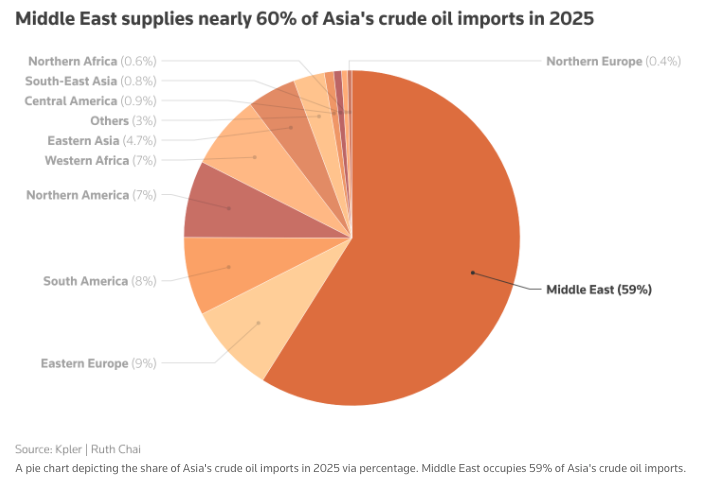
By midweek, Chinese officials had called for an immediate ceasefire in the U.S.-Iran conflict, as China’s energy imports are highly exposed to the region.
The key question now is whether the Trump administration can reopen the Strait while the IRGC’s drone threat may persist for months.
Tyler Durden
Wed, 03/04/2026 – 21:50
https://www.zerohedge.com/energy/china-linked-bulk-carrier-exits-strait-hormuz-without-incident

Chicago Blackhawks reportedly trade Jason Dickinson and Colton Dach to the Edmonton Oilers
The Chicago Blackhawks have reportedly traded centers Jason Dickinson and Colton Dach to the Edmonton Oilers in exchange for left winger Andrew Mangiapane and a 2027 first-round draft pick. The Hawks will retain 50% of Dickinson’s salary, and the pick is top-12 protected.
Frank Seravalli and Pierre LeBrun first reported the details of the trade.
Hawks general manager Kyle Davidson was again able to negotiate a higher-than-expected return for one of his veterans, the other being a 2028 second-round draft pick for defenseman Connor Murphy.
Dickinson, 30, was traded to the Hawks from the Vancouver Canucks on Oct. 7, 2022. He scored 30 points (nine goals, 21 assists) in 78 games in his first season with Chicago and signed a two-year, $8.5 million contract with the Hawks on Jan. 16, 2024.
The forward’s best season came in 2023-24, where he scored 35 points (22 goals, 13 assists) and played all 82 games. He also scored a career-high four game-winning goals and ended the year with a +4 plus/minus rating.
He earned the alternate captain’s patch that season after Jonathan Toews took a leave of absence from the NHL. He joined fellow alternate captain Murphy, who was traded to the Oilers earlier this week. Connor Bedard will be an alternate captain for the rest of the season after Murphy’s departure, so Dickinson’s ‘A’ may go to another youngster as well.
Chicago Blackhawks center Jason Dickinson collides with Winnipeg Jets goaltender Connor Hellebuyck in the third period of a game at the United Center in Chicago on Jan. 19, 2026. (Chris Sweda/Chicago Tribune)
Dickinson has missed some time this season for various injury-related reasons. He’s been out of the lineup for 14 games, including 10 on injured reserve due to a shoulder injury.
In his 11-season NHL career, Dickinson has 74 goals and 94 assists across 549 games and 11 game-winning goals. He was selected at No. 29 by the Dallas Stars in the 2013 NHL draft and scored a goal in his NHL debut on April 7, 2016.
The trade has always been a possibility to make room for the incoming Hawks prospects. Before the NHL’s Winter Olympic break, Hawks general manager Kyle Davidson said that he wanted to “keep giving young players opportunity.”
Dach has recently seen healthy scratch status for the Hawks, but remains one of the NHL’s most physical rookies. The center has laid 189 hits this season, 10th-most in the league.
He was selected No. 61 in the 2021 NHL draft. The Oilers will get a bottom-six forward who is both an enforcer and an energy magnet.
It’s another deal done with Oilers general manager Stan Bowman, who held the same position with the Hawks from 2009-2021, winning three Stanley Cups. He resigned after the team’s sexual assault case against video coach Brad Aldrich came to light. Then-assistant general manager Davidson became interim and later full-time general manager of the Hawks following Bowman’s departure.
Mangiapane has scored 14 points (seven goals, seven assists) in 52 games played with the Oilers this season. He signed a two-year, $7.2 million contract with Edmonton last July, a $3.6 million average annual value.
https://www.chicagotribune.com/2026/03/04/chicago-blackhawks-trade-jason-dickinson-colton-dach/
Boca se aprovecha de la resaca de Lanús y lo golea 3-0 en La Fortaleza
Por MARCELO R. ANDROETTO
BUENOS AIRES (AP) — Con su mejor actuación en mucho tiempo, Boca Juniors goleó el miércoles 3-0 a domicilio a Lanús, flamante campeón de la Recopa Sudamericana, y volvió a meterse en zona de playoffs de la Zona A del Torneo Apertura del fútbol argentino.
En un partido postergado por la séptima fecha, el “Xeneize” se impuso con absoluta claridad al reciente verdugo del Flamengo con tantos de Santiago Ascacíbar, a los 15 minutos, y un doblete del uruguayo Miguel Merentiel, a los 30 y 64.
El juvenil Tomás Aranda, en su primera titularidad, fue una de las figuras de la visita.
“Uno lo sueña cuando arranca de chico, se me van dando las cosas, hay que seguir para adelante. En este partido y ante un buen rival, nos salieron los goles”, declaró el mediocampista de 18 años.
El conjunto dirigido por Claudio Úbeda, que arrastraba una racha de cuatro partidos sin victorias en el certamen (una derrota y tres empates), suma 12 puntos y se ubica en la sexta posición, a seis unidades de Vélez Sarsfield, líder en soledad de su zona.
Los jugadores de Boca realizaron el tradicional “pasillo” a sus colegas del “Granate” para homenajearlos por su gesta de la semana pasada en el Maracaná, mientras los hinchas locales se entregaban a celebrar el título en medio de un festival pirotécnico y nubes de humo de colores. En La Fortaleza, excepcionalmente, también hubo aficionados visitantes.
Una vez iniciada las acciones, el “Xeneize” fue implacable: presión alta, movilidad y conexiones a partir de su triple eje de volantes conformado por Leandro Paredes, Milton Delgado y Ascacíbar, con Aranda libre, ocupando preferentemente la banda izquierda, y con Merentiel y el paraguayo Adam Bareiro como doble tándem de ataque.
En contrapartida, el equipo de Mauricio Pellegrino –que venía de igualar el domingo con Defensa y Justicia con una formación totalmente alternativa– presentó frente a Boca a la mayoría de sus habituales titulares, pero extrañó demasiado a Rodrigo Castillo, su goleador, recién vendido al Fluminense, y Marcelino Mareno, su mayor talento, ausente por una lesión en el metatarso izquierdo. Sus reemplazantes respectivos, Walter Bou y Franco Watson, no supieron estar a la altura. Y su rival fue superior de principio a fin.
El primer grito de Ascacíbar con la camiseta auriazul fue un excelente remate de media distancia del exjugador de Estudiantes de La Plata, que contó con la involuntaria ayuda de José Canale: la pelota se desvió en la espalda del defensor paraguayo y descolocó a Nahuel Losada.
Y el primer festejo de la noche para Merentiel llegó de cabeza, luego de que Aranda desbordó y el arquero anfitrión dio un rebote al centro del área. Bareiro, también de cabeza, estuvo a centímetros de estirar el marcador, pero Losada se lo impidió.
Sin duda, el gran acierto de Úbeda fue darle lugar a Aranda en el once titular, tras su buen ingreso del sábado ante Gimnasia de Mendoza en La Bombonera. El volante creativo siguió enchufado en el complemento y Paredes apareció en su mejor versión para potenciar el fútbol de un Boca que venía siendo cuestionado por sus pobres actuaciones recientes.
“Aranda jugó como si tuviera muchos partidos en Boca”, elogió el entrenador a su dirigido.
“Longaniza” Pellegrino metió dos cambios en el entretiempo, apostó a Dylan Aquino —autor del tercer gol ante el “Mengao” en Río de Janeiro– como revulsivo. Y a la hora de juego también ingresó el chileno Matías Sepúlveda, otro de actuación destacada en ambos partidos por la Recopa.
Pero nada cambió. Y poco después Boca redondeó la goleada con una exquisita asistencia de Paredes para la corrida de Merentiel, que la pinchó sutilmente de zurda, para concretar su sexto doblete en el club.
La goleada incluso pudo ser mayor, aunque el anfitrión también tuvo un par de oportunidades para descontar.
Parecía difícil de creer de todas formas que este Lanús fuese el mismo que alcanzó la gloria en Brasil y dejó sin trabajo a Filipe Luís. En realidad no lo fue, sin Castillo ni Moreno, y probablemente pagando el precio de aquel desgaste bajo la lluvia en el Maracaná y el natural relajamiento que sigue a los festejos, se trató de un “Granate” desteñido. Y Boca aprovechó para mostrar sus credenciales.
_____
Deportes AP: https://apnews.com/hub/deportes
The Iran War Exposes The Farce Of American “Representative Democracy”
The Iran War Exposes The Farce Of American “Representative Democracy”
Authored by Ryan McMaken via MisesInstitute,
The Trump administration has unilaterally—without any Congressional debate or vote, of course—forced Americans into yet another war. This time, the war is a large-scale military campaign against Iran. Was there any groundswell of public support for this war? Did the Congress vote to spend more American tax dollars on another war? Apparently not. According to a March 1 poll from Reuters, only 27 percent of Americans polled said they support the US’s new war on Iran. Needless to say, few Americans have been calling their representatives in Congress asking for yet another Middle Eastern war.
So, why is the US now at war with Iran? Not even the administration appears to know for sure. After the war had already begun, the White House repeatedly changed its stated rationale for opening hostilities against Iran. At the beginning the US regime had been claiming it wanted regime change in Iran to “liberate” Iranians. Yet, by Monday, when Trump listed his reasons for starting the war, he didn’t mention regime change at all. Rather, the administration now seems to have settled on claims that the Iran regime was creating a missile program that, somehow, endangers the United States. Yet, virtually no one believes that the Iranian regime has ever had long-range missiles capable of getting anywhere near US territory. Rather, the only “threat” to the United States is a threat to US bases which the US government has insisted on building 10,000 miles from US territory, and which have nothing to do with the safety of Americans in the United States.
On Monday, Rubio said that the United States began the war because the State of Israel planned to attack Iran, and that this would lead to Iranian reprisals against US bases. Rubio was essentially stating that Tel Aviv forced the US into the war. Trump today directly contradicted his Secretary of State—as well as the GOP Speaker of the House and GOP Senator Tom Cotton—and claimed “I might’ve forced their hand.”
Completely absent from all these confused and retroactive attempts to justify the war is any mention of the American people, their tax dollars, their freedoms, or even their alleged representatives in Congress. Nor is this surprising. The current war is a timely reminder that the US ruling elites regard the US taxpayers and ordinary Americans as little more than inconvenient afterthoughts in the formation of US foreign policy. At the same time, the US regime also claims to have the moral high ground precisely because the American regime is supposedly “democratic” with the support of “the people.”
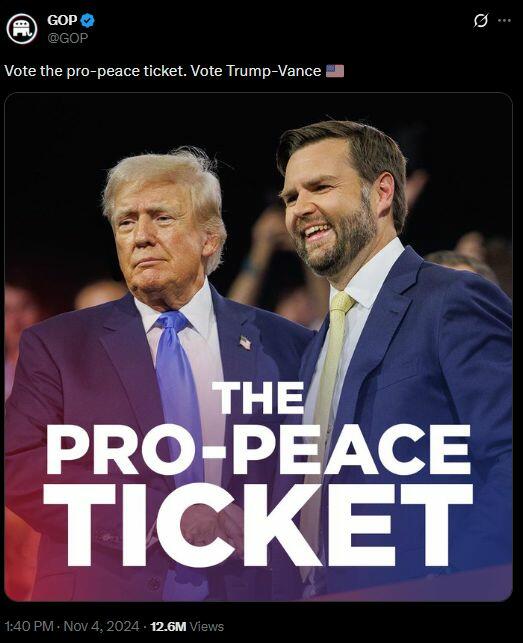
Indeed, the Trump administration overall has helped make it abundantly clear that US elections and public opinion are almost completely irrelevant to the foreign policy. Throughout his campaigns, Donald Trump repeatedly claimed to be the peace candidate, announcing in his speeches that he would end wars, rather than start them. In the days before the 2024 election, the GOP posted this image in social media, clearly presenting the Trump administration as “the pro-peace ticket”:
Yet, less than a year into his second term, Donald Trump’s foreign policy looks largely indistinguishable from that of the foreign policy of Barack Obama or Joe Biden. Indeed, if the current war drags on, we’ll be able to say Trump’s foreign policy is reminiscent of the George W. Bush administration.
It was clear during the campaign that the Trump ticket was trying to take advantage of public sentiment which favored less US involvement in foreign wars. With American foreign policy, however, elections don’t matter. This was recently emphasized by the bumbling US ambassador to Israel, Mike Huckabee, in a recent interview with Tucker Carlson. Carlson began with a simple question for Huckabee:
Carlson: How much does it matter what Americans think?
Huckabee: Well, it matters every bit what Americans think.
Carlson then points out that about 21% of Americans support war with Iran. He asks Huckabee if that’s enough for the US regime to start a war with Iran. Huckabee states “We don’t live in a world where you have a poll taken to find out whether our policy should be in a particular direction…”
Carlson then points out that Huckabee had just said public opinion matters a lot and Huckabee says “we care deeply about it…”
Carlson: “If we’re ignoring it, in what sense to we ‘care deeply about it?’”
Huckabee then offers a non sequitur: “I think we care deeply when we see there’s a threat.” Huckabee then continued with more word salad in a desperate attempt to make a connection between public opinion and his preferred policy of repeatedly starting elective wars with Middle Eastern regimes that are no threat to the US population.
The reality, of course, is closer to Rubio’s explanation for the US’s involvement in the war: following the lead of the State of Israel.
This is apparently fine with Ambassador Huckabee, of course, who in his Carlson interview, was asked if Huckabee thinks the State of Israel has a “right” to take over most of the Middle East. Carslon stated: ”Does Israel have the right to that land?” Huckabee responded ”It would be fine if they took it all.”
And what if most Americans don’t share this opinion? Clearly, the US regime doesn’t care, and neither does Huckabee, or Donald Trump.
Meanwhile, Donald Trump says he doesn’t care about polling so he won’t rule out deploying American troops on the ground in Iran.
In spite of all the US regime’s posturing about “the will of the people” and “representation” in Congress, what really matters in Washington is serving powerful interest groups. The taxpaying public simply exists as a resource to be bled dry in favor of wars, protectionism, and federal spending which serves the ruling elite’s complex system of patrons and clients that keeps the elite in power.
When it comes to US foreign policy in the middle east, the dominant interest group is the State of Israel. This is executed through the American-Israeli Political Action Committee (AIPAC) and other elements of what foreign-policy scholars John Mearsheimer and Stephen walt call “the Israel lobby.” When Mearsheimer and Walt released their book The Israel Lobby in 2007, they were predictably accused of anti-semitism. Yet, the book was ahead of its time in describing how pro-Israel interest groups have been extremely successful in gaining financial, military, and strategic favors for Israel from US policymakers. It has all been done at the expense of American taxpayers. The result has been an American foreign policy elite that overwhelmingly favors incessant foreign intervention to favor a foreign state—the State of Israel—regardless of any concern for the cost borne by Americans or the potential for drawing the US into broader conflicts that do not in any way increase the security of the United States.
In 2007, The Israel Lobby seemed controversial to many. In 2026, it is merely a statement of the obvious—that US foreign policy is tailored to favor certain interest group, rather than the interests of ordinary voters. This, however, is how all interest group politics works. The voting public doesn’t matter, and it hasn’t mattered for a long time.
This is shown in empirical studies that have tried to find a connection between public opinion and actual policies favored in Washington. The connection is tenuous at best.
For example, in a 2014 study by Martin Gilens and Benajmin Page, the authors note that when it comes to “impacts on U.S. government policy … average citizens and mass-based interest groups have little or no independent influence.” Gilens and page note that “the preferences of economic elites … have far more independent impact upon policy change than the preferences of average citizens do.”
This can be seen in Trump’s own fundraising given how one of his biggest donors, billionaire Miriam Adelson, is notable for an extreme pro-Israel position. This is, not surprisingly, reflected in Trump’s foreign policy.
The final conclusions of Gilens and Page are clear:
In the United States, our findings indicate, the majority does not rule—at least not in the causal sense of actually determining policy outcomes. When a majority of citizens disagrees with economic elites or with organized interests, they generally lose. Moreover, because of the strong status quo bias built into the U.S. political system, even when fairly large majorities of Americans favor policy change, they generally do not get it.
Perhaps no group of “economic elites” is more influential in foreign policy than those who control campaign funds distributed through pro-Israel interest groups like AIPAC, or through the spending of wealthy individuals like Adelson.
Other studies have come to similar conclusions. For example, in a 2017 paper on voter preferences, John Matsusake concluded that legislator preferences don’t correlate with voter preferences:
[W]hen legislator preferences differed from district opinion on an issue, legislators voted congruent with district opinion only 29 percent of the time. The data do not show a reliable connection between congruence and competitive election, term limits, campaign contributions, or media attention. The evidence is most consistent with the assumption of a citizen-candidate model that legislators vote their own preferences.
There is, of course, no such thing as a “district opinion,” but the general idea is clear enough: if a legislator’s campaign war chest depends on pleasing a specific interest group, then the preferences of the voters don’t really matter.
Similarly, in a 2016 study from Michael Barber, he writes on how votes in the US Senate bear little relation to public opinion: “[S]enators’ preferences diverge dramatically from the preference of the average voter in their state. The degree of divergence is nearly as large as if voters were randomly assigned to a senator.”
So, if policymakers are largely independent of the voters who the policymakers ostensibly “represent,” then what determines federal policy?
The current war is just the latest reminder that pluralism is wrong and elite theory is right. There is no “we the people.” There is no “representative democracy.” And, when it comes to the big stuff like war, federal spending, and the central bank, elections don’t matter. It’s why, no matter who gets elected, US foreign policy proceeds more or less as usual, year after year after year.
This is why it doesn’t matter that only about one in four Americans is interested in being on the hook for yet another Middle Eastern war with no apparent benefits for any average American. This is why the administration continues to engage in shifting claims about the origins of this conflict. The administration knows that claims about Iran being a threat to the American people are not tenable, and are on the same level as claims about Iraqi WMDs. Nor can the regime just come right out at say “our pro-Israel funders told us to fight Iran.” So, we have Rubio telling us the war was a “preemptive strike” against the potential blowback from US-funded Israeli strikes on Iran. This explanation is already falling apart, which is why Trump now denies it.
In the end, the regime doesn’t even really need to come up with a plausible explanation. The political fallout will settle largely on the current administration, and this will have little effect on the real governing elite which remains in control regardless which party is ostensibly “in power.”
Tyler Durden
Wed, 03/04/2026 – 21:20
https://www.zerohedge.com/geopolitical/iran-war-exposes-farce-american-representative-democracy
Fuentes de AP: Rams apuntalan su secundaria con canje por el esquinero estelar Trent McDuffie
Por GREG BEACHAM
LOS ÁNGELES (AP) — Los Chiefs de Kansas City y los Rams acordaron un canje que enviará al estelar esquinero Trent McDuffie a Los Ángeles a cambio de varias selecciones del draft, dijeron el miércoles tres personas con conocimiento de las negociaciones.
Las fuentes hablaron con The Associated Press bajo condición de anonimato porque el intercambio aún no se ha finalizado. Kansas City recibirá la 29na selección global en el próximo draft de la NFL, además de reclutamientos de quinta y sexta ronda esta primavera, junto con uno de tercera ronda del próximo año.
El acuerdo cubriría la mayor necesidad de la plantilla de los Rams al sumar a un esquinero de élite a su secundaria mediocre. Los Ángeles terminó en la posición 19 de 32 en defensiva contra el pase de la liga la temporada pasada, lo que mermó el trabajo de una sólida línea defensiva y del ataque más productivo de la NFL.
McDuffie, dos veces campeón del Super Bowl y un defensivo sólido de cobertura que también destacó presionando a los quarterbacks y conectando golpes durante sus primeras cuatro temporadas, fue esquinero de primer equipo AP All-Pro en el slot en 2023 y una selección del segundo equipo en 2024.
Elegido en la primera ronda del draft en 2022, McDuffie entra en el último año de su contrato de novato y ganará 13,6 millones de dólares esta temporada, aunque es probable que los Rams ya estén trabajando en un acuerdo a largo plazo.
Los Chiefs no habrían podido encajar un contrato a largo plazo con McDuffie dentro de su tope salarial, después de haber otorgado ya renovaciones importantes al quarterback Patrick Mahomes, a los linieros defensivos Chris Jones y George Karlaftis, así como a los linieros ofensivos Creed Humphrey y Trey Smith.
Con este capital adicional del draft, los Chiefs intentarán abrir una nueva oportunidad de Super Bowl para Mahomes al reforzar el talento a su alrededor. Kansas City también continuará su reciente tradición de separarse de sus mejores profundos defensivos cuando alcanzan la elegibilidad para sus segundos contratos: hace dos años traspasó a L’Jarius Sneed a Tennessee.
Los esquineros de los Rams fueron una falla evidente en el equipo poderoso de la temporada pasada, que llegó al partido de campeonato de la Conferancia Nacional antes de caer ante los Seahawks de Seattle, que terminaron ganando el Super Bowl.
Tras no conseguir ayuda significativa para la secundaria durante la temporada, el gerente general Les Snead manifestó el mes pasado la posición de esquinero era “un grupo a reforzar durante las próximas semanas”.
Snead está haciendo exactamente eso con un canje al estilo clásico de los Rams, utilizando sus activos del draft para reforzar una plantilla que quiere capitalizar los años que le quedan con el mariscal de campo Matthew Stafford, de 38 años, quien acaba de ganar su primer premio al Jugador Más Valioso de la NFL.
Más importante aún, los Rams todavía tienen la 13.ª selección global en el próximo draft tras adquirirla de Atlanta hace un año. También cuentan con espacio en el tope salarial para acomodar el contrato de un esquinero de élite.
McDuffie tiene tres intercepciones y 5 1/2 capturas en su carrera. Lidera a todos los esquineros con 34 presiones al mariscal de campo y ocho balones sueltos forzados durante sus cuatro temporadas, según NextGenStats.
___
El redactor deportivo de AP David Skretta en Kansas City y el redactor de fútbol americano profesional de AP Rob Maaddi contribuyeron a este informe.
___
Deportes en español AP: https://apnews.com/hub/deportes
Israel Officials Get Blunt On Iran Aims: ‘If We Can Have A Civil War, Great’
Israel Officials Get Blunt On Iran Aims: ‘If We Can Have A Civil War, Great’
US mainstream media is issuing one headline after another that read like they are ripped straight off the plot of Homeland or some other subpar CIA counter-terrorism series. For example, Wednesday: Israel Is Blowing Up Iran’s Police State to Clear the Way for a Revolt.
In a bit of incredibly naive and wishful thinking and fantasy, WSJ writes: “Israel’s military is targeting the Iranian police state that brutally suppressed protests and killed thousands of people, with the hope of clearing the way for a popular revolt to overthrow the Islamic government.”
Sure thing… it all sounds so nice and easy, and even ‘good’ on paper.
In this rosy US media narrative, Israeli and US forces are cast as the noble good guy warriors riding in to valiantly to crush the ‘baddies’ of the IRGC and Basij forces.
“Israeli officials have made it clear they are looking to do enough damage to Iran’s police state from the air that the people can take over on the ground. While Israel has long been content to weaken Tehran with military action or covert operations, Israeli officials have concluded they now must push for regime change,” the same report continues.
The Israelis, however, are busy presenting their war in aims with much less romanticism, idealism, and dressed-up propaganda.
Yet for all of these noble humanitarian goals – a separate report, this one in Financial Times, presents things with quite a bit more cold realism, laying out how Israeli officials actually think and view the situation:
For Israel, “If we can have a coup, great. If we can have people on the streets, great. If we can have a civil war, great. Israel couldn’t care less about the future …or the stability of Iran.”
That’s the assessment of Danny Citrinowicz, listed as an Iran expert and senior researcher at Tel Aviv’s Institute for National Security Studies.
The report further makes clear Israel is preparing at the very least for a “multi-week military onslaught” to dismantle the Iranian state.
“That is a point of difference between us and the US. I think [Washington is] more concerned about nation-building & threats to their regional partners,” @citrinowicz.
“We want to ensure Iran stays in disarray,” Israel mil official
— Laura Rozen (@lrozen) March 4, 2026
And they are at least a tad more realistic compared to their American counterparts:
A former senior Israeli official who is familiar with the current war plans warned that “this will take time . . . There is a lot of work to be done. Iran is huge.”
These Israeli officials are stating it bluntly on the record: the goal is to sow chaos, fragmentation, and sectarian hell inside Iran – akin to what happened in Syria:
Removing Iran’s ability to threaten Israel — primarily via missiles and a nascent nuclear programme — was the “obvious” endgame, but even more important to Israel’s government, Citrinowicz added, was “undermining this regime [so] it has to deal with internal problems”.
When you’ve lost something as establishment as The Telegraph:
If this what the right-wing pro-war Telegraph is telling you, then you can be sure the Israeli-US regime is waging an absolute war of terror on Iranian civilians pic.twitter.com/JyXHlrx7De
— Max Blumenthal (@MaxBlumenthal) March 4, 2026
Of course, there’s a flip side to this, given the likelihood of the Americans and Israelis suffering severe setbacks, casualties, and damage in the face of Iran’s resistance, which appears to somewhat already be happening.
Tyler Durden
Wed, 03/04/2026 – 20:50