Category: News

Evidencia indica que explosión que mató a 165 personas en escuela iraní fue por ataque de EEUU
Por JULIA FRANKEL y MICHAEL BIESECKER
JERUSALÉN (AP) — Imágenes satelitales, análisis de expertos, un funcionario de Estados Unidos e información pública difundida por los ejércitos de Estados Unidos e Israel apuntan a que una explosión que mató a decenas de niñas en una escuela de Irán seguramente fue causada por bombardeos de Estados Unidos, que también alcanzaron un complejo adyacente asociado con la Guardia Revolucionaria de Irán.
El ataque del 28 de febrero, que provocó el mayor número de muertes civiles desde que comenzó la guerra, ha sido objeto de duras críticas por parte de las Naciones Unidas y de observadores de derechos humanos. Más de 165 personas murieron, la mayoría de ellas niñas, en la explosión que se registró durante el ataque que lanzaron Estados Unidos e Israel mientras los niños asistían a la Escuela Primaria Shajareh Tayyebeh, según medios estatales iraníes.
Imágenes satelitales tomadas el miércoles y revisadas por The Associated Press muestran que la mayor parte de la escuela en la ciudad de Minab, a unos 1.100 kilómetros (680 millas) al sureste de Teherán, quedó reducida a escombros, con una forma de media luna abierta en su techo. Expertos señalan que el patrón concentrado de daños que es visible en las fotos satelitales es compatible con un ataque aéreo dirigido.
Irán ha culpado a Israel y a Estados Unidos por la explosión. Ninguno de los dos países ha asumido la responsabilidad. Al ser cuestionado sobre el ataque a la escuela en una rueda de prensa del Pentágono el miércoles, el secretario de Defensa Pete Hegseth afirmó que “lo único que puedo decir es que estamos investigando”.
Varios factores apuntan a un ataque de Estados Unidos.
Uno de ellos es el inicio de una evaluación del incidente por parte del ejército de Estados Unidos. Según las directrices del Pentágono sobre los procesos para mitigar el daño a civiles, se inicia una evaluación después de que un grupo de investigadores hace una determinación inicial de que el ejército de Estados Unidos podría tener responsabilidad. Un funcionario de Estados Unidos dijo a la AP que el ataque muy probablemente fue de Estados Unidos. El funcionario habló bajo condición de anonimato porque no estaba autorizado a comentar sobre el asunto de manera pública.
Otro factor es la ubicación de la escuela —junto a una base de la Guardia Revolucionaria en la provincia de Hormozgán y cerca de un cuartel de su brigada naval—. El ejército de Estados Unidos se ha centrado en objetivos navales y ha reconocido ataques en la provincia, incluido uno en las inmediaciones de la escuela.
Israel, que ha negado haber realizado el ataque, se ha centrado en zonas de Irán más cercanas a Israel y no ha informado de ataques al sur de Isfahán, a 800 kilómetros (500 millas) de distancia. Estados Unidos opera buques de guerra en el mar Arábigo, incluido el portaaviones USS Abraham Lincoln, por lo que la escuela queda a su alcance.
Al ser consultado por la AP sobre sus hallazgos, el portavoz del Comando Central del ejército de Estados Unidos, el capitán Tim Hawkins, declaró: “Sería inapropiado comentar dado que el incidente está bajo investigación”.
La secretaria de prensa de la Casa Blanca, Karoline Leavitt, dijo a reporteros el viernes que no tenía novedades sobre la investigación y no respondió directamente a una pregunta sobre si Trump estaba satisfecho con el ritmo de la pesquisa.
“Mi suposición es que probablemente hubo algunas actividades allí recientemente y las detectaron y rastrearon, pero… no sabían o no tenían una base de datos actualizada de que allí había una escuela de niñas y la bombardearon”, expresó Farzin Nadimi, un investigador sénior del Washington Institute for Near East Policy que estudia el ejército de Irán.
Imágenes satelitales muestran daños
La escuela está junto a un complejo amurallado que en los mapas figura como el Complejo Cultural Seyyed Al-Shohada de la Guardia Revolucionaria, que incluía una farmacia, un gimnasio y un campo deportivo.
Además de la escuela, las fotos satelitales muestran que las explosiones alcanzaron al menos cinco edificios del complejo de la Guardia Revolucionaria, dejando la zona marcada por cráteres, agujeros ennegrecidos en los techos y montones de escombros.
Aplicaciones iraníes de mapas en línea muestran un área de alojamiento de las Brigadas Assef a unos 150 metros (165 yardas) de la escuela, dentro del complejo de la Guardia Revolucionaria. El 16to Grupo Costero de Misiles Assef forma parte de la marina de la Guardia Revolucionaria, señaló Nadimi. El 1er Distrito Naval, al que pertenecen las Brigadas Assef, es responsable del estrecho de Ormuz, la angosta desembocadura del golfo Pérsico por la que pasa una quinta parte de todo el petróleo y gas natural que se comercia.
Tras el ataque, un video de la radiodifusora estatal de Irán verificado por la AP mediante imágenes satelitales mostró decenas de tumbas recientes excavadas en un cementerio cercano. Nadimi indicó que es probable que la escuela educara a hijas de personal de la Guardia Revolucionaria.
El ataque ha suscitado una amplia condena por parte del secretario general de las Naciones Unidas y de grupos internacionales de derechos humanos. Además ha habido reportes de más bombardeos contra otras escuelas en Irán.
Atacar escuelas sería una violación clara de las leyes internacionales que rigen los conflictos armados, señaló Elise Baker, abogada sénior del Atlantic Council, un centro de estudios sin fines de lucro con sede en Washington.
“Los ataques sólo pueden dirigirse legalmente contra objetivos militares y combatientes, pero la escuela era un objeto civil y los estudiantes y maestros eran civiles”, indicó Baker. “La proximidad de la escuela a instalaciones (de la Guardia Revolucionaria) y la asistencia de hijos de miembros (de la Guardia) a la escuela no cambian esa conclusión: era un objeto civil”.
El patrón de daños indica que fue un ataque dirigido
Tres expertos dijeron a la AP que las imágenes satelitales y los videos del lugar indican con fuerza que múltiples municiones impactaron el complejo. Lo que complica cualquier evaluación es la falta de imágenes de fragmentos de bombas de la explosión. Ninguna agencia independiente ha llegado al sitio durante la guerra para investigar.
No hay cráteres ni evidencia de bombas impactando en el vecindario circundante, lo que es indicativo de un alto grado de precisión, dijo Corey Scher, un investigador que utiliza imágenes satelitales y datos de radar para estudiar cambios del terreno en zonas de conflicto armado.
“Todos los ataques están agrupados dentro del complejo amurallado”, explicó Scher. “Ese es un nivel de precisión a escala de manzana. Y luego, la mayoría de los ataques básicamente terminan en impactos directos sobre edificios. Ese es otro nivel de precisión”.
Scher señaló que la escuela y los otros edificios alcanzados en el complejo mostraban daños compatibles con el uso de municiones aire-tierra.
“No explotaron en el aire por encima del edificio”, indicó. “Parece que la explosión ocurrió en el momento en que impactaron la superficie, ya fuera el edificio o el suelo”.
Sean Moorhouse, exoficial del Ejército británico y experto en desactivación de artefactos explosivos, dijo que las imágenes satelitales disponibles eran insuficientes para determinar exactamente qué tipo de municiones se usaron en el ataque, pero afirmó que los daños visibles eran compatibles con lo que cabría esperar de impactos de múltiples ojivas de alta explosividad de 2.000 libras (900 kilogramos). Añadió que los múltiples impactos precisos debilitarían cualquier insinuación de que un misil iraní defectuoso alcanzó la escuela.
N.R. Jenzen-Jones, director de Armament Research Services, dijo que la escuela y el complejo de la Guardia Revolucionaria fueron blanco de “múltiples ataques simultáneos o casi simultáneos”. Señaló que en videos de la escuela tomados inmediatamente después del ataque se ve humo elevándose desde el complejo de la Guardia Revolucionaria. También hubo impactos en múltiples edificios visibles en imágenes satelitales y reportes de medios que citan a testigos que dijeron haber escuchado múltiples explosiones.
“Si efectivamente se confirma que un ataque estadounidense o israelí alcanzó la escuela, hay varias posibles fallas en el ciclo de selección de objetivos”, afirmó Jenzen-Jones. “Podríamos estar viendo una falla de inteligencia, probablemente bastante temprana en el proceso, que identificó erróneamente el objetivo o no actualizó una lista de objetivos tras el cambio de uso del edificio”.
___
Biesecker informó desde Washington. Los periodistas de The Associated Press Jon Gambrell en Dubái, Emiratos Árabes Unidos, Konstantin Toropin y Michelle Price en Washington, y Aamer Madhani en Doral, Florida, contribuyeron a este despacho.
___
Esta historia fue traducida del inglés por un editor de AP con la ayuda de una herramienta de inteligencia artificial generativa.

Naperville activity center with 3 indoor swimming pools on March 17 primary ballot
With the March 17 primary election less than two weeks away, Naperville voters must decide if they want the Naperville Park District to borrow $120 million to build an indoor fitness and aquatic facility and acquire more open space land.
Proposed for the city’s south side, the $119 million Frontier Sports Complex activity center would would include three swimming pools, exercise rooms, gymnasiums, and a walking and jogging track.
The pool portion of the project would have an eight-lane, 25-yard lap pool, a warm water therapy pool and an activity pool with a water slide, play features and additional lap lanes. Naperville’s only pool right now is Centennial Beach, which is an outdoor seasonal swimming facility.
“We have heard from residents and program participants for many years (about) interest in additional indoor recreation space, and specifically indoor aquatic space being part of any future indoor space,” Naperville Park District Executive Director Brad Wilson said.
Money from the referendum also would pay for two parcels of open land for nature trails — 5.7 acres of wooded property to expand Walnut Ridge Park and 6.5 acres to expand Heritage Woods.
Acquiring them will cost about $5 million, but the district plans to use budget reserves to cover some of the expense so the amount needed will only be $120 million.
If the referendum is approved, a Naperville homeowner with a $500,000 fair market value home would pay about $117 more a year in taxes annually — about $9.78 a month — for a term not to exceed 20 years.
For nearly two years, the park district has made a concerted effort to gather community feedback and understand what Naperville residents want. Officials have also been candid about the capacity challenges at the Fort Hill Activity Center, which has waitlists for more than half of the classes it offers and gym space that is consistently filled, Wilson said.
Initially the district proposed a $135 million bond that would have included such projects as outdoor ice skating rinks and site improvements at a number of parks, but scaled it back after public input showed less interest in those projects and concerns about tax increases, he said.
“We felt that now is the time that we need to go out to the community and ask if there is that interest in supporting the funding for additional indoor recreation space as well as some additional open space to preserve and restore some natural areas,” Wilson said.
If the measure passes, construction on the activity center would likely start in 2027, he said. If the project ends up costing more than expected, park officials will work with the park board to adjust its scale to fit the budget.
If the referendum fails, then it’s back to the drawing board for the park district, Wilson said. They’d likely reach out to residents for feedback on how to proceed, he said.
Naperville Park District was established in 1966 with the passage of a referendum, and it remains the last successful referendum they’ve had, Wilson said. Although a number of them have been on the ballot — the most recent was in spring 1999, when the district sought funding for a Nike Sports Complex recreation center — all have failed.
Supporters of the $120 million bond sale have “expressed excitement about the possibility of additional indoor space in the amenities that are being proposed” as well as the addition of indoor aquatic spaces, Wilson said. The Conservation Foundation, based in Naperville, put out a statement in favor of the measure last month, highlighting the plan to buy land and add nature trails.
“That’s right up our alley and we’d like to see more of that so that’s specifically why we’re hoping people will consider supporting it,” Conservation Foundation CEO Brook McDonald said.
The amount of land left in Naperville that can be preserved is declining, McDonald said, possibly making this referendum one of the last opportunities for the district to secure green space.
However, there are referendum opponents who argue that property taxes are already high and shouldn’t be increased, Wilson said. There also are concerns that the location of the proposed center won’t be easily accessible to the whole community, Wilson said.
In November, Fry Family YMCA officials said the park district should reconsider the referendum because what’s being proposed duplicates things other area facilities are already providing. Specifically, the center would only be about 3,800 feet from the Fry YMCA and 4,100 feet from a new private facility coming to Naperville.
The YMCA also raised concerns about the proposed activity center membership fees and the financial burden the referendum could place on property owners in Naperville.
Since then, YMCA Executive Director Erika Wood has said the YMCA is “not engaging in the election,” but encourages residents to cast an informed vote.
In response to the YMCA’s concerns, Wilson said that research they’ve done indicates a need for both the Y and the center. They’ve spoken to YMCA officials but still believe that moving forward with a referendum is the best action, he said.
cstein@chicagotribune.com
https://www.chicagotribune.com/2026/03/06/naperville-referendum-activity-center-pools-election/

Substitute teacher fired by Chicago Archdiocese detained on felony sexual abuse charges
A former substitute teacher fired from the Chicago Archdiocese in January was ordered detained Friday on felony aggravated sexual abuse of a minor and wire fraud charges.
Brett Smith, 43, is accused of engaging in sexual contact with a 9-year-old boy he was hired to tutor at the home of the child’s parents in Orland Park.
Cook County Associate Judge Steven Jay Rosenblum said Smith should be detained while the case is pending as he poses a threat to the community as a whole.
“I won’t be responsible for what happens to other children,” Rosenblum said.
Smith was initially ordered detained after his January arrest by Judge William N. Fahy, but Smith was granted a fresh detention hearing after Fahy recused himself, having realized he may have represented Smith in the past.
Rosenblum said he based his decision on prior cases across two states where Smith was accused of having inappropriate conduct with children he was working with as a teacher or tutor, sometimes using aliases.
Assistant Cook County State’s Attorney’s Krista Peterson alleged Friday that Smith rubbed the Orland Park child’s back under his shirt during all 14 tutoring sessions from December to January. The child also reported Smith multiple times placed the child’s pen on his upper thigh or groin area, where the child would have to grab it to continue his work.
Defense attorney Steven A. Greenberg said Smith “has an issue of rubbing backs,” adding, “I don’t know why he keeps doing it.” But he said past cases brought against Smith show he is not guilty of more than that.
“With all of these allegations against him over the years, what ends up happening is when they get into the nitty gritty, there is no meat on the bones of the allegations,” Greenberg said.
Smith was also charged in Evergreen Park in January with misdemeanor battery. Prosecutors say he made unwanted physical contact with a juvenile while working at Queen of Martyrs Catholic school, placing his hand on the student’s hand and pressing his upper back onto the student’s back while conducting a school-related activity.
The archdiocese listed several names the teacher has used in the past, including Brett Zagorac, before legally changing his name.
Orland Park police previously said parents of a child Smith was tutoring under the alias BJ S. McAuliffe became concerned when the name for a requested bank payment appeared as Brett Smith.
After unearthing news articles and videos detailing prior allegations made about Smith’s behavior toward other children, the parents contacted Orland Park police, prompting a criminal investigation.
Smith was hired by the archdiocese in 2024, having passed background and fingerprint checks, and worked at at least four schools on the South Side of Chicago and in the south suburbs over the past 16 months. He started substitute teaching at Queen of Martyrs in January.
A parent of a student at Queen of Martyrs made the archdiocese aware of past allegations, the archdiocese said.
“Upon learning these allegations, we took immediate action to bar him from our schools and he has been terminated,” said the letter, signed by Greg Richmond, the superintendent of schools, and Leah Heffernan, director of the archdiocese’s office for the protection of children and youth.
A lawsuit filed in January alleges Smith began grooming and inappropriately touching a Queen of Martyrs student “immediately upon being hired” there. The lawsuit was brought by the student’s parent, who is unnamed.
The lawsuit alleges the grooming included Smith “bestowing disingenuous and inordinate adulation” onto the student while forcing bodily contact with the student while the student was confined to his desk.
The lawsuit names Smith, the Chicago Archdiocese, Queen of Martyrs priest the Rev. Ritchie Ortiz-Juárez and former Principal Stephen Davidson as defendants.
Davidson was named principal of Queen of Martyrs in 2023 but no longer works there. Beth Guerrero was appointed interim principal last month.
The lawsuit alleges the defendants were aware of past allegations of sexual misconduct by Smith when they hired him. It states that a parent in a nearby suburb filed a complaint with the local police department alleging Smith “perpetrated unauthorized and harmful bodily contact of her minor child during a tutoring session” before Smith was hired at Queen of Martyrs.
The lawsuit also alleges that another archbishop, teacher or representative was present when Smith engaged second grade students with reading materials used by persons intending to groom minors for sexual victimization.
The reading materials, while not sexually explicit, employ language often used as sexual slang, that could “deceive and delude minors that sexual touching between adults and minors is acceptable,” the lawsuit alleges.
Smith worked as a long-term substitute teacher at St. Walter-St. Benedict School in Chicago during the 2024-2025 school year, as a third party vendor at Pope John Paul II Catholic School in Chicago at the beginning of the 2025-2026 school year and as a substitute teacher at Queen of Martyrs Catholic School in January 2026.
Smith, under former name Zagorac, was charged in 2002 with two counts of misdemeanor battery in Lake County, Indiana, for inappropriately touching two students while he was working at Peifer Elementary School in Schererville. He was convicted a year later and sentenced to 90 days in jail, fined $250 and placed on one year of probation, according to the Post-Tribune.
While working as a substitute teacher at Edison Elementary School in Hammond in 2005, Zagorac was charged with child molestation for allegedly touching an 8-year-old boy inappropriately two years earlier, according to the Post-Tribune. Police reported that Zagorac touched the student’s rear, put his hand under his shirt and rubbed his back and fondled him outside his clothing after calling him up to the teacher’s desk to talk about an assignment.
The first trial ended in a mistrial, and the charges were later dropped after the victim’s mother said the boy was ill and afraid to come to court to testify, the Post-Tribune reported.
Zagorac was fired from substitute teaching jobs in Naperville District 203, Hinsdale District 181 and Schaumburg District 54 in 2005, after the districts realized their background checks did not extend beyond Illinois’ borders, according to the Naperville Sun.
He was later charged with criminal sexual abuse and battery of 13 elementary school students in Naperville and Downers Grove. On the day he was supposed to go to trial in 2007, he pleaded guilty to one misdemeanor battery charge involving a child and was sentenced to 20 days in the DuPage County Jail and fined $250, according to the DuPage County state’s attorney’s office.
Zagorac’s arrest record was expunged erroneously from the FBI National Crime Information Center computer in 2009, the Post-Tribune reported, after defense attorney Christopher Schmidgall filed a petition for the expungement. Lake Superior Court Judge pro tem Susan Severtson, acting on the recommendation of Magistrate Natalie Bokota, directed authorities to reconstruct his arrest record.
Zagorac was convicted of misdemeanor battery again in 2010 for inappropriately touching a 5-year-old student he was tutoring in Portage, Indiana, in 2009. He was sentenced to 180 days in jail but was released at the time because he had already served 184 days while awaiting trial on the original charges of felony child molestation, according to the Post-Tribune.
In 2015, he pleaded guilty to battery, aggravated sexual abuse and grooming in Wilmette, though the Cook County court records remain sealed. According to the Post-Tribune, he worked as a tutor and babysitter at the time, and was accused of sexually abusing a 9-year-old boy in 2014.
ostevens@chicagotribune.com
https://www.chicagotribune.com/2026/03/06/substitute-teacher-detained-sexual-abuse-charges/

Técnico de Al-Nassr dice que lesión de Cristiano Ronaldo es más grave de lo previsto
RIAD, Arabia Saudí (AP) — El técnico de Al Nassr, Jorge Jesus, reveló el viernes que la lesión en el isquiotibial de Cristiano Ronaldo es más grave de lo que se pensó al principio.
El astro portugués, de 41 años, salió cojeando de la victoria 3-1 de Al Nassr sobre Al Fayha en la liga de Arabia Saudí el fin de semana pasado.
“En el último partido, Cristiano salió con una lesión muscular”, dijo Jesus a los periodistas. “Después de las pruebas a las que se sometió, quedó claro que es una lesión más grave de lo que esperábamos”.
“Necesitará descanso y recuperación. Cristiano viajará a España para recibir tratamiento, al igual que otros jugadores que se lesionaron. Necesitará tratamiento de su fisioterapeuta personal. Esperamos que regrese pronto para ayudar al equipo”.
La disponibilidad del ex del Real Madrid para los amistosos de Portugal a finales de este mes con miras al Mundial, ahora podría estar en duda.
Portugal enfrentará a México en Ciudad de México, en la reapertura del estadio Azteca, el 28 de marzo antes de enfrentar a Estados Unidos en Atlanta el 1 de abril.
Cristiano ha marcado 21 goles en 22 partidos de liga esta temporada para Al Nassr.
___
Deportes AP: https://apnews.com/hub/deportes

Hobart man could get home detention in plea deal for wife’s death
A Hobart man could get home detention in a plea deal for his wife’s death.
Edwin Burgos, 66, admitted Friday in Lake Superior Court to neglect of a dependent resulting in bodily injury, a Level 5 felony, according to filings.
If a judge accepts the plea deal, it calls for him to serve four years in Lake County Community Corrections on home detention. In exchange, prosecutors would drop his murder charge in the Aug. 29, 2024, death of Patricia Burgos, 58.
A sentencing hearing is April 17.
According to the plea deal, Burgos allegedly admitted his wife had “significant medical conditions” that made her disabled. He was supposed to be her caregiver, helping her eat, take medications and with “everyday tasks.”
He failed to “provide adequate (medical) care” and did not get it when she needed it, the plea agreement states.
Deputy Prosecutor Infinity Westberg is prosecuting the case. Defense lawyer Maryrachel Durso is representing Burgos. The case is before Judge Salvador Vasquez.
According to the original affidavit, around 12:54 a.m. on Aug. 30, 2024, police were called to a residence in the 2900 block of State Street to find a dead woman in a bedroom, which was in heavy disarray, according to the probable cause affidavit. She had visible bruising on her head, face, and neck.
An autopsy report from the Lake County Coroner’s Office indicated that she was the victim of a homicide due to strangulation, including multiple blunt force traumas to the head, records state. There were dark brown contusions on her neck, which were from hemorrhages due to being strangled, and contusions on the lungs and brain.
Edwin Burgos Sr. told police that she fell down the stairs, which caused the bump on her eye and bruising and insisted that he didn’t hit her, court records state. He said he gave her medications on the morning of Aug. 29 and left her in bed, but checked on her several times during the day. When he came back in around 11 p.m., she was lying on the floor and not breathing. He drove to a residence in Hobart to ask for help, then headed back to Lake Station, where police were present, the affidavit states.
He denied choking Patricia Burgos in his first interview with police.
A witness told police that two weeks prior, Edwin and Patricia got into an argument and Edwin started throwing pictures on the floor as he was yelling, records state. He said the two often have loud arguments, claiming Patricia slept too much or wouldn’t clean up, which devolved into physical assault.
On Aug. 29, from 6 a.m. to 4 p.m., he heard constant loud arguing between the pair; after 4 p.m., only Edwin was yelling, court records state.
Police and EMS arrived around 11 p.m. that night to find her dead. He told police that Patricia did not have any bruising in the two days prior and she isn’t known to fall often, thus discrediting Edwin’s claims, the affidavit states.
Another witness told police that Edwin was yelling at Patricia to go downstairs and head to the store, which she didn’t want to do. Later, they headed back upstairs and around 6 p.m., he heard Edwin yelling at Patricia about not taking her pills and heard pictures breaking, records state. Patricia did not head downstairs like she usually does to go to the bathroom. He said Edwin came downstairs crying at some point and left the residence, court records state.
A third resident said Edwin was seen lying on the bedroom floor feeding Patricia and her voice sounded very low, which she said was abnormal.
In a second interview with police, Edwin said that around lunchtime, he went to his daughter’s house to ask about taking Patricia to the hospital, which he hadn’t mentioned initially, the affidavit states. Upon his return at 12:15 p.m., he said she was unresponsive and breathing, then corrected himself, saying it was 6 p.m., which was contrary to his initial statement that it was around 11 p.m.
He said he didn’t call 911 because he didn’t know how, records state.
Post-Tribune archives contributed; mcolias@post-trib.com

Editorial: In defense of McDonald’s CEO Chris Kempczinski, who only nibbled his Big Arch burger
America got a welcome distraction from the deadly serious issues of the day when a video of McDonald’s CEO Chris Kempczinski not exactly chowing down on the new Big Arch offering from the Golden Arches went viral. And not for reasons Team McD would have preferred.
Numerous very-online folks made merciless fun of Kempczinski for nibbling daintily, some even said reluctantly, at that legitimately hefty burger. It didn’t help that Kempczinksi in the video referred to the tasty-looking offering as McDonald’s latest “product” more than once. Not the most appetizing of terms.
Arch-rival Burger King (you might even call them McDonald’s “Big Arch” rival — we’ll see ourselves out) subsequently offered up a short video of CEO Tom Curtis taking a carnivorous chomp of a flame-grilled Whopper. He was fully prepared, donning an apron, and had so many blobs of sauce on his face afterward that he bemoaned not having a napkin at hand to wipe them off.
Social media had itself a very tasty time in reaction, with Curtis getting plaudits for demonstrating how properly to consume a burger (with zest) and Kempczinski getting roasted and accused (wrongly, we’re sure) of only pretending to enjoy McDonald’s latest concoction.
To his credit, Kempczinski seems to be taking the moment in stride, with McDonald’s poking fun at itself afterward.
We’re on Kempczinski’s side here.
Let’s consider the scene. He’s at work. And, unlike his Burger King counterpart, he isn’t wearing an apron so he faces down a clear and present danger.
How many times have any of us picked up a messy sandwich of some sort while at work and taken a big bite, only to find condiments of various sorts dribbling onto our nice clothes and envisioning an irritating dry cleaning bill in our near-term future and some humiliating stares at an afternoon meeting? Eating carefully so as not to make a mess of yourself in such a setting is a trait we applaud, especially in those lucky enough to lead large organizations. Like, say, the CEO of McDonald’s.
Speaking of which, whether one approves of Kempczinski’s burger-eating technique or not, the bottom line is what ultimately matters. (As far as we know, burger-eating technique is not on the standard list of CEO qualifications). So here is how that section of the burger-war arena plays out: Since Kempczinski became McDonald’s boss in late 2019, the Chicago-based fast-food giant’s stock is up about 74%, as of late Friday afternoon. Stock of Burger King’s parent company in that period has risen a scant 14%.
If you’re a shareholder of McDonald’s, you can buy yourself a whole lot more of whichever food “product” you prefer — the Big Arch or the Whopper — with those sorts of returns.
Submit a letter, of no more than 400 words, to the editor here or email letters@chicagotribune.com.

Official: SAVE legislation could make it harder for women to vote
As the Senate considers how to move forward with the SAVE Act, election experts and local election officials raised concerns about passing the bill amid the 2026 primary season kicking off.
The Safeguard American Voter Eligibility, or SAVE America Act, would require Americans to prove they are citizens when they register to vote, mostly through a valid U.S. passport or birth certificate. It would also require a valid photo identification before voters can cast ballots, which some states already demand.
It was approved on a mostly party-line vote, 218-213, in the House in February. It is currently in the hands of the Senate.
Elizabeth Bennion, Chancellor’s Professor of Political Science at Indiana University South Bend, said the timing of Congress considering the SAVE Act during the primary season “is designed to signal to Republican voters that current elected officials and GOP leaders are prioritizing election security.”
Republicans have pushed the SAVE Act because of election security concerns, while Democrats have opposed the bill because of worries that it would disenfranchise voters, including new citizens, women, poor people, young people, among others, Bennion said. Not all citizens have passports, Bennion said, and it is expensive to get a passport.
It’s unsurprising that Republicans are more likely to support the SAVE Act because it’s likely that more Democrats will be negatively affected by having to show a passport, birth certificate or documentation of proof of name change when registering to vote, Bennion said.
“This is really a discussion about burden of proof rather than fraud. There is no evidence of widespread or election-changing fraud in the U.S. election system. We know that in-person voting fraud is exceptionally rare, and there’s no empirical reason why these tightened ID requirements would be needed,” Bennion said.
Lake County Board of Elections and Registration Director Michelle Fajman said she’s concerned about the SAVE Act because it will disproportionately affect women, particularly women who changed their names after getting married.
Securing paperwork to prove a name change is time-consuming and it costs money, Fajman said. The burden increases if a woman was married in one state but moved, she said.
“I hate to see where we’re going back to the days where women, you didn’t have as much rights as men, and things are different because you are female,” Fajman said. “It just feels like we’re going back in time.”
Voters who would have to secure a copy of their birth certificate would face similar challenges, Fajman said. The challenges would increase if that voter moved away from the state where they were born, was born in a different country, or live in a region where natural disasters, like Hurricane Katrina, could’ve wiped vital records, she said.
“It’s not your constitutional right that you have to have a passport. Our constitutional right is that we have the right to vote. Why are we making it more difficult?” Fajman said.
Voters have called the election office to ask about the impacts of the SAVE Act and what documents they may need, Fajman said. While the bill’s fate isn’t clear, Fajman said the office has been communicating with voters to start collecting documents if they feel it will take them time to get the documents, she said.
The timing of the bill “is going to make it a lot more difficult,” Fajman said. If the SAVE Act becomes law, Fajman said it will likely require additional training for the election staff to learn which documents are now required and now to verify them, she said.
“Our goal should be to promote voting and to get our numbers higher, not looking at disenfranchisement and making it more difficult,” Fajman said.
Marie Eisenstein, associate professor of political science at Indiana University Northwest, said the bill requirements are for federal elections because the federal government can’t dictate to states who votes in state and local elections.
Eisenstein said election fraud isn’t occurring at a level to change the outcome of elections. But, because elections are decentralized, many Americans are concerned about election fraud, she said.
While some voters will be impacted by the bill if it becomes law, Eisenstein said, as a whole, the bill won’t impact election outcomes.
President Donald Trump’s push for the bill, backed by House conservatives and his most loyal supporters ahead of the midterm elections, has put new pressure on Senate Majority Leader John Thune as he tries to navigate an effort from inside and outside Congress to bypass normal Senate procedure. Thune has said he supports the legislation and that his GOP conference is still discussing how to pass it.
In an effort to get around Democratic opposition, Trump and others have pushed a so-called “talking filibuster,” which would bring the Senate back to the days of the movie “Mr. Smith Goes to Washington,” when senators talked indefinitely to block legislation. Today, the Senate mostly skips the speeches and votes to end debate or cloture, which takes 60 votes in the Senate where Republicans have a 53-47 majority.
Republicans wouldn’t have to change the rules to force a talkathon. They could simply keep the Senate open and make Democrats deliver speeches for days or weeks to delay taking up the legislation. But Thune would still need enough support from his caucus to move forward with that approach, and he said recently that “we aren’t there yet.”
Trump and his supporters say the talking filibuster would allow them to pass the legislation without any Democratic votes. But the maneuver could end up creating more problems for Republicans.
Under a talking filibuster, Democrats would have to stay on the floor and give speeches for an indefinite amount of time to block the bill. Each senator is only allowed two speeches on a particular piece of legislation, so the idea is that Democrats would eventually run out of speeches or quit due to exhaustion, allowing Republicans to proceed with a simple majority vote.
The reality on the floor would be more complicated. Democrats would be able to throw up procedural roadblocks, including restarting the clock for speeches if enough Republicans weren’t also present on the floor. That means nearly all 53 Republicans would need to remain close to the Senate during the filibuster, while only one Democrat would have to keep speaking. The process could last for weeks, given that there are 47 Democrats in the Senate.
Even if Republicans managed to break the first filibuster, Democrats could then offer an unlimited number of amendments on anything they wish, forcing Republicans to take hard votes in an election year and potentially adding some of their own priorities to the legislation if they have some bipartisan support. Each amendment would bring a new round of speeches as well.
In the 19th and early 20th centuries, it was common for the Senate to use this talking filibuster to block legislation, Bennion said. The filibuster was created to allow the Senate to conduct business in a timely manner, she said.
If the Republicans could maintain the discipline required under a filibuster, they could pass the bill with a simple majority of 51 votes, which they would have if the party holds together, Bennion said.
The Democrats would have to be prepared to talk through evenings and weekends to kill the bill, Bennion said.
But, the Democratic base would support the party filibustering to protect voting rights, though the question remains how long the base would support that action. The Republicans’ base would support the party powering through the filibuster and then passing a bill to protect election security, Bennion said.
The only way a filibuster would end would be if the Democrats stop talking or if 60 Senators vote for closure, Bennion said.
If the bill becomes law, Bennion said another concern would be the impacts to election offices across the country who would have to comply with new rules, like verifying citizenship of those registered to vote and those on the voter rolls. The concerns increase when considering that the election workers would face criminal penalties if a mistake was made, she said.
“All this creates a significant unfunded mandate without federal assistance. It is unclear where the time and resources and person power will come from to implement this new law,” Bennion said. “It would be a significant administrative hurdle for election officials nationwide.”
The Associated Press contributed.

The Fog Of Oil
The Fog Of Oil
Authored by Matthew Piepenburg via VonGreyerz.gold,
War, oil and gold are making headlines of late for overlapping and independent reasons. Below, we avoid the guesswork, finger-pointing or sensationalism attendant to current headlines concerning Iran and stick to a theme which offers some clarity, namely the interplay of oil and gold.
The Fundamentals Stay the Same
For years, of course, we have tracked the fundamental drivers which impact the gold price (from DXY debates, inflation signals, and de-dollarization headlines to COMEX outflows).
All of these complex signals and themes ultimately boil down to a simple realization: Gold rises as debt-trapped nations debase their currencies to monetize their increasingly unloved IOUs.
This is pure fundamentalist thinking, and it works. Gold’s direction is easy, because the fall of paper currencies is now obvious.
In short, real money (gold and silver) historically gets the last say over paper money (USD), paper metals (COMEX) and paper promises (USTs).
Or stated even more simply: Rock openly beats paper.
Gold, as a Tier-1 preservation asset, is thus not a trade to enter or exit; it’s a leading strategic reserve asset, FX protagonist and superior store of value to be held, not speculated. One saves in precious metals and spends in fiat.
Fundamentals such as these make a now dispositive case for the long-term holding of gold.
Oil Headlines, Gold Tailwinds
Notwithstanding such fundamentals of gold ownership and future direction, there are nevertheless additional reasons, and tailwinds, to gold ownership, including: Oil.
The interplay between oil and the dollar, oil and gold, and oil and war are themes we have addressed numerous times in prior articles and years.
This is because, having long ago understood just how much gold matters, we have not forgotten that oil matters too…
No Coincidences
As the U.S. now finds itself once again in a military conflict with a major oil producer like Iran (think back as well to Libya, Iraq, or Venezuela), do any of us really think oil is not a central character to this current global plot twist?
I, of course, am not here to pick winners or losers, identify good actors from bad actors, or make military or political predictions in a fog of war, politics, media pundits and armchair military strategists.
Such matters are for others to opine upon.
But as market participants, we can look less to FOX news or the latest bombing strikes and look objectively at those flows, signals and correlations which we can use to our advantage.
By this, I am referring specifically to the data on money flows and the rhyming (instructive) history of gold’s movements relative to oil shocks, oil wars and oil price patterns.
Why?
Again, because in a modern, energy-centric world, oil matters. It really matters.
Oil & War
Wars, for example, are not only fought over oil, they end over oil—at least for those who have the least of it.
One of Japan’s primary motives behind its surprise attack on Pearl Harbor, for example, was tied to protecting oil channels in the far east after a pre-December 7th America cut its critical oil imports.
And as for all the many reasons Germany lost that same war, much of it had to do with its oil reserves falling from 180,000 tons to 11,000 tons by 1945. Just ask Rommel’s tank commanders or any pilot flying for the Luftwaffe what oil meant to their plans…
Gold & Oil Supply Shocks
But not only does oil matter pre and post wars, its direct tie to gold pricing is equally confirmed by history, namely a history of oil supply shocks.
Many, for example, can remember OPEC’s 1973 oil embargo, which sent gold from $90 to $180 in 12 months. Six years later, during the 1979 revolution in Iran, the subsequent supply shock in oil took gold from $220 to $850 in a similar time frame.
Fast forward to the 1991 Gulf War, and gold rose by 10% in just weeks. Decades later, at the 2022 outbreak of war in the Ukraine, oil hit 130 and gold immediately broke a key, $2050 resistance line.
See any signals here? Any patterns?
In other words: Oil shocks send gold higher.
Current Headlines
What happens today or tomorrow in this latest conflict with Iran is beyond my crystal ball.
What we do know, however, is that 1/5 of the world’s oil flows through the Strait of Hormuz, over which Iran can cause obvious problems on shipping – i.e. a “supply shock.”
This might explain why Lloyd’s of London cancelled its maritime insurance for this region, forcing the UK government to do the insuring itself.
An Honest Lighthouse
For gold investors who have always known gold’s longer-term price direction and larger, evolving and historical role as a monetary metal in a time of changing monetary order, the case for gold remains as obvious today as it was yesterday and will be tomorrow.
What we are now tracking as to gold’s behavior with oil headlines, markets and potential supply shocks simply adds greater dimension (and likely tail winds) to an asset already moving secularly forward on its own fundamental properties and merits.
This direction is entirely due to the embarrassing lack of merit for paper dollars and unloved sovereign IOUs, themes we’ve been addressing for years.
As we stand today in the fog of yet another war whose ripple effects and currents invite the usual and seemingly endless commentary and debate, there is some consolation in having at least one honest and golden lighthouse upon which can rely to navigate today’s noise and preserve our wealth into an uncertain tomorrow.
Tyler Durden
Fri, 03/06/2026 – 16:20

‘Tis the season for students to pursue smaller scholarships: ‘Every penny helps’
As high school students in the Waukegan area learn which colleges accept them and their available financial assistance, there are a number of smaller scholarships of a few thousand dollars that can help reduce the cost of their education and reduce potential debt from student loans.
Aaron Arnold, the executive director of Waukegan to College, said the organization helps prepare first-generation college students for the experience. They can start as early as middle school, learning how to apply, what to expect and how to pay for their education.
Arnold said the organization sets a goal of ensuring the difference between the amount of financial aid a student receives and the full cost of attending the school of their choice is no more than $3,500. The hope is no debt at all.
“Every penny helps, especially in the first year,” Arnold said. “Once they’re there, they can better anticipate how much they will need.”
Waukegan-area high school seniors planning on college or trade school after graduation can now apply for a variety of scholarships for thousands of dollars online or otherwise to help fund their education, with deadlines looming as early as April.
Cecilia Rico, a college and career readiness manager for Waukegan Community Unit School District 60, works at the Washington campus of Waukegan High School, where juniors and seniors attend. Her job is primarily counseling students for life after high school.
Rico said the first thing students should do is complete their Free Application for Federal Student Aid (FAFSA) form. Once done, it lets them know much financial assistance they can receive based on their family’s economic condition. It does not bind those offering private scholarships.
As students learn where they are going to school, Rico said they can use an online guide — SchooLinks — to help them find a variety of smaller scholarships. Many are never sought by students.
Evonda Fulton, District 60’s college and career coordinator for postsecondary education, said students considering college should get an early start considering schools and the cost, even as early as their freshman year in high school. She encourages them to seek local scholarships, as well as national ones.
“There will be less people applying for the local scholarships,” Fulton said. “It gives them a better chance.”
Many of the state schools, like the University of Illinois at its campuses in Champaign and Chicago Circle, Northern Illinois University, Southern Illinois, Eastern Illinois and Western Illinois, among others, offer a major benefit. Rico said they waive tuition for top performers.
“Northern Illinois University waives tuition for students with a grade point average of 3.0 (or better),” Rico said. “There are conditions like family income. The programs vary from school to school.”
New in recent years among locally originated scholarships is the addition of trade schools for grants awarded by the Waukegan Park District and the Waukegan Public Schools Foundation. Tuition at Waukegan Technical School, to learn how to be a plumber, electrician or HVAC technician, ranges from $3,500 to $7,500.
Adriana Gonzalez, who is one of the members of the Waukegan Public Schools Foundation who helps manage the Waukegan Strong Scholarships, said a condition of the grant is a desire to return to Waukegan and be committed to the community. People in the trades can meet the requirement.
Ben Richards, the grants and special projects administrator for the Park District, said one of the conditions for the organization’s five $1,000 awards is a desire to return to the city and choose a career in parks and recreation. There are positions for people with the skills of a carpenter or an electrician.
Known as “stacking scholarships,” Gonzalez said receiving $4,000 over four years from Schueler Scholars and another $1,000 from I’m First, as the first in her family to go to college, made a difference in her four years at Pomona College, an elite school in Claremont, California.
“It helped me get airfare to go home for Christmas and over the summer,” Rodriguez said.
Carolina Fabian, a member of the District 60 Board of Education and the Waukegan Public Schools Foundation, who works with Gonzalez on the Waukegan Strong Scholarships, said two $3,000 scholarships are awarded annually. The application deadline is April 3.
“We focus on students who are involved in Waukegan,” Fabian said. “We want them to come back here and live here. We want them to bring their talent home.”
Richards said the Park District is also looking for people who want to return to their hometown and potentially work there with parks and recreation. The individuals need to live within the Park District’s boundaries — they are different from the city’s borders — and will be at a college or trade school this fall.
Waukegan Township is involved in the awarding of 10 scholarships, according to information on its website. There are five $1,000 grants for township residents either in college or heading there in the fall, and four $1,000 awards for students going to a historically Black college or university.
Along with the nine $1,000 township scholarships, there is also a $5,000 scholarship from the Coalition to Reduce Recidivism for people studying criminal justice, human services, psychology or a related field.
Waukegan Township Supervisor Marc Jones said in a text that although the scholarships cover a fraction of the cost of going to many colleges and universities, they can help with the purchase of books, travel home or other needs because, “every little bit helps.”
“We feel that it is important to award these scholarships to the youth in our community to assist in making access to a secondary education as equitable as possible despite a student’s economic status,” Jones said.
Arnold said Waukegan to College has a variety of scholarships it is able to offer through the largesse of donors. They range from $43,000 over four years to $4,000 over four years. There are 36 seniors headed to college in the fall through Waukegan to College.
Rico said other local scholarships include grants from sororities and fraternities, Baxter Credit Union, the Justus D. Howell Scholarships, the Christopher D. Redding Youth Asthma Foundation scholarship and elsewhere.
Details on the scholarships can be found on the organizations’ websites.
https://www.chicagotribune.com/2026/03/06/waukegan-college-scholarships/
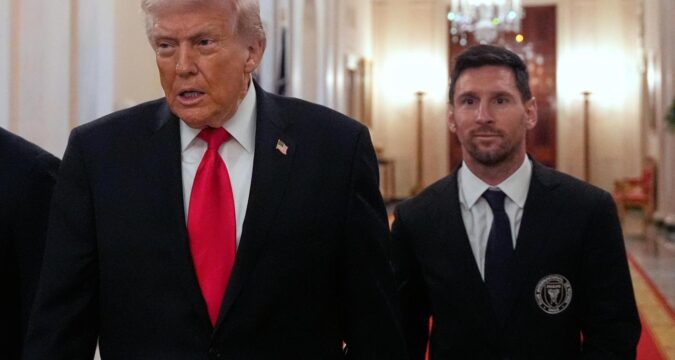
Lionel Messi has long steered clear of politics. Does his visit to Donald Trump’s White House mark a change?
BUENOS AIRES, Argentina — Assisted by a glittering, pink soccer ball, Lionel Messi crossed yet another frontier with his visit to the White House.
Until Thursday, the global soccer superstar had been equally adept at dodging defenders on the field and political leaders, especially those in his own country of Argentina. There were questions about whether he would even appear with the rest of Inter Miami to celebrate their MLS Cup win at the White House.
As the team assembled in the room, he wasn’t among their ranks; instead, he walked in alongside U.S. President Donald Trump and team owner Jorge Mas Santos and later presented Trump with the bedazzled ball.
Although Messi was silent throughout, his appearance seemed to speak volumes for a player whose politics have largely been shrouded in mystery.
When Argentina, captained by Messi, won the World Cup in 2022, the team declined to go to then-President Alberto Fernández’s Casa Rosada, or Pink House. Argentina’s current president — and Trump ally — Javier Milei has vocally praised Messi, but has yet to secure a public appearance or even photo together. A year ago, Messi was invited by then-U.S. President Joe Biden’s administration to be presented with the Presidential Medal of Freedom but could not attend because of a scheduling conflict.
Messi’s visit surprises some
In Argentina, the visit caused surprise and even dismay, particularly among those who appreciated the national team captain for not getting involved in politics, a trait that had distinguished him from his predecessor, Diego Maradona. (Some, though, thought his appearance could benefit Argentina as it gears up for its World Cup matches in the U.S.)
Kirk Bowman, a professor at Georgia Tech’s Sam Nunn School of International Affairs who studies soccer and politics in Latin America, isn’t surprised by Messi’s visit, though.
“He is very ‘long-termism’ in his career, both as a player but also as someone who has a very strong team building long-term wealth,” Bowman said, pointing to his myriad investments — including his equity in Inter Miami itself.
“He’s also embedded very strongly in Miami as a community, which is far more conservative as a soccer community than other parts of the United States,” Bowman added.
Messi stood to the side of Trump as the president offered comments on Iran, Cuba and Venezuela. At the end, the soccer star offered some applause. Messi’s supporters have defended him by saying he isn’t fluent in English, a perception Bowman says serves as “an extra layer of brand protection.”
Representatives for Inter Miami and Messi did not respond to The Associated Press’ requests for comment on the visit, though Inter Miami head coach Javier Mascherano was asked about it during a media availability Friday.
“I thought we would talk about football but I guess I’m not lucky. We were following the protocol that is practically a tradition for a team to visit the White House when it becomes champion,” Mascherano said.
He said the team spent a couple hours at the White House and that the “contact with Trump was what you saw on TV and not much more than that.”
Maradona, Barcelona, La Garganta Poderosa and … Saudi Arabia
The image of Messi with Trump led some fans to invoke the anti-American stance of the late Maradona, Argentina’s other great football idol. The captain of the 1986 World Cup-winning team was an active supporter of leaders like Fidel Castro and Hugo Chávez. He even had an image of the guerrilla fighter Ernesto “Che” Guevara tattooed on one of his arms.
Messi, by contrast, has stayed largely silent on issues in the various countries he’s lived in, whether Argentina, Spain, France or the United States. His career at FC Barcelona, spanning from his teen years to his exit in 2021, coincided with a politically charged period in Spain when Catalonia’s separatist movement seriously threatened to break off the northeastern region from the rest of the nation. Messi, however, steered clear of any political statements either for or against the independence push, which at its height divided Catalonia’s 5 million voters in half.
He deftly knew how to preserve his status as an idol of Barça’s divided fans, sticking to scoring goals and winning titles. He could be heard chanting “Visca Barça y visca Catalunya!” (“Long live Barça and long live Catalonia”) while celebrating a title, but the rallying cry was fairly standard for players and largely lacked political overtones.
He otherwise did not speak the local Catalan language but he only had nice things to say about the city he moved to when he was 13. In an interview with Catalan television channel Tv3 in 2024, Messi said that his “children are Catalans” and that “I feel like I am from Barcelona.”
Glimpses of some political leanings came in 2011 and 2020 interviews with La Garganta Poderosa, an Argentine magazine on the left. In the first interview, Messi spoke positively of Guevara, and in the latter, amid the coronavirus pandemic, he called inequality one of society’s most pressing problems.
Overall, though, it’s unlikely Messi will edge further into politics, Bowman says.
“I don’t think he’s really comfortable being political, but he’s not uncomfortable being used in politics as long as the net benefit is positive,” he said.
Bowman pointed to Messi’s commercial contract with Saudi Arabia’s tourism board and the “sportswashing” allegations that have followed. He also compared Messi’s approach with the kingdom’s typical “tarnish clause.”
“I think Messi is seen in the same way,” Bowman said. “He will participate in things as long as it doesn’t tarnish Brand Messi.”
Sen reported from New York. Associated Press journalists Joseph Wilson in Barcelona; Anne M. Peterson in Portland, Oregon; Davidde Corran in New York and Carlos Rodriguez in Mexico City contributed reporting.
https://www.chicagotribune.com/2026/03/06/lionel-messi-donald-trump-white-house/