
Category: News
La UE retrasa acuerdo de libre comercio con Mercosur, informa la Comisión Europea
La UE retrasa acuerdo de libre comercio con Mercosur, informa la Comisión Europea.

Lynwood man gets 30 years for dealing fentanyl
A federal judge sentenced a Lynwood, Illinois, man to 30 years on Wednesday for drug dealing.
Marco Sole, 52, pleaded guilty in September to distributing 40 grams or more of fentanyl, court filings show. He will also serve four years on supervised release after prison.
Assistant U.S. Attorney Michael Toth wrote Sole delivered nearly 50 grams of heroin cut with fentanyl worth $4,000 in June 2022. He was also involved in 14 other fentanyl deals in Indiana and Illinois.
The FBI raided Sole’s Chicago “stash house” on S. Bishop Street in September 2022, seizing fentanyl, nearly $1,800 in cash, five guns, ammunition and tools for making drugs. Prosecutors argued that Sole also mixed heroin with other substances, including p-flourofentanyl (a fentanyl analogue) and xylazine.
In court filings, defense lawyer Amir Mohabbat wrote he didn’t know the drugs “contained fentanyl” and denied running a trap (drug) house, saying it was an address he used to forward mail.
https://www.chicagotribune.com/2025/12/18/lynwood-man-gets-30-years-for-dealing-fentanyl/

WNBA players union authorizes negotiators to call a strike if needed during CBA talks
NEW YORK — WNBA players have authorized their union’s executive council to call a strike if necessary, the union announced Thursday as it continues to negotiate a collective bargaining agreement with the league.
The WNBPA and league have been negotiating a new agreement for the past few months, extending the deadline a couple of times with the latest one set to expire Jan. 9. The move gives union negotiators another tool to use in talks.
“The players’ decision is an unavoidable response to the state of negotiations with the WNBA and its teams,” the union said in a statement. “Time and again, the players’ thoughtful and reasonable approach has been met by the WNBA and its teams with a resistance to change and a recommitment to the draconian provisions that have unfairly restricted players for nearly three decades.”
The union said there was overwhelming support in the vote to allow the executive council to call for a strike when it sees fit. With 93% of players voting, 98% voted yes to authorize a strike if needed.
“The players’ vote is neither a call for an immediate strike nor an intention to pursue one. Rather, it is an emphatic affirmation of the players’ confidence in their leadership,” the statement said.
Players and owners have been meeting regularly to negotiate. Increased salaries and revenue sharing are two big areas that the sides aren’t close on.
The league offered a max salary that would have guaranteed a $1 million base, with projected revenue sharing pushing total earnings for max players to more than $1.2 million in 2026, a person familiar with the negotiations told The Associated Press. The person spoke to the AP on condition of anonymity Nov. 30 because of the sensitivity of the negotiations.
Napheesa Collier, who is on the executive council, said in a Zoom earlier this week that players are also fighting for child care and retirement benefits. She acknowledged that revenue sharing remains the main issue, which is why other topics haven’t been talked about as much.
“I don’t think there’s fatigue,” Collier said. “Obviously, there’s frustration in that both sides are trying to get what they want, but we still have that fire within us that we’re willing to do what it takes. We’re going to do whatever it takes to get what we think we deserve.”
Indiana Fever star Caitlin Clark said at USA Basketball camp last week that this was the “biggest moment in the history” of the league.
“It’s not something that can be messed up,” Clark said.
“We’re going to fight for everything we deserve, but at the same time we need to play basketball. That’s what our fans crave. You want the product on the floor. In the end of the day that’s how you’re marketable, that’s what the fans want to show up for.”
https://www.chicagotribune.com/2025/12/18/wnba-strike-cba-talks/

Has Orwell’s 1984 Become Reality?
Has Orwell’s 1984 Become Reality?
Authored by Bert Olivier via The Brownstone Institute,
To some readers it may seem like a rhetorical question to ask whether the narrative of George Orwell’s dystopian novel, Nineteen Eighty-Four (or 1984), first published in Britain in 1949, has somehow left its pages and settled, like an ominous miasma, over the contours of social reality. Yet, closer inspection – which means avoiding compromised mainstream news outlets – discloses a disquieting state of affairs.
Everywhere we look in Western countries, from the United Kingdom, through Europe to America (and even India, whose ‘Orwellian digital ID system’ was lavishly praised by British prime minister Keir Starmer recently), what meets the eye is a set of social conditions exhibiting varying stages of precisely the no-longer-fictional totalitarian state depicted by Orwell in 1984. Needless to stress, this constitutes a warning against totalitarianism with its unapologetic manipulation of information and mass surveillance.
I am by no means the first person to perceive the ominous contours of Orwell’s nightmarish vision taking shape before our very eyes. Back in 2023 Jack Watson did, too, when he wrote (among other things):
Thoughtcrime is another of Orwell’s conjectures that has come true. When I first read 1984, I would never have thought that this made up word would be taken seriously; nobody should have the right to ask what you are thinking. Obviously, nobody can read your mind and surely you could not be arrested simply for thinking? However, I was dead wrong. A woman was arrested recently for silently praying in her head and, extraordinarily, prosecutors were asked to provide evidence of her ‘thoughtcrime.’ Needless to say, they did not have any. But knowing that we can now be accused of, essentially, thinking the wrong thoughts is a worrying development. Freedom of speech is already under threat, but this goes beyond free speech. This is about free thought. Everybody should have a right to think what they want, and they should not feel obliged or forced to express certain beliefs or only think certain thoughts.
Most people would know that totalitarianism is not a desirable social or political set of circumstances. Even the word sounds ominous, but that is probably only to those who already know what it denotes. I have written on it before, in different contexts, but it is now more relevant than ever. We should remind ourselves what Orwell wrote in that uncannily premonitory novel.
Considering the rapidly expanding and intensifying, electronically mediated strategies of surveillance being implemented globally – no doubt aimed at inculcating in citizens a subliminal awareness that privacy is fast becoming but a distant memory – the following excerpt from Orwell’s text strikes one as disturbingly prophetic, considering the time it was written (1984, Free Planet e-book, p.5):
Behind Winston’s back the voice from the telescreen was still babbling away about pig-iron and the overfulfilment of the Ninth Three-Year Plan. The telescreen received and transmitted simultaneously. Any sound that Winston made, above the level of a very low whisper, would be picked up by it, moreover, so long as he remained within the field of vision which the metal plaque commanded, he could be seen as well as heard. There was of course no way of knowing whether you were being watched at any given moment. How often, or on what system, the Thought Police plugged in on any individual wire was guesswork. It was even conceivable that they watched everybody all the time. But at any rate they could plug in your wire whenever they wanted to. You had to live—did live, from habit that became instinct—in the assumption that every sound you made was overheard, and, except in darkness, every movement scrutinized.
Before adducing compelling instances of the contemporary, real-world surveillance equivalents of 1984’s ‘telescreen,’ which have become sufficiently ‘normal’ to be accepted without much in the form of protest, and to refresh your memory further, here’s Hannah Arendt, in The Origins of Totalitarianism (New edition, Harcourt, Brace Jovanovich 1979, p. 438):
Total domination, which strives to organize the infinite plurality and differentiation of human beings as if all of humanity were just one individual, is possible only if each and every person can be reduced to a never-changing identity of reactions, so that each of these bundles of reactions can be exchanged at random for any other. The problem is to fabricate something that does not exist, namely, a kind of human species resembling other animal species whose only ‘freedom’ would consist in ‘preserving the species.’
As Italian thinker Giorgio Agamben would say: totalitarianism reduces every singular human being to ‘bare life;’ nothing more, and after having been subjected to its mind-numbing techniques for a certain time, people start acting accordingly, as if they lack the capacity to manifest their natality (unique, singular birth) and plurality (the fact that all people are singular and irreplaceable). The final blow to our humanity comes when totalitarian rule’s coup de grȃce is delivered (Arendt 1979, quoting David Rousseton conditions in Nazi concentration camps,m p. 451):
The next decisive step in the preparation of living corpses is the murder of the moral person in man. This is done in the main by making martyrdom, for the first time in history, impossible: ‘How many people here still believe that a protest has even historic importance? This skepticism is the real masterpiece of the SS. Their great accomplishment. They have corrupted all human solidarity. Here the night has fallen on the future. When no witnesses are left, there can be no testimony. To demonstrate when death can no longer be postponed is an attempt to give death a meaning, to act beyond one’s own death. In order to be successful, a gesture must have social meaning…’
Surveying the present social scene globally against this backdrop yields interesting, albeit disturbing results. For example, Niamh Harris reports that German MEP Christine Anderson and British politician Nigel Farage have both warned that globalists are frantically trying to establish a fully fledged surveillance state ‘before too many people wake up’ to this state of affairs. Anderson – whose caution is echoed by Farage – points to the irony that people are waking up precisely because globalist efforts to hasten the installation of a totalitarian surveillance state are accelerating and becoming conspicuous. Hence, the more the process is ramped up, the louder critical voices become (and protests are likely to occur), and correlatively, the more anxious the neo-fascists become, to close the net around citizens of the world. She warns that:
‘Digital identity [is] not so your life is easier. It’s so government has total control over you.’
‘Digital currency [is] the crème de la crème of all control mechanisms…What do you think is going to happen the next time you refuse to take an mRNA shot? With the flip of a switch, they just cancel your account. You cannot buy food anymore. You cannot do anything anymore.’
Given these warnings, a case in point concerns well-known globalist Tony Blair’s recent attempt to assuage people’s fears about digital ID-systems. Needless to point out, his commendation of the system (because of its ‘amazing benefits’), in conjunction with AI and facial recognition capacity, is disingenuous in the extreme, as is palpably evident from his words (quoted from Wide Awake Media on X):
‘Facial recognition can now spot suspects in real time from live video…[It] helps identify suspects quickly in busy places like train stations and events.’ ‘AI will go even further—spotting crime patterns, guiding patrols and streamlining decisions…This is where technology, like digital ID, becomes critical.’
Wide Awake Media’s laconic comment on Blair’s words (alluding to the already dystopian surveillance practices in the United Kingdom) says it all: ‘Imagine this kind of system in the hands of a government that imprisons people for memes and jokes.’
It requires no genius to grasp that these examples of attempts at furthering the totalitarian agenda of complete surveillance, coupled with inescapable control mechanisms such as CBDCs, are rooted in the structural dynamics of the (no-longer-fictional) society of Big Brother, as evocatively depicted by Orwell more than 75 years ago. Except that – given the advent of the network society of electronically mediated actions and behaviour – such surveillance and control are at a level of efficiency and pervasiveness that Big Brother could only dream of. This is unmistakable when one peruses reports such as this one, which alerts one to the fact that, in Britain today, surveillance technology enables the neo-fascist authorities to identify, arrest, and imprison individuals for so-called ‘crimes’ which echo the thoughtcrimes of Orwell’s 1984, except that, by comparison, they seem trivial to the nth degree. As the article in question states,
Following a number of high-profile arrests for speech-related crimes, Britain is seen as far as the White House as a realm of tinpot, two-tier woke tyranny, where authors of errant tweets can expect to spend more time in prison than sex pests and paedophiles and which commentators and comedians should avoid — lest they be whisked straight from arrivals to a holding cell having offended Left-wing orthodoxies.
Lucy Connolly, a mother and childminder who received a 31-month prison sentence for ‘inciting racial hatred’ over a single (quickly deleted) tweet posted in the wake of the Southport Murders, is just one of many Brits that the state has pursued for such crimes in recent years. British police presently make 30 arrests per day for online speech offences, with many of these treated far more seriously than violent, sexual, or acquisitive crimes. Connolly’s was one of 44 convictions for ‘stirring up racial hatred’ last year…
Those, like Tony Blair, who are trying their best to justify surveillance as being ‘beneficial,’ even go as far as employing Orwell’s terminology to assuage the fears of the public who would be at the receiving end of such vaunted ‘protection.’ In this vein, in 2022 outgoing mayor of New York City, Eric Adams, was reported as claiming that:
Americans will learn to love the Chinese-style surveillance state, according to New York City Democrat Mayor Eric Adams who responded to criticism over increasing the use of facial recognition technology by declaring, ‘Big Brother is protecting you!’
Adams made the disturbing comments in response to elected officials who expressed concerns that using such technology is turning society into an authoritarian surveillance state.
Not everyone was enamoured of the mayor’s reassurance, however:
Albert Fox Cahn, the head of the Surveillance Technology Oversight Project, responded by warning that facial recognition technology would be weaponized to crack down on ‘every aspect of dissent’ in the city.
‘These are technologies that would be chilling in anyone’s hands. But to give an agency with such a horrifying record of surveillance abuse even more power, at a time when they face dwindling oversight, is a recipe for disaster,’ he said.
Part of the problem faced by freedom-loving citizens everywhere is the uncritical acceptance by many – although by no means all – people, that constantly changing technology is somehow self-justifying. It is not, as a simple thought-experiment confirms. If someone tells you that, compared to its 18th-century French Revolution precursor, today there is a much more efficient, ‘electronic guillotine’ available, which terminates a person’s life quickly, humanely, and painlessly, and could solve the overpopulation problem by euthanising people over 60 years of age, should you agree?
Of course not. For one thing, older people have the same right to life as anyone else, and many of one’s most productive, and enjoyable years come after 60. Hence, there is absolutely no ground for accepting or justifying new technology as ‘beneficial,’ simply because it is supposedly ‘more efficient.’
Yet, everyone of globalist persuasion seems to believe that, to persuade the ‘sheeple’ to enter the corral of digital imprisonment, all they need to do is to glorify the technology involved – lying through their teeth, of course. But lest I forget, according to the 1984 playbook, which all and sundry among the globalist neo-fascists seem to have adopted (stupidly believing that no one would notice), everything we have been taught in the world that preceded the attempt to establish their vaunted New World Order, has been turned on its head, so that ‘falsehood’ (lying) has now become ‘truth.’ If this sounds far-fetched, take a look at the globalists’ disingenuous pronouncements through the lens of 1984 (p. 6):
The Ministry of Truth—Minitrue, in Newspeak—was startlingly different from any other object in sight. It was an enormous pyramidal structure of glittering white concrete, soaring up, terrace after terrace, 300 metres into the air. From where Winston stood it was just possible to read, picked out on its white face in elegant lettering, the three slogans of the Party:
WAR IS PEACE
FREEDOM IS SLAVERY
IGNORANCE IS STRENGTH
The ‘Newspeak’ of today does exactly the same thing, as anyone who frequents the alternative media easily discovers.
Hence, if those among us who cherish our freedoms wish to preserve them, we had better be wide awake to any and all the continuing attempts to impose terminal limitations, or should I say, permanent termination, on them, all in the name of putative ‘benefits, safety, and convenience.’
If we don’t, we shall have only ourselves to blame if legislators of various stripes succeed in imposing them on us by stealth.
Tyler Durden
Thu, 12/18/2025 – 16:20
https://www.zerohedge.com/geopolitical/has-orwells-1984-become-reality
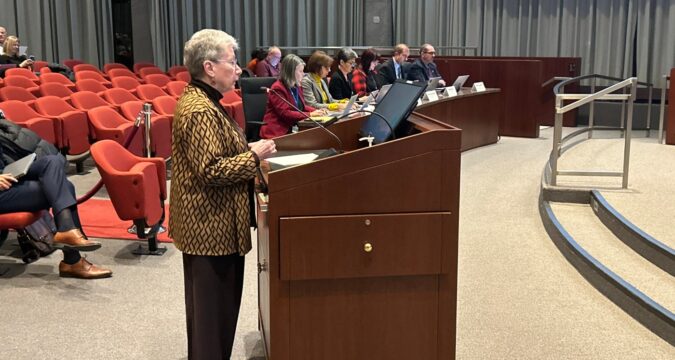
Naperville council says no to staff request to end public use of municipal center meeting rooms
The Naperville City Council has rejected a city staff recommendation to end the use of Municipal Center meeting rooms by non-governmental organizations and community groups.
Staff made the request out of concern for security as well as billing and reservation system challenges and a significant drop in room bookings, officials said.
“We have meetings that are occurring on evenings where we do not have city staff responsible for folks who are in the building,” said Marcie Schatz, assistant to the Naperville city manager.
A security guard at the entrance lets people in, Schatz said, but “it’s not a city employee who’s tracking the folks coming in, making sure that every person who has come in has left the building in case of an emergency in the building.”
The second issue stems from the city’s billing system, which Schatz said is a manual process that started 10 years ago and can be difficult to manage. City staff also use a calendar rather than a formal reservation system to book meeting rooms, which is burdensome, according to a city memo.
Beyond that, meeting room reservations have declined drastically, a change attributed to the impact of the COVID-19 pandemic. In 2015, about 900 room reservations were made annually by outside organizations but now the number is about 200, the memo said.
“This proposal does, unfortunately, kind of strike me as the latest in a series of changes which have the effect of making Naperville residents feel less welcome in the Municipal Center,” resident Tim Messer told the council at the meeting. “Doing things online is convenient, including having meetings, and it’s great to have that option, but it’s not and will never be a full replacement for in-person service.”
Local organizations also pushed back against the suggestion, arguing that the center’s meeting rooms are important to outside groups’ operations.
“We have really appreciated using the meeting rooms here at the Municipal Center, and especially every other month for our membership events, which are always at least 30 people and sometimes as many as 90,” said Jane Burke, speaking on behalf of Naperville Preservation Inc.
The most comparable rental room system is through Naperville Public Library, which offers “six larger meeting room options ranging in capacity from 40 to 150 people and conference room rentals for smaller meetings with capacity up to 15 people,” the city memo said. By comparison, the largest number of people for a meeting at the Municipal Center is about 100, according to the city website.
Other agencies that offer rental rooms include the Naperville Park District, Indian Prairie School District 204 and Naperville School District 203, the memo said.
But the reality is more complicated, according to Burke. Naperville Public Library’s booking system can be difficult to use and some of the other meeting room options noted in the city memo are in less accessible locations with fewer options for parking, she said.
“I’ve been on the board of Naperville Public Library for five years and, practically, I’ve seen how difficult it is to reserve a room there,” said Councilman Ashfaq Syed, recounting an experience from a few weeks ago where he struggled to book a room for a small community meeting.
Burke also emphasized that if the city improved its billing and reservation system, she believes meeting room use from outside groups would increase.
The Naperville Municipal Center opened in 1992. Since then, it’s been open for use by community groups.
“In my view, this is the people’s house,” said Councilman Ian Holzhauer, arguing that the public who funded the construction of the center with tax money should be able to host meetings in it.
Staff will report back at a future council meeting with solutions to keep meeting room rentals public while addressing concerns.
cstein@chicagotribune.com
https://www.chicagotribune.com/2025/12/18/naperville-council-meeting-rooms-center/

Mayor Brandon Johnson calls aldermen’s debt sale plan a ‘red line,’ yet mum on budget veto
Mayor Brandon Johnson on Thursday singled out a debt collection measure as his latest nonstarter in the budget proposal crafted by his aldermanic antagonists, who showed no signs of slowing their march toward an imminent final vote.
Following a City Council meeting where aldermen teed up their 2026 spending package for potential passage Saturday, the mayor told reporters it contains a major component he would not accept because it would hurt poor Chicagoans.
The plan to raise about $90 million by selling debt owed to the city would not only “result in debt collectors harassing residents who have fallen behind on some of their bills,” he said, but was completely speculative because there’s no guarantee there would be buyers.
“Yes. Yes. I mean, in very certain terms, yes,” Johnson said when asked if that part was a deal breaker. “I’m Gen X-er, right? There’s nothing more disturbing and troubling than someone inviting you on a road trip, and you don’t have a full tank of gas.”
But asked whether he would veto a budget that included the debt sale, the mayor demurred: “I’m saying that as long as that is the approach, then we have to keep talking and … working towards a reasonable compromise.”
“The means and the practices that they use in order to collect the debt are quite severe. And I know that firsthand,” said Johnson, who as a mayoral candidate drew scrutiny for owing more than $3,000 in water and sewer bills to the city before announcing he would pay them off during the runoff.
Mayor Brandon Johnson presides over a City Council meeting, Dec. 18, 2025. (Antonio Perez/Chicago Tribune)
Meanwhile, the group backing the alternative proposal rejected the mayor’s analysis and showed no signs of slowing down. Leaders of the aldermanic bloc said they have a council majority and expect to vote on their plan Saturday as the city gets closer to an end-of-year deadline.
“This coalition doesn’t need to play games,” Ald. Brendan Reilly, 42nd, toward reporters after the brief council meeting. “If the mayor chooses to veto this budget, that’s his decision, but he’s the one pushing us to the brink.”
And to justify the debt plan, Ald. Gilbert Villegas, 36th, said it will be up to Johnson to make sure the plan does not target poor people.
“We have billions of dollars of unpaid debt. The city government needs to make a decision. Are we going to collect this debt or not?” Villegas said. “There’s other people that can afford to pay that we haven’t targeted.”
In their plan, the city would sell $1 billion in long-uncollected debt owed to the city for $89.6 million. That high-dollar estimate makes the proposal the largest piece of the alternative group’s plan to balance the city’s budget. And it’s a striking contrast to Johnson’s proposed employee head tax on larger corporations, which he’s counting on to raise $82 million in a budget the council has apparently rejected.
Johnson’s team has repeatedly argued the novel tactic is untested and should not be relied upon in a budget, even though members of the administration reportedly explored the idea earlier this year. And if it were implemented, the “morally bankrupt” maneuver would lead to debt collectors aggressively targeting poor people and working-class people, the mayor said Thursday.
The debt collection controversy was the latest in a long-winding negotiation process over Chicago’s 2026 budget. Complicating this year’s budget fight for Johnson was his public threat of a mayoral veto last month after suffering a stinging loss in the Finance Committee over the head tax. He drew specific lines against a hike in property taxes or garbage fees, or a grocery bag levy.
The fracas could drag on even if a budget passes Saturday, according to Ald. Jason Ervin, a top Johnson ally who chairs the critical Budget Committee.
After Thursday’s meeting, Ervin said negotiations might need to continue beyond a vote in coming weeks to amend any spending plan because Johnson’s team still possesses broad discretion over how any new policies would be implemented. It was a nod toward a potential point of mayoral leverage as the alternative group tries to finally out-muscle Johnson.
“Without the buy-in of the executive branch, this is a setup for failure and that failure is going to impact our citizens,” Ervin said. “The executive branch does have the ability to not do things, and I think that’s the part of government that we sometimes don’t even think about.”
https://www.chicagotribune.com/2025/12/18/mayor-brandon-johnson-debt-sale-plan-mum-budget-veto/
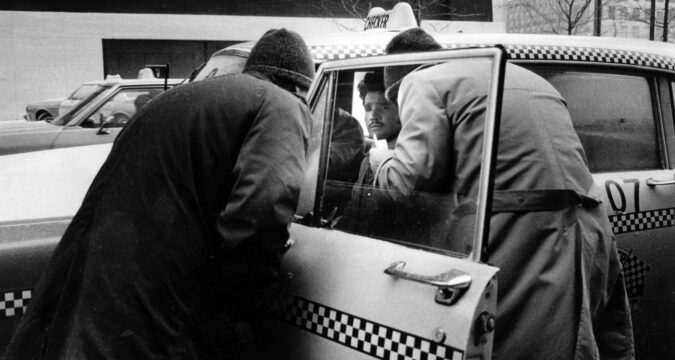
Vintage Chicago Tribune: Taxi drivers targeted in 1985 surprise immigration raids
Border Patrol Cmdr. Gregory Bovino and his agents returned to the Chicago area this week, targeting everyday working people as part of President Donald Trump’s immigration crackdown. Though recently released federal data shows that immigration agents booked roughly 1,900 immigrants in the first half of Operation Midway Blitz — two-thirds of them had no known criminal convictions or pending charges.
Landscapers, construction workers and even ride-share drivers at Chicago’s O’Hare International Airport have been arrested in the past few months. The Illinois Drivers Alliance — a labor coalition seeking to organize ride-share drivers — decried the raids, saying it was “deeply concerned that the drivers’ due process rights were violated.”
What to know about immigration enforcement raids in Chicago
Taxi drivers were also the focus of surprise immigration raids in Chicago 40 years ago. January 1985 began with the city assisting the U.S. Immigration and Naturalization Service in its efforts to arrest migrants who were working behind the wheel but lacked permanent legal status. Several months later, however, Mayor Harold Washington declared the city would no longer participate in INS activities — a standard that remains in effect today.
Chicago’s INS Director Alvin Douglas (A.D.) Moyer continued to target taxi drivers — whose country of origin was listed on their cab license applications. More than 100 cabdrivers were taken into custody as part of a Dec. 17, 1985, effort Moyer called Operation Taxicab.
A sweeping 1986 immigration act signed by President Ronald Reagan introduced a pathway for temporary legal residency for anyone who had been in the U.S. since 1982. The legislation, however, also gave the federal government the power to penalize employers who knowingly hired people who entered the country illegally. Locally, it also led to the opening of the Broadview detention center.
Desperately needed taxi industry reforms were finally introduced in 1990 — along with higher fares.
Here’s a look back at pivotal moments in immigration during the mid- to late-1980s.
January 1985
A taxi sloshes through high water at Lake Shore Drive and Ohio Street on Dec. 2, 1982, in Chicago. (Phil Greer/Chicago Tribune)
The city at first cooperated with immigration officials in a crackdown on immigrants living in the United States without permanent legal status who had obtained licenses to drive taxis in Chicago. Federal authorities used taxicab license applications to find these drivers.
One week later, however, corporation counsel James Montgomery recommended Chicago no longer assist INS authorities in arresting immigrants unless subpoenas were obtained.
Moyer criticized Montgomery’s suggestion.
March 7, 1985
Mayor Harold Washington raises his hand as he talks about signing an executive order to assure that all residents of Chicago, regardless of nationality or citizenship, shall have fair and equal access to municipal benefits, opportunities and services, on March 7, 1985. With Washington is his Latino Advisory Commission, including Jesús “Chuy” García, third from right in background. (Carl Hugare/Chicago Tribune)
Mayor Harold Washington signed an executive order that halted the city’s cooperation with federal immigration authorities and ended the city’s practice of asking job and license applicants about their citizenship status. Washington said citizenship questions would be asked only on applications for jobs or positions that were federally funded.
Though Nigerians made up the majority of people initially arrested in the taxicab investigation, the Hispanic community pressed Washington’s administration for policy changes because of harassment complaints.
May 21, 1985
The Department of Consumer Services displays taxicab medallions (licenses) on Jan. 28, 1976. (Roy Hall/Chicago Tribune)
Five people — including three employees of the Chicago Department of Consumer Services — were indicted by a federal grand jury on charges of accepting bribes of $350 to $600 to issue chauffeur’s licenses to immigrants living in the U.S. without permanent legal status.
The indictments outlined a scheme of payoffs, forged documents, cheating on tests and improper granting of licenses to 24 people — many of whom wanted to become cabdrivers. Three of the five people indicted were sentenced in December 1985, to three years’ probation and 300 hours of community service.
Ironically, Moyer said it was Jesse Madison — commissioner of the Department of Consumer Services — who asked immigration authorities to look into cab licenses. Moyer said Madison had received numerous complaints about taxi drivers who could not find prominent locations and could not speak English.
After the announcement of the indictments, Madison said the city’s system for issuing chauffeur’s licenses was under review.
Dec. 17, 1985
An abandoned taxi is prepared to be towed away from the Merchandise Mart, 222 Merchandise Mart Plaza, Chicago, on Dec. 17, 1985. An early-morning raid on cabdrivers conducted by federal immigration authorities called Operation Taxicab resulted in the arrests of 15 people at the building’s taxi stand. (Ernie Cox Jr./Chicago Tribune)
Federal authorities — in their bid to rid Chicago of what they called “a serious menace” — conducted Operation Taxicab. Cabbies were asked to provide proof of citizenship when stopped by immigration officials at O’Hare, Midway, the Merchandise Mart and downtown hotels.
In all, 129 drivers were arrested. They came from 22 countries, but none was Hispanic. Sixty-eight drivers were unable to prove they were legal residents, according to the INS. But the Washington administration said 86 were living in the U.S. legally. Twenty-eight were released after posting $2,000 bonds. Abandoned cabs littered downtown.
“These people are raising havoc with the city,” Moyer said. “They are a nuisance. They are abusing passengers, taking them to the wrong locations and overcharging them. And they are taking jobs away from American citizens and legal foreign residents.”
“A downright fabrication,” said Jeffrey Feldman, president of Yellow Cab Co. “If Americans want to become taxi drivers so badly, why do I have to advertise in the newspapers? Or put signs on my cars or on bus stop benches?”
Of the 11,000 licensed cab operators in Chicago at the time, Moyer estimated 600 of them were immigrants living in the the U.S. without permanent legal status.
There was, however, no federal law prohibiting employers from hiring these immigrants.
“They’re hurting innocent people,” Feldman said. “I had one driver who was stopped three times. It’s just plan harassment.”
Moyer said his department planned to make weekly raids of 30 to 40 people to “clean up the industry.” Another 47 cabbies were arrested in early January 1986.
Dec. 18, 1985
A stack of complaints against Chicago taxi drivers on May 7, 1986. (José Moré/Chicago Tribune)
City officials — who garnered an average of 170 complaints from cab passengers per week — conceded the written test for cabdrivers did not establish that an applicant knows the city’s geography, speaks English or understands the city’s rules and regulations governing cabs.
At least one of the tests administered to applicants seeking a chauffeur’s license contained a question regarding the location of a Chicago restaurant that had closed five years prior, acknowledged Tony Olivieri, deputy commissioner of the Department of Consumer Services.
The city revoked the licenses of just two cabdrivers in the previous two years for rule or safety violations.
Nov. 6, 1986
President Ronald Reagan signed into law the Immigration Reform and Control Act of 1986, which provided a provision that enabled people living in the U.S. without permanent legal status since before Jan. 1, 1982, to apply to obtain temporary legal residency. After 18 months, that status could be converted to permanent residency for those who could demonstrate an understanding of English, U.S. history and government.
Reagan said the new law will “go far to improve the lives of a class of individuals who now must hide in the shadows, without access to any of the benefits of a free and open society.”
The sweeping reform act, however, also included tough penalties for employers who hire workers without regard to their immigration status.
May 5, 1987
People wait in line outside the Mexican Consulate at 141 W. Ohio St. to get help in securing birth certificates and other documents to use in applying for legal residency in the United States on May 5, 1987, in Chicago. (Phil Greer/Chicago Tribune)
INS began accepting applications at four centers for temporary legal residency. It was estimated that almost 4 million immigrants were expected to qualify for the landmark program — including 300,000 in the Chicago area. The cost to apply was $185 per adult and $50 per child, with a maximum fee of $420 per family.
Several months into the program, only 19,000 people in the area had applied, which was fewer than expected. Potential applicants had many questions. INS — which called the program a “success” — and immigration reform groups blamed each other for the lack of communication.
The growing crowd inside the INS offices at 3119 N. Pulaski Road reflects the now-or-never atmosphere during the last hours in which immigrants could apply for legalization on May 4, 1988, in Chicago. (Phil Greer/Chicago Tribune)
The last applications were accepted on May 4, 1988. Thousands of Chicagoans put fear aside to submit their applications before the deadline, which was later extended until May 4, 1989. Still, advocacy groups said the new immigration law needed to cover more people and make the application process easier.
An estimated 1.5 million people — including about 100,000 from the Chicago area — applied.
Aug. 10, 1987
Javier Nava, who entered the United States illegally from Mexico in 1976, displays the temporary residence card he received on Aug. 10, 1987, while at Forest Park Mall, 7600 W. Roosevelt Road, in Forest Park. Nava was the first Chicago-area resident to receive the status as part of a nationwide program. (José Moré/Chicago Tribune)
Mexican immigrant Javier Nava became the first Chicago-area resident to obtain temporary residency as part of the program and was given a Social Security card from immigration officials.
In November 1988, Alejandro García and his family became the first Chicago-area family to gain permanent residency.
Oct. 19, 1987
Detention officer Joe Kolb processes a Yugoslavian immigrant who was arrested entering the country illegally, at the new Broadview detention facility on Oct. 30, 1987. (Guy Bona/Chicago Tribune)
“After six months of emphasizing the carrot in its new immigration policy, the U.S. Immigration and Naturalization Service has begun to unveil the stick,” Tribune reporters Constanza Montaña and Cheryl Devall wrote.
A detention center for immigrants — with no overnight accommodations — was opened in an industrial park in Broadview. The facility was designed to hold up to 200 people rounded up in raids on area businesses. People could then be shuttled to O’Hare International Airport for deportation.
Detention officer James Gibson, left, and Assistant District Director Roger Piper work in the radio room of the U.S. Immigration and Naturalization Service’s new lockup in Broadview on Oct. 30, 1987. (Guy Bona/Chicago Tribune)
“We’re very proud of this,” said Roger Piper, assistant district director for INS, during a tour of the facility, where detainees would be kept in large, glassed-in rooms equipped with indestructible plastic chairs, stainless steel toilets and telephones.
April 28, 1988
Maximino Carrasco proudly shows off the work permit he just received from the legalization offices at 3119 N. Pulaski Road in Chicago on April 4, 1988. (José Moré/Chicago Tribune)
Molon Motor and Coil Corp. became the first Chicago-area employer to be fined by INS for hiring immigrant workers without permanent legal status in violation of the 1986 federal immigration law. The Rolling Meadows manufacturer was fined $41,000 (or about $113,000 in today’s dollars).
May 1989
U.S. Immigration and Naturalization Service Chicago District Director A.D. Moyer, left, prepares to appear on a Spanish-language television show with Connie Lara, an INS attorney, on May 25, 1990, at WSNS-Ch. 44 TV studios, 430 W. Grant Place, Chicago. (Carl Wagner/Chicago Tribune)
When television station WSNS-Ch. 44 announced plans to give Moyer its inaugural Hispanidad award, many questioned why the local INS director should be given the honor. Moyer had been criticized for opening a detention center at Broadview during a time when the immigration agency was supposedly encouraging immigrants to apply for amnesty.
Yet Moyer, who remained INS director until the mid-1990s, was also beloved by others. He had his own weekly column in a local newspaper, often appeared on Spanish-language radio and his Spanish-language TV program “Linea Abierta” had been nominated twice for Chicago Emmy awards. The Tribune called him “an international celebrity.”
Feb. 7, 1990
Cabdrivers march in front of City Hall on Feb. 7, 1990, as the City Council overhauled cab regulations and increased taxi rates by 30% in Chicago. (Karen Engstrom/Chicago Tribune)
City Council approved a major overhaul on cab regulations that were designed to impose penalties on abusive drivers, improve driver proficiency and upgrade cab safety. The ordinance also brought the city’s first taxi rate increases — of roughly 30% — since 1981. The rate increases went into effect on March 9, 1990.
In response to the rate increase, Chicago cab companies raised the lease rates cabdrivers paid — leaving them no better off financially.
Want more vintage Chicago?
Become a Tribune subscriber: It’s just $1 for a 1-year digital subscription.
Thanks for reading!
Subscribe to the free Vintage Chicago Tribune newsletter, join our Chicagoland history Facebook group, stay current with Today in Chicago History and follow us on Instagram for more from Chicago’s past.
Have an idea for Vintage Chicago Tribune? Share it with Kori Rumore at krumore@chicagotribune.com.
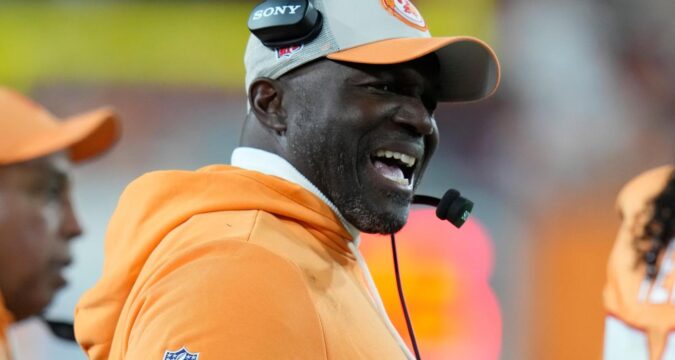
Bowles asegura que sus jugadores entendieron el mensaje tras la derrota de los Bucs
Por ROB MAADDI
TAMPA, Florida, EE.UU. (AP) — Todd Bowles transmitió un mensaje a su equipo con una reacción inusualmente cargada de palabras altisonantes durante una conferencia de prensa posterior al partido, después de que los Buccaneers de Tampa Bay desperdiciaran una ventaja de 14 puntos en el último cuarto la semana pasada.
Si tendrá impacto en el rendimiento del equipo se sabrá el domingo.
Los Buccaneers (7-7) han perdido cinco de seis duelos y seis de ocho antes del enfrentamiento por el primer lugar en la NFC Sur contra los Panthers de Carolina (7-7).
“La responsabilidad podría ser hacer las pequeñas cosas bien, podría ser compañeros hablando entre sí, tú hablando contigo mismo, entrenadores hablando entre sí. Entendimos el mensaje después del partido”, aseguró Bowles el miércoles. “Nos reunimos, hablamos sobre ello, lo sacamos de nuestro sistema. Todos están trabajando arduamente y tratando de hacer lo correcto para ganar el partido”.
Bowles arremetió contra su equipo directamente y en la conferencia de prensa después de que los Bucs desperdiciaran una ventaja de 28-14 y perdieran 29-28 el jueves ante los Falcons de Atlanta.
“Recibieron el mensaje”, dijo. “Es fútbol, chicos. No sé. Probablemente se han escrito mil millones de historias cuando los entrenadores han perdido y se han enfadado y han dicho algo a sus muchachos. No es un problema. Estamos bien”.
Técnicamente, los Bucs no tienen que ganar el domingo en el primero de dos encuentros en las próximas tres semanas contra los Panthers. Asegurarán su quinto título de división consecutivo con dos victorias en los últimos tres juegos. O, asegurarían con una victoria en dos juegos contra los Panthers si Carolina también pierde ante Seattle la próxima semana.
“Vas a perder algunos juegos en esta liga. Todos hemos perdido algunos a lo largo de nuestras vidas. No te gusta ese día, pero te levantas al día siguiente, bajas la cabeza, vas a trabajar, intentas corregir las pequeñas cosas y sigues adelante”, aseguró el entrenador. “No lo retienes ni lo haces más difícil de lo que tiene que ser. Es un juego de fútbol”.
Los Bucs comenzaron con marca de 5-1 y estaban 6-2 en su semana de descanso. Pero han perdido contra los Patriots, Bills, Rams, Saints y Falcons desde que regresaron. Su única victoria fue un 20-17 contra los Cardinals.
Bowles cuestionó si algunos jugadores se preocupan lo suficiente después de la derrota ante los Falcons. El mariscal de campo Baker Mayfield también ha llamado la atención a sus compañeros anteriormente y el tackle izquierdo All-Pro Tristan Wirfs esperaba que los jugadores “rumiaran” sobre la derrota ante Atlanta durante un mini-descanso el fin de semana pasado.
Aun así, los jugadores no están señalando con el dedo directamente.
“El señalamiento con el dedo solo ocurre si tienes una mala cultura en el edificio. Ese no es un problema con el que tengamos que lidiar”, dijo Mayfield. “Nos reunimos el lunes con la ofensiva, y les dije lo que dije en la conferencia de prensa posterior al partido. Dije que es mi responsabilidad, es de este grupo, espero que podamos anotar más de 28 (puntos) en una situación como esa y poner el juego fuera de alcance. Simplemente lo cortas de raíz desde el principio”.
___
Deportes AP: https://apnews.com/hub/deportes
Editorial: Leverage-obsessed Chicago Bears do their best to squelch the good seasonal vibes
Just as a long-suffering Chicago was feeling great about its 10-4 Bears and bulk-buying Old Style and eggnog for the most important Bears-Green Bay Packers game in a decade, along comes that grinch Kevin Warren to remind us that the city’s love affair with its NFL franchise is a one-way chimney and the Bears aren’t going to make like Santa Baby and slip a sable under any fan’s tree.
No siree. They want the mink, the yacht and the ring, all for themselves.
In what surely must have been the most ill-timed letter to season ticket holders in the history of ill-timed letters to season ticket holders, the president of the organization kindly informed us all that the team was not just playing Chicago and Arlington Heights against one another, as we have thought all these months, but also now seriously considering an additional wild card, making it a menage a trois.
Northwest Indiana is the lucky newcomer. Maybe a stadium could land right next to the Horseshoe Casino in Hammond. Or in Gary. Let’s not forget about Gary.
The Bears previously said that Arlington Heights was the only location in Cook County that “meets the requirements for a world-class NFL stadium.” Now it adds that maybe such a location also exists in Lake County, Indiana. Who knew?
Indiana officials did their job and used the Bears’ December folly to praise their own pro-business climate and exude excitement, but underneath all those quotes about doing whatever it takes to land the Bears for Indiana, a careful reader could detect a note of cynicism. Even the Hoosiers didn’t fully believe this was genuine; Garyland has been a bridesmaid too many times for that.
Now, Mr. Warren, you have irritated the Illinois governor you are going to need if you want to get anything out of the public purse for Arlington Heights, or if you want to hope for even a modicum of help with that pesky Soldier Field lease.
No doubt Gov. JB Pritzker is thinking twice about drawing up a chair next to a TV Saturday night and cheering with the rest of us. “Suggesting the Bears would move to Indiana is a startling slap in the face to all the beloved and loyal fans who have been rallying around the team during this strong season,” Pritzker spokesman Matt Hill told the Tribune.
State Rep. Kam Buckner (you’ll need him too, Mr. Warren) didn’t want to get left out of the scorn-o-rama. “I don’t disagree with part of the Bears’ assessment,” he tweeted. “It’s true that public dollars for a new stadium has not been a legislative priority. That’s because giving public money to a professional sports franchise doesn’t crack the top 100 things the people of Illinois are asking for, expecting, or willing to tolerate right now.”
He even later added, “Beat Green Bay!,” just to make clear he attached no blame to players or fans. Nice work, Rep. Buckner.
Of all the self-serving blather in Warren’s letter, including the use of the phrase “legislative partnership” to mean “legislative handout,” our biggest laugh came when we got to a statement that would not land any kid on Santa’s nice-and-truthful list: “this is not about leverage.”
Here’s a pro tip from your friendly editorial board, dear reader. Whenever someone insists it is not about leverage, you can be sure it is about leverage.
In this case, logic nixes any other potential explanation. If it were not about leverage, the Bears would negotiate with one potential locale at a time, explore the options, try to make their best deal in the moment and then either strike said likely imperfect deal or stomach the risk that the next deal will be worse, and move on elsewhere. Bears fans have to do this all the time in their actual lives. But not their team. Not an organization that prefers to make public threats. We don’t care if Warren was trying to get ahead of his own story with his letter; the timing is the timing, and it was lousy.
Now, it’s true that New Yorkers cross state lines to watch football, and so the Bears are under no obligation to Illinois. Indeed, Hammond is closer to Soldier Field than Arlington Heights and northwest Indiana is both a legitimate part of our metro area and long where Chicagoans have to gone to place their sports bets. Lake County, Indiana, also could use an economic boost, and there are train lines leading to Hammond and Gary. The Bears are of course a private business and it’s rightly their call where they choose to build their stadium on their dime.
We’ll just reiterate our long-held position. We’re in favor of a reasonable infrastructure package from the public purse, reflecting the economic benefit of a new stadium, just as long as the team does not twist the word “infrastructure” into a backdoor way to get a subsidized stadium and just as long as the Bears honor their commitments to Soldier Field. And they deserve “property tax certainty,” if and when you get that too for your home or commercial building, dear reader.
All that said, this time it feels like Warren and his organization have overplayed their hand by flirting with yet another potential location, this one in a different state. Their targets are reacting like the goalposts have been moved one too many times, and understandably so. Warren should have recognized that the team’s fans want, and deserve, to focus on the big game at hand, not these torturous and frequently disingenuous stadium negotiations.
Take a break for the holidays with all that stadium stuff, man, and come back after you win the Super Bowl.
Submit a letter, of no more than 400 words, to the editor here or email letters@chicagotribune.com.
Kane state’s attorney confirms she’s investigating Elgin ICE complaints
Kane County prosecutors are investigating complaints against U.S. Immigration and Customs Enforcement agents resulting from a Dec. 6 operation in Elgin in which people were allegedly pepper-sprayed and assaulted, State’s Attorney Jamie Mosser confirmed Thursday.
Elgin police received more than 50 calls that day, with 11 police reports generated because of a crash involving ICE agents and a man they were trying to take into custody and during a barricade situation in which the man held agents at bay while inside a Maple Lane apartment, officials said.
In a statement issued by Mosser, she said “my office has been asked to review the matter for possible criminal charges. As the state’s attorney, I have a legal duty to prosecute all violations of state criminal law occurring within Kane County.”
Elgin police refute ICE claims that ‘bottles and rocks’ were thrown during weekend standoff
Mosser said no other information was available for public release.
No arrests were made because of the incident other then for the man being taken into custody by federal agents following the barricade incident.
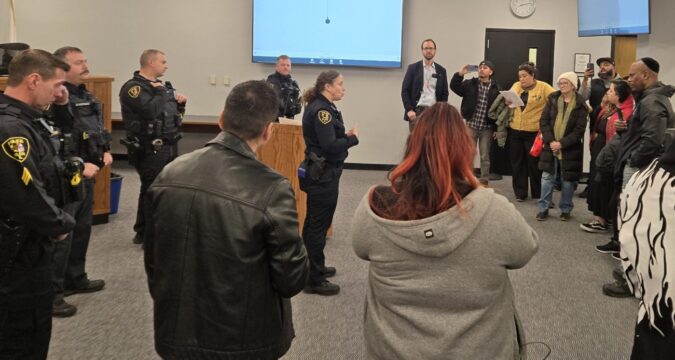
Elgin Police Chief Ana Lalley updated the Elgin City Council on the status of her department’s investigation into the incidents at its Wednesday night meeting. She urged anyone in the public with more information or video to contact the police.
“The department and I remain committed to our community,” Lalley said. “I know these words may not provide comfort to some people or an outcome they may want. It is still very important to me that the Elgin community hear this from me.”
Immigration advocates and residents have questioned Elgin police officers’ actions that day, alleging that no one helped protestors when ICE agents allegedly interacted physically with people and threw chemical irritants at the crowd.
Community members and federal agents face off during a standoff along Maple Lane in Elgin on Dec. 6, 2025. (Stacey Wescott/Chicago Tribune)
People who attended the council meeting to publicly complain twice disrupted the session by chanting “No justice, no peace” and “Who do you protect? Who do you serve?” The second incident resulted in the audience being removed from the council chambers.
Among those in attendance was Delani Hernandez, who said an ICE agent shot pepper spray into her brother’s face at the Dec. 6 event.
“I’m very scared, hopeless, frustrated and, to be quite honest with you, mad,” she said. “I am seeing my community under attack by ICE agents running wild in the streets, our streets.
“We are not just people who live here. We are people who try to make this city better,” said Hernandez, who noted that both she and her brother volunteer at an Elgin soup kitchen.
She saw people being attacked “simply because of the color of our skin, because we are brown,” Hernandez said. “At this time, we don’t feel safe. We don’t feel heard. We don’t feel protected.”
Angel Manuel Martinez said he received a fractured rib during the incident, forcing him to take two weeks off from work without pay.
“On Dec. 6, the city of Elgin and this leadership failed us,” Martinez said. “Our kids are asking us, ‘Are you coming home today?’ Our kids are asking us, ‘Is it going to be you today?’”
Mayor Dave Kaptain called for a 10-minute meeting recess during the second disruption. Lalley, who had left the meeting after her report, returned with five officers so she could speak to the protestors.
One woman told the chief that she had called 911 after being pepper-sprayed three times and assaulted by ICE agents. She wanted police to document what happened because she was afraid.
“(The officers she spoke to) just walked away. They said they couldn’t interfere,” the woman said.
Lalley, who was often shouted down while she tried to speak, persisted in her effort to address the crowd.
“If what you guys want to do is just express your frustration, I’m more than happy to stand here and listen,” Lalley said.
But she also stressed that local police officers are prohibited from interfering with federal immigration enforcement due to the state’s TRUST Act.
“We did what was within the law,” Lalley said. “It doesn’t mean we don’t care. There are some things we can’t do.”
EPD officers did respond to 911 calls and helped provide medical assistance to people affected by the pepper spray, she said.
They’ve also viewed police body camera video and social media accounts in an effort to determine what happened and if crimes occurred. The department’s preliminary findings to ICE charges that bystanders threw bottles and rocks at agents was that there was no evidence so far to support the claims, according to a statement issued by police last week.
David Morgan, a member of One People’s Project who has a TikTok account called MoModerate, live-streamed the scene and said ICE violated local and national laws.
“You guys have to wake up to the fact of where we are at,” Morgan said. “This Republican Party, this (expletive) administration does not plan to fail. They are going all the way. They are going to do everything they can to subjugate and eradicate a group of people who don’t (expletive) deserve it.”
“Historically, this does not end well,” Morgan said.
“I hear you, sir,” Lalley said.
On Thursday, the chief said the city plans to hold a town hall meeting about ICE enforcement efforts in Elgin.
Gloria Casas is a freelance reporter for The Courier-News.
https://www.chicagotribune.com/2025/12/18/elgin-kane-investigation-ice-agents/



