Category: News

Environmental groups file lawsuit to stop coke oven pollution exemptions
On Monday, multiple organizations filed a lawsuit challenging exemptions from President Donald Trump’s administration that would allow coke ovens to spew chemicals that lead to hazardous air pollution.
Involved organizations include the Environmental Law and Policy Center, EarthJustice, Just Transition Northwest Indiana, Hoosier Environmental Council and Sierra Club.
“This latest proclamation for coke ovens continues the Trump administration’s year-long practice of undermining industry’s compliance with toxic air pollutant standards by issuing meritless exemptions and delays,” Brian Lynk, senior attorney at the Environmental Law and Policy Center, said in a news release. “The communities who live with these plants and depend on clean and healthy air, in Northwest Indiana and around the country, deserve better.”
Coke ovens are used in steelmaking, heating coal to produce coke, which is used as a fuel. The ovens are a “major source of hazardous pollution,” according to the Environmental Law and Policy Center, which includes toxic chemicals and metals, including lead, mercury and benzene.
In November, Trump issued a proclamation providing regulatory relief for coke ovens nationwide, according to the White House, claiming that a U.S. Environmental Protection Agency coke oven rule places “severe burdens on the coke production industry” and affects American infrastructure, defense and national security.
“Many of the testing and monitoring requirements outlined in the coke oven rule rely on technologies that are not practically available, not demonstrated at the necessary scale, or cannot be implemented safely or consistently under real-world conditions,” the proclamation said. “Due to the coke oven rule’s onerous implementation and compliance schedule for these standards, many coke production facilities are in the impossible position of designing and engineering novel systems with unproven technology within a short time frame.”
It allows a two-year exemption to the coke oven rule because Trump claimed the technology doesn’t exist commercially and cannot allow corporations to comply with the rule. The Environmental Law and Policy Center claims that the exemption applied to more than 180 facilities across six industries.
“The Trump administration is delivering another tough blow to local communities,” Tosh Sagar, senior attorney at EarthJustice, said in a news release. “These unlawful exemptions have real consequences for real people. While people living near these toxic coke oven facilities are breathing in poison every day, corporate polluters get another pass. Corporate profits should not come at the expense of public health.”
According to the Environmental Law and Policy Center, the EPA finalized revisions to the Clean Air Act that introduced the 2024 coke ovens rule, which “introduced a fenceline monitoring requirement, stricter limits on leaks from coke oven battery doors, lids and offtakes, and new emission standards for several hazardous air pollutants.”
Compliance deadlines were staggered between July 2025 and January 2026.
“Communities living near steel industry coke ovens advocated for many years for common-sense federal regulations to protect them from hazardous air pollution,” Haley Lewis, senior attorney for the Environmental Integrity Project, said in a news release. “The EPA’s 2024 rule requiring air monitoring and cleanup of dangerous levels of pollution from coke ovens would have provided meaningful improvements, had President Trump not granted an exemption last month. This exemption should be thrown out by the courts for the sake of the health of all the workers and families living near the industry.”

23-year-old fatally wounded overnight in Uptown neighborhood
A 23-year-old man was fatally wounded overnight in the Uptown neighborhood on the North Side, Chicago police said.
About 4 a.m., officers responded to a call of someone wounded in the 5100 block of North Sheridan Road where they found a victim lying on the ground with a gunshot wound to the head. He was pronounced dead at the scene.
A witness told officers they saw a vehicle fleeing the scene, police said.
No one was in custody for the fatal shooting and detectives were investigating.
https://www.chicagotribune.com/2025/12/27/gun-violence-uptown/

Don’t Travel To ‘Lawless’ Germany, Russia Tells Citizens
Don’t Travel To ‘Lawless’ Germany, Russia Tells Citizens
Russia has taken the very rare step of warning its citizens from traveling to leading EU member Germany, describing that Russians have increasingly been targeted for persecution and harassment based on ethno-nationalism.
On Thursday Foreign Ministry spokeswoman Maria Zakharova cited recent repeat instances of “unjustified harassment” by German state authorities, under the pretext of EU sanctions imposed related to the Ukraine war.
A once busy destination, the Kremlin is now telling all Russians to avoid traveling to Germany unless absolutely necessary, based especially on the policy of German customs officials going so far as to seize personal use items from Russian citizens as they leave the country.
Zakharova described that even purchases worth merely more than about €353 are affected. She said that people are being “robbed in broad daylight,” by customs officials, and are often missing their fights due to harassment by officials at airports.
She mentioned examples of high profile individuals related to Russian soccer teams being harassed, and further described:
Germany has been “de facto transformed into a ‘lawless territory’ for people of a certain nationality – in this case, people from Russia… The German law enforcement officers have become punishers, pursuing Russians with maniacal persistence. They bully them and do not even hide this fact.”
She said that this is on the level of violation of rights…
“In the context of the escalating confrontation… we urge you to refrain from traveling to the United States and its allied states, including primarily Canada and European Union countries—specifically Germany—during these holidays,” Zakharova stated.
Germany has been a leading country transforming itself from dove to hawk in the wake of the Russia-Ukraine war, and its massive ramping up in defense spending reflects this.
💬 #Zaharova: In Germany, unjustified persecution of Russian citizens and compatriots by government officials continues.
❗️ We strongly urge our citizens to refrain from traveling to Germany. pic.twitter.com/bEqZ6JLXDv
— MFA Russia 🇷🇺 (@mfa_russia) December 25, 2025
There’s even lately been talk of instituting a draft and greatly expanding troop numbers. All of this is happening as diplomacy takes a far backseat, but there have been recent signs Berlin is being forced to soften its approach.
Tyler Durden
Sat, 12/27/2025 – 08:45
https://www.zerohedge.com/geopolitical/dont-travel-lawless-germany-russia-tells-citizens

Turkey Makes Another $9 Billion Bet On Russian Nuclear Power
Turkey Makes Another $9 Billion Bet On Russian Nuclear Power
Authored by Julianne Geiger via OilPrice.com,
Turkey just took another very large, very deliberate step deeper into Russia’s energy orbit — and this time it comes with a $9 billion price tag.
Ankara says that Russia has provided $9 billion in new financing for the Akkuyu nuclear power plant, Turkey’s first-ever nuclear facility, which is being built by Russia’s state-owned Rosatom on the Mediterranean coast. According to Energy Minister Alparslan Bayraktar, the bulk of that money will be deployed in 2026 and 2027, with as much as $4–5 billion flowing next year alone. The plant is now expected to come online in 2026, after multiple delays.
While this may look like a straightforward infrastructure update, it’s more about how deeply intertwined Turkish and Russian energy interests remain, despite years of flowery talk about diversification and reduced dependence on Moscow.
Akkuyu has always been different from Turkey’s other energy ambitions. It is a build-own-operate project. This means that Rosatom shoulders the financial risk, owns the plant, and will operate it for decades. That structure is precisely why Akkuyu survived when Turkey’s second nuclear project at Sinop collapsed under runaway costs and political complexity. Only Russia stayed.
What makes the timing interesting is that this financing lands just as Turkey is loudly advertising its renewable credentials. The country’s installed renewable capacity has surged to roughly 74 gigawatts, solar capacity has doubled in under three years, and Ankara says wind and solar have helped avoid $15 billion in natural gas imports since 2022. Turkey has also set a 2053 net-zero target and is negotiating massive new solar projects, including a 5-gigawatt package with Saudi Arabia’s ACWA Power.
Yet nuclear sits outside that clean-energy narrative. Akkuyu alone is expected to supply roughly 10 percent of Turkey’s electricity demand once fully operational. It reduces gas imports, stabilizes baseload power, and quietly locks in a long-term strategic partnership with Russia that renewables simply do not replace.
Turkey is also talking to South Korea, China, and the United States about future nuclear projects in Sinop and Thrace. But talk is cheap. Russia already has steel in the ground, reactors rising, and now another $9 billion on the table.
For Ankara, this is more than simply choosing Moscow over Brussels or Washington. It is about leverage. Turkey is building an energy system that is diversified on paper, but ruthlessly pragmatic underneath. Russian gas, Russian nuclear financing, Middle Eastern solar capital, European grids, and domestic renewables all coexist because Turkey wants options and bargaining power.
So regardless of what Turkey says publicly about diversification, it is not finished doing business with Russia.
Tyler Durden
Sat, 12/27/2025 – 08:10
https://www.zerohedge.com/energy/turkey-makes-another-9-billion-bet-russian-nuclear-power

ECHL — the minor hockey league 2 tiers below the NHL — postpones 13 games after players go on strike
The ECHL postponed 13 games Friday after players went on strike, causing a work stoppage in the North American development minor hockey league two tiers below the NHL.
The Professional Hockey Players’ Association announced it “commenced job action” and cited travel for back-to-back games, a holiday break, guaranteed contracts, health benefits during the offseason and player compensation as unresolved issues in talks on a new collective bargaining agreement.
“Our members are simply seeking reasonable improvements that allow them to work safely and earn a sustainable living while continuing to perform at a high level,” executive director Brian Ramsay said. “Despite the union’s repeated efforts to meet and engage in bargaining, the league has continued to communicate directly with players in a manner that bypasses the union’s role as the exclusive bargaining representative.”
Members of the PHPA voted last week to authorize its negotiating committee to call for a strike. The league and union have been engaged in collective bargaining since January.
“Unfortunately, union leaders deprived players of the opportunity to vote on our last, best, and final offer,” the ECHL said in a statement, adding it would raise player salaries 20% in the first year, increase per diems, guarantee more off days and expand equipment made available to players. “We did everything possible to avoid this outcome and hope that the union leadership will drop its unworkable scheduling demands, let the players vote on our offer and make it possible for players to return to work.”
The league said its latest offer ups the salary cap by 19.8%, an increase from the 16.4% from the proposal posted to its website Monday.
“The ECHL made clear to union leadership that this was the best offer and that any future offers likely will need to account for losses in revenue attributable to missed games from a player strike,” the league said in a statement. “While we did not receive a formal response, we have heard from certain players that they will not be reporting for their scheduled games.”
The ECHL has 30 teams, 29 of which are in the U.S. and one in Canada in Trois-Rivières, Quebec.
https://www.chicagotribune.com/2025/12/27/echl-players-strike/

“Common Sense” Is Back: UK Finally Scraps Non-Crime Hate Incident Laws Nationwide
“Common Sense” Is Back: UK Finally Scraps Non-Crime Hate Incident Laws Nationwide
Police chiefs will reportedly seek to scrap non-crime hate incidents in plans they will present to the Home Secretary next month.
The Telegraph reports that police leaders have decided that NCHIs are no longer “fit for purpose” after warnings that recording them undermines freedom of speech and diverts officers away from fighting crime.
Under the plans, NCHIs will be replaced with a new “common sense” system, where only a fraction of such incidents will be recorded under the most serious category of anti-social behaviour.
An NCHI falls short of being criminal but is perceived to be motivated by hostility or prejudice towards a person with a particular characteristic.
They stay on police records indefinitely and can come up in background checks.
The move to scrap them follows high-profile cases such as that of Graham Linehan, the Father Ted co-creator, whose arrest for a series of posts on X was criticized by the Trump administration as a “departure from democracy”.
The plans will be published next month by the College of Policing and National Police Chiefs’ Council (NPCC) and are expected to be backed by Shabana Mahmood, the Home Secretary.
Lord Herbert, the chairman of the College of Policing, told The Telegraph:
“NCHIs will go as a concept. That system will be scrapped and replaced with a completely different system.”
“There will be no recording of anything like it on crime databases. Instead, only the most serious category of what will be treated as anti-social behaviour will be recorded. It’s a sea change.”
Their exclusion from crime databases means any incidents will no longer have to be declared as part of checks in job applications.
Police forces would be instructed not to log “hate” incidents on crime databases, instead treating them as “intelligence” reports.
Police guidance on the recording of NCHIs was first published in 2005, following recommendations by an inquiry into the murder of Stephen Lawrence – the London teenager who was stabbed to death in a racist attack in 1993.
As The BBC reports, Lord Herbert said “an explosion of social media” in the years since they were introduced has meant police had been drawn into monitoring “mere disputes” online.
Officers do not want to be “policing tweets”, he told BBC Radio 4’s Today program.
Last year, The Telegraph reported that 43 police forces in England and Wales had recorded more than 133,000 NCHIs since 2014.
Tyler Durden
Sat, 12/27/2025 – 07:35

Lake Bluff and Lake Forest: In 2025, the communities saw changes at institutions and the loss prominent individuals
A Year in Review: Lake Forest and Lake Bluff in 2025
For Lake Forest and Lake Bluff residents, major construction projects marked 2025, some changes at key institutions, and the loss of several individuals who left lasting marks on the community. Below is a look back at some of the most significant developments of the year.
Infrastructure Projects Reshape Downtowns
Shortly after the start of the year, the City of Lake Forest launched a long-discussed project to renovate Deerpath Road, the main east-west corridor through downtown. The work focused on improving pedestrian safety, upgrading aging infrastructure, and enhancing the overall streetscape.
The city also undertook a similar project on Bank Lane, between Deerpath and Southgate, a narrow stretch that had long been a challenge for both vehicles and pedestrians.
The Deerpath project, which continued through October, required the closure of the roadway to vehicular traffic and making pedestrian access difficult for nearby businesses. While many residents agreed that replacing aging water mains and utilities was necessary, some business owners questioned whether the scope and duration of the project outweighed the benefits.
In response, the city offered grant funding to affected businesses. As of Dec. 23, 12 businesses had applied for assistance, according to city spokeswoman Dana Olson. The deadline for applications was Dec. 31.
In Lake Bluff, infrastructure improvements also moved forward including on a major stormwater project designed to divert excess water to Lake Michigan, which is expected to continue for years. Separately, the State of Illinois resurfaced the section of Sheridan Road that runs through the village and adjacent streets.
Community Mourns Notable Losses
Both communities said goodbye in 2025 to several individuals with deep local ties.
A photo of a young Ryne Sandberg is seen among items honoring the Cubs legend at the base of his statue in Gallagher Way outside of Wrigley Field in Chicago before a game between the Cubs and the Cincinnati Reds at Wrigley Field in Chicago on Aug. 5, 2025. Sandberg died last week after a battle with cancer. (Chris Sweda/Chicago Tribune)
Those who passed away included former Lake Forest Mayor Jack Preschlack; former City Manager John Fischbach; longtime Lake Forest College President Eugene Hotchkiss; former Lake Bluff Village Clerk Babette “Babs” Rosenthal; and Lake Forest Hospital gynecologist Dr. Hugh Falls.
The year also marked the passing of Chicago Bears owner Virginia McCaskey, whose team has maintained a presence in Lake Forest for more than 50 years.
Astronaut Jim Lovell, a Lake Forest resident who once operated a popular restaurant on Waukegan Road, was also remembered, as was actor and director Robert Redford, whose 1980 film Ordinary People was largely shot in Lake Forest.
Finally, Chicago Cubs star Ryne Sandberg also passed away. He had moved to Lake Bluff in recent years to be closer to his family.
New Leadership at Lake Forest College
Following the abrupt departure of President Jill Baren late in 2024, the Lake Forest College Board of Trustees appointed Mike Sosulski as the school’s 15th president.
A West Chicago native, Sosulski previously held a series of academic leadership positions nationwide and officially began his tenure in August.
Mike Sosulski spoke of the challenges ahead as the new president of Lake Forest College. (Daniel I. Dorfman/ For the Pioneer Press)
“There are a lot of things going well here very clearly, and I’m not here as a reformer,” Sosulski said in a September interview. “I’m here as someone who wants to join and enhance all the great things that are already happening.”
New Police Station Moves Forward
Plans to relocate the Lake Forest Police Department advanced in October when the City Council approved construction contracts to renovate a building in the Conway Park office complex.
The city purchased the now vacant building for $3.5 million in 2024 and then approved the $26 million contract. Officials anticipate the department will move into the 98,000 square foot facility in late 2026..
Lake Bluff Responds to Federal Immigration Activity
In December, the Lake Bluff Village Board approved a series of measures addressing concerns related to activity by U.S. Immigration and Customs Enforcement.
While village officials emphasized that they cannot interfere with federal enforcement, the board adopted a four-part policy aimed at providing guidance to village employees and clarifying protections for residents.
Starbucks Proposal Falls Through
Plans for a Starbucks at the long-vacant southeast corner of Everett and Waukegan roads in Lake Forest were shelved in 2025.
Company officials decided not to proceed with the location as part of a broader reduction in new store development. The site’s owners, the Iosue family, are now considering other options.
“Realistically, we are looking at a variety of development opportunities,” said Jack Frigo, the family’s real estate advisor.
The property has remained without commercial use for nearly two decades.
City Committees Dissolved
The Lake Forest City Council voted this year to dissolve the city’s legal committee and its parks and recreation board.
Mayor Stanford “Randy” Tack said the committees had limited responsibilities and that the city did not want to unnecessarily burden residents serving on them.
Lake Forest Caucus Vote Revisited
Although the slate endorsed by the Lake Forest Caucus ran unopposed in municipal elections, the Caucus leadership had a setback a proposed bylaw change to allow electronic voting narrowly failed in October.
Later in the year, caucus officials announced a second vote on that issue would be held on Saturday, Jan. 24.
Progress at Lake Bluff’s Block Three
Long-stalled redevelopment in Lake Bluff’s Block Three area, just east of the downtown, moved forward in 2025.
The village approved a plan for an eight-unit condominium development by local developers Todd Altounian and Peter Witmer. After the approval, a long-vacant bank building was torn down allowing for construction to start. Occupancy is expected in late 2026, Witmer said.
Village trustees approved a separate plan by residents Jason and Courtney Trombley to build four condominiums on an adjacent Evanston Avenue property, despite some neighborhood opposition.
Lake Forest Hospital Rebranded
Lake Forest’s primary medical center received a new name in 2025 following a major donation from Chicago billionaire Ken Griffin.
The hospital is now known as Northwestern Medicine Catherine Gratz Griffin Lake Forest Hospital, named in honor of Griffin’s mother, who once lived in the community.
Daniel I. Dorfman is a freelance reporter for Pioneer Press.
https://www.chicagotribune.com/2025/12/27/lake-bluff-lake-forest-2025-review/

Column: Chicago Bears are closing in on a worst-to-first turnaround — and they want to capitalize on it
There’s a gravitational force in the NFL that tends to pull the 32 teams toward the middle of the pack.
That’s why the idea of parity is constantly bandied about. The salary cap and a draft based on the reverse order of standings fuel competitive balance. Well-stocked rosters for well-run organizations can be outliers for a good stretch. Bad rosters for franchises that are poorly managed wind up being routine bottom dwellers, a predicament the Chicago Bears have worked hard to escape.
The bulk of the league regularly cycles through an ebb and flow, the kind of thing that can make a worst-to-first season not all that uncommon. The Bears are on the precipice of going from last place in 2024 to first place, needing one victory or one Green Bay Packers loss in the final two weeks to clinch the NFC North.
Since 2002, when the NFL moved to eight four-team divisions, 25 teams have gone from the outhouse to the penthouse. While there wasn’t a single example last year, the Bears (11-4) and San Francisco 49ers (11-4) — opponents Sunday night at Levi’s Stadium — have a chance to do so this year, as do the New England Patriots (12-3). The Jacksonville Jaguars (11-4), who have a one-game lead in the AFC South, finished third a year ago when they were 4-13.
They stand as four of the best stories in the league in an unpredictable year in which three teams many expected to challenge for the Super Bowl — the Kansas City Chiefs (6-10), Baltimore Ravens (7-8) and Detroit Lions (8-8) — have hit rough patches. The Ravens are still in the playoff hunt, but their season has been filled with challenges.
Bears nose tackle Andrew Billings, an eight-year veteran, admitted having a little envy as he watched other teams perform worst-to-first turnarounds throughout his career. This is the first team he has been on that will finish with a winning record, and he has been on four teams that have finished last, including the Bears the previous two years.
“I’m not going to lie,” Billings said, “I still don’t know what it is. It’s that factor … intangibles. Maybe we’ll look back at it one day and say, ‘That’s what it was.’ But right now? I don’t know. And it’s not like we’ve had crazy turnover. The O-line is different and that’s shown up. Not a lot of player change otherwise.”
That’s a nod to general manager Ryan Poles and the front office for assembling a roster that was readier to compete than most noticed — with the definite exception of coach Ben Johnson. Remember, Johnson declared he was on a mission to “win and win now” when he was hired in January.
There’s a fine line between winning and losing in the NFL, a razor-sharp edge the Bears have been on with a 6-1 record in games decided by five points or fewer and so many games coming down to the final two minutes and even overtime, such as the Week 16 victory over the Packers.
“It’s really just a belief,” middle linebacker T.J. Edwards said. “When you get a group of guys that are all believing in one another no matter what’s going on or what the score is, that’s hard to beat. That’s the culture and what sustains.
“We started to build that early. It’s one of those things where it didn’t pop right away. We had to keep going and it’s starting to show up now.”
Bears coach Ben Johnson greets tight end Cole Kmet before the game against the Packers on Dec. 20, 2025, at Soldier Field. (Brian Cassella/Chicago Tribune)
Said Johnson: “When you look at our roster, we have a number of really talented players that have not been a part of this. When you look at DJ (Moore) and Cole (Kmet), guys that have been (around) — I just talked to Andrew Billings about it and this is the most (wins) he’s ever been a part of.
“These guys have been around for a long time. When that happens and you’re someone that hasn’t experienced it a whole lot, you’re just grateful. And you want to take advantage of the opportunity. You just don’t know when it’s going to happen again. That’s the nature of the NFL. The parity is so strong that when you have a good season and you win some of these one-score games like we’ve been able to do to put ourselves in a good spot, we want to make sure we capitalize on it.”
That’s why Johnson emphasized the Bears have checked only one box on their list of goals — securing a playoff spot. Remaining on the to-do list are winning the division, challenging for the No. 1 seed and, finally, a deep playoff run.
Since the NFL expanded to four divisions in 1967, four teams that went from worst to first in their division went on to win the Super Bowl. The first was the 1999 St. Louis Rams, followed by the 2001 Patriots, 2009 New Orleans Saints and 2017 Philadelphia Eagles. The first three were led by current or future Hall of Fame quarterbacks — Kurt Warner, Tom Brady and Drew Brees — and the 2017 Eagles stand as one of the great Cinderella stories with backup quarterback Nick Foles leading the way.
Of the 25 worst-to-first cases since 2002, five went on to repeat as division champions the next year, including the 2005 Bears. Just as many returned to last place the following season. Of the 25, eight made it back to the playoffs the next season.
While the focus should remain on the season at hand and opportunities ahead of the Bears, the big picture cannot be overlooked, and sustained success is the ultimate goal. The fact only 40% of worst-to-first teams returned to the postseason the year after their breakthrough is indicative of the cycle, the parity and how truly laying a foundation for success can be challenging even when so much is seemingly going right.
Related Articles
Today in Chicago History: Bears introduce new coach Ralph Jones
Green Bay Packers QB Jordan Love will not play in Saturday’s game against Baltimore Ravens
WR Rome Odunze will miss 4th consecutive game for Chicago Bears, but Luther Burden III poised to return
NFL playoff picture: 3 spots remain open — only 1 in NFC — after Detroit Lions are eliminated
5 things to watch in Sunday night’s Chicago Bears-San Francisco 49ers game — plus our Week 17 predictions
The Bears hit a tailspin after going from worst in 2017 to first in 2018, spinning out with Mitch Trubisky at quarterback and then floundering during the Justin Fields era. The quarterbacks were only part of myriad issues that plagued the organization, but as this year’s team has shown, maybe there was more to win with than met the eye during a dysfunctional 2024 collapse.
The Bears also bottomed out in 2002 coming off a 13-3 season in 2001 that followed a last-place finish in 2000. That 2002 season deserves an asterisk as the team was playing home games at the University of Illinois in Champaign and injuries ravaged the roster.
Right guard Jonah Jackson was part of the rebuild in Detroit, and while the Lions went from fourth to second before winning the NFC North, it was a rapid ascent when they finally got going.
“Even though we were really bad in Detroit, we were losing close games,” Jackson said. “The margin of defeat was minimal. It just comes down to belief and finishing the game. That’s what I feel has been the masterful part of our season.
“We don’t feel like our luck has ever run out. I’m not saying it’s luck, but we know at some point, someone is going to make something happen and we’ll be able to capitalize.”
With the playoffs ahead, an opportunity presents itself. The Bears could very well be one of the latest worst-to-first examples — but that alone won’t meet their desires.
Scouting report
San Francisco 49ers safety Malik Mustapha celebrates an interception against the Cardinals on Nov. 16, 2025, in Glendale, Ariz. (Mike Christy/Getty Images)
Malik Mustapha, 49ers free safety
Information for this report was obtained from NFL scouts.
Mustapha, 5-foot-10 and 206 pounds, is in his second season with the 49ers, who drafted him in the fourth round in 2024 out of Wake Forest. Despite missing the first five games of the season with a knee injury, he is fourth on the team in tackles (68) and second in solo tackles (39).
Mustapha has 32 tackles (21 solos) over the last four games and has two career interceptions and seven pass breakups.
“When he was in school — and I’m not very often watching Wake Forest tape — this guy was dynamic downhill and violent downhill,” the scout said. “I mean, he is a demon going downhill. Extreme forward ability. A missile to the football. He sees things fast, he doesn’t use a lot of wasted movement and he will thump you on contact.
“The best thing they did for him this year was bringing Robert Saleh back as defensive coordinator. In Saleh’s scheme, they play a lot of split safety and they will move him down to the box where he can be that natural disruptor around the line of scrimmage and he keeps the ball in front of him. Where he gets into issues is he doesn’t have a ton of range over the top. He’s not a post player. He’s more of a short strider, so if he gets caught over the top, he can be exposed in coverage.
“But Saleh protects him in that scheme and allows him to be a downhill menace. That’s what he is. He makes plays and he hits at top speed. He’s fearless, but, again, he’s got some limitations. I call him a scheme-specific player.”
https://www.chicagotribune.com/2025/12/27/chicago-bears-worst-to-first/

Stockman: The Real Story Behind The Russia–Ukraine War… And What Happens Next
Stockman: The Real Story Behind The Russia–Ukraine War… And What Happens Next
Authored by David Stockman via InternationalMan.com,
Notwithstanding the historic fluidity of borders, there is no case whatsoever that Russia’s invasion of Ukraine in February 2022 was “unprovoked” and unrelated to NATO’s own transparent provocations in the region.
The details are arrayed below, but the larger issue needs be addressed first.
Namely, is there any reason to believe that Russia is an expansionist power looking to gobble up neighbors which were not integral parts of its own historic evolution, as is the case with Ukraine?
After all, if despite Rubio’s treachery President Trump does manage to strike a Ukraine peace and partition deal with Putin you can be sure that the neocons will come charging in with a false Munich appeasement analogy.
The answer, however, is a resounding no!
Our firm rebuke of the hoary Munich analogy as it has been falsely applied to Putin is based on what might be called the double-digit rule. To wit, the true expansionary hegemons of modern history have spent huge parts of their GDP on defense because that’s what it takes to support the military infrastructure and logistics required for invasion and occupation of foreign lands.
For instance, here are the figures for military spending by Nazi Germany from 1935–1944 expressed as a percent of GDP. This is what an aggressive hegemon looks like in the ramp-up to war: German military spending had already reach 23% of GDP, even before its invasion of Poland in September 1939 and its subsequent commencement of actual military campaigns of invasion and occupation.
Not surprisingly, the same kind of claim on resources occurred when the United States took it upon itself to counter the aggression of Germany and Japan on a global basis. By 1944 defense spending was equal to 40% of America’s GDP, and would have totaled more than $2 trillion per year in present day dollars of purchasing power.
Military Spending As A Percent Of GDP In Nazi Germany
1935: 8%.
1936: 13%.
1937: 13%.
1938: 17%.
1939: 23%.
1940: 38%.
1941: 47%.
1942: 55%.
1943: 61%.
1944: 75%
By contrast, during the final year before Washington/NATO triggered the Ukraine proxy war in February 2022, the Russian military budget was $65 billion, which amounted to just 3.5% of its GDP.
Moreover, the prior years showed no build-up of the kind that has always accompanied historic aggressors. For the period 1992 to 2022, for instance, the average military spending by Russia was 3.8% of GDP– with a minimum of 2.7% in 1998 and a maximum of 5.4% in 2016.
Needless to say, you don’t invade the Baltics or Poland—to say nothing of Germany, France, the Benelux and crossing the English Channel—on 3.5% of GDP! Not even remotely.
Since full scale war broke out in 2022 Russian military spending has increased significantly to 6% of GDP, but all of that is being consumed by the Demolition Derby in Ukraine—barely 100 miles from its own border.
That is, even at 6% of GDP Russia has not yet been able to subdue its own historic borderlands. So if Russia self-evidently does not have the economic and military capacity to conquer its non-Ukrainian neighbors in its own region, let alone Europe proper, what is the war really about?
In short, it is rooted in territorial disputes and civil strife in lands which have been vassals or integral parts of greater Russia for several centuries. As indicated, Ukraine actually means “borderlands” in the Russian language, connoting stateless areas that were first assembled into a coherent polity by Lenin, Stalin and Khrushchev by force of arms after 1920.
In fact, prior to the communist takeover of Russia, no country that even faintly resembled today’s Ukrainian borders had ever existed. So what NATO’s proxy war actually amounts to is an insensible attempt to enforce the dead hand of the Soviet presidium, as we amplify below.
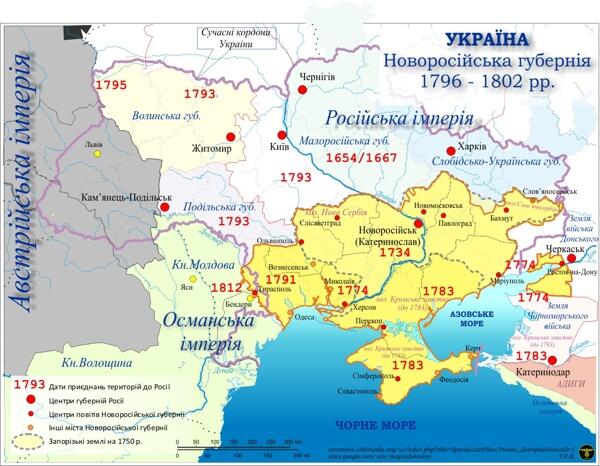
For avoidance of doubt here are sequential maps that tell the story, and which make mincemeat of the Washington/NATO sanctity of borders malarkey. The first of these is a 220-year-old map from 1800, where the yellow area depicts the approximate territory of the five regions—Donetsk, Luhansk, Kherson and Zaporizhia plus Crimea—that will be allowed to go their own way, including back to Mother Russia, if the key ingredients of the Donald’s 28-point peace place can be resurrected.
As it has happened, these regions have voted overwhelmingly during referendums in 2023 and 2014, respectively, to separate from Ukraine in favor of affiliation with Russia.
Collectively, the five regions were historically known as the aforementioned Novorossiya or “New Russia” and had been acquired by Russian rulers, including Catherine the Great between 1734 and 1791.
The red markings within the yellow areas of the map designate the year of Russian acquisition. Self-evidently, therefore, the Russian Empire had gradually gained control over this vast area north of the Black Sea before the end of the 18th century. To that end, it had signed peace treaties with the Cossack Hetmanate (1734) and with the Ottoman Empire at the conclusion of the various Russo-Turkish Wars of that era.
Pursuant to this expansion drive – which included massive Russian investment and the in-migration of large Russian populations to the region – Russia established the “Novorossiysk Governaorate” in 1764. The latter was originally to be named after the Empress Catherine, but she decreed that it should be called “New Russia” instead.
The Provinces Of Ukraine Slated For Partition By The Trump Plan Were Part Of Russia Before The US Constitution Was Even Written
Map: © Роман Днепр, CC BY-SA 3.0
Completing the assemblage of New Russia, Catherine forcefully liquidated its aforementioned century-long Cossack ally known as the Zaporizhian Sich (present day Zaporizhia) in 1775 and annexed its territory to Novorossiya, thus eliminating the independent rule of the Ukrainian Cossacks. Later in 1783 she acquired Crimea from the Turks, which was also added to Novorossiya, as shown in yellow area of the map above.
During this formative period, the infamous shadow ruler under Catherine, Prince Grigori Potemkin, directed the sweeping settlement and Russification of these lands. Effectively, Catherine had granted him the powers of an absolute ruler over the area from 1774 onward.
The spirit and importance of “New Russia” at this time is aptly captured by the historian Willard Sunderland,
“The old steppe was Asian and stateless; the current one was state-determined and claimed for European-Russian civilization. The world of comparison was now even more obviously that of the Western empires. Consequently, it was all the more clear that the Russian empire merited its own “New Russia” to go along with everyone else’s New Spain, New France and New England. The adoption of the name of New Russia was in fact the most powerful statement imaginable of Russia’s national coming of age.
In fact, the passage of time solidified the borders of Novorossiya even more completely. One century later the light-yellow area of the 1897 map below gave an unmistakable message: To wit, in the late Russian Empire there was no doubt as to the paternity of the lands adjacent to the Azov Sea and the Black Sea: They were now part of the 125 years-old “New Russia”.
Where’s Waldo—Ukraine—on This Map
After the Russian Revolution, of course, the pieces and parts in this region of the old Czarist Empire were bundled-up into a convenient administrative entity by the new red rulers of Moscow, who christened it the “Ukrainian SSR” (Soviet Socialist Republic). In a like manner, they created similar administrative entities in Belorussia, Georgia, Moldavia, Turkmenistan etc.—ultimately confecting 15 such faux “republics”.
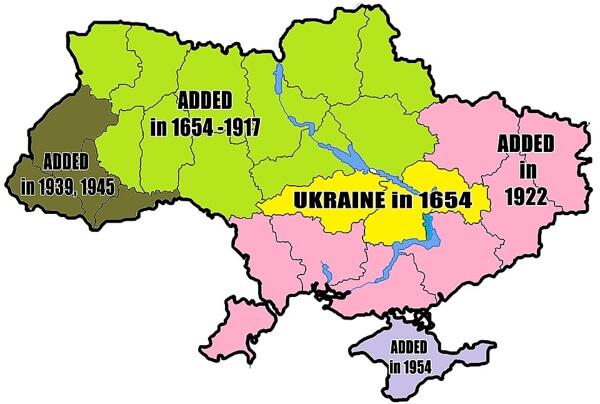
During the course of this communist state-building, here is how and when these brutal tyrants attached each piece of today’s Ukrainian map to the territories acquired or seized by the Russian Czars over 1654-1917 (yellow area):
The old Novorossiya of the Donbas and Black Sea rim was added to the Ukraine SSR by Lenin in 1922.
The western territory around Lviv that been known as Little Poland and Galicia were captured by Stalin in 1939 and thereafter when he and Hitler carved up Poland.
Upon the death of the bloody Stalin in 1954, Khrushchev made a deal with his Presidium allies to transfer Crimea from the Russian SSR to the Ukrainian SSR in return for their support in the battle for succession.
In a word, Ukraine is the bastard spawn of communist blood and iron. Yet during the last decade the Washington and the NATO warhawks have spent upwards of $300 billion to ensure that the handiwork of autocratic Czars and Commissars remains intact into the 21st century and presumably beyond.
It is ironic, therefore, that the historically illiterate Donald Trump has the good sense to dispense with one of the stupidest crusades that the War Party on the Potomac has yet concocted. So doing, he would enable the failed handiwork of communist tyrants to be made right with history—an outcome that can now happen if and only if the Donald gets the Rubio digression back on track.
Modern Ukraine: Born In Communist Blood and Iron
Image: © Sven Teschke et al., CC BY-SA 3.0.
Of course, had the above-mentioned 20th century communist trio been noble benefactors of mankind, perhaps their subsequent map-making handiwork and reassignment of Novorossiya to Ukraine might have been justified. Under this benign counterfactual, they would have presumably combined peoples of like ethnic, linguistic, religious and politico-cultural history into a cohesive natural polity and state. That is, a nation worth perpetuating, defending and perhaps even dying for.
Alas, the reason that Trump is right to attempt to end this bloody catastrophe via partition is that the very opposite was true. From 1922 to 1991 modern Ukraine was held together by the monopoly on violence of its brutally totalitarian rulers. And that became more than evident when the Kremlin temporarily lost control of Ukraine during the military battles of World War II. During that especially bloody interlude, the communist administrative entity called Ukraine came apart at the seams.
That is, local Ukrainian nationalists joined Hitler’s Wehrmacht in its depredations against Jews, Poles, Roma and Russians when it first swept through the country from the west on its way to Stalingrad; and then, in turn, the Russian populations from the Donbas and south campaigned with the Red Army during its vengeance-wreaking return from the east after winning the bloody 1943 battle of Stalingrad that turned the course of WWII.
Not surprisingly, therefore, virtually from the minute it came out from under the communist yoke when the Soviet Union was swept into the dustbin of history in 1991, Ukraine has been engulfed in political and actual civil war. The elections which did occur were essentially 50/50 at the national level but reflected dueling 80/20 vote breakouts within the regions. That is, the Ukrainian nationalist candidates tended to get vote margins of 80% + in the West/Central areas, while Russian-sympathizing candidates got similar pluralities in the mainly Russian-speaking East and South.
This pattern transpired because once the iron-hand of totalitarian rule ended in 1991, the deep and historically rooted conflict between Ukrainian nationalism, language and politics of the central and western regions of the country and the Russian language and historical religious and political affinities of the Donbas and south came rushing to the surface.
Accordingly, so-called democracy barely survived these contests until February 2014 when one of Washington’s “color revolutions” finally “succeeded”. That is to say, the Washington fomented and financed nationalist-led coupe d état ended the fragile post-communist equilibrium.
That’s the true meaning of the Maidan coup. It ended the tenuous cohesion that kept the artificial state of Ukraine intact for barely two decades after the Soviet demise. So save for Washington’s destructive intervention, the partition of a communist-confected state that had never been built to last would have materialized all on its own–perhaps like in Czechoslovakia—-and likely sooner than later.
At the end of the day, therefore, the necessary impending partition of the rogue state of Ukraine is not a case at all of legitimate sovereign borders being violated. Nor does it involve an assault on the hypocritical notion of a “rules-based international order” that has not actually ever existed and which, instead, has been a cover for Washington’s global hegemony all along.
But the lessons are nonetheless profound. History accumulates and eventually leads to destructive, but wholly unnecessary outcomes.
That is the case today with the utterly foolish action of Washington during the 1990s and 2000s to bring former Warsaw Pact Nations, and even breakaway Soviet Republics into a NATO alliance whose mission was over and done in 1991.
It should have been dismantled then and there. When the old Soviet monster with its 50,000 tanks and 7,000 nuclear warheads disappeared into the dustbin of history, there was no longer a threat to the east. There was no “front line” to defend.
At that point Washington should have and easily could have led the world to disarmament and to a revival of the lasting peace that had disappeared in the “Guns of August” in 1914.
But now the NATO section 5 mutual defense commitment to these 31 nations is equivalent to a stupid charity that the nearly bankrupt Federal government cannot afford in any case.
There is absolutely nothing in it for the enhancement of America’s homeland security, and huge incentives for the politicians of these nations to caterwaul against Russia rather than seek peaceful accommodation.
So here is the historic moment before us: The Donald now needs to tell Rubio in no uncertain terms to take a hike and then return to the essence of the 28-point plan and agree with Putin to a partition of Ukraine.
So doing, he would not only end the utter stupidity of NATO’s proxy war on Russia, but in the process accomplish something more of literally epic proportions: Namely,the defenestration of the neocons, official Washington, NATO, the rules based international order and all the other globalist humbug that has saddled America with $1.5 trillion per year Warfare State and Global Empire that it cannot afford and doesn’t need.
* * *
If the history laid out above makes anything clear, it’s that the real danger to America rarely comes from distant, shifting borders—but from the misguided ambitions of those who gamble with our future in the name of “global leadership.” As Washington sleepwalks deeper into conflicts that have nothing to do with genuine US security, the stakes for ordinary Americans grow higher by the day. That’s why now is the moment to get informed, not after the next crisis erupts. Legendary investor Doug Casey has issued a stark warning about what he believes may be the most dangerous event of the 21st century—an event set in motion by the very forces discussed in this article. His special report explains what’s coming, why it matters, and how you can prepare before it’s too late. If you want to understand the real risks ahead—and what they could mean for your freedom, finances and future—you can access Doug’s urgent video report here.
Tyler Durden
Sat, 12/27/2025 – 07:00

Clarendon Hills Lions Club marks 75th anniversary by carrying its mission forward
The Clarendon Hills Lions Club didn’t create any fanfare to celebrate its 75th anniversary in 2025.
Rather, the organization continued with the same mission it’s always had and is carrying into 2026: to provide humanitarian service and financial support to the community and Lions International through the voluntary involvement of members.
The Lions Club has worked to raise funds to enable the disadvantaged to see more clearly with a pair of glasses, or a blind child to read with specialized equipment.
“We obtain large print books for the library, and we raise funds to tackle tough problems like drug abuse prevention, river blindness and diabetes awareness,” said Brian Keating, the group’s president. “Serving as a member of the Clarendon Hills Lions Club takes time and sometimes involves hard work, harsh conditions and sweat. We do our work and serve so that others may have a higher level of dignity in their lives.”
Bill Hamel has operated a dentistry practice in Clarendon Hills for about 40 years. He has been a Club member since 1985 and currently is its secretary. He joined the club on a suggestion from someone and has remained active ever since.
“My time is more valuable than my money,” Hamel said. It’s all about philanthropy. It is really important to me to give back; my life is blessed. You see so much need, it drives you forward. And I kind of got hooked on it, meeting great people.”
Hamel said the Clarendon Hills Lions Club currently has 51 members and has had up to 75 in past years.
Keating said group members represent many different careers and participate in many other organizations, including various civic and faith based organizations.
“As Lions we come together to work and serve with over 1.3 million Lions members worldwide to help answer specific needs that challenge our community,” he said.
The Clarendon Hills Lions Club’s biggest annual fundraiser is its Christmas Tree sale that has taken place for more than 60 years. Since its inception, the tree sale has provided more than $1 million to worthy causes. In addition, when Dutch elm disease was killing the elm trees in the village in the 1960s and 70s, the Lions Club used some of the proceeds from the Christmas tree sale to plant more than 1,000 trees in Clarendon Hill parkways.
“The Christmas tree sale is a tradition for numerous families, starting from the time the children are infants to when they return as adults with children of their own,” group member Jim Johnson told others in the Clarendon Hills Lions Club.
“Many generations have come to the tree sale because they want to give back in a tangible way to help those less fortunate than themselves. Others continue to come year after year because the Lions helped their family members get through some difficult times with health issues. Many times, people come to the tree sale, see the good work being done, and then want to join the Clarendon Hills Lions Club.”
Students from Hinsdale Central and Hinsdale South high schools earn community service credit for helping with unloading the trees and sales.
Probably the place where the name of the local Lions Club is most often seen is the swimming pool — Lions Park Pool — operated by the Clarendon Hills Park District. The pool was opened in 1992 and managed and operated by the Lions Club. In 2003, the Lions Club decided it no longer was up to those tasks, so the park district was asked to take over.
While it no longer operates the pool, the Lions Club did work toward the passing of the 2024 $8 million referendum to fund improvements at the pool and some additional park improvements. The pool was closed in 2025 for improvements work and is scheduled to open on Memorial Day weekend in 2026.
Chuck Fieldman is a freelance reporter for Pioneer Press.
https://www.chicagotribune.com/2025/12/27/clarendon-hills-lions-club-anniversary/