
Category: News
Edward Keegan: This year in Chicago architecture wasn’t on anyone’s bingo card
Architecture unfolds slowly. Big plans take years, sometimes even decades, to complete. And yet some years come with lots of surprises, and 2025 included a few head-scratchers: a papal pilgrimage site in suburban Dolton, an entire wing of the White House demolished, and likely landmark protection for the mediocre office building that replaced Louis Sullivan’s Chicago Stock Exchange. Nobody had any of these on their bingo card when the calendar last rolled over.
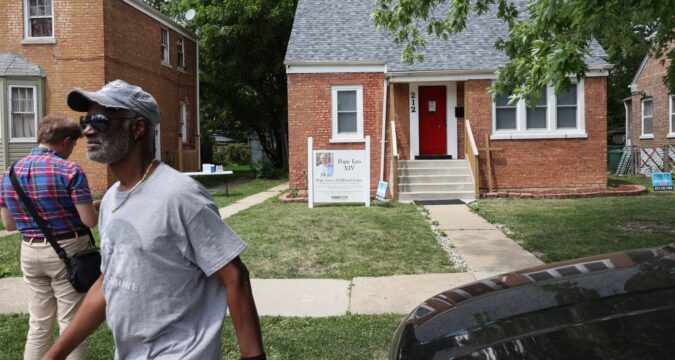
A new local pilgrimage site: Pope Leo XIV’s modest childhood home in Dolton was acquired by the town in July, just two months after the favorite son became pontiff. Declared a historic landmark earlier this month, plans to open the house to the public are still being developed. While the designation has nothing to do with the building’s architecture, the single-family brick structure epitomizes suburban tract development that was built in the years immediately following World War II.
General Services Administration in the crosshairs: Now more than 11 months into Trump 2.0, the developer president has had startling effects on building culture. The teardown of the White House’s historic East Wing in October was probably the most startling unannounced demolition since Mayor Richard M. Daley’s middle-of-the-night bulldozing of Meigs Field in March 2003. Earlier in the year, the General Services Administration, which owns and operates most federally owned structures throughout the country, showed interest in disposing of many properties, including portions of the Ludwig Mies van der Rohe-designed Federal Center complex in the Loop and the recently landmarked Century and Consumers Buildings on State Street. It’s almost guaranteed that these will be revisited in the next year.
Residential renovations on LaSalle Street: The residential conversion of older office buildings along LaSalle Street continued, albeit with one unfortunate new precedent. Earlier this month, the banal 1970s office structure at 30 N. LaSalle St. received preliminary landmark status from the Commission on Chicago Landmarks. It’s a laughably nonsensical move by the city to help the developer tap into public subsidies. Stopping demolition through thoughtful reuse of older buildings is almost always good, but landmarking is not the correct tool for this project. Here, the city is encouraging good development the wrong way.
Google glass: Google’s remake of the James R. Thompson Center continues to provide construction watchers with fodder for social media. The full exposure of the building’s structural frame was a highlight of the past year, but the continuing installation of clear glazing is proving that the renovation by Jahn/ — the successor firm to Murphy/Jahn, the original architects — is a more dramatic makeover than initially revealed. New terraces have been created under the sloped glazing, which now appears as a series of bustling skirts rather than part of the main body of the building.
Glass is installed on part of the exterior of the Thompson Center building in Chicago as its redevelopment into office space for Google employees continues May 7, 2025. (Terrence Antonio James/Chicago Tribune)
And Google wins no awards for its lack of transparency as to the design’s scope. The entire year passed with no updates to the handful of renderings that the digital behemoth released in 2024. We’re finding out what we’re getting as it’s being built.
A New Lincoln Yards: There’s no reason to lament the demise of the overwrought plans for Lincoln Yards. Following a change in ownership, the northern portion of the parcel has now been dubbed Foundry Park and sports a new master plan by Hartshorne Plunkard Architecture. The scale remains too large for this swath of the North Side, but the new renderings indicate a more textured and nuanced architecture than previously proposed. And the end of the year has a possible buyer for the southern tract where we’ll be waiting for new plans in the new year.
Related Articles
Edward Keegan: Robert A.M. Stern wrote 7,000 pages about New York architecture. Who can write Chicago’s tome?
Edward Keegan: Frank Gehry’s generous and democratic architecture
Edward Keegan: Frank Lloyd Wright’s chairs get a thoughtful presentation in Wisconsin
Edward Keegan: Architecture becomes real through construction at Revolution Workshop
Edward Keegan: Columbus, Indiana’s architecture festival embraces the spirit of Chicago improv with ‘Yes And’
Assorted stadiums: In November, the Chicago Architecture Center (CAC) released “Win/Win: The New Game Plan for Urban Stadiums” that notes it’s an auspicious moment for stadiums in Chicago, as active development exists around the future homes for the Bears, Fire, White Sox, Bulls and Blackhawks. The study argues for the integration of stadium and community benefits and assets — an approach that’s been developed and honed by New Urbanists for more than 30 years.
Earlier, the City Council approved the Gensler-designed Chicago Fire Stadium at The 78, just south of Roosevelt Road on the east bank of the Chicago River. And we’re no closer to finding out where the Chicago Bears will play in decades to come. After abandoning Chicago for Arlington Heights (again) earlier in the year, the team ended 2025 with the announcement that it’s now considering northwest Indiana for the Bears’ next home. The CAC should send a few copies of its report to the McCaskey family …
In memoriam: Frank Gehry’s death in early December was just one of several losses to the Chicago architectural scene. Leon Krier and Robert A.M. Stern, both winners of the Richard H. Driehaus Prize, passed away this year. Krier, the inaugural laureate in 2003, was best known as the urban planner of Poundbury, working for now-King Charles III, but he was the initial director of the Chicago-based SOM Foundation in the late 1980s. Stern won the Driehaus in 2011 and built One Bennett Park and the bus shelters.
David Childs of SOM passed in March. His sole Chicago design, 400 North DuSable Lake Shore Drive, continues to rise on the lakefront just north of the Chicago River. Ricardo Scofidio of Diller Scofidio + Renfro designed the David Rubenstein Forum at the University of Chicago; he also died in March. The forum’s memorable stack of boxes will soon be in dialogue with the nearby Obama Presidential Center. Marilyn Hasbrouck, the longtime proprietor of the Prairie Avenue Bookshop, passed away in March as well. Her shop was a haven for architects from around the globe.
And in the year ahead: The architecture world will turn its collective eyes to Chicago in the new year with the June opening of the Obama Presidential Center in Jackson Park with architecture by Tod Williams Billie Tsien Architects and landscape design by Michael Van Valkenburgh Associates. And there’s another presidential library with Chicago connections. Studio Gang was selected in August to develop extensive renovations for the Clinton Presidential Center in Little Rock, Arkansas. Designs are expected early in the new year.
And since 2025 was hardly predictable, it’s hard not to expect more architectural surprises in 2026.
Edward Keegan writes, broadcasts and teaches on architectural subjects. Keegan’s biweekly architecture column is supported by a grant from former Tribune critic Blair Kamin, as administered by the not-for-profit Journalism Funding Partners. The Tribune maintains editorial control over assignments and content.
Submit a letter, of no more than 400 words, to the editor here or email letters@chicagotribune.com.
Here’s what Mayor Brandon Johnson’s 2024 tax returns show
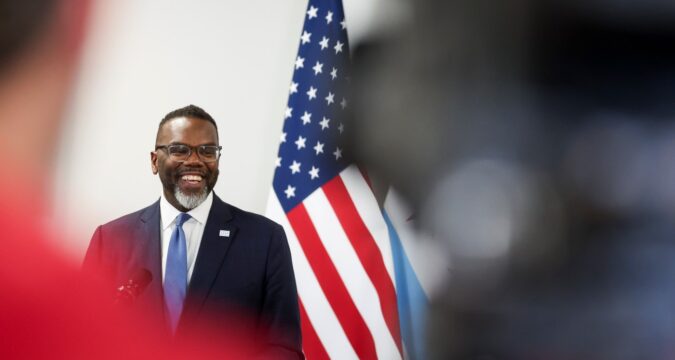
Mayor Brandon Johnson released his most recent tax returns to the Tribune this month, showing the freshman chief executive remains less wealthy than his predecessors and does not earn outside income.
Johnson’s tax returns show the family brought in just over $196,000 in wages for 2024, his second year as mayor of Chicago. His full salary as mayor of Chicago last year was just over $221,000.
After claiming the standard $29,200 deduction for filing jointly with wife Stacie and the $4,500 child tax credit for his three children, records show he paid $22,427 in federal taxes for an effective tax rate of 16%. Like last year, the Johnsons didn’t claim any other income from investments, retirement fund distributions or capital gains in 2024.
Johnson separately paid about $9,000 in state income taxes, up from about $8,000 the year before, paying an effective rate of 4.87%.
His family also received a $144 credit for the $2,887 in property taxes they reported paying on their Austin home. The Johnsons overpaid on their state and federal returns and received refunds for both.
Next year, Johnson’s wages as mayor of Chicago will remain the same, as he is skipping a raise in the 2026 budget.
Johnson again did not provide his full 2022 returns, which the Tribune has requested for multiple years. That was from when he worked as an elected Cook County commissioner and Chicago Teachers Union organizer.
The Tribune annually requests the Chicago mayor’s tax returns, a long-standing tradition in U.S. politics when it comes to major public offices. Politicians are not required to disclose their income tax forms, but many do so to demonstrate transparency about potential conflicts — of a particular importance to many voters in Illinois, where generations of politicians have enriched themselves through their government roles.
Some quirkier discoveries from tax returns include Gov. JB Pritzker taking home more than $1.4 million in gambling winnings last year, which his campaign spokesperson said he planned to donate to charity after media reports of his fruitful Las Vegas visit went viral. Pritzker, a billionaire heir to the Hyatt Hotels Corp., only releases partial tax returns and reported $10.3 million in taxable income in 2024.
Johnson grew up in northwest suburban Elgin and often draws upon his humble upbringings when tapping into his progressive brand.
Now a resident of the Austin neighborhood on the West Side, Johnson has parried past criticism over his unpaid city water bills during the 2023 mayoral race by noting the debt indicates he understands the plight of struggling Chicagoans. Although, by then he was employed as an official with both Cook County and CTU.
Still, Johnson’s tax forms show his income history is more modest than that of his predecessors, Lori Lightfoot and Rahm Emanuel, while they were in office. Lightfoot, who grew up in the working-class town of Massillon, Ohio, reported $402,414 in adjusted gross income in 2021, the most recent year the Tribune requested her returns. She reported taking out $210,000 in early distributions from retirement accounts that year to supplement her mayoral salary.
While working as a partner at law firm Mayer Brown before becoming mayor, Lightfoot reported an average adjusted gross income of $971,626 from 2014 through 2017.
Emanuel reported making $554,000 while mayor in 2017, including $353,000 from interest, dividends and capital gains from investments.
The mayor’s “tax the rich” agenda most recently came to a head during his 2026 budget fight with City Council that hinged on, among other issues, whether Chicago should reinstate a corporate head tax. He lost; aldermen revolted earlier this month to pass a spending plan without the mayor’s support for the first time in four decades.
The mayor’s latest tax return and other filings dating back to 2018 that Johnson’s campaign provided to the Tribune during the mayoral race show the family reported about $176,278 in gross income in 2023, $162,782 in 2022, $161,000 in 2021 and $160,000 in 2020. The Tribune knows his 2022 gross income despite not having his full returns because the accountant who prepared Johnson’s 2023 filings provided a year-over-year rundown of his effective tax rates.
Between 2018 and 2022, Johnson worked two jobs as a county commissioner earning $85,000 annually and for his role with CTU, where annual pay varied. Johnson also reported some income before his time as mayor as a media personality, and wife Stacie also reported work as a doula in previous years.
https://www.chicagotribune.com/2025/12/28/mayor-brandon-johnson-2024-tax-returns/
New law requires public libraries across Illinois to carry opioid OD reversal medication
Rob Simmons estimates that, over the last decade, Oak Park Public Library employees have helped save the lives of about 20 people who overdosed on opioids.
In some cases staff members saw that a patron had potentially overdosed in the library and called 911. In other instances, staffers administered a naloxone nasal spray that can reverse the effects of opioid overdoses, he said.
Opioid abuse among library patrons is “a real challenge and an unfortunate reality,” said Simmons, director of social services and public safety at the Oak Park Public Library. “I think to have an intervention available on-site that can save lives is crucial.”
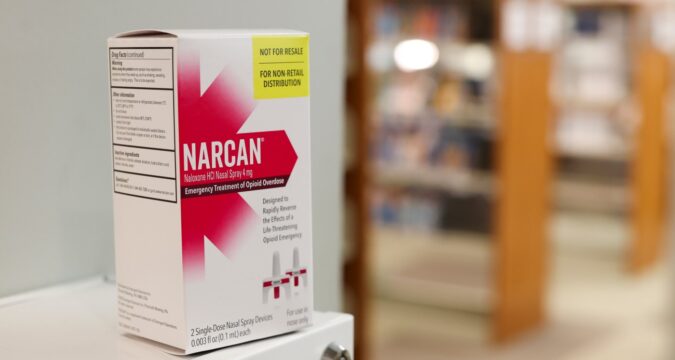
Though many Illinois libraries, like Oak Park’s, already have supplies of medications that can reverse opioid overdoses, a new state law will soon require all public libraries to stock them. The new law, which takes effect Jan. 1, also instructs libraries to take “reasonable steps” to make sure there’s always a staff member present who’s been trained in how to recognize and respond to opioid overdoses.
“We know opioid antagonists like Narcan, if administered when someone is having an overdose, can be very effective in preventing someone from dying from an overdose,” said state Rep. Anna Moeller, an Elgin Democrat, who sponsored the bill behind the law.
“Libraries are public places,” Moeller said. “You have a lot of people who are there. It could be a place where somebody might be having an emergency like that.”
The new law shouldn’t cost libraries anything, as they can get free opioid antagonists and training through the state, Moeller said. Earlier this month, the Illinois Department of Public Health also issued an updated standing order, clarifying that libraries can get opioid antagonists without a prescription, to make it easier for libraries to comply with the new law.
Moeller got the idea for the measure from Jordan Henry, a teen who worked on the concept as part of a school project at the Illinois Mathematics and Science Academy.
Henry — a frequent library patron herself — had heard about Chicago Public Library locations keeping opioid antagonists on hand and wondered why more libraries couldn’t do the same.
“Libraries are such a huge part of the community,” said Henry, who’s now a freshman at Loyola University Chicago. “They’re free, they’re open most days of the week. They’re usually in very centralized locations. … There’s so many across the state, so it’s easier for people to reach them regardless of circumstances.”
Henry’s mother was at an event with Moeller at their local library in Elgin, where she heard that the representative wanted to work on bills with community members. Henry said her mother asked if she was interested, and after she said yes, they set up a meeting.
Henry said she initially thought they would work on extending opioid antagonists to just her local library, but Mueller suggested they go statewide.
Keeping supplies of naloxone on hand has made a big difference at the Oak Park Public Library, Simmons said. Since 2023, the library has had a red box on a wall near its entrance with naloxone that anyone in the community can take.
People frequently grab the medication, and the local health department typically replenishes supplies in the box a couple of times a week, Simmons said.
The library also keeps supplies of nasal sprays provided by Live4Lali in the public safety staff office, for those workers to use on patrons in emergencies. Live4Lali is an Arlington Heights-based group that works to prevent substance abuse and reduce harm from substance abuse.
Simmons estimated that about two or three people overdose at the library each year, often in the bathrooms.
The Evanston Public Library also has a box on the wall with naloxone sprays for community members to take freely, said Ellen Riggsbee, marketing and communications manager for the Evanston library.
Ellen Riggsbee stands near a public supply of naloxone in a box on a wall in the Evanston Public Library on Dec. 22, 2025. In the new year there will also be staff supplies of naloxone in anticipation of a new law. (Eileen T. Meslar/Chicago Tribune)
In anticipation of the new law, the library also acquired supplies of naloxone to be used specifically by staff in emergencies.
So far, about two-thirds of the library’s staff has been trained on how and when to use opioid antagonists, Riggsbee said. They’re learning about how to respond to potential overdoses.
For example, if a patron is passed out, a staff member may tap on a table or nearby surface to try to rouse the person, Riggsbee said. If the person doesn’t wake, the staffer may ask for the library’s public safety staff to come over, and together they’ll look for signs of an opioid overdose, such as blue nails or breathing that’s slow, irregular or stopped.
If the signs are there, after calling 911, staff members may retrieve one of the library’s nasal sprays, and administer a dose in hopes of potentially saving the person’s life, Riggsbee said.
“We know this is just a realistic part of a library’s work,” Riggsbee said. “It’s a public library and we have to ensure the safety of everybody who comes in.”
The O’Fallon Public Library, near St. Louis, has had supplies of naloxone for about five years, said Ryan Johnson, the library’s director.
The naloxone is part of the library’s regular first-aid kits, with one kit on the first floor and another on the second floor.
Staffers haven’t had to use the naloxone yet, but Johnson, who is also a past president of the Illinois Library Association, is glad to have it on hand.
“You put it in your toolbox and hopefully you never have to use it, but if you do, you’ve got it and you can potentially save someone’s life,” Johnson said.
https://www.chicagotribune.com/2025/12/28/libraries-opioid-reversal-naxalone/
2025 in review: A look back at immigration enforcement raids in Chicago through op-eds
After his inauguration, President Donald Trump quickly got to work fulfilling a campaign promise by increasing arrests and deportations of immigrants in the United States.
Looking back now, the immigration raids in other cities, subsequent protests and National Guard response in Los Angeles gave Chicago a sense of what was to come in the fall. The Department of Homeland Security launched Operation Midway Blitz on Sept. 8 to target “criminal illegal” immigrants and, it said, honor Katie Abraham, who was killed in a drunken driving accident by an immigrant lacking permanent legal status.
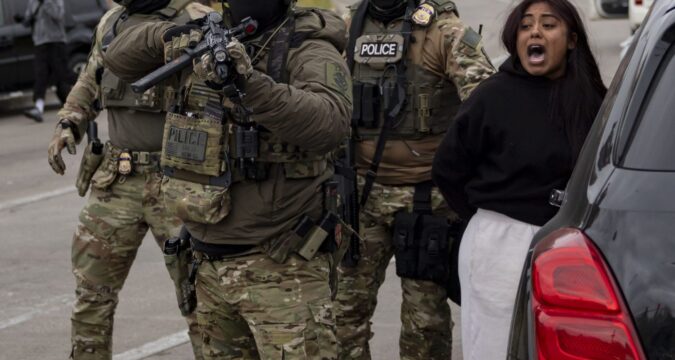
Masked Border Patrol and Immigration and Customs and Enforcement agents spread out on the streets of Chicago and its suburbs to ramp up arrests, and their often brutal tactics were met with resistance. Protests increased at the Broadview detention facility, and neighbors in Chicago and its suburbs blew whistles and created informal community groups.
Our commentary from this chaotic time examined the actions and decisions of federal immigration agents, whether the operation honored or marred Abraham’s legacy, and how Chicagoans responded and found solidarity during the worst moments of the blitz.
Here is a look back in excerpts.
June 13: Edwin C. Yohnka, “ICE officers should not be allowed to wear masks”
It is not surprising that some ICE agents want to hide their faces. The work they are doing is unpopular and cruel. The harsh, militaristic nature of their actions is not normal and is being met with protest and opposition across the country. The White House, of course, responded to this opposition and protest in Los Angeles by sending National Guard troops to further militarize the implementation of the administration’s policies. The secretary of defense even plans to deploy Marines, further escalating tensions.
Groups of masked agents, armed with weapons, moving around the streets of a city in unmarked vehicles creates a public safety risk for police and for residents. If an armed group of local police confronts these masked ICE agents, how will they know they are federal law enforcement officers? It is not hard to see a situation like this escalating rapidly.
Worse still, the masks send a signal to ICE officers and the public that they are not accountable for their actions — even unconstitutional and illegal actions — and that their superiors will cover for them and encourage them to hide their identities when they are acting in their official capacity. This is the opposite of accountability. There is good reason why Chicago police officers are expressly prohibited from hiding their nameplates or badge numbers when out on the streets. But federal immigration officers are not held to the same standard.
Oct. 22: Denise Lorence, “My daughter is the face of Operation Midway Blitz. I am reclaiming her legacy.”
A photo of Katie Abraham. (Stacey Wescott/Chicago Tribune)
Katie would not want to be associated with an operation in which kids witness their parents being taken into custody on their way to or from school. She wouldn’t support scaring kids with the use of military efforts in their neighborhoods or in their apartment buildings.
She would not have wanted to be associated with a campaign that targets Chicago — a city she not only loved but felt safe in. Since she was in middle school, she and I took hundreds of drives through the city’s neighborhoods. On those drives, we’d talk about music, life, her future and her thoughts on current events — you name it, we talked about it. I will always cherish those drives because we not only saw what Chicago had to offer, but Katie and I really bonded on those drives. I learned who she was becoming with each passing drive — week after week, month after month, year after year.
Oct. 30: Allison Pleas, “Fear of ICE is stealing the simple moments in my Chicago neighborhood”
Just six months ago, my daughter would beg me for cotton candy from one of the after-school vendors, and we’d stay on the playground a little longer before heading home. Now, the vendors are gone, the playground is closed and the small routines that once made the day feel full have quietly disappeared because of fear.
In recent weeks, many families have decided it’s safer to keep their children home. They’d rather stay together than risk being separated. In some homes, the parent with the safer job goes to work while the other stays home to avoid being taken away. Many street vendors still take the risk, knowing that each day out could be their last. They live with fear every day — fear of waiting for the bus, fear of driving, fear of standing outside the school to pick up their child. Some families have chosen to return to their countries rather than face the possibility of separation. It doesn’t matter whether they were born here, are on the pathway to citizenship or are hoping to become citizens — the fear is the same for everyone.
At the park, I used to sit on the bench watching families grill carne asada while kids played soccer and salsa music blared from a speaker, wishing I could be part of it. That’s what family looks like to me — the same warmth and joy I see every day at school. But lately, some of those same families tell me they’re staying home, avoiding the places they love. Fear is stealing the simple moments.
Oct. 31: Joe Abraham, “We all share my daughter Katie’s legacy — and her death must still mean something”
Katie’s death was preventable. She was killed by a man, Julio Cucul Bol, who entered and remained in our country illegally. He was using multiple aliases, exploiting gaps in an overwhelmed and disorganized immigration system. Illinois’ sanctuary law allowed this monster to roam free. He should have been removed long before he could take my daughter’s life.
It would be unjust and unreasonable to separate my family’s loss from the policies that failed us. We did everything right. We worked hard, obeyed the law, paid our taxes and trusted that government would protect us in return. That trust was broken. Our leaders — from the governor’s office on down — have not treated immigration as a matter of public safety or national security.
Nov. 5: Sen. Graciela Guzmán and Gabe Gonzalez, “There is something deeper at work in Chicago than residents blowing whistles”
Baltazar Enriquez, president of the Little Village Community Council, blows a whistle as people face off with federal agents after a raid at Discount Mall on West 26th Street in Chicago’s Little Village neighborhood on Oct 23, 2025. (Antonio Perez/Chicago Tribune)
While the daily imagery of neighbors standing up to ICE agents is a powerful contagion for courage, there is something far deeper at work than just residents blowing whistles and recording arrests.
Chicagoans are feeling compelled to act — engaging by the thousands because the threat to liberty is personal and clear. What needs to happen next is for that collective action to coalesce into a force that tells the next chapter in American history.
Typical of all authoritarian advancements, public justification is built on a pyramid of lies. The foundational lie is that American cities like Chicago have been invaded by dangerous criminals. That these criminal invaders are to blame for our problems and can only be dealt with by militarized federal forces encroaching on the rights of everyday Chicagoans. But, those who call this city home did not buy into the absurd lie that we should go to war with our neighbors. The forceful rejections from Chicago, Memphis, D.C., Portland and L.A. have shaken the hold that MAGA lies have on our country. In every instance they have tried to operationalize the repulsive idea that some human beings should be considered “illegal” and disposable for merely existing, and they failed.
This has forced the Trump administration into a very unfavorable fork in the road regarding Chicago. They can try to double down on the plan of breaking the soul of this city, which would mean sending more ill-trained, occupying forces — an unwise option, considering unpaid neighborhood defense recruitment seems to be outpacing ICE’s, even with their $50,000 signing bonuses. Or, they can take the path of declaring fictitious victory here and retreat to smaller, more vulnerable cities — a risky option for an authoritarian regime reliant on its image of absolute strength. In either choice, the facade of lies will be badly fractured.
Nov. 8: Jane Charney, “Chicago does not feel safe for anyone, no matter our status”
Border Patrol agents detain a person in a Home Depot parking lot as they conduct an immigration enforcement action Dec. 17, 2025, in Evanston. (Armando L. Sanchez/Chicago Tribune)
Right now, the city of Chicago does not feel safe for anyone, no matter their status. We’ve seen people being arrested without a warrant, tear gas released near schools, people knocked down and car windows smashed. Make no mistake. These tactics threaten all of us. When one person’s right to due process is taken away, all of us have lost that foundational right. Our Constitution ensures that our laws and legal system operate with equity and fairness and apply to everyone who is on U.S. soil. We are seeing the consequences of actions that sow fear in real time, and this trauma will be with our communities for years.
My family came to the United States with three truths firmly rooted in our minds: There’s no antisemitism in America; America is a country of immigrants and values our contributions; and everyone is subject to the rule and protection of our laws. 2025 is proving us wrong on all three counts, and we’re ever closer to resembling the Soviet Union.
Nov. 26: Kerry Lester Kasper, “Chicago has become the ‘City of the Big Shoulders’ once again”
Recently, in issuing a sweeping injunction on the use of force by immigration agents in Operation Midway Blitz, U.S. District Judge Sara Ellis did something you rarely hear in even the most vaunted courtrooms in this country: She read a poem. In its entirety.
Carl Sandburg’s 1914 poem “Chicago” is a powerful, sweeping description of the city at the turn of the 20th century. Chicago’s oft-cited nickname, the “City of the Big Shoulders,” comes from it.
But it’s more than that.
Some 110 years later, Sandburg’s words are illustrative of the moxie this place has always had but only recently visibly reclaimed.
“Come and show me another city with lifted head singing so proud to be alive and coarse and strong and cunning,” Sandburg wrote. “Flinging magnetic curses amid the toil of piling job on job, here is a tall bold slugger …/ Bareheaded,/ Shoveling,/ Wrecking,/ Planning,/ Building, breaking, rebuilding.”
Building. Breaking. Rebuilding. It’s not lost on me that Ellis articulated the legacy of the city in the same halls that only a year before saw her colleagues weigh the fates of some of the city’s power players, the old order. It’s a fitting nod to the sentiment that despite all of our recent trouble, we remain proud to be the scrappy, inimitable city that we are.
This renewed energy across Chicago’s gridded streets emerged as coordinated defiance of federal immigration agents who arrived in September.
Submit a letter, of no more than 400 words, to the editor here or email letters@chicagotribune.com.
https://www.chicagotribune.com/2025/12/28/opinion-2025-chicago-immigration-enforcement-raids/

How can I best keep my sidewalks safe during winter?
How can I best keep my sidewalks safe during the winter? The snow so far this year has been a big challenge.
— Erin Holbach, Gurnee
Winter has gotten off to a fast start this year, with lots of snow along with some cold weather. There is a lot of winter weather yet to come, so it’s best to be prepared. One of the most important steps in effective snow management is proper removal. You may want to consider purchasing a snow thrower or snow blower if you have a large area to clear. A snow thrower is a single-stage machine that gathers snow with an auger and discharges it through the chute in a single motion. They’re good for storms with 8 to 9 inches of snow or less. I’ve even used a snow thrower with a rubber paddle for much deeper snow at home, and I have a big driveway, but it was time-consuming to work through the drifts. My driveway was built with old Chicago brick and has a slightly uneven surface, but the rubber paddles on my snow thrower handled it with ease. A snow blower will be available in bigger sizes to remove snow more quickly and will have more power to handle deep snow. The snow is removed in two stages, with an auger feeding the snow into an impeller, which sends the snow through the chute. These machines will typically be self-propelled. The best choice for you depends on the size of the area that you have to clear, and your budget. Snow throwers require more effort to operate, but I found it easy to clear the first 8-inch snowstorm with my small paddle snow thrower.
I consistently see ice melt products over-applied by homeowners and commercial businesses, which is harmful to the hardscape and to the environment. Removing snow before it’s
packed down from walking or driving can help; snow covering your walks and driveway can turn into ice with consistent traffic. This happened on the walk out of my back door after
three to four days of foot traffic from letting dogs out in the past. I’ve been very careful to keep this walk clear this winter, since an icy walk is always dangerous, and more so when it’s
dark. You shouldn’t need to apply deicing products after every storm, and when you do, you shouldn’t need it on all the driveway and sidewalk surfaces. Read the label of the product
you’re planning to purchase and follow the label instructions to maximize effectiveness and minimize negative effects. Calcium chloride, which works when temperatures are as low as
minus 20 degrees Fahrenheit, is less damaging to plants than products made with sodium chloride (rock salt), but it’s similarly harmful to carpet, tile, and shoes and it’s corrosive to
concrete and metal. A similar product, potassium chloride, is also less damaging to plants and works until temperatures drop below 15 degrees. Calcium magnesium acetate (CMA) is
generally considered to be the best deicer with less impact on plants and the environment. It’s effective for temperatures as low as 20 degrees, so it loses effectiveness in cold weather. Many ice melt products on the market include a blend of active ingredients to maximize performance at different temperatures. The key thing is to apply only the recommended amounts to minimize negative impacts on garden plants and hardscape, and only when needed. I only use ice melt at home when I feel conditions would be very dangerous without it.
If snow or ice was previously treated with a deicing product, try to avoid piling it on the root zone of just one nearby tree or shrub. Spreading the treated snow around reduces the
likelihood of toxicity building up in one area. Also, try to avoid piling treated snow or ice on long-lived trees. Turfgrass can be killed when large amounts of salt-laden snow are piled on it over the course of winter.
Another option for controlling ice with minimal negative impact on the environment is to use an anti-icing product, which is generally applied as a liquid using a sprayer right before a storm. As the snow falls, the bottom half-inch or so will turn into slush that can be removed, which prevents ice from forming that would require a de-icer. The Garden currently uses sand on roads and walks to control slippery conditions once the snow is removed, with deicing products used minimally in certain areas. The sand improves traction on slippery surfaces and it’s environmentally benign. Try mixing some deicing product in with sand to minimize the amount of ice melt used at home while keeping walks safe.
All ice melt products pose some kind of risk to your pets by irritating paws and causing gastrointestinal upset if it’s ingested. Repeated exposure can cause chemical burns on paws.
Most common ice melt products contain sodium chloride, potassium chloride, calcium chloride or magnesium chloride, which are all toxic to dogs if ingested. Pet-friendly ice
melts typically contain urea or magnesium chloride, which are considered safer but still might cause gastrointestinal upset while being less effective at melting ice. Ethylene glycol-based ice melts contain the same active ingredient as antifreeze, which is deadly to pets if ingested. Products with urea as the main ingredient are considered some of the safest
options for pets. Keep yourself — and your pets — safe out there.
For more plant advice, contact the Plant Information Service at the Chicago Botanic Garden at plantinfo@chicagobotanic.org. Tim Johnson is senior director of horticulture at the Chicago Botanic Garden.
https://www.chicagotribune.com/2025/12/28/sidewalks-ice-safety-winter/
2025 in review: Aggressive federal immigration enforcement roils Chicago
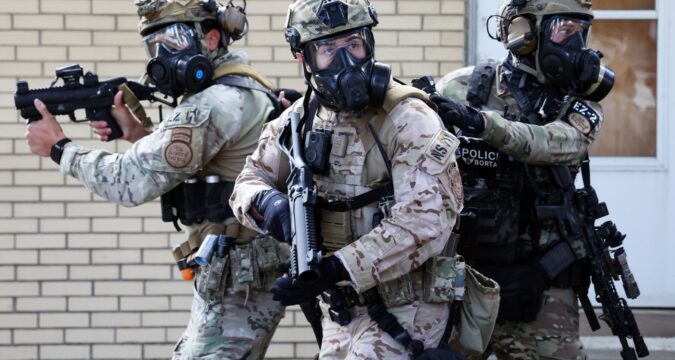
2025 will be remembered by most Chicagoans for the arrival here of the Border Patrol, which joined agents from Immigration and Customs Enforcement in aggressive enforcement of the nation’s immigration laws, as directed by the president of the United States. Accompanied by protesters wherever they went, the agents arrested people throughout the city, often in ways more associated with military-style governments.
As part of our annual review of the year, here is our look back at what the Tribune Editorial Board had to say about their action. In this edition, we are focused on what happened in the later third of the year.
Trump’s bellicose words before an audience of generals who must follow his orders don’t give us comfort. Chicagoans have the constitutional right peacefully to protest their government and should feel safe when doing so without worrying about use of force by a National Guard member or any other member of the Armed Forces in need of “training.”
Which brings us to the second major issue with Trump’s remarks. Our city — or any other American city — should not be a “training ground” for troops ultimately enlisted to fight foreign adversaries. President Trump, Chicagoans are your fellow Americans.
Oct 1: A sun-soaked Sunday in downtown Chicago is marred by a Trumpian show of force.
Federal agents march along North Clark Street by the Newberry Library on Chicago’s Near North Side on Sept. 28, 2025, as part of an immigration blitz show of force. Gov. JB Pritzker said he had received a report that federal officials are seeking to deploy troops to Illinois in support of President Donald Trump’s surge in immigration enforcement. (Brian Cassella/Chicago Tribune)
A beautiful early fall weekend in downtown Chicago. Sun-splashed lakefront. Families enjoying the museums and city sights. Packs of men in military fatigues carrying high-powered long guns and seemingly stopping people on the street based on the color of their skin.
Which of those images doesn’t belong?
On Sunday, Immigration and Customs Enforcement agents made a performative show of transforming an otherwise peaceful downtown into something out of a bad movie. Masked and menacing by design, they tromped around Millennium Park, patrolled the Magnificent Mile and manned boats traversing the placid waters of the Chicago River.
And for what? Why?
Gregory Bovino, the chief patrol agent for the weekslong Chicago operation that ICE is calling Operation Midway Blitz, didn’t substantively answer questions posed to him Sunday by journalists reporting on the scene. But we think we understand what was at work.
We believe this was essentially a provocation, a response to sharp criticism from Gov. JB Pritzker and Mayor Brandon Johnson and a blunt demonstration of the truth that our state and local politicians essentially have no say over where these federal agents choose to go.
Federal officers clear protesters from the entrance of the U.S. Immigration and Customs Enforcement holding facility in Broadview on Sept. 19, 2025. (Stacey Wescott/Chicago Tribune)
This is a moment for Gov. JB Pritzker to show leadership beyond calling President Donald Trump names and exhorting ordinary folks to document on their phones what the federal agents are doing. We understand that the governor is building his political brand nationally as a preeminent leader of the Democratic Party resistance to Trump, but a higher priority must be keeping Illinoisans safe. And in that task we believe he and state law enforcement can do considerably more to assist a village of less than 8,000 that seems understandably overwhelmed with being the focal point of anger around the ongoing federal immigration-enforcement surge in Chicago.
There’s a need to separate protesters from ICE agents, and state and local police are in our minds best equipped to accomplish that. Pritzker said Monday that he understands Trump intends to send 100 federal troops, National Guard or otherwise, in response to the Broadview issues. Trump on Tuesday reiterated that “we’re going into Chicago very soon.”
If state and local police were establishing designated protest areas around the detainment facility that facilitated ingress and egress for federal vehicles without coming into contact with demonstrators, there would be no justification for federal troops — and likely no legal way for Trump to deploy them.
Oct. 7: Ice-related chaos intensifies. The editorial board urges calm from public officials.
Federal agents use tear gas and smoke on community members and activists while they protest near the 3900 block of South Kedzie Avenue on Oct. 4, 2025, in Chicago. (Armando L. Sanchez/Chicago Tribune)
The Chicagoans who are aghast at the chaos the ICE incursion is creating in our city. The public officials who are trying to remain cool in the face of such pressure, some more successfully than others. And even Chicago police officers who are catching intense heat from the right in following state and local laws that don’t allow them to cooperate with ICE in enforcing federal immigration laws in the absence of a warrant signed by a judge — even after more than two dozen of them were exposed to ICE-sprayed chemical agents while responding to a scene involving the federal agents.
The entire spectacle leaves all of us distraught.
In a statement over the weekend, the Civic Federation, the Civic Committee of the Commercial Club of Chicago, and the Chicagoland Chamber of Commerce called for cooperation from the Trump administration with law enforcement in Chicago rather than more provocations. “National Guard troops on our streets … have the potential to sow fear and chaos, threatening our businesses’ bottom lines and our reputation,” they wrote.
We have said much the same before, and continue to believe that military deployment against the wishes of local officeholders would be counterproductive at best and dangerous at worst. Any military deployment, if necessary, ought to be done in close coordination with local law enforcement. Under the present circumstances, that appears highly unlikely.
People stand on the sidewalk at the scene where residents said Border Patrol agents deployed tear gas while detaining a landscape worker, a resident of the area, and a woman on a bike in the 3700 block of North Kildare Avenue on Oct. 25, 2025, in Chicago. (Armando L. Sanchez/Chicago Tribune)
Friday lunchtime, a guy was walking his fluffy dog at the corner of Henderson and Lakewood streets in Chicago’s leafy Lakeview neighborhood. On any other sunny, autumnal Friday, such a stroll would have been as calming and uneventful as the city gets.
But on this most recent one, the man found himself at what looked like a scene from the TV show “Chicago Fire,” which has filmed on and around this very block: he came upon screaming, yelling, fighting, spilled blood, tear gas canisters and masked federal agents in military-style fatigues moving their vehicle backward down a one-way street as an infuriated neighborhood repelled them with all the force its collective voice could muster.
The man responded in kind: screaming and hollering at the agents as they took a man away from a $300,000 renovation of a classic Chicago three-flat, even as he tried to keep hold of his dog. He didn’t care what the worker allegedly had done nor did he care about his immigration status and even if he had, no one would have explained. The man just wanted the invaders gone.
Had someone happened on this scene without the context of an immigration enforcement operation happening over the strenuous objections of the residents of an American city, they would not have believed their eyes, any more than they would if they had happened on a similar scene in the Old Irving Park neighborhood where, as the Tribune reported, “residents were tackled and tear-gassed as children prepared for a Halloween parade.” Little Village and Southeast Side residents, among others, have experienced the same.
Let that sink in, U.S. Secretary of Homeland Security Kristi Noem. A conservative from South Dakota should understand that man’s impulse is to defend his homeland from invaders.
If you are radicalizing the Chicago guy with the poop bag and making kids in wizard hats rub their eyes, then, Madam Secretary, you are not doing your job very well. And if you don’t think that is happening, well, you are wrong. We watched it happen in real time.
Border Patrol officers question a man about his immigration status while conducting immigration sweeps in Chicago’s Edison Park neighborhood on Oct. 31, 2025. (Armando L. Sanchez/Chicago Tribune)
As the telltale signs of autumn envelop us, familiar sights have cropped up in Midwestern neighborhoods. Much as golden and crimson leaves adorn the trees, we’ve decorated our homes to suit the season.
Some of us have opted for a more subdued nod to the harvest, setting out pumpkins and potted mums, while others have gone whole hog on Halloween. We know many young families who turn after-dinner walks into a bona fide neighborhood tour, hunting for the best-decorated houses to ogle. Larger-than-life skeletons — some as big as trucks, torsos erupting from the ground — have become suburban staples alongside massive Bluey inflatables, not to mention life-sized zombies and scarecrows that jump out at you when you walk by. This is what life is meant to be like in the fall around these parts.
There’s comfort to be found in the predictable and thus we welcome a moment that deserves protection. Nothing should interfere with trick-or-treat rituals or other neighborhood festivities.
So we were glad to hear U.S. District Judge Sara Ellis express a similar sentiment this week.
“I do not want to get violation reports from the plaintiffs that show that agents are out and about on Halloween where kids are present and tear gas is being deployed,” she told U.S. Border Patrol Cmdr. Gregory Bovino Tuesday.
Had you just woken up from a deep sleep, you’d be amazed that such a judicial pronouncement was even necessary. But as Halloween 2025 arrives, this is where we live now.
U.S. Border Patrol Cmdr. Gregory Bovino talks with residents after agents detained a person while conducting an immigration enforcement operation in Little Village on Dec. 16, 2025. (Armando L. Sanchez/Chicago Tribune)
After making this the the most fraught Halloween we can remember in Chicago, Border Patrol Cmdr. Greg Bovino evidently has decided to try to render the 2025 Christmas season one to remember for all the wrong reasons, too.
Bovino and dozens of his Border Patrol officers returned to the area in recent days and resumed their practice from earlier months of snatching at least one tamale vendor off the street and patrolling Home Depot parking lots, where migrants look for daily work.
In Forest Park, Bovino was heard to say, “We love Chica-ho-ho-ho,” as drivers honked their horns in anger. “Merry Christmas, if I don’t see you again,” Bovino called out to another unhappy crowd.
The return of Operation Midway Blitz, which apparently won’t run nearly as long as the weekslong effort in the fall that badly disrupted peace of mind and ordinary commerce in Chicago, appears to be a performative reminder to Latino communities throughout the area that federal immigration authorities will be returning again and again.
Submit a letter, of no more than 400 words, to the editor here or email letters@chicagotribune.com.
64 days in Chicago: The story of Operation Midway Blitz
After 64 days, they celebrated.
They gathered at one of Chicago’s most beloved landmarks, in the middle of a city where they’d wrought so much fear and pain, and they celebrated. It was the second Monday in November and early in the morning, the season’s first snowfall still fresh, when they parked along Monroe Street and made their way toward Millennium Park, more than 150 strong.
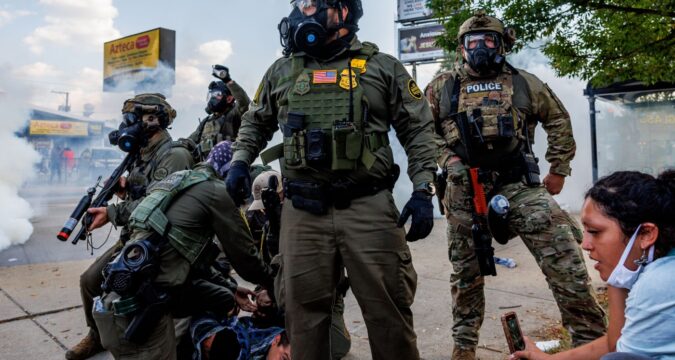
Some carried weapons. Two of them led dogs on long leashes. Some wore the camouflaged fatigues of military battle and others dark green uniforms. They all displayed markings that made clear their status as agents with the U. S. Border Patrol, and they’d arrived to complete one final Chicago mission — for the moment — to pose for the camera. One last made-for-social-media moment.
At least 100 agents, including their leader, Cmdr. Gregory Bovino, would return to Chicago six weeks later to continue a mission that President Donald Trump said hadn’t “gone far enough.” They would bring their cameras again. They would post their tweets. And they would argue with residents as they patrolled city and suburban streets in the days leading up to Christmas.
“We’re here to do a legal, ethical, moral mission,” Bovino would tell the Tribune outside a Home Depot on a cold December morning as bystanders blew whistles to warn of his whereabouts. “We’re going to keep doing that.”
Bovino’s mere presence — accompanied by his previous threat to return again in the spring and detain even more people — would renew the sense of alarm in a metropolitan area that has been demonstrably changed by the 64-day federal incursion and evoke memories of the most surreal autumn in recent local history.
The tear-gassing of Chicago neighborhoods. The rousing of suburban mothers in bathrobes, drawn into streets to yell at agents and shame them. The attempted deployment of the Texas National Guard, on Trump’s command, only for a federal judge to order the troops to stand down almost immediately upon their arrival in Illinois.
The agents who pointed guns and other weapons at bystanders. The arrests of more than 4,500 people in a mission, the Department of Homeland Security said targeted “the worst of the worst.” The reality is that most of them were people with brown skin who were at the right place — their landscaping jobs, the hardware store, a Dunkin’ Donuts drive-thru — at the wrong time.
A federal agent points a weapon to hold back a crowd as they briefly detain a woman pulled from her car before releasing her along West 26th Street on Nov. 8, 2025, in Cicero. (Brian Cassella/Chicago Tribune)
The Trump administration, though, has steadfastly defended its mission, even when the facts did not support its claims or federal judges outright refuted them. Tricia McLaughlin, assistant secretary for public affairs at the U.S. Department of Homeland Security, sent a statement to the Tribune for this story praising the operation and providing the names of seven convicted felons who were detained as part of Midway Blitz.
“This operation targeted the criminal illegal aliens who flocked to Chicago and Illinois because they knew Governor (JB) Pritzker and his sanctuary policies would protect them and allow them to roam free on American streets,” the statement said. “So far Operation Midway Blitz has resulted in the arrest of more than 4,500 illegal aliens. There is no way to say Operation Midway Blitz has not been a success with these results.”
Yet the government’s own data shows the agents failed to meet their stated goal: In what data the government has so far released, covering the first half of the blitz, a Tribune analysis found only about 1.5% of those detained for immigration-related reasons had been convicted of a violent felony or sex crime.
But the operation’s toll is still being understood, with impact that goes far beyond data points. The families who’ve been torn apart. The U.S.-born children who are now without fathers or mothers because their parents have been sent back to places they tried to escape. The people who built lives here, held down jobs, contributed to their communities but now are just gone.
Detained. Deported. Disappeared, in some cases.
U.S. Border Patrol agents detain landscapers Armando Lagunas, left, and Crispin Pérez who were mulching outside a building in Oak Park on Oct. 30, 2025. Three days later, the men had been deported to Mexico. (Brian Cassella/Chicago Tribune)
What happened here for more than two months is unlike anything in recent American history: the federal government sending agents dressed for war into neighborhoods of the country’s third-largest city to arrest mostly people who look Latino and to ask questions later. To target people largely on the basis of their skin color, on the presumption that they may be in the country without documentation, or that they may have a criminal record, or an association with a gang.
Cook County Board President Toni Preckwinkle, a former history teacher, said she had never seen anything like the autumn raids in her lifetime and she believes the operation will be judged harshly.
“Historians are not going to be kind to us in this moment,” she said. “We should all be ashamed of what our country is doing in our name.”
When the Border Patrol gathered at Millennium Park, it was two days after one of the agents executed a drive-by pepper-spraying of a young couple and their 1-year-old daughter in Little Village. Five days after they stormed a Spanish-immersion preschool in North Center and arrested a beloved teacher.
It was less than two weeks after a dizzying stretch that left Chicagoans stunned in late October:
On Oct. 23, agents tossed tear gas behind the discount mall in Little Village, the proud Latino neighborhood that, from the beginning of Trump’s immigration enforcement operation in Chicago, had remained a focal point.
On Oct. 24, agents lobbed more tear gas in Lakeview, a wealthy neighborhood that up until that moment had been relatively unaffected by the chaos.
Oct. 25, agents deployed even more tear gas, this time right before a children’s Halloween parade in Irving Park, where a resident raced out of his house, still in his Chicago Blackhawks pajamas, to confront feds who’d tackled a man in his front yard.
On Oct. 31, agents fired pepper balls in Albany Park, pointed weapons and assaulted residents in Evanston and grabbed workers in Edison Park, Hoffman Estates, Skokie and Niles.
Federal immigration officers detain a person in Chicago’s Albany Park neighborhood on Oct. 31, 2025. (Armando L. Sanchez/Chicago Tribune)
For some of the agents, the Nov. 10 trip to Millennium Park represented a return. The park, after all, is where some of them detained a Guatemalan family with children aged 3 and 8 as they ate Popsicles on a Sunday afternoon. That incident, in which a crying 8-year-old girl clutched her doll as she was led away by federal officers, became an early flashpoint.
Now, roughly two months later, early in the morning, before the crowds of tourists could gather in the quiet, cold dawn of a Chicago fall turning into winter, the agents entered Millennium Park. They headed toward the shiny metallic sculpture officially known as Cloud Gate but more commonly known as The Bean, and surveillance footage from that morning revealed an odd if not ironic scene.
It was one that suggested an appreciation for the artwork. An admiration, perhaps. A joy, even, in visiting one of Chicago’s most visible landmarks, and of having it all to themselves. On the pavilion, some agents can be seen stopping to take in the splendor of the sculpture. Some passed phones to each other and posed for photos, these masked agents of chaos behaving like tourists.
Soon enough, they lined up in rows on the stairs. There were at least 166 of them, but the photo that was shared later, the one DHS used to sell a story of a job well done, is blurry upon zooming, making it difficult to tell exactly how many agents stood in front of The Bean for what looked like a celebratory class picture.
What’s clear is that some of the agents were family men, with wedding rings. And that some of them held weapons. And that some of them came with their tactical vests. And that at least 89 of them wore face coverings and that at least 65 others did not, leaving their faces to be blurred out with the smudge of a Photoshop brush before the image became public.
In the middle of the front row, the leader of Operation Midway Blitz stood without a mask, as usual, and without a blurred face. He was meant to be seen. His command of the mission drew ire from residents, local leaders and U.S. District Judge Sara Ellis, who characterized him as “not credible” and chided him for “outright lying” in testimony about his actions throughout the fall in Chicago.
While Bovino posed at The Bean, he wore the stony expression of a man trying to look his most intimidating. Days later, as expected, he posted the photo on social media.
“Since we’ve BEAN here,” Bovino wrote, “crime is down,” falsely claiming credit for a decrease in homicides, shootings and carjackings that had dipped well before the feds’ arrival. By the time Bovino shared the class picture, he had already left town and was on his way to North Carolina. His agents were gone, too.
What they left behind will be remembered in Chicago for a long time.
The Before
They knew something was coming but they did not know what, exactly. They could not know, because there was no modern precedent. No way to know how to balance the Trump administration’s typical bluster with the specter that it might actually follow through.
For years, Chicago and its home state, with their Democratic leadership, had been in the crosshairs. Mayor Brandon Johnson and Illinois Gov. JB Pritzker had grown used to the attacks, but the president had always hit them with inflammatory rhetoric or insults, never tear gas or rubber bullets.
On social media and in off-the-cuff moments over the past decade, Trump displayed disdain for the city, railing against its challenges with crime and gun violence and using “sanctuary city” as a slur. He described Chicago as an all-caps “DISASTER” in 2013 and 2020. As a “WAR ZONE” in August 2024, months after he used his same social media platform to promote “the best hotel in Chicago” — the one bearing his name on a tower along the river.
Pritzker became governor in 2019, toward the end of Trump’s first term, and as the possibility of a second began to crystallize in 2024, he started to worry about Trump’s familiar threats to send troops into American cities.
Still, “I hadn’t fully absorbed the idea,” Pritzker said in a recent interview with the Tribune. “It was something I have feared, but there were things I feared during Trump’s first administration that didn’t come about.”
In time, the governor would come to think of Operation Midway Blitz in an extraordinary way:
“An invasion,” he said.
Homeland Security Secretary Kristi Noem and White House “border czar” Tom Homan speak with reporters at the White House in Washington on Jan. 29, 2025. (Yuri Gripas/Abaca Press)
It’s not that immigration enforcement was new to Chicago. There’s long been a gray area between what the nation’s outdated immigration laws say and what has been allowed. Most Americans agree on a middle ground: Go after bad guys and let law-abiders stay. But Congress hasn’t been able to convert that sentiment into law, creating an unease for years in places like Chicago where ICE continued to operate, targeting undocumented immigrants with serious criminal records while trying to draw little attention to itself.
Then voters handed Trump the mantle of power again.
Pritzker and Johnson, who became mayor in 2023, both point to the same moment when, in hindsight, they began to understand what might be coming. The harbinger was Tom Homan, the former U.S. Border Patrol agent who had served as a high-ranking Immigration and Customs Enforcement official under President Barack Obama.
Homan’s role grew during Trump’s first presidency and, at the start of the second, Trump afforded him a new title, and one that hadn’t previously existed: White House border czar. During Homan’s visit to Chicago for a Republican fundraiser in December 2024, Pritzker took note of his rhetoric.
“Chicago’s in trouble because your mayor sucks and your governor sucks,” Homan said then, while indicating that Chicago would be among the Trump administration’s first targets for immigration enforcement.
It wasn’t long after Trump’s inauguration that ICE activity increased in the city. Pritzker followed the news of the more robust immigration enforcement efforts in Chicago and couldn’t help but notice a difference: that they appeared manufactured. That they looked like scenes from some kind of twisted reality show. He noted the camera crews and the social media influencers wearing ICE jackets and pumping out content.
“So you could tell,” Pritzker said. “This is going to be different.”
Handcuffed detainees, including Marina Lopez Perez, third from right, are led into a van by federal agents on South Michigan Avenue as protesters demonstrate on June 4, 2025, outside an Intensive Supervision Appearance Program office run by Immigration and Customs Enforcement in the South Loop. (Brian Cassella/Chicago Tribune)
For months, apprehension built. State and city leaders traded intel and speculation, trying to predict the actions of an unpredictable and, as it relates to speaking in facts, often unreliable president. On social media, Trump first referenced his desire for troops to infiltrate Chicago in 2013. In 2017, not long after his first swearing-in, he warned that “if Chicago doesn’t fix the horrible ‘carnage’ … I will send in the Feds!”
Trump’s criticism of the city and its leadership long focused on crime. His broader emphasis on securing the southern border and facilitating the mass deportation of undocumented immigrants, though, provided another way for him to target the city. In the weeks and months after the initial burst of ICE activity early this year, Pritzker began receiving word of plans that concerned him.
“I would call them informed rumors,” he said. “Over the years, you know, you have relationships in various agencies of bureaucrats, I guess you’d say, who just hear things and know things and people who care about Chicago and Illinois. And so we would get a call, a text, something.”
From 2,000 miles away, Johnson and Pritzker paid close attention to what was happening over the summer in Los Angeles, where immigration raids sparked outrage and fiery protests. Trump deployed the National Guard there in June, and Johnson began a dialogue with Karen Bass, the Los Angeles mayor. The conversations were part exercises in empathy and part a desire, as Johnson put it, to “prepare for what was to come.”
He figured it was only a matter of time. In early September, Trump on his Truth Social account wrote that “Chicago is about to find out why it’s called the Department of WAR.” In the same post he referenced the 1979 movie “Apocalypse Now,” declaring: “I love the smell of deportations in the morning.”
Soon, the federal government gave the mission a name: Operation Midway Blitz. At an ICE processing and detention facility in Broadview, protesters gathered in larger numbers and tension heightened. Across the city and into the suburbs, residents braced themselves.
Leodegario Martinez Barradas is detained by federal agents on Sept. 7, 2025, in the Archer Heights neighborhood. (Gissele Garcia)
On the first Sunday in September, ICE agents detained a man in the parking lot of a car dealership in Archer Heights. The man’s name was Leodegario Martínez Barradas. He became the first known person detained in Operation Midway Blitz and, a week after his arrest, he was already back in Mexico.
After his apprehension, Barradas’ niece, Olga Sangabriel, worried that she and her husband, both of whom are undocumented, might be next to be detained. They have three children who are U.S. citizens.
“We are scared because we think that (agents) will show up at our house at any moment,” she said, “and I have my children here. Or that they will grab us when we go drop them off at school or while we’re out walking.”
Her uncle, meanwhile, had no known criminal record. ICE provided no information that suggested Barradas had been a threat, or belonged among “the worst of the worst.”
At the time of his arrest, he’d been selling flowers on a street corner.
The During
For 64 days, the pace remained relentless.
In the darkest moments, one of America’s most diverse yet segregated cities united in outrage. The regular tear-gassing of neighborhoods, eight of them in all, brought everyday people into the streets in opposition. Days into the blitz, federal agents fatally shot Silverio Villegas-Gonzalez, an undocumented immigrant and single father who agents say fled when they tried to arrest him.
Though the Department of Homeland Security claimed at the time of the shooting that Villegas-Gonzalez had endangered their agents’ lives, body-worn camera recordings from Franklin Park police captured an agent with bloody hands and knees describing his injuries as “nothing major.”
Less than a month into the blitz, an agent shot Marimar Martinez five times in Brighton Park and bragged about it afterward in text messages to colleagues.
Other moments, ones that fueled more mockery than fury, might’ve been comedic if they hadn’t underscored the cruel absurdity of it all: Bovino and his agents riding down the Chicago River in boats, as if reenacting Washington crossing the Delaware; agents in uniform marching down Michigan Avenue, toting weapons and bemusing tourists; the clumsy and viral attempt to apprehend a man who escaped on a bike downtown.
Jaime Ramirez, his daughter Dasha, 8, and wife Noemi Chavez are taken into custody by federal agents near Millennium Park in Chicago on Sept. 28, 2025. (Lindsay Rich)
But there was one incident — the arrest of the family with small children in Millennium Park — that seemed to change everything for politicians and the public.
It was then, Pritzker said, when he understood that this was an “invasion.” It was then, Johnson said, when he understood “what it meant for us as a city,” that, indeed, Operation Midway Blitz “was everything that people were warning us about.”
There became no place to escape in or around Chicago. No suburb. No neighborhood. Little Village and Pilsen remained obvious targets, where some residents lived in hiding, but no street offered refuge.
Even in Lakeview, on some scaffolding high above the intersection of Belmont Avenue and Broadway, there remains a literal sign of the mission’s reach. It reads: “a man was kidnapped from right here, 10-24-2025,” and it references the moment agents apprehended someone off the street.
A handwritten sign alerting people that a person was detained by Border Patrol agents at the corner of Belmont Avenue and Broadway in Chicago. (Chris Sweda/Chicago Tribune)
It happened just outside the Laugh Factory, the comedy club that draws national acts and offers a launching pad for locals. Nate Griffin, one of the club’s night managers, lives in an apartment on the same block. He was on his way to breakfast with his mother and sister when Border Patrol agents arrived at Belmont and Broadway to make an arrest.
While agents struggled to detain their target, “we stood there for a second, kind of in disbelief,” Griffin said. Moments later, after the arrest, Border Patrol officers returned to the intersection. A car door opened, and Griffin shut it on one of the agents’ legs.
For that he was wrestled to the ground, arrested, taken to the FBI’s Chicago headquarters and charged with assaulting, impeding or interfering with a federal officer. His moment of resistance put him at risk for an eight-year prison sentence.
And while Griffin appeared on an agent’s body-worn camera “mouthing off the entire time” about what he thought of Operation Midway Blitz during the ride to the FBI, he said weeks later that it had been a defense mechanism.
“I make jokes when I’m in tense situations,” he said. “I was just afraid.”
It took weeks for his charges to be dropped after a grand jury refused to indict him. Griffin became one of at least 10 American citizens whose cases have disintegrated in the wake of federal charges.
But, by that time, the damage had been done.
Griffin said his mom has relived his arrest over and over. He has learned to live with anxiety and the feeling of looking over his shoulder. He lives in the shadow of where federal agents executed what many locals consider a kidnapping and he doesn’t know what he’d do if he witnessed a similar scene again.
“It’s kind of hard because they do successfully scare you,” Griffin said.
Fear is something Chicagoans have learned to endure, and fight. For some it’s a much more arduous battle. Mario Hernandez Garcia is among those who suffers from nightmares. Sometimes he awakes in the night unable to breathe.
In his dreams, he’s being chased again. He’s being arrested. He’s being taken back to a room inside ICE’s Broadview facility. There are 80 people there, trying to sleep standing up, even in the bathroom, where the floor is covered in urine — just as it was in real life.
Hernandez, 33, arrived in Chicago in 2011 from the Mexican state of Michoacan. He aspired to find work and help his parents back home. Since 2023, he has had a pending U-visa — intended for crime victims who assist in investigations — made possible after he and his brother were carjacked in the Humboldt Park neighborhood.
When Trump became president again, Hernandez feared what it might mean for him and others like him. Then came Sept. 14. Hernandez said he was driving to get propane in Brighton Park when five vehicles of federal agents surrounded him.
They ordered him to roll down his window, he said, then broke the window when he didn’t roll it down far enough. After his arrest he passed out and needed hospitalization. A doctor diagnosed him as having a panic attack, Hernandez said, while the agent keeping watch over him accused him of faking it. Then he was taken to the Broadview processing center. His experience there mirrors those described in a federal lawsuit against DHS that accuses the government of maintaining dirty, unsafe conditions at the facility.
Mario Hernandez Garcia hands a customer food from his taco truck Dec. 20, 2025, in Chicago’s South Shore neighborhood. He was detained for five days by federal immigration agents while transporting equipment for his business in September. (John J. Kim/Chicago Tribune)
The lawsuit alleges that agents crammed more than 100 people into four small rooms and held them there for days. In the room Hernandez found himself, he initially did not understand why the floor was wet.
“Then I figured it out,” he said through a translator. “It was people urinating outside the stalls.”
On the fourth day of his detention, Hernandez refused to sign a form that would have led to his transfer to a detention facility in Michigan. On the fifth day, he said, he witnessed a fight between a detainee and four federal agents. Two hours later, he was released without explanation and on his way to 25th Avenue in Broadview.
Hernandez walked to a gas station and called his girlfriend. He was happy at first, he said, “because the nightmare was over.” The ones in his sleep had yet to begin.
He was, in a way, one of the lucky ones. He disappeared for only five days.
‘An extraordinary thing’
The first part of their journeys often ended in Broadview, at a charmless two-story brick building surrounded by railroad tracks and the hum of the Eisenhower Expressway. In the early days of Operation Midway Blitz protesters and agents routinely collided outside in a storm of expletives, pepper balls and tear gas.
If those detained and brought to Broadview could prove their American citizenship, their time in the system often ended. For many, though, Broadview was just the start. A place of holding before bus rides to the airport, or to prisons or immigration facilities all over the country.
People arrested by ICE or Border Patrol in Chicago wound up confined in Wisconsin or Indiana, Michigan and Kentucky. Some were imprisoned in Texas. Others in Missouri or Kansas or Louisiana. Some in Oklahoma. Some in Arizona. Some in New Mexico.
Their trips to those places may have passed through Broadview but they all began with a moment before. A traffic stop. A chase through a parking lot, on a stranger’s front lawn. An interrupted walk across the street on a sunny fall day, with agents rushing out of a vehicle to surround them. One minute free, the next on the ground, the one after in handcuffs.
Chicagoans tried to bear witness. They tried to fight back. The city’s reaction to federal immigration agents followed a long-established pattern of resistance born here during the workers’ rights movement of the 1880s and the Civil Rights Movement more than a half-century later. Despite the racial segregation that still defines many of its neighborhood borders, Chicago, as much as any American city, is a place that unites against forces its people find unjust.
And so a city came together. Its residents marched down streets and made noise at the sight of federal agents roaming neighborhoods. People came out of their houses to point cameras at attempted apprehensions or heated interactions between agents and citizens. In some moments, they locked arms to block the agents’ vehicles, forming a human chain. In many other instances, locals hustled through their blocks in Revere-esque fashion to give warning: ICE is coming.
These actions often came with a price. There were bruises from pepper balls and fits of sickness, of respiratory stress from the tear gas. But more than that there came to be the shattering of illusions and the loss of an inherent faith that what they witnessed could not happen in America. And that if it did, it certainly couldn’t happen on their street, or right outside their door.
The blitz was proof that these things could happen in those places. They did happen.
A woman is given milk to ease the pain in her eyes after federal officers threw canisters of chemical agents at community members and protesters from their vehicles while leaving the Brighton Park neighborhood on Oct. 4, 2025. (Armando L. Sanchez/Chicago Tribune)
Kevin Boyle, a professor of American history at Northwestern University, said the federal incursion into Chicago was “quite an extraordinary thing” and “a political act meant to intimidate people.”
“I hope the country should, and I think historians will, judge this sort of action really harshly,” Boyle said.
“This is disturbing in two different ways. One is … it’s the federal government doing something that breaks the guardrails in a really dangerous way. Sending federal authority into a city that you have, yes, rhetorically, disparaged as a hellhole, but to send those federal authorities in against the expressed wishes of state and local authorities is a really big line to cross.
“It’s breaking guardrails that are important not to break. Then there’s the desire of the federal government to target places that vote for the other party to assert a police power that is meant to intimidate people.”
Witnesses to what agents wrought in Chicago provided declarations that are a part of a federal lawsuit against Kristi Noem, the secretary of the Department of Homeland Security, and others. In dozens of court statements, people provided testimony to their experience with federal agents.
In one of them, an Oak Park resident named Scott Blackburn recalled an encounter at a Broadview protest in which he claimed that Bovino and his agents tackled him to the ground. In another, Andrea Pedroza recounted watching TV at her home off of 105th Street on the East Side when she heard the noise of agents crashing into cars on her street. A crowd gathered. She watched those agents tear-gas protesters and recalled one with his finger on a trigger, aiming a weapon at a minor.
“I spent the whole rest of the day thinking about how I never thought something like this would happen in front of my house.”
On the morning of Oct. 25, a Saturday, James Hotchkiss was about to leave his house with his wife and his two children, both in costume. They were all headed to a neighborhood Halloween parade in Old Irving Park.
He said he went into his garage to “get a second spinny toy” for one of his kids and that’s when he heard commotion. As Hotchkiss walked down the street he watched two agents tackle a man in a neighbor’s front yard. The neighbor, Brian Kolp came outside, still wearing his Chicago Blackhawks pajamas.
According to Hotchkiss’ declaration, agents accosted a woman in her 60s and pushed another man to the ground, putting him in a headlock before letting both go. Moments later, Hotchkiss heard someone say, “Oh my God, they’re putting on their gas masks,” and soon a plume of tear gas filled the street.
Kolp, a former prosecutor with the Cook County state’s attorney’s office, picked up the tear gas canister and preserved it for evidence. In his declaration he said the agents “showed no respect for the rule of law.”
“As someone who supports law enforcement and has represented them as an attorney, I feel that the behavior of these agents is embarrassing and tragic,” he said in his signed statement.
In some moments there were no witnesses. Only the recordings of agents’ body cameras.
‘Not our problem’
One such recording captured a pursuit on a sunny early-October day on a quiet corner in Little Village. The footage shows agents roaming the city in a silver Chevy Silverado. There’s at least three of them, all in green Border Patrol uniforms, the driver wearing a backward hat with the logo of Sitka, a company that makes hunting gear.
The agent in the back twists open a bottle of water. The truck comes to a sudden stop.
The agents rush out and toward two people crossing the street: an older man in dark pants and a white shirt, and a much younger man, in his early 20s, in shorts and a light shirt. It is a father and his son.
Almost immediately, the camera captures the fear in their eyes. And almost immediately, the son steps in front of his father, shielding him. The agents approach and the son holds up his hand and pushes his father a little farther away.
“He has a disabled kid, honestly,” the son says.
“How about we start with you,” an agent says to the younger man. “Who are you?”
“I’m a United States citizen.”
“OK,” the agent says. “Can I talk to him, please?”
“No. … He has a disabled kid, honestly,” the son says again, pleading.
“That’s not our problem,” another agent says.
“You’re a father, right?” the son asks.
Behind him, his father has been grimacing. He looks scared but resigned.
He tells his son to relax, again and again. He seems to understand and to accept what is to come.
Moments later, agents push the son away and onto the ground. While he’s placed in handcuffs, the father is taken down, too. In the commotion they both cry out before they’re taken away. From start to finish, the entire encounter lasts a little more than three minutes.
Had it happened in another time, the scene might’ve commanded more attention. It might’ve conjured widespread heartbreak or outrage or become a flashpoint. As it was, though, it happened days after the militarized raid of a South Shore apartment building, in the days of endless raids, chases, gassings. It blended into all the rest.
In 2025, it was just another October morning in Chicago.
‘Less than human’
In the moments before he rode in a white van from a downtown Chicago immigration facility to the ICE building in Broadview, Jhoanni Pineda Mesa pleaded with officers to allow him to use the bathroom.
“Please,” he recalled asking after being placed in chains and put in a room with other detainees. “I have a medical condition and I really need to pee.”
The request was denied, he said, and Pineda Mesa was led into the van headed to Broadview. During the ride he could no longer hold his bladder and he wet himself. Thus began a disorienting, weekslong descent into a detention system that operates like a black hole, one that causes people to “disappear” within custody, according to human rights lawyers.
Pineda Mesa’s ordeal began with a regularly scheduled check-in at a downtown immigration facility on Oct. 29. The appointment was a routine part of his pursuit of asylum. He’d come from the Dominican Republic three years ago to reunite with family in Chicago, and though he wasn’t a full-fledged American citizen he had a work permit and a social security card.
During the blitz, though, check-ins like Pineda Mesa’s became easy targets for agents with a mission to detain people. He had attempted to comply with the law. He arrived for an annual check-in, just as required, and he expected to receive a date for his next one.
The refusal of a bathroom in the moments after agents apprehended him was only the start of a series of indignities. At the facility in Broadview, with Pineda Mesa’s pants now wet and soiled, agents again denied his request for a restroom, he said. He used a phone call to contact one of his sisters who tried to deliver medication, but he said the delivery never reached him.
Jhoanni Pineda Mesa becomes emotional on Dec. 26, 2025, as he talks about his time in detention after a routine check-in with immigration officials in Chicago. He was transferred without notice through multiple detention centers across several states and says he suffered through cold and hunger. (Terrence Antonio James/Chicago Tribune)
For three nights, Pineda Mesa said, he remained in a large room with about 100 other detainees. There were no beds, he said. No food. No hygiene products. He described it as “humiliating.” He said several other detainees, like him, had been brought there after routine court appearances.
“People wouldn’t sleep because there were no beds,” he said. “Some would cry, others would pray.”
Agents presented Pineda Mesa with forms to sign to ensure his voluntary deportation. He refused.
“And they told me, ‘OK,’” he said. “‘Then you’re going to be here for a long time.’”
After his third night in Broadview, at 5 a.m., agents again placed him in chains. They escorted him and about 40 others to a bus. There was no indication where they were going, Pineda Mesa said, and he came to have one terrifying, recurring thought.
“I was afraid that they would disappear me and that I would never see my family again.”
“Tenía miedo de que me desaparecieran y nunca volver a ver a mi familia.”
For several hours he did not know where he was or where he was going. The bread and water agents handed out remained difficult to consume, with the restriction from the chains. At a stop at an unknown location, agents transferred Pineda Mesa and others to another bus.
They were all “hungry, sleepy, dirty and lost,” he said.
“We felt less than human.”
They spent several more hours on the second bus. His thoughts grew darker.
“I thought we were going to die or that something really bad was going to happen to us.”
The ride ended at another detention facility. Pineda Mesa believed it to be in Missouri, based on road signs. In a phone call that lasted seconds, he let his family know he was alive, in jail and didn’t really know where.
At the time of that phone call, Pineda Mesa’s family had been trying to locate him for days. The effort continued after the call. A sister who spoke with him said their family’s attempts to go through ICE turned up nothing. The DHS phone numbers they scrambled to find were dead ends.
“We were desperate and hopeless,” said his sister, who asked that her name not be used out of fear of retaliation. “We couldn’t believe that this government operated this way. We ran away from governments that disappear people, that have no accountability, and the same thing is happening here.”
Stories like Pineda Mesa’s have become common in Chicago and in other parts of the country where federal agents have targeted undocumented immigrants, according to families, advocates and immigration attorneys. Accounts of “disappearing” people — of those lost in a maze of transfers and unobtainable records — have been some of the most difficult to document during the blitz.
“There’s just several factors and policies working together that make it so that it is challenging to know where your loved ones are, and challenging to know the cause of the arrest,” said Jennifer Babaie, associate director of the National Immigrant Justice Center’s Adult Detention Project.
For attorneys who have spent years navigating ICE’s bureaucracy, the past year feels different. Rapid and unannounced transfers of those in custody, sometimes across multiple states within 48 hours, have become routine. Even attorneys of record are often never notified of a transfer, Babaie said, and that’s if those detained are somehow able to get an attorney.
“You can have a legal call scheduled, be preparing for an upcoming hearing, and then your client just vanishes,” she said. “They disappear from the detainee locator for a few days.”
Sometimes they don’t show up at all.
“There’s not a lot of reliability with the ICE detainee locator. So it’s not unheard of to have you put in an A number” — a record associated with immigrants used to locate them in federal custody — “and the person doesn’t show up, even though you know that they were arrested.”
Soon, Pineda Mesa was on the move again. Agents transferred him from Missouri to Texas.
Then from Texas to St. Louis. And finally to the Miami Correctional Facility in Crawford, Indiana.
He came to see it as a “strategy,” he said later, and more deliberate than dysfunctional.
“They move you,” he said, “so no one can find you.”
The After
On Nov. 17, a week after Bovino and his agents gathered for their team picture at The Bean, Jhoanni Pineda Mesa received news he craved. He did not expect to receive it and weeks later he could not explain why it happened. But it happened , nonetheless: He’d been granted his release from the Miami Correctional Facility in Crawford. After 19 days, he was free.
He was released, he said, without a phone call and without his belongings. He made his way to a nearby Mexican restaurant and used the phone there. He was hungry. He told a worker that his sisters could pay for a meal when they arrived to pick him up, and the worker began to prepare one.
“May God bless that woman,” he said of one of the restaurant employees, “because she gave me a taco and a Coke. I tried to eat slowly until my sisters arrived so they wouldn’t kick me out.”
Soon he was on his way back to Chicago. For many others, the blitz brought an end to their time in America. The U.S. Department of Homeland Security did not answer questions about how many of its 4,500 arrests in the Chicago area ended in deportations. Nationwide, more than 2.5 million undocumented workers left the country in 2025, including 1.9 million who departed voluntarily, according to the Trump administration.
Adriana Rivera, 44, was among those who’d decided to leave. She’d lived in Chicago for 14 years when she packed her life into one large suitcase and two carry-ons and said goodbye to a small circle of friends. There were tears and embraces. On Dec. 14, a bitterly cold Sunday, Rivera went on her way to reunite with her deported husband in Michoacán, Mexico.
Theirs had been a story, at one time, of hope and American aspiration. Rivera’s husband, Arturo Rodríguez Bellos, lived in the United States for 25 years and settled into Little Village. Rivera joined him there years later. Both undocumented, they initially wanted to earn money to pay for the education of their two sons and then, later, to build their children a home.
In recent years, health problems plagued Rivera and Rodríguez Bellos, 44. They hoped to remain in Chicago long enough to save more money for their family. But then came the start of the blitz, and Bovino’s performative visits to Little Village, where he often tangled with protesters, and perhaps where he most embraced his mission with a militaristic bravado made for the cameras.
Rodríguez Bellos understood the danger of the raids. Everyone in Little Village did. But he was not a criminal, he said during a recent phone call from Mexico, and so he thought it was worth the risk to remain in public and continue working as a street vendor. For years, he’d sold farm-fresh eggs from Wisconsin.
And then, just like that, he was detained when Bovino and his agents made one of their many sweeps of the neighborhood. Rodríguez Bellos could have fought to stay. He’d been here for more than two decades. He’d built a life.
“We didn’t know how long he would be detained or how much money we would need for an attorney,” Rivera said. “So we decided it was best for him to return to Mexico.”
Rivera spent most of the next two weeks in bed. For the first time since arriving in Chicago 14 years earlier, she was alone. She said she barely ate. She spent a lot of time crying, unable to move. She felt trapped. She had no savings. She feared that if she attempted to sell eggs, she’d suffer the same fate as her husband.
Two friends, who also happened to be two of her husband’s most loyal customers, wanted to help. Maria Hernandez and her husband, Javier Tlaxcala, both 75, had always bought their eggs from Rodríguez Bellos. They made Rivera an offer:
“We will help you sell the eggs.”
Adriana Rivera sits among eggs that she usually sells as a street vendor while at her friend María Hernández’s home on Dec. 12, 2025, in Chicago’s Little Village neighborhood. Hernández and her husband agreed to sell the eggs for Rivera after she moves to Mexico. (Dominic Di Palermo/Chicago Tribune)
For weeks, Rivera weighed her future. She faced limited job prospects. All around her in Little Village were stories of upended lives and families torn apart. Leaving the country came with its own burdens. The cost, for one. The challenge of starting over in an unfamiliar place.
Hernandez tried to offer reassurance.
“We will find a way to help you,” she said, and others in the community offered assistance, too. When Rivera decided to leave Chicago and join her husband in Mexico, one woman donated money to cover Rivera’s remaining rent and part of her plane ticket. Others offered to buy eggs.
“They’re my angels,” Rivera said.
The day before Rivera left, Hernandez hosted a farewell party. Surrounded by hundreds of Wisconsin eggs that Hernandez and her husband promised to sell, Hernandez kissed Rivera goodbye. The women embraced.
“I’m going to miss you very much,” Hernandez said as she wrapped Rivera in a hug. “But we will stay in touch. Maybe one day you can come back.”
Adriana Rivera hugs her friend María Hernández goodbye before she went through security for her flight to Mexico at Chicago’s Midway Airport on Dec. 13, 2025. (Dominic Di Palermo/Chicago Tribune)
The next day, Rivera boarded a plane with a one-way ticket to Morelia, Michoacán. Her deported husband waited. While he spoke by phone from Mexico during a recent interview, Rodríguez Bellos walked through the plaza of the town where he grew up. He lacked money and good health but, he said, “I’m glad we are both safe.”
“And I’m grateful that we will be together again. The rest, we will figure out. Our life must go on.
“We have to find a way to keep living.”
Despite the ending, their time in Chicago was worth it, they said. They were able to send money home. They put one of their sons through college. Little Village, Rivera said, “will always be in my heart.”
“It took part of our lives, but it also gave us so much. We knew we couldn’t stay forever.”
They could never apply to adjust their undocumented status because they lacked a sponsor. They doubt whether they’ll be able to live in the United States again. They left their old lives behind, and a lot of eggs. Hernandez and her husband promised to sell them and send the money to Mexico.
‘A miracle story’
They arrived in the dim light of a freezing December Friday morning, temperatures in the low 20s just after sunrise, and gathered as close as they could to the ICE detention facility in Broadview. They secured an iPad to a tripod for those joining online and handed out prayer cards while an elderly woman in scarves and a heavy winter coat went around giving out rosary beads.
About two dozen people trickled in, some holding coffees in gloved hands while they walked over an ice-covered road to join the group. A couple of them carried American flags. One brought a large Mexican flag. Another came with a flag in honor of Our Lady of Guadalupe, as this particular Friday happened to coincide with her feast day.
For 19 years, Chicago-area priests and nuns have led prayer vigils every Friday morning outside of the ICE facility in Broadview every Friday morning. That’s when the buses would emerge from a gate next to the ICE building, carrying detainees on their way to be deported.
The gatherings were started by the late Sister Pat Murphy and Sister JoAnn Persch, who were longtime advocates for immigrant rights. They would pray the rosary just outside the entrance of the building. There was a time they were even allowed onto the departing buses, offering one final Hail Mary, one last sign of the cross, to detainees headed to O’Hare.
In mid-September, there came to be a “much, much different vibe” surrounding the vigils, said the Rev. Brendan Curran, a Catholic priest who has been a regular in Broadview since the Friday gatherings began almost 20 years ago. Four days after DHS announced the start of the blitz, Curran arrived like usual early on a Friday and noticed the windows of the ICE building had been boarded.
It was as if there’d been preparations “for a riot,” he said, and the scene reminded him of when he worked 20 years ago along the Gulf Coast in the days before Hurricane Katrina.
“You had to board up because a hurricane was coming, right?” he said. “So I’m like, ‘What’s the hurricane here?’ I know when you’re at a federal building, it’s about, ‘What’s the riot you expect?’”
He saw camouflaged and masked agents atop the building. They carried what Curran perceived to be guns, though they could have been pepper ball launchers. Either way, the agents aimed them at Curran and others while they met to pray. It was the last time for a while that the prayer group met so close to the building.
On that day, and on many that followed, tensions in Broadview simmered. Confrontations between agents and protesters sometimes became physical. The release of tear gas and pepper balls became routine. Residents who lived nearby could recount agents chasing people through their yards and the burning sensation of gas and pepper spray on their skin and in their eyes.
Some were afraid to let their children go outside. While Broadview became the epicenter of a lot of the ire that amassed throughout Chicago, the prayer group continued to meet on Friday mornings. They were forced to gather more than a block away, but on Dec. 12 they were as close as they’d been in three months. Curran considered it a small victory.
He considered it “a miracle story of the holidays,” too, that, all things considered, the city had kept its relative cool over the past several months. There had been no riots. No need for the boards on the windows at the ICE facility in Broadview. To Curran, the story of the blitz was as much about people coming together in opposition to it as any of the trauma it inflicted.
“Throw all of the policy stuff out the door for a minute,” he said. “In the midst of inciting violence by federal officials — which is, in my estimation, especially in a place like Chicago, a very dangerous, pouring-oil-onto-a-fire kind of thing — I was shocked at the discipline, the civic discipline.
“People kept their cool in a remarkable way.”
In the same breath, he said, “I don’t know how long that can last,” though he prayed it would.
Holding hands for a final prayer, the Rev. Brendan Curran, center, gathers with faith leaders and advocates near the U.S Immigration and Customs Enforcement holding facility in Broadview on Dec. 12, 2025. (Antonio Perez/Chicago Tribune)
The vigil that cold Friday morning in December began at 7:15 sharp, just like always. It was a reflection of the broader faith that spread throughout the past several months in Chicago. In the spring, the city united to celebrate one of its one, Robert Prevost, rising to become Pope Leo XIV, and the first American-born pope. In the fall, the city united in opposition of what many considered to be an invasion, and one unlike any in American history.
Pope Leo inserted himself into the movement from the Vatican, as he spoke out against the treatment of migrants in the United States and the Trump administration’s refusal to allow religious leaders to pastor to Broadview detainees.
By mid-December in Broadview, few signs of the turmoil remained. The ICE facility held far fewer detainees than it did in September. On the road, someone had written “we love our resistance” in chalk. The attendees huddled together and recited the Our Father and three Hail Marys, first in English and then in Spanish.
They prayed for immigrant children. They prayed for those detained, and for the country.
And while they prayed a gate opened down the street. A white bus slowly emerged and pulled away.
‘The federal government is powerful’
On the same mid-December Sunday when Rivera boarded her flight to Mexico, a group of seven women from the city’s farthest northwest corner gathered at a coffee shop just beyond the Chicago border.
Culturally and ideologically, Edison Park and Norwood Park are as far removed from Chicago’s Latino enclaves as any place around the city. And yet even there, locals gathered to organize against the threat of federal immigration agents.
The women, part of the Ebinger ICE Rapid Response team — named for one of their local elementary schools — wanted to be ready. They wanted to provide training for neighbors. They wanted to connect with other groups of parents on the Northwest Side who’d grown wary of agents sowing mayhem in their communities.
In the aftermath of the most frenzied part of the blitz, the gathering at Off the Wall Cafe in Park Ridge reflected one of its most enduring lessons: that leaders with the most power actually had little to combat what they considered to be an invasion. That it was instead up to citizens to protect their communities.
Members of the Ebinger ICE Rapid Response team, made up of residents from Chicago’s Edison Park neighborhood and surrounding communities, meet Dec. 7, 2025, to discuss their plans at Off the Wall Coffee in Park Ridge. (Brian Cassella/Chicago Tribune)
Pritzker earlier in December compared the learn-on-the-fly response to Operation Midway Blitz to what it was like during the pandemic. Every day, or week, brought new lessons. Slowly, he and his leadership team understood more and more about what they were dealing with.
Part of that process, though, included an uncomfortable truth: They couldn’t do a whole lot.
“I think we’ve learned what their tactics are,” he said of federal agents. “We’ve learned what things can be done. We’ve learned what the protest looks like, and we’ve learned what the limitations are on us with regard to addressing the brutality and breadth of the ICE-CBP invasion and then, of course, everything legally we’ve learned about the National Guard.”
“I do want to liken this to COVID, because we knew more six months in then we knew, you know, one month in. And it wasn’t that we had all the answers, but you kind of — you understood. And understand now the tactics and what the likely trajectory is, (and) that’s helpful for the next time this happens.”
“One thing I learned during COVID was that the public without solid information or without truthful information is lost,” he said. “The public is uneasy and wants somebody to tell them what’s really going on.”
Lisa Porter yells at federal agents and tells them to leave as they sit in their SUV along East Busse Avenue on Oct. 19, 2025, in Mount Prospect. (Stacey Wescott/Chicago Tribune)
Johnson put it more bluntly: “I will say the big thing we learned is that there is a way in which we can be united around a mission,” he said, “and also wrestle with the fact that there are some limitations to what we can do. And that’s a tough lesson.”
Johnson, who grew up in Elgin, considered the blitz an attack on his adopted city, and perhaps one that was inevitable. He saw no use in trying to engage Trump in hopes of softening the blow, and was adamant that “there was nothing that was going to stop the president of the United States of America from invading the city of Chicago.”
“Nothing,” Johnson said.
“It would have been a fool’s mission to go in there and try to explain to him … to convince the president from not invading an American city. Tell me someone who has a template around how that works?”
Like many in Chicago, Johnson experienced a mix of outrage and empathy throughout the fall. When stories emerged of people being chased through neighborhoods, or a downtown park, he imagined his own family on the receiving end. The little girl with the doll in Millennium Park made Johnson think of his own daughter.
He tried to decompress with long rides on a bike. He tried to present strength in the midst of attack after attack. He received regular briefings throughout the blitz and found a lot of details — about South Shore, and the shooting in Brighton Park — to be “graphic” and “horrific,” he said.
“The federal government is powerful,” Johnson said, “and it’s more powerful than the state, more powerful than local government, and it didn’t stop us from coming up with ideas to figure out how to mitigate some of the harm. Right?
“And here’s what I believe, and this is not just gut or intuition or my heart, it’s just based upon evidence. If we did not acknowledge that pain and we didn’t do what we did do, it would have been far more severe in this city, hands down.”
Back in the coffee shop at Park Ridge, the women of the Ebinger ICE Rapid Response team went to work. In the early days of the blitz, they didn’t necessarily think it would reach their corner of the city. But then came raids in Lakeview. In Irving Park.
“It’s like a literal storm,” said Charity Haines, one of the group members. Haines, 47, had joined a group of concerned neighbors on Signal a few days before Halloween, when Bovino and his agents made an arrest outside of Frederick Stock Public School as children played outside. Not long after, agents were on Haines’ block, questioning a pair of Polish workers who turned out to have legal status. Haines had been bringing in her groceries.
“And you’re just overcome with anger,” she said.
In the weeks since, the response group has grown. Some of its members regret that they didn’t start it sooner. There are similar groups all over Chicago, ones that have led the whistle-packing events and that have spread the word when ICE arrives in a given neighborhood; groups that have tried to protect members of their community and embraced a grassroots power.
One of the group members got in touch with Liz Rincon, who works for state Sen. Robert Martwick, and volunteered to help the group organize a “know your rights” training. The workshop took place days before Bovino and his men took their photo at The Bean.
“I don’t want people to think they got involved too late,” said Rincon, 45. She believes that if and when federal agents returned, they’d “be met with a bunch of very prepared people.” That if ICE and Border Patrol came back to the Northwest Side and expected little resistance, they’d be met with something else, entirely.
“A little army of Lululemon women,” Rincon said, “with our Stanley cups.”
And then, not long after, word spread throughout Chicago.
Bovino had indeed returned.
The epilogue
He stood on a snowy Little Village curb while his men escorted a grimacing man down 27th Street and into one of their Wagoneers. It was a Tuesday morning, Dec. 16, and except for the thick green winter coat, with the yellow U.S. Border Patrol patch on his right arm, everything about Greg Bovino looked the same as it did in the fall.
He wore his usual helmet. He moved, like usual, as if ready to fire, with his right finger near the trigger of a gun. He listened to furious neighbors with an expression that conveyed a mix of calm and contempt. For weeks he’d been gone, but “we never left,” Bovino told those gathered around him.
“We never left, guys.”
It was as if the photo at The Bean never happened. As if it hadn’t been a celebratory farewell.
That Tuesday morning in mid-December, sightings of the federal convoy and all-caps warnings of arrests in a Cicero parking lot filled social media. People lined 26th Street in Little Village, craning their necks on business steps and street corners, whistles in hand and horns blaring in the distance. Around the federal convoy, traffic slowed and brakes squealed as dozens of cameras rolled.
Among those arrested during Bovino’s return was 23-year-old Sergio Ceballos, who was detained while riding his bike in Little Village. He is currently being held in Texas, awaiting deportation.
His family knows well the fear and uncertainty of the situation. They went through it three months earlier with Ceballos’ older cousin, Leodegario Martinez Barradas, the flower vendor who became the first known arrest in Operation Midway Blitz.
Despite their age difference, the cousins have much in common. Neither have criminal records. Both came to Chicago seeking a chance.
“That is our crime,” Barradas’ niece Olga Sangabriel said. “Seeking a better life for our family.”
While he encountered people upon his return to Little Village, Bovino ignored onlookers’ questions and phone cameras. He simply said, “Merry Christmas if I don’t see you again,” before he sauntered toward his white Suburban. Later, stopping in a Forest Park gas station, he couldn’t resist offering angry onlookers another pun, this one holiday-inspired:
“We love Chica-ho-ho-ho.”
The next day, it took the convoy most of a morning of driving before it stopped in the parking lot of an Evanston Home Depot. Everyone assumed their familiar roles.
Evanston Mayor Daniel Biss, who had protested outside the Broadview facility early in the blitz, demanded that the agents stop arresting his residents. Bovino, flanked by two masked agents, kept a straight face amid the forest of cameras and phones.
“They’re illegal aliens,” he said. “They’re not residents.”
Biss called the campaign a “reign of terror.” Bovino smirked and pledged to continue conducting “legal, ethical and moral” immigration enforcement.
Less than two days later, federal agents gathered for another farewell photograph, this time at the DuPage Airport. This one appeared more impromptu than the one at Millennium Park more than a month earlier.
Federal agents pose for a photo in front of a Coast Guard airplane before departing DuPage Airport on Dec. 19, 2025, in West Chicago. (Stacey Wescott/Chicago Tribune)
There were no face coverings. No dogs or guns. They dressed in jeans and sweatshirts and smiled in front of a U.S. Coast Guard plane.
Soon they were gone again, for now, but the past several weeks and months had come to underscore a difficult truth for a wounded and resilient city: that the mission Bovino and his agents started in September was not, in fact, over. That it was only a matter of time before they’d be back.
https://www.chicagotribune.com/2025/12/28/chicago-immigration-operation-midway-blitz-2/
New Illinois laws taking effect in 2026 touch on policing, expand abortion access and regulate some AI use
As Illinois turns the calendar to 2026, it will bring more than fresh resolutions. It will also usher in hundreds of new state laws, statutes that will quietly reshape daily life from grocery store checkout lines and police departments to college classrooms, hospital exam rooms and workplaces.
Related Articles
Gov. JB Pritzker signs controversial Illinois medical aid-in-dying law amid strong debate and opposition
Waymo wants to bring self-driving taxis to Illinois. Does the Land of Lincoln want them?
Illinois ‘Clean Slate’ bill that would speed sealing of many criminal convictions awaits Pritzker signature
Beginning Jan. 1, roughly 300 new laws will take effect, reflecting Democratic Gov. JB Pritzker and lawmakers’ priorities following debates over public safety, reproductive rights, higher education, environmental protection and the role of emerging technologies.
The laws arrive as Springfield braces for another high-stakes legislative year. Lawmakers will soon return to the Capitol to negotiate a multibillion-dollar budget amid the 2026 election as Pritzker runs for a third term and many legislators’ names will be on the ballot for reelection or bids for Congress. Democrats, who retain supermajorities in both the state House and Senate, are also preparing for potential clashes with President Donald Trump’s administration over federal funding, health care and education policy.
Questions also remain over whether any progress will be made regarding a new Chicago Bears stadium. That’s especially noteworthy after Bears officials on Dec. 17 said state elected leaders were not prioritizing getting a deal done in Springfield and said they were beginning to look across the border for stadium opportunities in Indiana.
Somewhat closer to home, the elimination of Illinois’ 1% grocery tax — a signature Pritzker initiative — will take effect Jan. 1, drawing cheers from consumers and concern from some municipalities that rely on the revenue and have instituted a tax of their own to pick up the slack.
Against that backdrop, here is a look at some of the most consequential new Illinois laws taking effect as the state rings in 2026.
Homicide clearance rates
Chicago police officers investigate the scene after two people were fatally shot in a vehicle in the 300 block of West 31st Street in Chicago’s Armour Square neighborhood on Oct. 17, 2025. (Peter Tsai/Chicago Tribune)
To address the scourge of gun violence and public frustration over unsolved crimes, Illinois will now require the publication of detailed information about clearance rates for homicides.
The Illinois Criminal Justice Information Authority will be tasked with publicly reporting how many such crimes occur and how many are cleared by arrest, along with additional details explaining why cases were closed — including when a suspect has died or when prosecutors declined to pursue charges. The Illinois State Police will serve as the central data hub, collecting information from local agencies.
State Rep. Kam Buckner, who was one of the architects of the law, said earlier this year that Illinois does not have “a comprehensive, standardized and publicly accessible system” for ordinary people to learn about how often police make arrests in these violent crimes, which over the years has given cities like Chicago an unflattering reputation.
“The information exists but it is often fragmented, delayed or difficult for the public to access,” said Buckner, a Democrat from Chicago’s South Side, where much of the city’s gun violence has historically taken place.
Police accountability
Another law aimed at police accountability is meant to prevent officers with troubled histories from quietly moving between departments.
Police applicants must now allow the release of extensive employment records from prior law enforcement agencies, including background investigations, fitness-for-duty exams, performance evaluations and records related to alleged misconduct or criminal behavior.
The measure followed the July 2024 fatal shooting of Sonya Massey, a 36-year-old Black mother of two, by Sangamon County Sheriff’s Deputy Sean Grayson in a case that sparked national outrage and calls for police reforms. Grayson had previously worked for multiple departments despite documented concerns about his conduct. Pritzker called the law a national model when he signed it.
Grayson was ultimately fired by Sangamon County after the shooting, but at that point, the sheriff’s office had been the sixth police department in Illinois that he’d worked for, despite previous police employers criticizing his abilities as an officer. A downstate jury in October found Grayson guilty of second-degree murder.
“Officers with histories of serious disciplinary issues should not be serving in those capacities in our communities,” Pritzker said.
Rewilding
Beginning in 2026, the Illinois Department of Natural Resources will be explicitly authorized to reintroduce native animal and plant species to lands where they were previously eliminated. That comes despite objections the legislation would encourage the proliferation of wolves and other apex predators.
Supporters of the so-called “rewilding” measure say the law gives IDNR more flexibility to restore ecosystems. Skeptics raised concerns about risks to livestock and public safety. Sponsors stressed the measure does not mandate any reintroduction and leaves decisions to IDNR professionals.
“We’re not talking about reintroducing large animals to villages, cities, farms, et cetera,” said state Rep. Anna Moeller, a Democratic sponsor from Elgin.
Abortion shields
Illinois is expanding legal protections for abortion care providers amid national uncertainty over federal regulation.
Under a new law championed by Pritzker, health care providers may prescribe medications deemed effective by the World Health Organization even if the U.S. Food and Drug Administration revokes approval.
That move was aimed at safeguarding access to mifepristone, a commonly used abortion drug that has come under scrutiny from conservatives. The law also extends Illinois’ abortion shield protections to licensed midwives.
Dillon’s Law
Known as “Dillon’s Law,” another measure broadens who can administer epinephrine during allergic emergencies.
Anyone who completes approved training — not just health care professionals — will be authorized to administer the lifesaving drug, commonly prescribed as an EpiPen, to individuals experiencing anaphylaxis from allergens such as food or insect stings.
The law is similar to legislation in Wisconsin named for Dillon Mueller, an 18-year-old who died in 2014 after a bee sting when epinephrine was not available.
Illinois state Rep. Maurice West, a Rockford Democrat and the new law’s House sponsor, said that as a parent of a child with a severe peanut allergy, he understands the fear that comes from not knowing whether anyone will be around to help in emergency situations.
“We are ensuring that life-saving epinephrine is more accessible when and where it’s needed most,” West said in a statement in May.
Human trafficking
Various state agencies will come together under another law to build a network for victims of human trafficking.
The initiative involves the Illinois State Police, Department of Children and Family Services and others, with an emphasis on resources for trafficking victims such as therapy, substance abuse counseling and legal help, among other services.
The law would also ensure that treatment providers, child welfare investigators, foster parents, and residential home personnel have the training to work with victims and that protocols are in place for appropriate law enforcement responses.
Some provisions took effect earlier; others begin Jan. 1.
State Sen. Julie Morrison, a Lake Forest Democrat who sponsored the measure, said the law is designed to break down silos that leave victims without clear paths to help.
“Young men and women that come into this situation usually don’t have much support, may not be super capable of finding help for themselves for so many reasons. It’s very stigmatizing. It may have been a lifestyle they’ve had for several years and they don’t know what to do or where to go,” Morrison said. “So rather than penalize this person, who is a victim, this bill attempts to kind of bundle all of the resources and services together and provide the best that we can for those victims who we’re able to identify and bring into the program.”
Domestic violence recording protection
Employees who document domestic violence using work-issued phones or devices will receive new legal protections.
The law shields survivors from workplace retaliation and guarantees access to recordings stored on employer equipment.
It was inspired by a case in New York in which a state worker was disciplined after documenting abuse from her husband, according to the office of the bill’s Senate sponsor, Democratic Illinois state Sen. Mary Edly-Allen of Libertyville. After the woman’s employer disciplined her when she came forward, she was killed by her husband, the office said.
Funding for Western Illinois University
Tanner Hall sits empty on the north end of the Western Illinois University campus, Aug. 22, 2025, in Macomb. The residence hall has been closed since 2019. (John J. Kim/Chicago Tribune)
Facing declining enrollment, layoffs and budget cuts, Western Illinois University will be allowed to borrow up to $2 million from banks or an affiliated foundation, provided the loans are repaid within five years.
The university, which has campuses in Macomb and the Quad Cities, has laid off dozens of employees and frozen hiring amid an enrollment drop from more than 13,500 students in 2004 to about 6,300 in 2024.
State Sen. Michael Halpin, the main Senate sponsor of the new borrowing law for WIU, noted that schools like WIU are underfunded due to across-the-board cuts in higher education funding over the last decade, amid difficult budget years. But monetary issues at WIU are especially stark. According to records on equitable funding options for higher education, Western Illinois was the farthest from full funding among the state’s 12 public universities.
“What those changes in funding don’t take into account is that different universities have different sizes, have different student body makeup, have different enrollment mixes,” Halpin, a Democrat from Rock Island, said during a brief interview on WIU’s main campus in Macomb in August, “and that we can’t necessarily treat every student as if they’re in a vacuum, and we have to tailor our funding to the university’s mission.”
Regulating AI at community colleges
Also on the higher education front, community colleges will be barred from using artificial intelligence as the sole instructional tool.
It was one of many AI-related measures Illinois lawmakers tackled over the last couple of years as they became better informed about the burgeoning technology.
State Rep. Abdelnasser Rashid, a Bridgeview Democrat who sponsored the bill, said the legislature acted preemptively as AI technology rapidly evolves. Four-year universities were excluded for “technical reasons,” though Rashid has signaled further discussion ahead.
While he said he knows of no instances of AI solely replacing classroom instruction, he has said it’s still important for the legislature to implement preventive measures.
“While that has not happened yet, the pace of AI development and deployment is so rapid that it would not be unwarranted to think that community colleges and universities would do this if we did not preempt it,” Rashid said during an interview this past summer.
Secretary of state’s office initiatives
Several laws backed by the Illinois secretary of state’s office also take effect Jan. 1. They include measures to strengthen government oversight of towing companies, including empowering the secretary of state’s office to suspend tow truck registrations for companies that fail to pay fines to the Illinois Commerce Commission.
As the overseer of libraries in the state, the secretary of state’s office also cited another new law that allows it to issue security grants for libraries amid threats of violence against librarians. The measure allows grant applicants to seek funding for security cameras, silent alarms and other security equipment, the office said.
“This past legislative session delivered some big wins for Illinoisans that will make a real difference in their everyday lives,” Secretary of State Alexi Giannoulias said in a statement. “These laws move us closer to our goals of making our roads safer, ensuring our libraries have the tools they need to serve their communities and creating a more efficient and responsive government.”
https://www.chicagotribune.com/2025/12/28/new-illinois-laws-2026/
Elizabeth Shackelford: No peace for Palestinians in the land of Bethlehem
As Christians around the world celebrated the birth of Jesus in Bethlehem, I hope they took some time to think of the children who are there today too. This region that many people only think of in biblical terms is a real place where children and families today live in a constant state of fear and trauma that will continue to perpetuate insecurity in the region if left unresolved.
Bethlehem is a town in the West Bank, the Palestinian region west of the Jordan River, approximately the size of Delaware. The West Bank is home to about 3 million Palestinians, nearly half of them children. It has been under military occupation by Israel since 1967. Although it has not faced the same levels of destruction and suffering as the war in Gaza, the West Bank has seen a dramatic increase in violence, injustice and aggression over the same period.
Since Oct. 7, 2023, the day Hamas killed more than 1,200 Israelis and kidnapped about 250, more than 1,000 Palestinians in the West Bank have been killed by Israeli forces and “settlers,” the term used to describe the Israeli citizens living on property taken forcibly from Palestinian residents.
The Israeli government defends its military operations there as essential to protect against terrorism and rioters. But the excessive and disproportionate use of force suggests collective punishment of the population. More than 200 of these victims are children. This includes a 2-year-old named Laila who was shot in her home during an Israeli security operation that emptied three Palestinian refugee camps, and a 9-year-old named Mohammad who was shot by Israeli Security Forces while playing football.
In at least 244 cases, Israeli authorities then delayed or blocked medical assistance from reaching the injured. Several of these cases were children left to die.
Meanwhile, Israeli settlers “armed with bats and Molotov cocktails” have plundered and destroyed Palestinian homes and property daily in communities across the region, as reported by PBS “NewsHour” earlier this month. They burn olive groves and cut down the trees, some hundreds of years old, in order to destroy Palestinian livelihoods and heritage. And they do so with utter impunity. Tens of thousands of Palestinians have been displaced by settler attacks, strikes on refugee camps, demolitions, and hundreds of checkpoints, roadblocks and other obstacles to obstruct movement.
Since the occupation began, Israel has gradually expanded its settler population by force, even though this explicitly violates international law. About 700,000 settlers live in the West Bank today. This month, the Israeli government approved 19 new Jewish settlements, which means this government has increased these illegal settlements by 50% in just three years. This expansion has been accompanied by a harsh campaign of repression. West Bank Palestinians are denied basic rights and freedoms and have no protection from arbitrary detention, deprivation or violence, which they experience frequently at the hand of Israeli troops and settlers with no recourse.
Consider what life looks like for children there today. They live in the shadow of heavily armed soldiers who see them as the enemy. They must navigate threatening blockades and checkpoints and hope they don’t make a mistake or misstep that could cost them their lives. The threat of violence against their family and friends is constant and arbitrary. At any moment, they could be under attack too. If they feel threatened by settlers who menace their village or take their property, they have no trusted authorities to seek protection from. They look to their parents or other adults for protection, but their elders have little security to offer. It is a bleak existence that does not inspire hope for the future, and it’s only getting worse.
Residents and observers of this region argue over who is to blame for the waves of violence that both Israel and the occupied territories have experienced for generations. But nothing in that history justifies the violence and injustices these children must endure today. Even so, their continued exposure to conflict and trauma will sow the seeds for that violence to continue in the years ahead, if they see little reason for hope and trust in a future.
If the Israeli government continues to deny that hope by blocking a future Palestinian state, ongoing violence and instability there will continue to cause trauma for its own population too.
Some schools and families in the West Bank are trying to help their children cope better with the stress of occupation. One example is House of Hope Vision School, which provides a trauma-informed curriculum and nonviolence education for young children, teachers and moms in the West Bank town of Eizariya just outside of Bethlehem. Using role models such as the Rev. Martin Luther King Jr. and Mahatma Gandhi, these families learn to live and practice nonviolence in their own lives as they learn coping skills to ease the psychological stress of occupation.
It is no substitute for a political solution that could offer a better future to the population as a whole. But during this holiday season, we should all be grateful to those who work to bring hope and resilience to the vulnerable under the hardest circumstances and consider how we can support better outcomes too.
Elizabeth Shackelford is a senior adviser with the Institute for Global Affairs at Eurasia Group and a foreign affairs columnist for the Chicago Tribune. She is also a distinguished lecturer with the Dickey Center at Dartmouth College. She was previously a U.S. diplomat and is the author of “The Dissent Channel: American Diplomacy in a Dishonest Age.”
Submit a letter, of no more than 400 words, to the editor here or email letters@chicagotribune.com.
https://www.chicagotribune.com/2025/12/28/column-israel-palestinians-west-bank-settlers-shackelford/
Today in Chicago History: Montgomery Ward department store announces it will shut down operations
Here’s a look back at what happened in the Chicago area on Dec. 28, according to the Tribune’s archives.
Is an important event missing from this date? Email us.
Weather records (from the National Weather Service, Chicago)
High temperature: 69 degrees (1984)
Low temperature: Minus 13 degrees (1924)
Precipitation: 1.47 inches (2015)
Snowfall: 8 inches (1987)
This drawing for a dishwashing machine, which was patented on Dec. 28, 1886, was developed by Chicago inventor Josephine Cochran. (U.S. Patent Office)
1886: Chicago resident Josephine Cochran received U.S. Patent No. 355,139 for a dishwasher. Although she was not the first to invent it, hers was the first design to use water pressure rather than scrubbers to clean dishes. Chicago’s Palmer House was the first to order her machine.
The Chicago Cardinals won their second NFL championship on Dec. 28, 1947, by defeating the Philadelphia Eagles 28-21. (Chicago Tribune)
1947: The Chicago Cardinals — the oldest pro football franchise in the NFL — won their second championship with a 28-21 victory over the Philadelphia Eagles in the title game at Comiskey Park.
Team owner Violet Bidwill moved the team to St. Louis in 1960, where her second husband, Walter Wolfner, was from. Though she, too, later died suddenly, the Bidwill family still retains ownership of the team, now the Arizona Cardinals, because of her efforts.
1956: The final episode of “Ding Dong School” aired after host Frances Horwich (Miss Frances) refused to accept an ad from a maker of BB guns. NBC then canceled the show.
The father of sisters Barbara and Patricia Grimes identified their bodies, which were discovered on Jan. 22, 1957, near Burr Ridge. The girls had disappeared on Dec. 28, 1956. (Chicago Tribune)
Also in 1956: Barbara and Patricia Grimes slipped away from their home in Chicago’s McKinley Park neighborhood to see an Elvis Presley movie at a nearby theater, but never returned.
Their nude bodies were discovered along a rural road in January 1957 near Burr Ridge. The case remains unsolved.
1998: Chicago Bears coach Dave Wannstedt was fired, after back-to-back 4-12 seasons.
Mike Ditka’s successor came highly regarded after coaching the Dallas Cowboys defense to a Super Bowl victory under Jimmy Johnson, but he made the playoffs only once as Bears coach. His 1-11 record against the Green Bay Packers didn’t help either.
Chicago-based department store Montgomery Ward & Co. announced on Dec. 28, 2000, it was shutting down operations. (Chicago Tribune)
2000: Montgomery Ward & Co. — one of the nation’s oldest retailers and a venerable Chicago institution — announced it would liquidate its 250-store chain after a disappointing Christmas selling season. The decision was made by Ward’s parent, General Electric Co.
Vintage Chicago Tribune: Shopping malls!!!!!
The closure meant 28,000 employees would lose their jobs — including about 1,000 corporate employees at the company’s headquarters at 535 W. Chicago Ave.
Northwestern running back Justin Jackson (21) runs for a touchdown against Pittsburgh during the third quarter of the Pinstripe Bowl on Dec. 28, 2016 in New York. (Julie Jacobson/AP)
2016: Northwestern defeated No. 22 Pittsburgh 31-24 in the Pinstripe Bowl at Yankee Stadium, the third bowl victory in the school’s history. Tailback Justin Jackson — a Glenbard North grad — rushed for 224 yards and three scores on 32 carries.
Want more vintage Chicago?
Subscribe to the free Vintage Chicago Tribune newsletter, join our Chicagoland history Facebook group, stay current with Today in Chicago History and follow us on Instagram for more from Chicago’s past.
Have an idea for Vintage Chicago Tribune? Share it with Kori Rumore and Marianne Mather at krumore@chicagotribune.com and mmather@chicagotribune.com
https://www.chicagotribune.com/2025/12/28/chicago-history-december-28/


