
Category: News
Military Spending Is On The Rise In Asia
Military Spending Is On The Rise In Asia
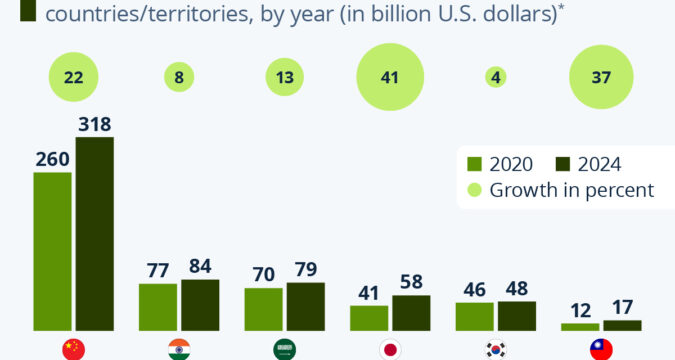
Over the past five years, military expenditure in Asia has climbed sharply, reflecting escalating regional tensions and global security concerns. According to the most recent SIPRI data, major military spenders in the region, such as China, India, Saudi Arabia, Japan and Taiwan, have significantly boosted their defense budgets.
As Statista’s Tristan Gaudiat details below, China remains the region’s top spender: according to SIPRI estimates, its military budget has grown by more than 20 percent between 2020 and 2024, reaching around 320 billion dollars (constant 2023 prices and exchange rates). Chinese military expenditure is driven by the country’s armed forces modernization and territorial ambitions.
You will find more infographics at Statista
India, facing border disputes and maritime challenges, has increased its spending by 8 percent over the same period. Prioritizing technological advancement and self-reliance, the Indian army’s budget reached 84 billion dollars in 2024.
Just behind, with a budget of 79 billion dollars, Saudi Arabia has increased its spending by 13 percent since 2020, amid growing instability in the Middle East.
Meanwhile, in East Asia, Japan has accelerated defense investments by over 40 percent between 2020 and 2024. Its military budget, 58 billion dollars, now surpasses that of its Western neighbor, South Korea (48 billion dollars in 2024, +4 percent from 2020), amid North Korea’s missile threats and China’s military assertiveness.
Taiwan, under constant pressure from Beijing, saw a 37 percent increase over the last five years on record, focusing on asymmetric defense capabilities.
Tyler Durden
Thu, 01/08/2026 – 05:45
https://www.zerohedge.com/military/military-spending-rise-asia

Today in History: Joaquin ‘El Chapo’ Guzman captured
Today is Thursday, Jan. 8, the eighth day of 2026. There are 357 days left in the year.
Today in history:
On Jan. 8, 2016, Joaquin “El Chapo” Guzman, the world’s most-wanted drug lord, was captured for a third time in a daring raid by Mexican marines, six months after walking through a tunnel to freedom from a maximum-security prison.
Also on this date:
In 1790, President George Washington delivered the first State of the Union address in New York City.
In 1815, the last major engagement of the War of 1812 came to an end as U.S. forces defeated the British in the Battle of New Orleans, not having received word of the December signing of a peace treaty.
In 1867, the U.S. House of Representatives joined the Senate in overriding President Andrew Johnson’s veto of the District of Columbia Suffrage Act, giving Black men in the nation’s capital the right to vote.
In 1964, President Lyndon B. Johnson, in his State of the Union address, declared an “unconditional war on poverty in America.”
In 1998, Ramzi Yousef, the mastermind of the 1993 World Trade Center bombing, was sentenced in New York to life in prison without the possibility of parole.
In 2011, U.S. Rep. Gabrielle Giffords, D-Ariz., was shot and critically wounded when a gunman opened fire as the congresswoman met with constituents in Tucson; six people were killed and 12 others were injured. (Gunman Jared Lee Loughner was sentenced in 2012 to seven consecutive life sentences, plus 140 years.)
In 2020, Iran struck back at the United States for killing Iran’s top military commander, firing missiles at two Iraqi military bases housing American troops. More than 100 U.S. service members were diagnosed with traumatic brain injuries later. As Iran braced for a counterattack the same day, the country’s Revolutionary Guard shot down a Ukrainian jetliner departing Tehran after apparently mistaking it for a missile, killing all 176 people on board.
Related Articles
Nancy Cirillo, UIC scholar on fascism and Atlantic slave trade, dies at 93
Today in Chicago History: Rev. Martin Luther King Jr. selects ‘typical ghetto apartment’ on the West Side
Today in History: Marian Anderson sings with the Metropolitan Opera
Chicago weather: How our 2025-26 seasonal snowfall compares with previous years
Today in Chicago History: Cody Parkey kicks ‘double doink’ that costs Bears chance to advance in playoffs
In 2023, supporters of former Brazilian President Jair Bolsonaro who refused to accept his election defeat, stormed Congress, the Supreme Court and the presidential palace in the capital of Brasilia, a week after the inauguration of his leftist rival, President Luiz Inácio Lula da Silva.
Today’s birthdays: Singer Shirley Bassey is 89. Fashion designer Carolina Herrera is 87. Country-gospel singer Cristy Lane is 86. Rock musician Robby Krieger (The Doors) is 80. Singer Jenny Lewis is 50. Filmmaker and actor Sarah Polley is 47. Actor Gaby Hoffman is 44. Actor Cynthia Erivo is 39. Actor Drew Scheid is 28.
https://www.chicagotribune.com/2026/01/08/today-in-history-joaquin-el-chapo-guzman-captured-2/

Today in Chicago History: Brown’s Chicken murders — 5 employees, 2 owners found dead inside Palatine restaurant
Here’s a look back at what happened in the Chicago area on Jan. 8, according to the Tribune’s archives.
Is an important event missing from this date? Email us.
Front page (Sports front) flashback: Jan. 9, 2014
Both Chicago baseball teams were represented on the first ballot of the Baseball Hall of Fame on Jan. 8, 2014. White Sox slugger Frank Thomas and Cubs pitcher Greg Maddux received enough votes for induction. (Chicago Tribune)
Chicago White Sox slugger Frank Thomas and Atlanta Braves/Chicago Cubs pitcher Greg Maddux were elected by the Baseball Writers’ Association of America to the Hall of Fame.
Weather records (from the National Weather Service, Chicago)
High temperature: 63 degrees (1965)
Low temperature: Minus 11 degrees (1942)
Precipitation: 1.18 inches (1935)
Snowfall: 3.6 inches (1974)
Poet Gwendolyn Brooks, center, lived on Chicago’s South Side all her life. She walks unrecognized by passersby in Chicago in 1961. (Chicago Tribune archive photo)
1968: Gwendolyn Brooks was named the poet laureate of Illinois, succeeding Carl Sandburg, who died July 22, 1967. She held the position until her death in 2000.
Among those killed in a Brown’s Chicken & Pasta restaurant in Palatine on Jan. 8, 1993, were Richard E. and Lynn Ehlenfeldt, a couple who bought the business just months earlier; Guadalupe Maldonado, an immigrant cook; and Michael C. Castro and Rico L. Solis, Palatine High School students. Palatine residents Thomas Mennes and Marcus Nellsen were also victims. (Chicago Tribune)
1993: Seven people — five employees and the couple that owned the restaurant — were killed inside Brown’s Chicken & Pasta at 168 W. Northwest Highway in Palatine.
Juan Luna and Jim Degorski escaped justice for nearly a decade until investigators caught a break. Degorski had told an ex-girlfriend of his role in the killings, and a friend who overheard her talking about it in 2002 went to police.
Another piece of evidence was crucial to the case. Investigators had saved a discarded meal from the scene, and as DNA analysis improved, they were able to match DNA left on a chicken bone with Juan Luna’s saliva. The two were arrested in May 2002. Luna was convicted of murder in 2007, and Degorski followed two years later. Jurors spared them the death penalty, but both are serving life sentences with no possibility of parole.
Then-Bears coach Matt Nagy celebrates after the team clinched the NFC North title with a 24-17 victory over the Packers on Dec. 16, 2018, at Soldier Field. (Chris Sweda/Chicago Tribune)
2018: The Chicago Bears hired Matt Nagy as the franchise’s 16th head coach.
With a loss to the Vikings in the last game of the 2021 season, Nagy ended his fourth season with the team with a 34-31 record. Nagy and Bears general manager Ryan Pace were fired the next day.
Want more vintage Chicago?
Subscribe to the free Vintage Chicago Tribune newsletter, join our Chicagoland history Facebook group and follow us on Instagram for more from Chicago’s past.
Have an idea for Vintage Chicago Tribune? Share it with Kori Rumore and Marianne Mather at krumore@chicagotribune.com and mmather@chicagotribune.com
https://www.chicagotribune.com/2026/01/08/january-8-chicago-history/

Bus Drivers Arrested For Earning Up To €50k-A-Year Cash Transporting Illegals Between France And Spain
Bus Drivers Arrested For Earning Up To €50k-A-Year Cash Transporting Illegals Between France And Spain
Authored by Thomas Brooke via Remix News,
Spanish police have arrested 15 international bus drivers in Barcelona, accused of transporting illegal migrants between France and Spain in exchange for cash, exploiting their access to regular cross-border routes, according to reports by El País.
The Spanish National Police said the drivers used their positions on international services, particularly the Paris–Barcelona route, to bring “undocumented or visa-less foreigners into the country in exchange for money,” describing the scheme as “a new type of illicit human trafficking in the international land transport sector,” as reported by Le Parisien.
Migrants paid between €20 and €400 to travel without identity documents, without a valid ticket, or using tickets issued in someone else’s name, and bus drivers received payment to turn a blind eye.
According to the police statement, the drivers coordinated with intermediaries operating in bus stations and outside transport companies, who arranged payments and ensured migrants were allowed to board vehicles. Those arrested are being prosecuted on charges of aiding and abetting illegal immigration.
The investigation began in March 2025 and uncovered a network involving not only drivers but also auxiliary staff linked to private transport companies. Police said those involved “took advantage of their access to European routes” to facilitate the irregular movement of migrants between Spain and France, earning some drivers as much as €50,000 per year.
Investigators also identified recruiters operating outside transport companies who negotiated payments with drivers and helped migrants board buses using false, manipulated, or no documents at all.
The operation was carried out in cooperation with French authorities, with police checks conducted in La Jonquera, Irún, Madrid, Barcelona, and Murcia.
The dispersal across Europe of migrants residing in Catalonia will be cause for concern to many, in light of recent reports detailing no-go zones for police officers in the region.
In September last year, Torelló, a town in the Osona region of Catalonia, faced growing insecurity after a leaked recording revealed local police officers acknowledging they are unable to control violent migrant groups gathering in certain areas, and have been laughed at and forced to retreat from dispatch calls.
The audio, verified by authorities and reported by ElCaso.cat, captured an officer telling a resident that police cannot act against migrant rioters due to insufficient resources.
“They are laughing at us,” the officer said in the call. “They are throwing us out. If we don’t want to get hurt, we too [must leave],” he added, describing how officers had to withdraw after being met with hostility.
While net migration to Spain and its islands was down last year, according to Frontex, huge numbers have already crossed and are now contributing to integration concerns. Despite numbers being down, Spain’s socialist government remains committed to importing newcomers.
In September, it began the gradual transfer of more than 600 Moroccan minors from the North African enclave of Ceuta to different regions on the mainland.
The decision has reignited debate in Madrid over how to manage unaccompanied minors entering the country, as new figures revealed just 41 of the nearly 30,000 minor arrivals since 2018 have been repatriated.
With an increase in internal illegal migration routes within the European Union itself, keeping tabs on new arrivals will become increasingly more problematic.
Tyler Durden
Thu, 01/08/2026 – 05:00
US To Withdraw From 66 International Bodies, Treaties
US To Withdraw From 66 International Bodies, Treaties
Authored by Jaki Thrapp via The Epoch Times,
The Trump administration withdrew the United States from 66 international organizations, conventions, and treaties that it said go against the country’s interests, the White House announced on Jan. 7.
According to the presidential memorandum, 31 entities were tied to the United Nations, while 35 others were not.
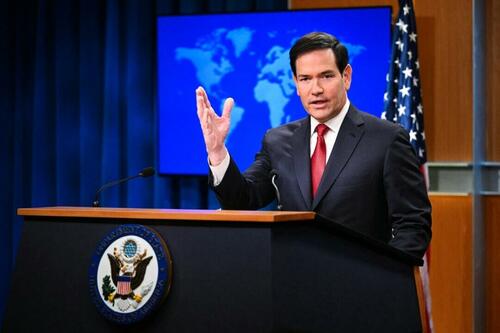
“The Trump Administration has found these institutions to be redundant in their scope, mismanaged, unnecessary, wasteful, poorly run, captured by the interests of actors advancing their own agendas contrary to our own, or a threat to our nation’s sovereignty, freedoms, and general prosperity,” Secretary of State Marco Rubio wrote in a statement shortly after the list was revealed.
“President [Donald] Trump is clear: It is no longer acceptable to be sending these institutions the blood, sweat, and treasure of the American people, with little to nothing to show for it. The days of billions of dollars in taxpayer money flowing to foreign interests at the expense of our people are over.”
The State Department was ordered to review the international intergovernmental organizations that “no longer serve American interests” in February 2025, per an executive order signed by President Donald Trump.
Rubio accused many entities of being “often dominated by progressive ideology and detached from national interests.”
“From DEI mandates to ‘gender equity’ campaigns to climate orthodoxy, many international organizations now serve a globalist project rooted in the discredited fantasy of the ‘End of History.’
“These organizations actively seek to constrain American sovereignty. Their work is advanced by the same elite networks—the multilateral ‘NGO-plex’—that we have begun dismantling through the closure of [the United States Agency for International Development].”
The U.N.-related entities that the Trump administration withdrew from include the Department of Economic and Social Affairs, International Law Commission, International Trade Centre, Peacebuilding Commission, Peacebuilding Fund, U.N. Democracy Fund, U.N. Energy, U.N. Entity for Gender Equality and the Empowerment of Women, and U.N. University.
The non-U.N. organizations included the 24/7 Carbon-Free Energy Compact and the Commission for Environmental Cooperation.
The memorandum cited over two dozen “hybrid threats,” such as the Forum of European National Highway Research Laboratories and the Global Community Engagement and Resilience Fund.
Wednesday’s memorandum came less than a year after Trump withdrew the United States from the UN Human Rights Council.
On Feb. 4, 2025, the same day the White House assigned Rubio to investigate the international organizations, Trump signed an executive order exiting from the U.N. Human Rights Council. At the time, Trump said it “has not fulfilled its purpose and continues to be used as a protective body for countries committing horrific human rights violations.”
The White House expanded on those issues, such as allowing China and Iran to be in the council despite their violations, and alleged there was bias against Israel.
Tyler Durden
Thu, 01/08/2026 – 04:15
https://www.zerohedge.com/geopolitical/us-withdraw-66-international-bodies-treaties

How Chinese-Made Radar Defense Systems Failed In Venezuela
How Chinese-Made Radar Defense Systems Failed In Venezuela
Authored by Sean Tseng via The Epoch Times (emphasis ours),
U.S. forces stormed into Venezuela before dawn on Jan. 3 and captured Venezuelan leader Nicolás Maduro and his wife, Cilia Flores, in a lightning operation that punched in and out of Caracas before its air defenses could mount an effective response.
Illustration by The Epoch Times, Imaginechina/Alamy, public domain, Freepik, The White House
The operation resulted in no U.S. fatalities and no loss of U.S. military equipment, U.S. officials said.
The U.S. mission—code-named Operation Absolute Resolve—has quickly become more than a political shockwave. Analysts have said it was also a real-world test of U.S. military power against a country that has spent years buying Chinese- and Russian-made air-defense systems and showcasing them as proof that it could deter Washington.
The raid raised uncomfortable questions for Beijing about the limits of the Chinese-supplied systems that Venezuela has leaned on—especially “anti-stealth” radar that China advertised as capable of spotting and stopping U.S. stealth aircraft, a military analyst said.
The analyst told The Epoch Times that the most damaging takeaway for China isn’t the failure of a single piece of equipment—it’s what the operation suggested about deeper weaknesses: corruption in China’s defense industry and lack of reliability of the technology and command structure meant to tie those systems together.
“A system built to look modern on paper and intimidating in propaganda falls apart under the demands of real combat,” said Yu Tsung-chi, a retired major general from Taiwan and former president of the Political Warfare College at Taiwan’s National Defense University.
He said Beijing’s performance claims often lean more on messaging than combat validation.
China condemned the capture of Maduro and accused Washington of acting as a “world judge,” in a blunt response that underscored how closely Beijing saw the fallout tied to its influence and credibility in Latin America.
Operation Measured in Hours
President Donald Trump ordered the operation at 10:46 p.m. ET on Jan. 2, Chairman of the Joint Chiefs of Staff Gen. Dan Caine said.
Aircraft launched from about 20 land and sea bases across the Western Hemisphere, and the helicopter force approached Venezuela at roughly 100 feet above the water to maintain the element of surprise.
Within five hours, by 3:29 a.m. ET, U.S. forces had Maduro and Flores aboard the USS Iwo Jima, an amphibious assault ship. They were then flown to the United States.
This illustration depicts Caracas and the states in which the Venezuelan regime said U.S. military strikes occurred before the capture of Venezuelan leader Nicolás Maduro and his wife on Jan. 3, 2025. Anika Arora Seth, Phil Holm via AP(Left) The Fuerte Tiuna neighborhood of Caracas, Venezuela, on Dec. 22, 2025. (Right) The same neighborhood after U.S. strikes on Jan. 3, 2026. U.S. forces carried out a pre-dawn raid in Caracas, capturing Venezuelan leader Nicolás Maduro and his wife, Cilia Flores, and flying them to the United States to face federal charges. ©2026 Vantor via AP
U.S. officials said the operation involved more than 150 aircraft along with integrated electronic attack and nonkinetic effects from U.S. Cyber Command, Space Command, and other assets to suppress Venezuelan defenses and clear a path for the helicopters.
Briefings described a layered effects approach: bombers, fighters, surveillance and reconnaissance aircraft, electronic warfare jets, and drones overhead; space and cyber support to disrupt Venezuelan systems; and strikes intended to dismantle and disable air defenses as helicopters closed on Caracas.
According to officials, aircraft used in the operation included B-1B bombers, F-22 Raptors, F-35 Lightning II fighters, EA-18G Growler electronic attack jets, E-2 Hawkeye early warning aircraft, and numerous drones alongside transport and helicopter assets.
China’s Systems
For years, Venezuela has spent heavily on Chinese and Russian equipment while claiming that it was building one of the region’s most modern defense systems.
In recent months, reports have highlighted Venezuela’s installation of Chinese-made JY-27A radar units, marketed as able to detect “low-observable” aircraft—exactly the kind of system meant to complicate U.S. operations involving stealth platforms.
That promise did not hold on Jan. 3.
Yu said neither Chinese nor Russian air-defense systems “made the slightest bit of difference” once the United States brought real-time intelligence, electronic warfare, and precision weapons to bear.
The real contest, he said, wasn’t just radar range or missile specs, but a fast chain of detection, communications, decision-making, and joint execution—exactly where weaker militaries tend to break.
Beyond radar, Venezuela has also displayed and fielded Chinese-made ground systems that Beijing has marketed abroad—from VN-16 amphibious assault vehicles and VN-18 infantry fighting vehicles to Chinese rocket artillery systems.
Venezuelan parades in recent years have showcased those platforms as symbols of a growing partnership and a tougher military posture.
But Yu said glossy displays don’t matter much if the wider network—sensors, communications, command, training, and logistics—can’t hold up under pressure.
Parades Versus Combat Reality
Yu said the U.S. raid on Caracas exposed the limits of China’s propaganda-first military culture—one that rewards polished demonstrations more than hard, repeated combat validation.
He said the People’s Liberation Army (PLA) has not fought a major war since 1979, and it studies foreign conflicts in part because it lacks large-scale, recent battlefield feedback of its own.
“You can look perfectly aligned and advanced on a parade ground,” Yu said, “but without real combat to back it up, it’s all just stage effects.”
Read the rest here…
Tyler Durden
Thu, 01/08/2026 – 03:30
https://www.zerohedge.com/political/how-chinese-made-radar-defense-systems-failed-venezuela
Hungary Won’t Leave The EU, It Will Fall Apart On Its Own, Orbán Says
Hungary Won’t Leave The EU, It Will Fall Apart On Its Own, Orbán Says
Hungarian Prime Minister Viktor Orbán said that Hungary would not leave the European Union, which instead would “fall apart on its own” due to “leadership chaos” and said Brussels aimed to cut Hungary off from Russian energy supplies during a press conference on Monday.
As EuroNews reports, Orbán rejected the possibility of Hungary leaving the EU, saying the country lacked the size to make such a decision sensible. However, he stressed Hungary’s future lay within the bloc and NATO but with “a sovereign foreign policy and economic policy”. He said: “EU membership is an important opportunity, but if we were to get stuck in this single bloc, we would drink the juice. It makes sense to have the best possible relations with all blocs, including America, Russia, China, the Arab world and the Turkish world.”
Orbán has clashed repeatedly with Brussels over rule of law concerns, blocked EU support to Ukraine and maintained ties with Moscow despite all his European peers blacklisting Putin. In return, the EU has withheld billions of euros in funding for what it claims is “democratic backsliding” in Hungary.
On energy policy, Orbán said Brussels aimed to cut Hungary off from Russian oil and gas supplies. He said the government was defending itself through legal action against the European Commission while politically opposing EU regulations, hoping sanctions would be lifted by 2027, when the war ends.
Hungary has secured exemptions from EU sanctions on Russian energy and remains heavily dependent on Russian oil and gas.
Orbán said US President Donald Trump’s seizure of Venezuela’s Nicolas Maduro marked a new era in international politics, claiming the operation could allow the US to control up to half the world’s oil reserves.
He told reporters that 2025 had been “a very eventful year” and Trump’s inauguration “gave the coup de grace” to what he called the “liberal world order”. He said the new era is “the era of nations” and described himself as a harbinger of this shift since 2010.
On Venezuela, Orbán said the US military operation represented “a powerful manifestation of the new world”.
“Together with Venezuela, the United States can control 40-50% of the world’s oil reserves, a force capable of significantly influencing the price of energy on the world market.” He added that this could benefit Hungary by creating cheaper global energy prices.
Orbán has cultivated close ties with Trump and is one of the few European leaders to openly support the US military action in Venezuela, which most EU member states have criticised as violating international law.
Orbán said Hungary would not provide financial support to Ukraine, stating, “We have money if we don’t give it to others, so we are not giving our money to Ukraine.”
“We are not giving them a loan either, because everyone knows that the Ukrainians will not pay it back,” he added.
Hungary has been the primary obstacle to EU military and financial support for Ukraine since Russia’s full-scale invasion in early 2022, forcing the 27-member bloc to find workarounds to bypass Budapest’s vetoes.
On migration, Orbán said Hungary would not accept Brussels dictating “who we should live with”, rejecting an EU regulation due in June requiring member states to admit 350 people and process over 20,000 applications.
Hungary has refused to participate in EU asylum schemes and built border fences to keep out migrants, leading to ongoing legal battles and trading barbs with Brussels.
Asked about a reported financial agreement with Trump, Orbán confirmed: “I asked for it, we agreed that there would be one.”
Trump denied Orbán’s previous claims about such an agreement, telling Politico in November: “I didn’t promise him anything like that, but he asked me very much.”
Meanwhile, the Hungarian PM said details of the “defense shield” were still being worked out, adding Hungary has needed “some kind of protective shield” since World War I and “cannot rely on Brussels”.
Orbán said he would not debate Tisza party leader Péter Magyar in the April elections, claiming he could only debate with “sovereign people” and that “those who have masters abroad are not sovereign”. He said his ruling party, Fidesz, aimed to repeat its 2022 election result.
Magyar and his party have surged in polls and pose the most substantial electoral challenge to Orbán’s rule in two and a half decades. Orbán has governed Hungary since 2010 and is the EU’s longest-serving leader among the current heads of state.
Tyler Durden
Thu, 01/08/2026 – 02:45
https://www.zerohedge.com/economics/hungary-wont-leave-eu-it-will-fall-apart-its-own-orban-says
Germany’s Deindustrialization: Capital Flight, Green Policy, And The Point Of No Return
Germany’s Deindustrialization: Capital Flight, Green Policy, And The Point Of No Return
Submitted by Thomas Kolbe
The German Chamber of Industry and Commerce (DIHK) sees the German economy in a prolonged phase of deindustrialization. Together with the Federation of German Industries (BDI), the chamber reiterates calls for far-reaching reforms to boost growth and investment. Yet both associations still shy away from touching the golden calf of the green transformation.
Germany’s economic crisis continues into the new year without interruption. A survey conducted by the DIHK among 23,000 member companies found that only one in six firms expects an economic upswing in 2026.
Twenty-five percent of companies are planning further job cuts, and only one third intend to make growth investments. For DIHK President Helena Melnikov, the situation is dramatic. If policymakers fail to act decisively, Germany faces a further massive loss of value creation and jobs, Melnikov warns. As before, the DIHK locates the core of the economic decline in German industry. According to chamber calculations, the sector has shed around 400,000 jobs since 2019.
This weighs particularly heavily because these positions are typically well-paid and highly skilled. Their value creation reverberates throughout Germany’s economic structure—among industry-related services, regional trade, and ultimately public finances.
As a result, municipal treasurers in industrial crisis hubs are increasingly confronted with insoluble challenges amid growing budget deficits. In cities such as Stuttgart, Erlangen, Wolfsburg, and elsewhere, business tax revenues are now visibly shrinking.
Reality Denied
Existing reforms are failing to reach companies, Melnikov warns, pointing to high labor and energy costs. The BDI likewise called 2026 a “year of reforms” in comments to Reuters.
All of this is correct. And yet the question remains why leading figures of German business still lack the courage to openly criticize government policy and finally bury the visibly failed project of greening German society.
We are witnessing a monumental failure of the economic elite—if it can even still be called that. The deindustrialization diagnosed by Melnikov is simply denied by large parts of the mainstream press as well as by policymakers. And yet the numbers speak clearly.
It is not yet fully clear how large capital outflows were last year. In 2024, net direct investment outflows amounted to €64.5 billion; in 2023 they exceeded €100 billion. Previous years were likewise marked by sustained capital flight.
Those who can are heading for the exits—fleeing green regulatory policy, high fiscal burdens, and the economic devastation inflicted on companies by Germany’s energy transition.
Calls for sweeping reductions in bureaucracy also naturally feature on the list of location weaknesses. A perennial political evergreen—and a hollow demand in light of the massively increased pace of state intervention. The state will have to create tens of thousands of new public-sector jobs, at its development banks such as KfW and the state banks, in order to weave the flood of cheap credit into the arteries of the economy.
On massive state intervention, business prefers to remain silent. Companies take what they can get. There is no talk of criticizing market distortions or the systematic crowding-out of the private sector from capital markets by the state.
For the current year, the DIHK expects officially reported GDP growth of 0.7 percent. However, this figure includes net new public borrowing—including special funds—of around 5.5 percent, with a state share exceeding 50 percent of GDP. The private sector, by contrast, is likely to shrink by roughly four percent.
Political room for maneuver is narrowing. Flight to the capital markets appears to be the last remaining way to buy time and maintain the illusion of social and economic stability through ever new subsidy programs.
Location Patriotism Meets Reality
And before the first patriotic crocodile tears are shed: every plant manager, CEO, capital-rich fund, individual investor, and family office will have carefully weighed its judgment on the destructive political framework conditions in Germany and the EU—and will not turn away from the location without reason.
Insisting on location patriotism, after decades of deliberate erosion of patriotic sentiment, German traditions, and culture by the political apparatus and its associated media empire, is at best infantilizing—more bluntly put: cynical.
Federal Chancellor Friedrich Merz and his finance minister Lars Klingbeil, for their part, have not hesitated in the past to play the patriotism card more or less openly when it came to the accelerating departure of German companies.
In October, Klingbeil, in a display of helplessness, publicly called on business at the IGBC trade union congress in Hanover to commit to the location and safeguard jobs.
A cheap media stunt, as Klingbeil is fully aware that energy-intensive production can no longer be defended at the German location, and that the policy of green transformation deliberately and systematically pushes industrial production abroad—or increasingly into insolvency.
The narrative of a lack of loyalty to the location is now firmly established. It shows that politics has already identified its scapegoats—entrepreneurs and investors who are to be publicly blamed for the country’s economic decline. They are henceforth portrayed as irresponsible profiteers abandoning employees, society, and the community in the pursuit of supposed profit maximization.
The depth of the ongoing recession and the now unmistakable deindustrialization of the country make it increasingly likely, week by week, that a point of no return—an economic tipping point—has already been crossed.
German society is therefore left with essentially two options. Either it falls for the rhetorical tricks of the central planners around Friedrich Merz and Lars Klingbeil, accepts further nationalization and the construction of centrally planned artificial economies such as a war economy or a leaden eco-industry. Or it eventually broadens its horizon, returns to the principles of the free market economy, and accepts the social pain that any genuine transformation for the better must necessarily entail at the outset.
* * *
About the author: Thomas Kolbe, born in 1978 in Neuss/ Germany, is a graduate economist. For over 25 years, he has worked as a journalist and media producer for clients from various industries and business associations. As a publicist, he focuses on economic processes and observes geopolitical events from the perspective of the capital markets. His publications follow a philosophy that focuses on the individual and their right to self-determination.
Tyler Durden
Thu, 01/08/2026 – 02:00

Stephen Curry y Jimmy Butler lideran a Warriors en victoria 120-113 sobre Bucks
SAN FRANCISCO (AP) — Stephen Curry anotó 31 puntos, destacándose con un triple en retroceso a 26 segundos del final, y añadió siete asistencias y siete rebotes para que los Warriors de Golden State vencieran el miércoles 120-113 a los Bucks de Milwaukee.
De’Anthony Melton sumó 22 puntos desde el banquillo, Jimmy Butler terminó con 21 unidades y cinco rebotes, y el dominicano Al Horford totalizó ocho tantos, diez tableros y seis asistencias en uno de sus mejores partidos completos desde que se unió a los Warriors.
Curry embocó 12 de 21 disparos con tres triples. Hizo su primer tiro desde lejos a los 4:44 minutos del primer cuarto y anotó 14 tantos al llegar al medio tiempo.
La bandeja de Giannis Antetokounmpo con 4:38 minutos restantes acercó a los Bucks a diez puntos, pero Butler respondió en el otro extremo.
Antetokounmpo registró 34 puntos, diez rebotes y cinco asistencias, mientras que Kevin Porter Jr. contribuyó con 15 tantos, nueve asistencias y cuatro tableros por los Bucks, quienes no pudieron resistir los 18 triples de Golden State y una desventaja de 53-42 en el rubro de rebotes.
Milwaukee había ganado dos duelos seguidos y cuatro de cinco. Había tenido dos días completos de descanso después de una victoria 115-98 en Sacramento el domingo.
_____
Deportes AP: https://apnews.com/hub/deportes

Asking Eric: He believes he is the smartest person in the room
Dear Eric: I have to work with a very arrogant person, and it is hard to manage his dismissive attitude and grumpy remarks.
The thing is, I am paying him to do work on my home. He is a talented and skilled person, but his personality is very off-putting as he seems to honestly believe he is the smartest person in the room, which is ridiculous.
He acts like everyone else is stupid but him. Although he doesn’t actually directly call me or anyone else stupid, his attitude says it clearly. Consequently, I dread dealing with him, but I do need his help right now.
How do you deal with someone who isn’t directly calling you a moron but acts like you are one?
I have come to believe he actually thinks he is being polite and helpful when his demeaning and rude dismissiveness is what is actually coming across.
– Respect, Please
Dear Respect: You may not be able to change this guy’s personality – which may be predisposed to arrogance and dismissiveness – but you can give him some constructive criticism relating to how the two of you interact.
Try to pick one or two things that you’ve noticed repeatedly and address them specifically, rather than talking to him about his general demeanor. It is easier to get defensive and dismissive about broad statements. Instead, try saying something like, “I want to give you some feedback about our working relationship, if you’re open to it. I’d like to be able to communicate clearly so the project is successful. When I hear things like [here you’d insert a specific example], it sounds dismissive to me. Instead, if you’re giving me an update on the work, could you phrase it like this instead?” Adjust the language to suit your style, of course. The goal is to bridge the gap between intention and impact.
Working relationships thrive on communication, so it’s good to ask for what you need and to offer solutions for parts of the relationship that aren’t working for you. I hope he’s receptive and communicates his needs clearly back to you. If he’s not, he may not be the best person for the job.
Dear Eric: To your excellent reply to “Leftovers, Anyone?”, who was a bit unsettled over her daughter-in-law’s Friendsgiving meal mirroring her own Thanksgiving, I have a suggestion. My wife and I are the eldest of our extended family and often host Thanksgiving. This year, with my wife recovering from surgery, we had a dish-to-pass non-traditional meal, where I cooked the main entree (grilled dry-rub flank steak) and everyone brought a side dish or dessert. We all had a great family time, and no one complained about the lack of turkey!
– No Turkey, Still Great
Dear Still Great: I love a potluck holiday! Many hands make light(er) work.
Dear Eric: Librarian here, replying to “Deleted Post”, whose son got angry about a parent posting news about the letter writer posting a photo of the son’s wedding to social media. The letter writer wrote, “I feel bad because my son seems to feel he can forbid me from sharing this news with my friends.”
I have noticed that many people default to “owning” their social media accounts and therefore the right to post whatever they like. Friends and family members will take photos, or, sometimes worse, be browsing their old files and snap a pic of an ancient photo and share it online.
Enthusiastic and informed consent is the way to go here. Show the people in the photo the photo first. Before you post, ask, “Do you mind if I post this on [this platform]”? Every. Single. Time.
You don’t own their faces. There are lots of reasons someone might not want a photo posted, ranging from it simply being an unflattering shot, to future employers Googling their name, through to hiding from an abusive ex or being in witness protection.
Even with privacy settings locked down, the Terms of Use that we all click “agree” to, usually without reading, give the online platform free range of whatever you post. The landscape is entirely different. The way we post and share must be, too.
– Social Media Caution
Related Articles
Asking Eric: I don’t like taking money from friends
Asking Eric: Judged for hearing loss
Asking Eric: I’m not having him over again unless he apologizes
Asking Eric: Why should I go to my 50th high school reunion?
Asking Eric: Can I take their leftovers?
Dear Caution: This is an important reminder for everyone. When it comes to someone’s digital footprint, it’s always better to ask permission than to ask for forgiveness after posting. And when it comes to sharing personal news online, it’s best to ask oneself, “whose news is this?” If it’s your news, you can share it. If it’s someone else’s news, even if that person is a child or close relative, get their OK. Or better yet, let them share it and follow their lead.
(Send questions to R. Eric Thomas at eric@askingeric.com or P.O. Box 22474, Philadelphia, PA 19110. Follow him on Instagram and sign up for his weekly newsletter at rericthomas.com.)





