Category: News

Woldhuis Farms Sunrise Greenhouse open after fire, though food court and 1 greenhouse destroyed
Woldhuis Farms Sunrise Greenhouse in Grant Park remains open after an electrical fire tore through two of its structures Wednesday morning, though the business owners continue to assess damage.
The fire started at about 11:30 a.m. on the west side of the 160-acre farm’s greenhouse storefront, where the business’ food court and a food truck sit. Owner Trevor Woldhuis said a little beforehand, employees began to smell smoke, but weren’t immediately alarmed as business owners have a burn pile on the property to get rid of some organic materials.
“We don’t know exactly what, but we suspect (something) electrical happened over in that area, and then all of a sudden it did start bursting into flames and spread pretty quickly,” Woldhuis said Friday.
The food court greenhouse was quickly consumed by the fire, and the connected structure known as the chicken house was also heavily damaged. Live chickens used to be in the building that now only houses products including pottery and ceramics, some of which are salvageable, Woldhuis said.
After the fire broke out, Woldhuis said, one employee called 911 while others unsuccessfully tried to douse the flames with fire extinguishers.
“It was too small of tools for how the fire was quickly spreading,” Woldhuis said.
Resulting damage to the food court area of Woldhuis Farms Sunrise Greenhouse from an electrical fire Jan. 14, 2026. (Trevor Woldhuis)
Grant Park firefighters responded quickly and requested a box alarm, notifying many neighboring areas, officials said. Responding firefighters came from Crete, Kankakee, Manhattan, Monee, Riverside, University Park and Frankfort, the Grant Park Fire District said in a statement.
“The fire was successfully contained, limiting damage to the affected structure and preventing further loss to the property,” the fire district said. The cause of the fire remains under investigation, but “no one was injured, civilian or fire personnel, during the incident,” the statement said.
Woldhuis said the food court was lost to the fire, but he hopes to be able to restore the chicken house, which is one of the business’ oldest structures.
“I remember as a kid, a lot of our growing and transplanting took place in that building,” Woldhuis said. “So it has a lot of really neat sentimental memories behind it … It’ll be a shame if we have to tear it down.”
The inside of a building known as the chicken house, which holds greenhouse inventory including pottery, was damaged in the Jan. 14, 2026 fire at Woldhuis Farms Sunrise Greenhouse. (Trevor Woldhuis)
The business reopened the next day, though phones and internet were temporarily down as their systems were housed in the chicken house building. The nurseries and greenhouses where plants are sold were not damaged, Woldhuis said.
He said the business is working with its insurance company to finance repairs and rebuilds and expressed appreciation for an outpouring of community support since the fire.
“It’s been very humbling and a huge encouragement to know how many people are thinking about us, supporting us through this trial,” Woldhuis said.
ostevens@chicagotribune.com
https://www.chicagotribune.com/2026/01/16/woldhuis-farms-sunrise-greenhouse-destroyed-fire/

Slam de un punto cautiva a estrellas y aficionados en el Abierto de Australia
Por JOHN PYE
MELBOURNE, Australia (AP) — El Slam de un punto probablemente no será un éxito efímero.
En tono de broma le preguntaron a Jannik Sinner en la conferencia de prensa oficial del viernes antes del inicio del Abierto de Australia, cómo podía esperar un triplete en el Abierto de Australia si no podía vencer a un aficionado en una exhibición de un solo punto.
“¡Sí, espero tener un poco más de control en tres de cinco sets!” expresó Sinner.
La segunda pregunta también se relacionó con la presión del éxito o fracaso instantáneo de la competencia que presentó una mezcla de estrellas contra jugadores de club, mujeres contra hombres y que finalmente fue ganada por el poco conocido aficionado local Jordan Smith en un Rod Laver Arena.
El formato incluyó un concurso de piedra, papel o tijera para decidir quién servía en el partido de un solo punto.
“No era un gran fan al principio, pero cuando estás allí jugando y viendo otros partidos, fue muy divertido”, comentó. “Tener un estadio lleno antes del evento principal, es genial”.
También le encantó el resultado contra todo pronóstico.
“No hubo mejor final, diría yo, especialmente para la primera edición, que un aficionado gane”, manifestó. “Realmente lo necesita de una manera muy positiva”.
Concurso
El concurso de estilo de programa de juegos, donde el ganador se lleva un millón de dólares, cautivó tanto a los profesionales experimentados como al público el miércoles. Roger Federer dijo que estuvo pegado a él y que le habría gustado participar.
Y fue uno de los temas del día cuando los principales jugadores de tenis del mundo aparecieron en conferencias de prensa dos días antes de que comience el primer major de la temporada.
Iga Swiatek, Coco Gauff y Amanda Anisimova estuvieron entre las estrellas del circuito femenino que lo adoraron.
La parte estresante para las estrellas fue lo desconocido.
“Fue algo diferente… porque no estás caliente, esperas 40 minutos, y luego solo juegas tal vez un punto o ni siquiera juegas porque alguien comete un error”, dijo Sinner, el dos veces campeón defensor del Abierto de Australia. “Fue algo divertido de jugar, pero sobre todo también de ver”.
Swiatek estaba preparada
A diferencia de Sinner, Swiatek sí se calentó para ello —“Estaba lista”, dijo— y eliminó a un par de hombres. Para avanzar, un jugador solo tenía que ganar un punto. Así que, si fallas un segundo servicio, estás fuera.
“Fue genial. Creo que fue muy divertido. Honestamente, como, todos estaban mirando. Como también fuera de la cancha, todos decían que estaban tan, como, emocionados por ello”, comentó Swiatek.
Venía de una victoria con Polonia en la United Cup, y se preparaba para su intento de completar un Grand Slam de carrera ganando el título australiano por primera vez, por lo que sirvió como una distracción refrescante.
Anisimova, quien llegó a las finales en Wimbledon y el Abierto de Estados Unidos el año pasado, dijo que le gustaría ver el Slam de Un Punto expandido a los cuatro grandes torneos.
“Fue tan divertido, porque todos estábamos, como, igualmente muy, muy nerviosos”, expresó. “Solo hablábamos de lo nerviosos que estábamos.
Otra oportunidad
La dos veces ganadora de Grand Slam Gauff dijo que le gustaría tener la oportunidad de redimirse si el evento se lleva a cabo el próximo año.
“No esperaba ganar. Le decía a todos que eso no iba a suceder. La gente decía: ‘¿Qué vas a hacer con el dinero?’”, comentó. “Dije que quería que ganara un aficionado. Creo que el mejor escenario posible ocurrió”.
Smith venció a Joanna Garland, la número 117 del mundo de Taiwán, quien, según Gauff, “se convirtió en una celebridad de la noche a la mañana”.
Pensó que era bueno escuchar historias de personas que juegan al tenis pero que nunca obtienen exposición pública, y sugirió que las rondas de clasificación —jugadas en clubes de tenis locales alrededor de Australia— también deberían ser televisadas.
“Hubo un par de historias geniales de las rondas de clasificación en las que estuve que desearía que algunas personas pudieran ver en Rod Laver”, dijo Gauff.
___
Deportes AP: https://apnews.com/hub/deportes

Trump planea indultar a exgobernadora de Puerto Rico en caso de financiación ilegal de campaña
Por DARLENE SUPERVILLE
WASHINGTON (AP) — El presidente de Estados Unidos, Donald Trump, planea indultar a la exgobernadora de Puerto Rico, Wanda Vázquez, afirmó un funcionario de la Casa Blanca el viernes.
Vázquez se declaró culpable en agosto pasado de una violación de financiamiento de campaña en un caso federal en el que, según las autoridades, también participaron un exagente del FBI y un banquero venezolano. Su sentencia estaba prevista para los siguientes días de este mes.
Los fiscales federales habían pedido una condena de un año tras las rejas, algo a lo que los abogados de Vázquez se opusieron, acusando a los fiscales de violar un acuerdo de declaración de culpabilidad alcanzado el año pasado en el que se retiraron cargos anteriores, entre ellos, soborno y fraude.
Señalaron que Vázquez había aceptado declararse culpable de aceptar una promesa de contribución de campaña que nunca se recibió.
Hasta el momento, los abogados de Vázquez no han respondido a las solicitudes de comentarios.
El funcionario que confirmó el indulto indicó que Trump veía el caso como una persecución política y dijo que la investigación sobre Vázquez, una republicana alineada con el Partido Nuevo Progresista, que está a favor de la estadidad, había comenzado diez días después de que ella respaldara a Trump en 2020. El funcionario no estaba autorizado para revelar la noticia utilizando su nombre y habló bajo condición de anonimato.
Pablo José Hernández, representante de Puerto Rico en el Congreso y miembro del principal partido de oposición de la isla, condenó el indulto a Vázquez.
“La impunidad protege y promueve la corrupción. El indulto… debilita la integridad pública, lacera la confianza en la justicia y ofende a los que creemos en el gobierno honesto”, dijo Hernández, demócrata del Partido Popular Democrático de Puerto Rico.
Vázquez, abogada de profesión, fue la primera exgobernadora del territorio estadounidense en declararse culpable de un delito, específicamente de aceptar una donación de un extranjero para su campaña política de 2020.
Fue arrestada en agosto de 2022 y acusada de participar en una red de soborno desde diciembre de 2019 hasta junio de 2020 mientras era gobernadora. En ese momento, dijo a los periodistas que era inocente.
Las autoridades señalaron que la Oficina del Comisionado de Instituciones Financieras de Puerto Rico investigaba a un banco internacional propiedad del venezolano Julio Martín Herrera Velutini debido a presuntas transacciones sospechosas que no habían sido reportadas por la institución.
Las autoridades dijeron que Herrera y Mark Rossini, un exagente del FBI que brindaba servicios de consultoría a Herrera, supuestamente prometieron apoyar la campaña de Vázquez si ella destituía al comisionado y nombraba a uno nuevo a elección de Herrera.
Las autoridades dijeron que Vázquez exigió la renuncia del comisionado en febrero de 2020 tras aceptar presuntamente la oferta de soborno. También fue acusada de nombrar a un nuevo comisionado en mayo de 2020: un exconsultor del banco de Herrera.
Vázquez fue la segunda mujer en servir como gobernadora de Puerto Rico y la primera exgobernadora en enfrentar cargos federales.
Fue juramentada como gobernadora en agosto de 2019 después de que el exgobernador Ricardo Rosselló renunciara tras enfrentar protestas multitudinarias. Vázquez sirvió hasta 2021, después de perder las primarias del Partido Nuevo Progresista ante el exgobernador Pedro Pierluisi.
___
La reportera de The Associated Press Dánica Coto en San Juan, Puerto Rico, contribuyó a este despacho.
___
Esta historia fue traducida del inglés por un editor de AP con la ayuda de una herramienta de inteligencia artificial generativa.

Advocate Lutheran hospital in Park Ridge aims to build new $99 million cancer center
Advocate Lutheran General Hospital wants to spend $99 million to create a new cancer center on its Park Ridge campus, a move that would have it join a growing list of Chicago-area hospitals boosting their cancer care.
The hospital is aiming to build a two-floor, 77,000-square-foot addition to an existing outpatient facility that would be attached to the existing building via a walkway, creating a Comprehensive Cancer Center, according to an application for the project filed with the Illinois Health Facilities and Services Review Board. The state board must approve the application for the project to move forward.
Outpatient cancer services would be consolidated and expanded with the new addition. The project would also include modernization of an outpatient lab in the connected building.
In its application, Advocate Lutheran General cited statistics predicting increasing demand for outpatient cancer services, as more procedures become available on an outpatient basis, as the area’s older population continues to increase and as access to cancer screenings grows.
The project is expected to be completed and operational by the end of 2028, according to the application.
“This project is designed to meet the growing need for innovative cancer care as well as the projected demand for these cutting-edge treatments in a coordinated, fully integrated location with increased space and resources,” the hospital said in its application.
Advocate Health Care did not immediately respond to a request for comment Friday morning.
In recent years, many Chicago-area hospitals have embarked on projects to expand their cancer care as baby boomers continue to age.
The Centers for Disease Control & Prevention has projected a 49% increase in annual cancer cases between 2015 and 2050 — and hospitals are working to position themselves to meet that demand. Cancer care also continues to advance, with 70% of people diagnosed with cancer surviving for at least five years, up from about half in the mid-1970s, according to an American Cancer Society report released this week.
UChicago Medicine is building a 575,000 square foot freestanding cancer hospital on Chicago’s South Side that’s intended to give area residents greater access to care and help the hospital attract more patients from across the region.
Endeavor Health is adding a two-story addition to its Knowles Cancer Center at Endeavor Health Elmhurst Hospital, and converting a floor of the Galter Medical Pavilion at Endeavor Health Swedish Hospital into a cancer space with additional rooms.
Northwestern Memorial Hospital also plans to construct a new tower on its Streeterville campus with more than 200 beds that would also consolidate oncology services now spread across five buildings on the hospital campus.
The state Health Facilities and Services Review Board recently approved Northwestern’s application to spend $56 million on the tower’s design, and Northwestern is now asking the board to approve plans to spend another $51 million demolishing a three-story basement on the site, in anticipation of building the tower. Northwestern has not yet submitted a plan to the board for the actual construction of the tower.
UChicago Medicine and Rush University System for Health have also started affiliating with hospitals in other parts of the country on cancer care.
https://www.chicagotribune.com/2026/01/16/advocate-lutheran-hospital-cancer-center/

Brady Glynn, who’s into Texas Hold ’em, plays his cards right for Lincoln-Way West. ‘You feel that dominance.’
Lincoln-Way West junior Brady Glynn understands how to play his cards right.
Glynn has an affinity for board games and also has a knack for playing Texas Hold ’em, a card game of the poker family driven by patience, calculation and risk tolerance.
“At the start of a match, you don’t want to go out crazy,” Glynn said. “But once you get into that flow, once you feel that dominance, that’s what I’m looking for — controlling the match.
“When I get there, I feel really comfortable.”
Glynn got into the comfort zone again Thursday night, using four takedowns for a 12-5 decision over Lockport’s Isaac Zimmerman at 132 pounds to lead the Warriors to a 47-25 win in a SouthWest Suburban Conference dual meet.
Lincoln-Way West (16-4, 5-0) captured nine of the 14 matches, powered by five falls and two technical falls. Sophomore Michael Scott (106), senior Carter DiBenedetto (126) and senior Jimmy Talley (215) won by pins.
Lincoln-Way West’s Brady Glynn, left, gains control against Lockport’s Isaac Zimmerman at 132 pounds in a SouthWest Suburban Conference dual meet in Lockport on Thursday, Jan. 15, 2026. (Steve Johnston / Daily Southtown)
Freshman Noe Hernandez (113), senior Chris Miller (175) and senior Ethan Robledo (heavyweight) posted victories for the Porters (4-10, 1-4).
Glynn (29-5), meanwhile, entered the match ranked No. 6 by the Illinois Wrestling Coaches and Officials Association website. Zimmerman was ranked No. 8.
The two had never formally wrestled in a match, but they have trained together.
“I knew Isaac coming into that match — he’s dangerous,” Glynn said. “I knew if I set the pace and got to my shots, I’d be good. If I dictated things on my feet and got my takedowns, I knew the outcome would take care of itself.
Lincoln-Way West’s Shane Stream, top, spins over Lockport’s Justin Godina at 138 pounds during a SouthWest Suburban Conference dual meet in Lockport on Thursday, Jan. 15, 2026. (Steve Johnston / Daily Southtown)
“When I slow down, that’s when people can catch up to me. So I try to stay on my attacks, keep the pressure on and get to my shots.”
Junior Shane Stream, who’s ranked No. 9 at 138, confirmed that Glynn’s IQ matches his physical talent.
“He’s got a really sharp mind,” said Stream, who also won by fall. “When he’s wrestling a good guy, he mentally and physically prepares himself the right way.
“You can’t break him. He could be down 13-0 against a really good guy and he’s still fighting. He’s got that warrior mindset. He’s not going to accept defeat.”
Lincoln-Way West;s Jimmy Talley, top, pins Lockport’s Oliver Knoepfle at 215 pounds during a SouthWest Suburban Conference dual meet in Lockport on Thursday, Jan. 15, 2026. (Steve Johnston / Daily Southtown)
Last season, Glynn qualified for state at 113, and wrestling is the family business. He’s the oldest of four kids. His freshman brother, Owen, is DiBenetto’s backup at 126.
Glynn’s youngest brother is in seventh grade. His sister is in fourth grade. They are all wrestlers.
Their father, Brian, is Lincoln-Way West’s head coach.
“I’ve really enjoyed coaching all my kids,” Brian said. “There are moments where I get a little extra excited, but I try to keep my coach’s face on. Our assistant coaches do a phenomenal job handling situations where it might be better coming from someone who isn’t their dad.”
“(Brady) has always been a gamer. When he’s put in big situations, he tends to overperform. He doesn’t get nervous. Sometimes, I wish he’d get a little more excited, but that’s his personality and it has worked.”
Lincoln-Way West’s Brady Glynn, left, tries to turn Lockport’s Isaac Zimmerman at 132 pounds in a SouthWest Suburban Conference dual meet in Lockport on Thursday, Jan. 15, 2026. (Steve Johnston / Daily Southtown)
Brady pointed out that his father gives him no special preferences and he never feels any added pressure dealing with the expectations.
“It’s awesome,” Brady said. “You don’t always get someone who’s there for you all the time and that supportive. He’s always there fixing my stuff, helping me out.
“He definitely picks on me a lot, but it’s all good intentions.”
What his father describes as cool and aplomb, Brady Glynn calls his competitive makeup and desire. His fondness for games befits his ability to visualize success before it happens.
“You can lose a match in two seconds if you take yourself out of position,” he said. “You need an approach for every match, especially against good guys.
“I love close matches. That adrenaline, that edge — once you find it, it’s exciting. That’s when you know you’re going to be dominant.”
Patrick Z. McGavin is a freelance reporter for the Daily Southtown.
https://www.chicagotribune.com/2026/01/16/brady-glynn-lincoln-way-west-lockport-ihsa-wrestling/
The Wrong Solution: AI Productivity, Employment, & UBI
The Wrong Solution: AI Productivity, Employment, & UBI
Authored by Lance Roberts via RealInvestmentAdvice.com,
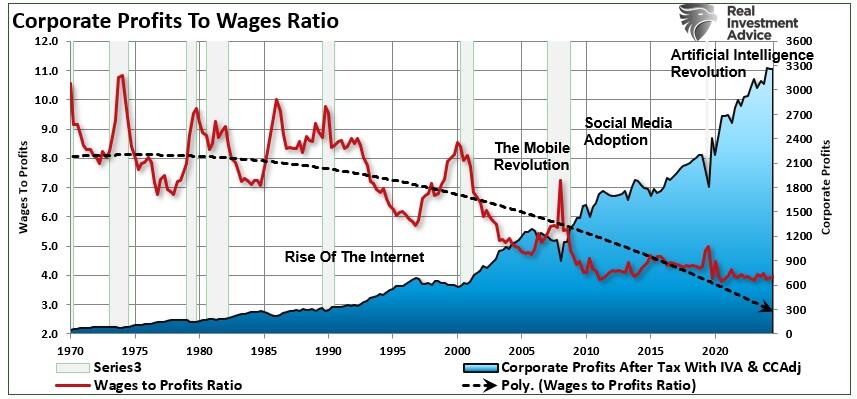
It is expected that AI productivity increases will vastly transform the U.S. economy. Firms are utilizing AI productivity enhancements to automate repetitive tasks, and research and coding functions have already been implemented. The obvious problem is that when machines perform functions once done by humans, what are the humans supposed to do for income? This increase in AI productivity is measurable across various sectors, as supply chains operate more efficiently, data analysis accelerates, and customer service utilizes automated agents to streamline tasks. Manufacturing, once considered a stable sector of the economy, is increasingly using robotics to reduce labor costs. Professional services are also increasingly displacing workers in medical, legal, and other areas of the service economy to improve output (read: profits) per worker.
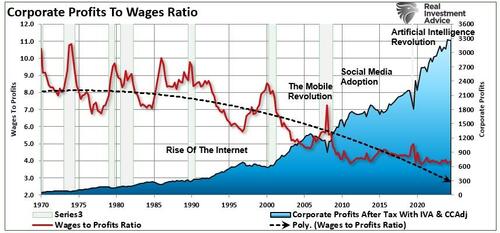
This is not a new thing. It has been accelerating since the invention of the fax machine and phone answering devices. The use of AI productivity-enhancing technology is becoming increasingly apparent. But as shown, the shift by corporations to focus on worker productivity is ongoing.
Recent corporate statements confirm this shift. At a 2025 financial conference, JPMorgan Chase reported that AI adoption doubled productivity gains in certain operations from 3% to 6%, with some roles seeing efficiency increases of 40% to 50%. Other banks said AI allows them to accomplish more work with the same headcount.
In theory, the promise of AI productivity increases is alluring. While firms can produce more with fewer inputs, humans will have more time to pursue education, leisure, and spend time with their families, increasing overall health and happiness. Again, that is theory, and the subject of today’s commentary.
Productivity Set To Surge
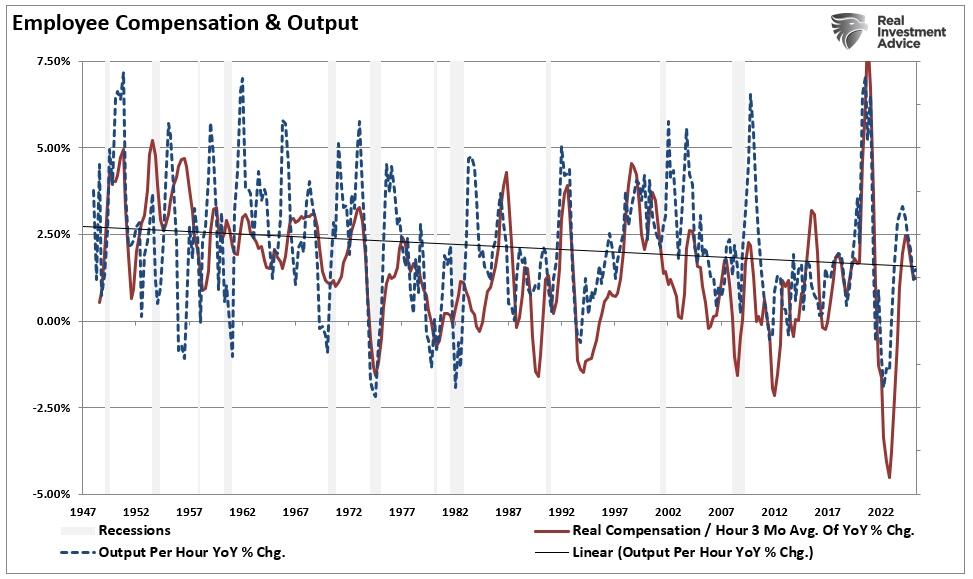
The strict definition of “productivity” is the output per unit of input. In other words, if output rises, it should correspond to an increase in employee compensation, as economic demand leads to the production of more products. Since 1947, a correlation has existed between economic output and the 3-month average of the annual rate of change in employee compensation.
Between 2004 and the pandemic, annual labor productivity growth averaged just 1.5% per year, significantly below the pace required for sustained real wage improvement. Recent gains measured in 2023 showed a temporary uptick; however, whether this marks a trend driven by AI rather than short-term business cycles remains unclear.
Furthermore, emerging research suggests that AI has the potential to deliver significant productivity improvements. A study of generative AI usage found that average workers using tools like ChatGPT completed tasks 40% faster with higher quality, implying substantial productivity enhancements when AI is integrated into work processes. The Federal Reserve Bank of St. Louis estimated that generative AI contributed a roughly 1.1% boost to aggregate productivity, with individual workers saving multiple hours per week on routine tasks. Lastly, a TIME-published analysis of Anthropic research suggests that AI has the potential to double U.S. labor productivity growth, increasing it by approximately 1.8% if widespread adoption occurs.
These projections also align with broader institutional forecasts. The IMF reports that AI could significantly impact nearly 40% of jobs worldwide, presenting both opportunities and risks for income growth and inequality. Yet, productivity gains alone do not automatically lead to wage increases or employment growth.
The Problem
The problem arises when productivity increases without a corresponding demand for labor. AI operates without downtime, 24/7, and does not require traditional wages, benefits, or breaks. If AI performs tasks that previously employed millions of workers, the question of how displaced workers earn income becomes central. Corporate leaders acknowledge this challenge. Federal Reserve Chair Jerome Powell has highlighted the unpredictability of AI’s impact, noting that productivity gains may come with labor market disruptions that current policy tools are ill-equipped to manage.
Historical examples show how technological shifts displace workers in the short term. For instance, during the “Industrial Revolution,” artisans lost jobs to mechanized production. Horse‑drawn carriage drivers disappeared with the advent of automobiles. Yes, workers eventually moved into new fields, but the transition involved hardship and community upheaval. Automation in prior eras often created new kinds of jobs, but the pace and breadth of AI disruption could set this wave apart. Instead of merely replacing manual labor, AI now substitutes for tasks across both blue-collar and white-collar jobs. Research by Oxford economists Carl Frey and Michael Osborne highlighted that many occupations have tasks that are susceptible to automation, and could disappear entirely.
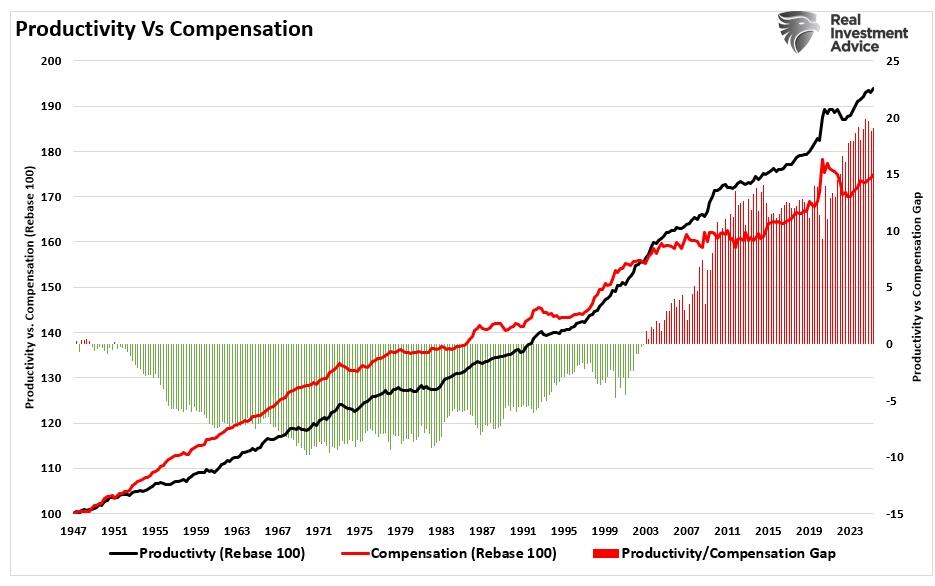
Compounding the challenge, since the late 1970s, productivity gains started diverging from typical worker compensation. According to the Economic Policy Institute, productivity growth far outpaced wage growth for the median worker, signaling that gains from technology and economic expansion have accrued disproportionately to capital owners and high‑skill labor. This productivity-pay gap signals that, even before AI’s full impact arrives, workers were not sharing equitably in productivity-driven prosperity.
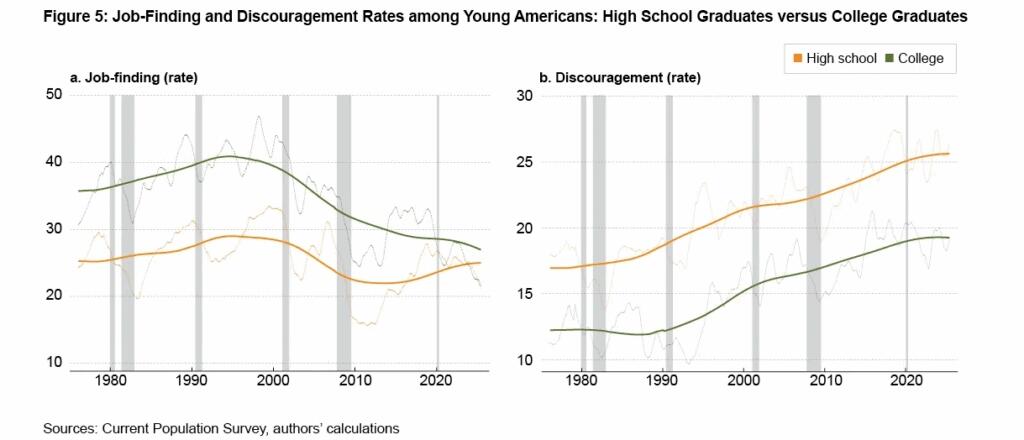
The pace of technological change means millions of Americans face an uncertain labor market. Young workers entering the workforce find fewer traditional hiring pathways and rising expectations around digital and AI‑related skills. Older workers frequently lack the time or resources to retrain in rapidly shifting skill environments. Across age groups, employers deploying AI experience reduced labor costs and increased productivity, which simultaneously puts pressure on wages and job security.
The reality is stark. The economy may grow, but how the gains are distributed will determine whether everyday Americans thrive or struggle. Without structural policy interventions, technological displacement risks widening income inequality and weakening labor market attachment. The promise of more leisure, education, and family time from productivity gains remains theoretical. If workers lack stable incomes, employment opportunities, or bridging support, the rest won’t matter.
But, this is where the “cries for UBI” become most vocal.
The Wrong Solution
Legendary investor Howard Marks has described AI’s impact on employment as “terrifying.” He emphasized that work provides purpose and identity beyond mere income. Notably, he stated that “…financial support alone will not replace the psychological and social benefits of employment.” That is a crucially important statement, which we now have the data to support. Universal Basic Income (UBI) is the default proposal to offset the impacts of increased AI productivity. The logic sounds simple enough: “If AI displaces workers, send checks to households to replace lost wages and economic stability returns.”
The problem is that the evidence does not support this conclusion.
Following the pandemic-driven shutdown of the economy, we sent checks to households, which was a form of Universal Basic Income. Many articles espoused the benefits of such an operation, but the results were far less appealing. Surging inflation eroded the benefits of the stimulus and left Americans far worse off than they would have been otherwise. However, other real-time tests have also yielded less than promising outcomes.
We previously discussed one of the UBI experiments, which found predictable results. Short-term relief did not translate into higher employment, improved skills, or long-term income growth. Cash transfers temporarily increased consumption but did not raise productivity, increase labor force participation, or improve economic mobility.
“Participants in the study generally did not use the extra time to seek new or better jobs—even though younger participants were slightly more likely to pursue additional education. There was no clear indication that the participants in the study were more likely to take the risk of starting a new business, although Vivalt points out that there was a significant uptick in “precursors” to entrepreneurialism. Instead, the largest increases were in categories that the researchers termed social and solo leisure activities.”
The Argument magazine also reviewed multiple studies on guaranteed income and reached a similar conclusion. While recipients reported lower stress and higher short-term satisfaction, these gains faded quickly. Employment outcomes showed little improvement, job search intensity declined in several cases, and participation in education and retraining did not rise significantly.
In other words, giving people money without purpose helped much less than promised.
The core flaw in UBI is structural, as it treats income as the problem. Employment is the real issue. Yes, work provides wages, but it also offers skill development, social structure, and a sense of purpose, along with long-term stability. A simple check replaces none of those, and unfortunately, as 2020 shows, when producers realize that checks are being sent, they raise prices to capitalize on it. In other words, an artificial increase in incomes will quickly be absorbed by higher prices (inflation), effectively rendering the UBI useless.
Here is the most critical point.
“An economy cannot function on transfers alone; production must precede consumption. UBI reverses this order.“
Cost also matters. A national UBI program large enough to offset AI-driven displacement would require trillions of dollars annually. Funding such a program would either require higher taxes, debt expansion, or both. While each option will reduce future growth, higher taxes reduce investment incentives, while increased debt raises interest costs and crowds out private capital. Neither path supports long-term prosperity.
UBI also weakens the labor signal. Wages communicate where labor is needed, and training follows opportunity. UBI dulls this signal by separating income from work, and, over time, workforce attachment erodes, skills decay, and reentry into employment becomes increasingly complex. This dynamic showed up repeatedly in pilot programs.
Most importantly, UBI avoids the hard work of reform. It sidesteps education reform, workforce retraining, mobility assistance, and pro-growth labor policy. It accepts displacement as inevitable and permanent. History shows this approach fails, and past technological shifts succeeded because workers moved into new roles. In other words, policy supported adaptation, not withdrawal.
AI productivity gains will demand active solutions, not government gifts. Skill development, apprenticeships, employer-based training, wage insurance, and mobility support. These tools address displacement directly, while UBI does not.
Defaulting to UBI is an admission of policy failure and signals surrender to the disruption rather than managing it. The United States grew prosperous by expanding opportunity, not replacing work with checks. That lesson remains relevant today as AI continues to reshape the economy.
Tyler Durden
Fri, 01/16/2026 – 14:20
https://www.zerohedge.com/ai/wrong-solution-ai-productivity-employment-ubi

Elgin News Digest: Les Ballet De Trockadero to perform Jan. 31 at ECC; national group names Judson a bike friendly university
Les Ballet De Trockadero to perform Jan. 31 at ECC
Les Ballets Trockadero de Monte Carlo will perform at 7 p.m. Saturday, Jan. 31, at the Blizzard Theater in Elgin Community College’s Performing Arts Center.
Founded in New York City in 1974, the all-male company combines humor and technique, according to the arts center’s website. Over the past 50 years, they have done shows in 667 cities in more than 43 countries.
Tickets are $45 for adults and $20 for children 12 and younger. They can be purchased online at eccartscenter.org, in person at the arts center box office or by calling 847-622-0300.
The Judson University Bike Shop holds Saturday bike rides to various areas, including the Fox River Trail. (Judson University Bike Shop)
National group names Judson a bike friendly university
Judson University in Elgin has been awarded Bicycle Friendly University status by the League of American Bicyclists.
Judson, Southern Illinois University Edwardsville and Illinois State University were the only Illinois schools among the 45 institutions across the United States to be given the designation, according to a news release.
Judson was cited for having its own bike shop and offering weekly organized bike rides, mountain biking trips, bike promotion events and campus bike paths with access to the Fox River Trail.
Nominees sought for Hanover Township service awards
Nominations are being accepted through Friday, Feb. 27, for the 2026 Hanover Township Supervisor Brian P. McGuire Community Service Awards.
The awards recognize organizations and individuals who volunteer their time to help make Hanover Township a better place to live, work and raise a family, according to a news release.
Nominations will be accepted in the categories of adult volunteer, youth volunteer, senior volunteer, business community and service club/organization.
Applications are available online at www.hanover-township.org or at Hanover Township Town Hall, 250 S. Route 59, Bartlett. An awards ceremony will be held in the spring, offficials said.
Mental health first aid training offered in Kane County
The Kane County Health Department is working with the Family Service Association of Greater Elgin to offer mental health first aid training in Kane County.
Kane provided a federally funded grant of $75,000 to to the Family Service Association to provide initial training to 15 trainees, who in turn will offer low-cost training to other community members throughout 2026, according to a news release.
The goal is to have 2,000 county residents trained using an evidence-based, early intervention approach. Participants will be taught how to identify and respond to signs of mental illnesses and/or substance use disorders and will learn risk factors and warning signs.
Organizations, businesses and individuals interested in being trained in mental health first aid should contact Ashley Kellenberger at AKellenberger@fsaelgin.org or 847-695-3680.
The Center for Effective Lawmaking, a nonpartisan thinktank, has named state Rep. Anna Moeller, D-Elgin, one of Illinois’ most effective legislators. (Anna Moeller)
Moeller named one of Illinois’ most effective legislators
The Center for Effective Lawmaking, a nonpartisan thinktank, has named state Rep. Anna Moeller, D-Elgin, one of Illinois’ most effective legislators.
According to the Center’s website, Moeller ranks fourth among House Democrats. The findings measure how successful General Assembly members are at moving sponsored bills through the lawmaking process, the site said.
Created in 2017, the Center for Effective Lawmaking is a joint partnership between the Frank Batten School of Leadership and Public Policy at the University of Virginia and Vanderbilt University in Nashville, Tennessee.
https://www.chicagotribune.com/2026/01/16/elgin-ballet-moeller-judson-bike-mental/
Manhattan woman, 24, identified as driver in fatal crash with school bus
Makenna M. Maurisak, a 24-year-old Manhattan woman, was killed Thursday as a result of a crash with a school bus on eastbound Manhattan-Monee Road in Manhattan Township, the Will County coroner’s office reported Friday.
Illinois State Police said the accident occurred at 8:17 a.m. just west of School House Road.
Preliminary information indicates a Chevrolet Malibu sedan driven by Maurisak was traveling east while the school bus was heading west, Illinois State Police said Friday.
“For an unknown reason, the driver of the Chevrolet Malibu lost control of their vehicle and crossed over the center boundary line into the westbound lanes,” police said.
The front of the school bus struck the passenger side of the Chevrolet Malibu, police said.
The school bus was transporting students from Manhattan Elementary District 114, officials said. Ten children and the school bus driver were taken to Silver Cross Hospital as a precaution, but no serious injuries were reported.
All students were released to their parents by Thursday afternoon, District 114 said.
State police said Friday they are continuing their investigation and did not have more information.
Manhattan Mayor Mike Adrieansen called it a heartbreaking tragedy, and pointed to recent efforts to get the state to address safety concerns on roads it maintains near and in the village, including a meeting with the Illinois Department of Transportation Nov. 25, 2025.
“Following that meeting, traffic safety changes were implemented on state-maintained roads, and we will continue advocating for additional improvements to help prevent future tragedies,” Adrieansen said in a statement.
Michelle Mullins is a freelance reporter for the Daily Southtown.
https://www.chicagotribune.com/2026/01/16/manhattan-woman-driver-crash-school-bus/

Chicago Bears’ playoff run means big postseason business for Soldier Field food service
When the Chicago Bears host the Los Angeles Rams on Sunday evening, it will be just the fifth time in the storied history of Soldier Field that the lakefront stadium will be the site of two NFL playoff games in one season.
For Chicago, the team and its long-suffering fans, the postseason run on frigid home turf is a boon to both civic pride and a wide range of businesses gearing up for game day, from bars and restaurants to Houston-based manufacturer Foam Party Hats, whose cheese grater hats are on backorder through March in the wake of last week’s 31-27 comeback playoff win over the Green Bay Packers.
But perhaps no business is more directly connected to the home playoff run than Chicago-based Levy, which is firing up its team of more than 1,200 mostly seasonal food service workers again this week to sate 60,000 boisterous Bears fans Sunday at Soldier Field.
“This is like bonus money to them,” said Ryan Craig, 35, now in his second season as executive chef for Levy at Soldier Field, which took over concessions for the stadium in 2024. “They’re coming in and they’re working additional weeks that otherwise weren’t on schedule. So I think the excitement around the employees is just as much as it is around the fans.”
One of the largest sports concessionaires in the country, Levy provides game day food and beverage service for 10 NFL stadiums. In addition to Soldier Field, Chicago-area sports venues served by Levy include Wrigley Field, United Center, Rate Field and Now Arena in Hoffman Estates, as well as the Chicago Fire’s new soccer stadium going up in the South Loop.
Each year, there are 10 Bears home games at Soldier Field including the preseason and regular season. The postseason run not only expands the schedule for Levy, playoff games tend to generate more concessions revenue, with fans pouring into the stadium earlier than usual to be part of the excitement, Craig said.
Ryan Craig, executive chef for Levy at Soldier Field, showcases the food offerings for Chicago Bears games, Sept. 4, 2025. (Brian Cassella/Chicago Tribune)
For last week’s game with the Packers, Levy cooked up a number of promotions to rev up the oldest rivalry in football, including sending staff out with cheese graters to add some shredded cheddar — and a side of snark — to just about everything.
“We had some people wearing the cheese grater hats, and they had cheese graters and cheese and they’re walking around almost like a restaurant offering to grate cheese on stuff for people,” Craig said. “That’s what the fans were going for. So we jumped in on it all the way with the fans.”
The Levy team has been gearing up all week for Sunday’s game against the Rams, which has been somewhat more challenging in terms of food service themes. Not only is it a less heated rivalry, but the weather is going to be downright cold, with game-time temperatures expected to be in the teens by the 5:30 p.m. kickoff.
The arctic blast, however, could be good for food sales at Soldier Field. Craig said fans generally eat more when it’s cold, especially hot food.
“They don’t buy as much popcorn and pretzels, and they buy more hot dogs, burgers, Italian beef, things like that to stay warm,” Craig said. “But we do actually see a lift in food sales when it gets colder.”
Levy is introducing an “Iceman” cocktail this weekend in honor of the weather and Caleb Williams, who earned that moniker from his teammates for coolly guiding the Bears to seven fourth-quarter comebacks this season, including last week’s win over the Packers.
To combat the frigid temperatures, Craig also plans to have a reservoir of hot chocolate on tap to warm up the fans. A Chicago twist this season includes a concoction with a little more punch — Malort hot chocolate with salted caramel marshmallows.
“It was a good combo, and it keeps people warm,” Craig said.
Molly’s mac and cheese with cavatappi, cheddar and American cheese is prepared on Sept. 4, 2025, as the Chicago Bears showcase food offerings at Soldier Field. (Brian Cassella/Chicago Tribune)
Meanwhile, the foam cheese grater hats may be in short supply Sunday at Soldier Field. They not only have little relevance to the Rams, but also are nearly impossible to get at this point, with demand far outstripping supply.
The cheese grater hat itself was born of Packer resentment, according to Manuel Rojas, who started Foam Party Hats in 2017 with his mother, Grace, after the family immigrated to Texas from Venezuela.
In 2023, they created the cheese grater hat in response to receiving a cease-and-desist letter from the Packers for the firm’s knockoff version of the team’s officially licensed cheesehead hat, long a signature accessory of its fanbase.
Foam Party Hats rolled out their cheese grater hat with the elan of a “Curb Your Enthusiasm” spite store, notching a few hundred sales in the first year. By the 2024 NFL season, it began to resonate with fans of NFC North rival teams, including the Bears, Minnesota Vikings and most notably, the Detroit Lions, who beat the Packers twice on the way to a division title.
“It was just like adding fuel to the fire, because people not only like the product … but also the back story of the Packers messing with a small business, and you have this David against Goliath situation,” Rojas said.
The company sold about 1,000 cheese grater hats in 2024, but sales have increased exponentially this season, due in large part to the Bears’ last-to-first success story, Rojas said. The hats sell for $39.99 with free shipping, but getting one before the Bears’ playoff run is over may be a challenge.
The cheese grater hats went viral in Chicago as the Bears took the NFC North and finally vanquished the Packers in what had been a one-sided rivalry for most of the new millennium.
Chicago Bears fans wearing cheese grater hats eat in the stands before the NFC wild-card game between the Bears and the Green Bay Packers at Soldier Field in Chicago on Jan. 10, 2026. (Chris Sweda/Chicago Tribune)
Some of the 8,000 cheese grater hats sold this season have shipped as far away as Germany, United Kingdom and Asia, ostensibly to overseas Bears fans/Packer haters, but the bulk of orders have headed to Chicago.
“We could have sold way more than that, if we had the capacity,” Rojas said.
When Williams and his teammates donned cheese grater hats after the Bears home playoff win last week against the Packers, demand spiked, generating 2,000 paid orders and 5,000 more on a waitlist, Rojas said.
The factory hired more workers, adding overnight and weekend shifts to churn out cheese grater hats, but the company has pushed back the delivery date for new orders to March 2 -– nearly a month after Super Bowl LX is held Feb. 8 at Levi’s Stadium in Santa Clara, California.
Down the road, Foam Party Hats is trying to get the cheese grater hat and other products officially licensed by the NFL to build an even bigger retail pipeline. For now, Rojas is grateful just to be a part of the Bears’ playoff run this season.
“Aside from making money and growing the business, it’s been really special to feel all the love of an entire city and being part of something so crazy as the Bears’ season that they’re having,” Rojas said. “It’ll be completely amazing if they make it to the Super Bowl and win the Super Bowl, because I think people in Chicago will see their cheese grater hat as an insignia for good luck.”
While both the Bears and Levy are taking it one game at a time, if the home team beats the Rams and the 49ers beat the Seahawks this weekend, the NFC championship game would take place at Soldier Field the following Sunday, making it the third home playoff game during a memorable season.
Beyond that is the Super Bowl, which the Bears last played in 19 years ago — losing 29-17 against the Indianapolis Colts.
“This season has been unlike any other I’ve experienced as a lifelong Bears fan,” Andy Lansing, CEO of Levy, said in a statement. “Chicago has rallied around this team, and the team keeps delivering. It’s something special. We’ve loved the opportunity to amplify the enthusiasm with fun food and drink specials that honor this team and resonate with the fans.”
Whether the Bears make it to the Super Bowl or not, the Levy team will be there as the food service provider at Levi’s Stadium.
It will mark Levy’s seventh Super Bowl since the dawn of the new millennium. The concessionaire last provided food service two years ago for Super Bowl LVIII at Allegiant Stadium in Las Vegas.
Craig said if the Bears do make it to Santa Clara, he will be there as well to help bring a taste of Chicago to the Super Bowl menu.
“I have two sous chefs that are already scheduled to go to the event and work it,” Craig said. “But if the Bears are in it, I will absolutely be there to make sure they have a great experience, from the ownership to the players to the Bears fans that are coming.”
rchannick@chicagotribune.com
https://www.chicagotribune.com/2026/01/16/bears-playoff-soldier-field-food-service/

Niles Township School District 219 gets national award for presentation of its fiscal budget
Niles Township High School District 219 received national accolades for the presentation of its current fiscal year budget, which district leaders say emphasizes the district’s “dedication to responsible financial stewardship.”
District 219 was given the Meritorious Budget Award from the Association of School Business Officials International for the 2025–2026 fiscal year. District leaders call their work on the spending plan and the presentation of it clear, transparent and high-quality, according to a school district news release announcing the honor.
ASBO International is a nonprofit organization that represents a global network of some 30,000 school business professionals, the release states.
According to the release, the Meritorious Budget Award program is the standard bearer for school budget development and communication. The program helps school business professionals enhance financial planning skills, the release explains, and helps to ensure that district budgets are comprehensive, accessible and informative for stakeholders.
“We are incredibly proud that our fiscal accountability contributes to positive student outcomes throughout the district,” said Jim Vreeland, the District 219 assistant superintendent for business. “Our business team is committed to consistently reaching the highest standards in budget practices.”
Niles Township High School District 219 enrolls over 4,500 students across its two schools — Niles North and Niles West — and serves the surrounding towns of Skokie, Niles, Lincolnwood and Morton Grove. The district’s 2026 school year budget is $176 million.
In order to be considered for the award, school districts submit budget documents for a rigorous peer review process conducted by experienced school finance professionals, the release explains. The submissions are reviewed against a MBA program checklist, and districts get critical feedback that helps refine and strengthen the budget presentations.
“An effective school budget is more than just numbers – it’s a vital tool for building trust and engaging the community,” Jim Rowan, executive director of ASBO International, stated in the release. “The Meritorious Budget Award recognizes districts like Niles Township High School District 219 that prioritize financial clarity and accountability. We commend their dedication to upholding nationally recognized budget presentation standards.”