Category: News

Naperville council votes down controversial data center proposal
Naperville City Council members, facing a packed house opposed to a data center being built on Naperville’s far northeast side, voted 6-1 Tuesday night to reject the project.
Developer Karis Critical made one last attempt at submitting a plan it hoped would pass council muster, scaling down the proposed building to 145,000 square feet, but failed to persuade council members that it was a good fit for the 1960 Lucent Lane property, located off the Interstate 88 corridor.
The final version of the plan called for a 24-megawatt IT load center and 12 back-up generators, representing a 33% reduction in scale, Karis attorney Russ Whitaker said. Revisions were made following legal negotiations with the city.
When Naperville residents first learned of the proposal nearly five months ago, Karis was requesting to construct two 211,000-square-foot data center buildings with a 72-megawatt IT load.
Negative resident feedback and an assessment that city utilities could not accommodate that size prompted the company to reduce it to a single 211,000-square-foot building with a 36-megawatt IT load and 24 backup generators. That version won the backing of the city’s Planning and Zoning Commission.
Many residents opposed to plans to build a data center on the city’s northeast side attended Tuesday night’s Naperville City Council meeting at which the proposal was rejected with a 6-1 vote. (Armando L. Sanchez/Chicago Tribune)
“The Karis data center is consistent with all the underlying zoning and 60 years of the Nokia campus being a center of innovation, investment and jobs in the city of Naperville,” Whitaker said, arguing it would be no different than the adjacent Nokia building, which also has a data center.
Neighboring property owners, however, were vocal in their objections. Many said they believed the project, regardless of its size, was unsuitable for its location given its close proximity to homes and the noise and potential health problems it could generate.
Council members Patrick Kelly, Supna Jain, Ian Holzhauer, Mary Gibson, Ashfaq Syed and Benny White voted against the center. Councilman Josh McBroom voted in favor of it. Mayor Scott Wehrli and Councilman Nate Wilson abstained.
Similar to past Planning and Zoning Commission meetings on the topic, Naperville residents flooded the meeting, had their children attend and carried signs saying “No data centers near neighborhoods.” Council chambers were standing room only throughout the evening.
When Naperville resident Rich Janor asked those opposed to the center to stand up, a majority in the room did so. Dozens of people spoke against the project, although there were some — many affiliated with construction and trade organizations — who supported it.
“Revitalizing the Lucent campus is not just another construction project. It’s an opportunity to bring jobs, investment and new opportunities to Naperville,” said Anthony Giunti, a Naperville resident and an international representative of the International Brotherhood of Electrical Workers 6th District.
Russ Whitaker, a lawyer representing Karis Critical, speaks at a Naperville City Council meeting Tuesday, Jan. 20, 2026, in favor of a data center proposed for the city’s northeast side. (Armando L. Sanchez/Chicago Tribune)
Katherine Butt, a 7-year-old who lives in the Fairview subdivision, was among those who asked the council to reject the plan.
“I want my neighborhood to be safe,” Katherine said. “One of my school rules is to be safe. Is building a data center safe? Another one of the rules is respectful. Is building a data center respectful? I also think you can build it, but far, far away, at least 100 miles away.”
Janor criticized Karis for presenting yet another new version of the center just before the council vote, calling it “legal maneuvering at the 11th hour, presumably to cast some doubt on a potential no vote here tonight.”
“Lawsuits against this body are lawsuits against all of us, and I can assure you that if any entity threatens legal action, residents in this room will have your back, Mr. Mayor and city council.”
The majority of council members appeared to agree with the protesters, who raised concerns about the center not fitting the city’s conditional use requirements, the noise the facility would generate and the health impact of the exhaust generated by the backup diesel generators.
“I find that petitioner has not met its burden by preponderance to show that the use will not be detrimental to public health, safety, general welfare,” Kelly said, “and that failure alone justifies denials of the application.”
In light of the scaled-back proposal, Werhli at one point proposed that the vote by pushed back to at least Feb. 17 so the developer would have time to conduct a new air dispersion study. Without that information, the council would be making a decision without all the information.
If that happened, it would require another public hearing, City Attorney Michael DiSanto said.
“I believe there’s certainly relevant information that, apparently, was potentially obstructed from us having tonight because of negotiations with city staff,” Wehrli said. The new study might sway council members to change their vote, he said.
Naperville Mayor Scott Wehrli, center, proposed at the Tuesday night Naperville City Council meeting that a vote on a proposed data center be delayed so Karis Critical could do a study on the scaled-back version of its project. (Armando L. Sanchez/Chicago Tribune)
But Holzhauer pushed back against that, describing the efforts to delay the vote as “contrived.”
“If this council, to my surprise, somehow decided to prolong this, I think that would be fraught with legal peril,” he said.
Wehrli’s motion to table the issue to allow time for a study to be done failed with a 6-3 vote.
“I think this is a unique moment in our economic development history,” the mayor said. “I can’t recall another matter where council or any petitioner, members of the council have asked for additional time and information, and then we’ve been told no.”
Collecting as much information as possible should be the priority, not taking a “vote of convenience.”
For that reason, the mayor abstained in voting.
A spokesperson for Karis said the company did not agree with the council’s action.
“We are disappointed by the outcome of the vote, which overturned the city plan commission’s recommendation, and by the city council’s decision not to allow additional time for further studies to address concerns regarding our operations,” the spokesperson said following the meeting.
cstein@chicagotribune.com
https://www.chicagotribune.com/2026/01/21/naperville-karis-data-center-vote-rejected/

Corte Suprema de EEUU se muestra dispuesta a mantener en su puesto a gobernadora de la Fed
Por MARK SHERMAN
WASHINGTON (AP) — La Corte Suprema de Estados Unidos pareció inclinada el miércoles a mantener en su puesto a la gobernadora de la Reserva Federal, Lisa Cook, poniendo en riesgo el intento del presidente Donald Trump de tomar el control del banco central del país.
Los jueces escucharon argumentos sobre el esfuerzo de Trump para despedir a Cook basándose en acusaciones de que cometió fraude hipotecario, lo cual ella niega. Ningún presidente ha despedido a un gobernador en funciones en los 112 años de historia de la Fed, estructurada para ser independiente de la política diaria.
Permitir el despido de Cook “debilitaría, e incluso destrozaría, la independencia de la Reserva Federal”, dijo el juez Brett Kavanaugh, uno de los tres designados por Trump al máximo tribunal del país.
Al menos otros cinco jueces de los nueve miembros de la corte también se mostraron escépticos sobre el esfuerzo de removerla de su cargo.
Cook y el presidente de la Reserva Federal, Jerome Powell, escucharon casi dos horas de argumentos en una sala de audiencias llena.
“En tanto sirva en la Reserva Federal, mantendré el principio de independencia política en servicio del pueblo estadounidense”, afirmó Cook en una declaración emitida tras la presentación de argumentos.
Los críticos de Trump dicen que la verdadera motivación para intentar despedir a Cook es el deseo del presidente de controlar la política de tasas de interés de Estados Unidos. Si el presidente logra remover a Cook, la primera mujer afroamericana gobernadora de la Reserva Federal, podría reemplazarla con su propio designado y obtener una mayoría en la junta del organismo. El caso es observado de cerca por los inversores de Wall Street y podría tener un amplio impacto en los mercados financieros y en la economía de Estados Unidos.
Trump ha desdeñado las preocupaciones de que reducir las tasas demasiado rápido podría desencadenar una mayor inflación. Quiere reducciones dramáticas para que el gobierno pueda pedir prestado más barato y los estadounidenses puedan pagar costos de endeudamiento más bajos para nuevas viviendas, automóviles u otras compras grandes, ya que las preocupaciones sobre los altos costos han decepcionado a algunos votantes con respecto a su gestión económica.
En un discurso pronunciado la mañana del miércoles en Davos, Suiza, Trump reiteró su llamado a que la Fed reduzca drásticamente las tasas, argumentando que Estados Unidos debería pagar “las tasas de interés más bajas del mundo”.
La junta redujo una tasa de interés clave tres veces seguidas en los últimos cuatro meses de 2025, pero Trump desea una reducción más rápida. La Fed también indicó que podría dejar las tasas sin cambios en los próximos meses debido a preocupaciones sobre la inflación.
La cuestión ante la corte es si Cook puede permanecer en el cargo mientras su impugnación al despido se desarrolla en los tribunales. Los jueces de tribunales inferiores le han permitido permanecer en su puesto como parte de los siete gobernadores del banco central. Los jueces podrían simplemente negar la apelación de emergencia que busca Trump y permitir que el caso siga desarrollándose en los tribunales inferiores.
El presidente de la Corte Suprema, John Roberts, quien también se mostró escéptico de las acciones de Trump, sugirió que podría ser inútil devolver el caso a los tribunales inferiores en lugar de emitir un fallo más duradero. Mientras el caso de Cook estaba bajo revisión en el máximo tribunal, Trump escaló dramáticamente su confrontación con la Fed. El Departamento de Justicia ha abierto una investigación penal sobre Powell y ha entregado citaciones al banco central.
Powell mismo dio el inusual paso de responder a Trump, calificando la amenaza de cargos penales como “pretextos” que enmascaran la verdadera razón, la frustración de Trump por las tasas de interés. El Departamento de Justicia ha dicho que la disputa se debe, evidentemente, al testimonio que Powell presentó en junio ante el Congreso sobre el costo de una renovación de gran magnitud en los edificios de la Fed.
En el primer año de Trump en el cargo, los jueces generalmente, pero no siempre, siguieron las súplicas de Trump para realizar acciones de emergencia con el fin de contrarrestar fallos de tribunales inferiores en su contra, entre ellos, permitir los despidos de los jefes de otras agencias gubernamentales a discreción del presidente, sin alegar que cometieron alguna falta.
Pero la corte ha enviado señales de que está abordando con más cautela la independencia del banco central del país, llamando a la Fed “una entidad cuasiprivada, estructurada de manera única”.
En el caso de Cook, Trump no afirma que puede despedir a los gobernadores de la Fed a voluntad, dijo el procurador general D. John Sauer. Cook es una de las varias personas, junto con la fiscal general de Nueva York, Letitia James, y el senador demócrata de California Adam Schiff, que han sido acusadas de fraude hipotecario por el funcionario federal de vivienda Bill Pulte. Todos ellos han negado las acusaciones en su contra.
El caso contra Cook se deriva de acusaciones de que ella declaró dos propiedades, en Michigan y Georgia, como “residencias principales” en junio y julio de 2021, antes de unirse a la junta de la Fed. Tales declaraciones pueden producir una tasa hipotecaria más baja y un pago inicial más pequeño que si una de ellas hubiera sido declarada propiedad de alquiler o segunda vivienda.
Esas solicitudes, dijo Sauer, son evidencia de “negligencia grave en el mejor de los casos” y le dan motivo a Trump para despedirla. En cualquier caso, argumentó, los tribunales no deberían estar revisando su decisión y Cook no tiene derecho a una audiencia.
Cook ha negado cualquier irregularidad y no ha sido acusada de ningún delito. “No hay fraude, no hay intención de engañar, nada en absoluto que resulte criminal o que sea remotamente una base para alegar fraude hipotecario”, escribió en noviembre un abogado de Cook, Abbe Lowell, a la secretaria de Justicia Pam Bondi.
Cook especificó que su condominio en Atlanta sería una “casa de vacaciones”, según una estimación de préstamo que obtuvo en mayo de 2021. En un formulario para solicitar una autorización de seguridad, lo describió como una “segunda vivienda”. Lowell escribió que el caso en su contra se basa en gran medida en “una referencia aislada” en un documento hipotecario de 2021 que era “claramente inocuo a la luz de las otras divulgaciones veraces y más específicas” sobre las viviendas que ha comprado.
___
Los periodistas de The Associated Press Fatima Hussein, Christopher Rugaber y Lindsay Whitehurst contribuyeron a este despacho.
___
Esta historia fue traducida del inglés por un editor de AP con la ayuda de una herramienta de inteligencia artificial generativa.

The Stock Market Isn’t A Market Anymore – It’s A Political Control Mechanism
The Stock Market Isn’t A Market Anymore – It’s A Political Control Mechanism
Authored by Nick Giambruno via InternationalMan.com,
It has become increasingly clear to me that the stock market is no longer a stock market in the traditional sense.
Its primary purpose was once straightforward: a venue where companies could raise capital by selling shares to the public, and where investors could freely buy and sell those shares among themselves.
Today, the market still performs that function — but it has been far overshadowed by three larger, unofficial roles that have become existential to social and political stability:
Liquidity Sponge: All the trillions in newly created currency units have to go somewhere. Better to have them chasing stocks than bidding up the price of groceries.
De Facto Savings Account: Most people treat their brokerage account as if it were a savings account. Their financial futures depend on the stock market continuing to rise. But putting money into the stock market is not saving — it’s investing, and that’s a very different thing. The rapid debasement of fiat currency has destroyed savings for the average person, forcing them into riskier assets like stocks in a desperate attempt to outpace inflation.
Crucial Tax Revenue: Taxes on capital gains, dividends, corporate profits, and other market-related activity have become an essential pillar of government funding.
As the failure of DOGE — the most serious attempt to cut federal spending in most people’s lifetimes — demonstrated, it’s politically impossible to even slow the growth rate of federal spending, let alone cut it. It doesn’t matter which party is in office; they’re all headed in the same direction. It’s like riding a runaway train with no brakes.
Issuing debt and then printing money to buy that debt remains one of the primary ways this out-of-control spending is financed.
All those new currency units need an outlet.
If people lose interest in the stock market because it has declined, those freshly created dollars will start flowing elsewhere, bidding up the prices of housing, food, and other basic necessities, which could trigger real social upheaval.
Another reason the government cannot allow the stock market to fall is that it would devastate retirement savings and infuriate the most politically active demographic.
It’s a near-guaranteed way to lose the next election.
A third reason is fiscal. A declining market would slash hundreds of billions in federal revenue from taxes on capital gains, dividends, corporate profits, and other market-linked activity. That shortfall would further explode the deficit, which would then need to be financed by even more borrowing and even more money printing, compounding the problem.
This is why, in short, the political establishment cannot tolerate a sustained downturn in the stock market. It would unleash intense social and political instability that could bring down the entire system.
And this is also why the stock market is no longer primarily a stock market in the traditional sense. It has become a mechanism that the political establishment relies on to maintain control.
This is the backdrop behind today’s absurd valuation metrics.
The S&P 500’s Price-to-Earnings (P/E) and CAPE (Cyclically Adjusted P/E) ratios are near historical highs, while Free Cash Flow Yield and Dividend Yield are near historical lows.
Meanwhile, Market Cap to GDP (the Buffett Indicator) sits at a record high. It measures the total value of the US stock market relative to US GDP. Today, that ratio stands at roughly 221% — far exceeding prior peaks of 139% at the height of the dot-com bubble in 2000 and 106% at the peak of the housing bubble in 2007.
These are just a few examples. Nearly every fundamental measure of valuation is at or near all-time highs — and still climbing.
This highlights the biggest challenge with investing today: rampant money printing by central banks has distorted financial markets like never before, rendering traditional fundamental analysis far less effective. It’s like using a measuring stick where the length of a centimeter keeps changing.
As a result, finding high-quality businesses at reasonable valuations through Graham-and-Dodd-style securities analysis is becoming increasingly difficult, if not impossible.
You would be mistaken to believe today’s insane valuations reflect a voluntary free market of rational buyers and sellers operating with honest money. What we are witnessing instead is the financial equivalent of a carnival fun house — a distorted, warped mirror shaped by an ever-increasing supply of fake money.
Many are understandably confused because today’s stock market valuations don’t make financial sense. But what they overlook is that these valuations do make political sense — and political concerns will continue to trump fundamentals as long as politicians control the money printer.
The financial fun house illusions will persist, and they will become even more absurd.
To distill it down to its most concise form: the US government can either let the stock market decline and watch the whole house of cards come tumbling down, or continue to goose it with easy money. It’s not difficult to predict which option they’ll choose.
That is why, if we do see a stock market decline, I do not expect it to be prolonged. In the past 26 years, the only extended downturns were the dot-com bust and the 2008 financial crisis. Every other pullback — including the 2020 Covid collapse — was so brief that if you’d taken a long vacation, you might have missed it entirely. That’s because at the first sign of trouble, the Federal Reserve stands ready to create as many currency units as necessary to prop up the system.
I expect this dynamic to persist. If another downturn is coming, I wouldn’t expect it to last very long.
The far more likely outcome is that we’ll continue to experience a melt-up (in nominal terms) until they destroy the currency.
Ludwig von Mises, the godfather of free-market Austrian economics, summed up the US government’s dilemma:
“There is no means of avoiding the final collapse of a boom brought about by credit expansion.
The alternative is only whether the crisis should come sooner as the result of a voluntary abandonment of further credit expansion, or later as a final and total catastrophe of the currency system involved.”
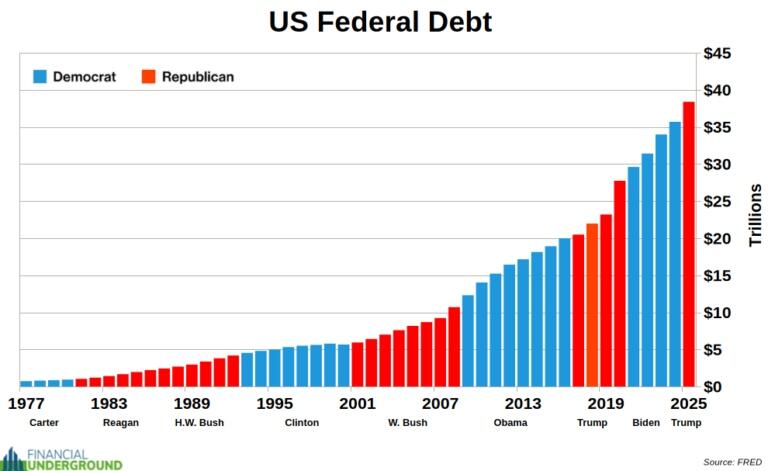
The US government will not voluntarily “abandon credit expansion,” as Mises puts it, because Washington is dependent on issuing increasing amounts of debt — which the Fed buys with dollars it creates out of thin air — to pay for the ever-growing costs of Social Security, national defense, welfare, and interest on the federal debt.
That means their only choice is to debase the US dollar by ever-increasing amounts until, as Mises puts it, the “final and total catastrophe of the currency system involved.”
It’s like a drug addict who needs to keep raising his dose to get the same effect… until he dies of an overdose.
Could that happen in 2026?
I think it’s a growing possibility, but not the most likely outcome. I believe it’s more likely the melt-up continues.
My primary mission at Financial Underground: SPECULATOR is to put together the pieces to reveal the true Big Picture and get positioned in unstoppable investment trends ahead of the crowd with smart speculations.
I’m more interested in getting the Big Picture right than gambling on short-term trades in rigged markets.
In my latest free PDF report, The Most Dangerous Economic Crisis in 100 Years… the Top 3 Strategies You Need Right Now, I break it all down, explore what’s in store, and determine the best ways to get positioned for profits amid what promises to be a tumultuous year.
Tyler Durden
Wed, 01/21/2026 – 13:15
https://www.zerohedge.com/markets/stock-market-isnt-market-anymore-its-political-control-mechanism

Watch Live: President Trump Sits Down With CNBC’s Joe Kernen
Watch Live: President Trump Sits Down With CNBC’s Joe Kernen
President Trump will sit down for an interview with CNBC’s Joe Kernen in Davos, Switzerland on Wednesday.
Earlier, Trump gave a speech at the World Economic Forum where he touted the strength of the U.S. economy and criticized Europe, saying it “is not heading in the right direction.”
Trump also doubled down on his desire to take control of mineral-rich Greenland, but said he wouldn’t use force to achieve this goal.
“People thought I would use force. I don’t have to use force. I don’t want to use force. I won’t use force,” Trump said in the highly anticipated address to the WEF.
The question is – will Trump refocus his attention on domestic matters – affordability – or keep going on the earlier more interventionist speech.
Watch live (due to start at 1300ET delayed start to 1400ET):
Tyler Durden
Wed, 01/21/2026 – 13:05
https://www.zerohedge.com/political/watch-live-president-trump-sits-down-cnbcs-joe-kernen

Chicago paid $26.5 million in OT to ineligible employees, report says
Chicago doled out $26.5 million in overtime in recent years to government employees who should not have gotten it, according to a report released Wednesday by the city’s Inspector General.
Over 1,000 likely ineligible employees received the extra pay from 2020 to 2024, according to the report by Inspector General Deborah Witzburg. The payouts were not “nefarious or stealing,” but mistakes akin to “a series of spreadsheet errors,” Witzburg told the Tribune.
“It’s no secret that the city is in pretty desperate financial straits,” she said. “This is just sloppy financial management, to the tune of $10,000,000’s, when the city can ill afford that.”
Witzburg’s report noted that many of the employees worked in management positions and without collective bargaining agreements, making them ineligible for the extra pay. The most-involved departments included the Fire and Police departments, libraries, Water Management and Office of Emergency Management and Communications.
Nearly a quarter of the extra pay went to just 18 employees, the report said. Topping that group were three Fire Department deputy district chiefs who each raked in around $600,000 during the five-year period.
“This isn’t nickels in the couch cushions… this is big money,” Witzburg said. “No one can afford to dismiss the significance of an eight-figure mistake.”
The city’s Office of the Inspector General alerted former Mayor Rahm Emanuel to its overpay concerns in 2013, the report said.
Sandra Blakemore, appointed by Mayor Brandon Johnson to lead the city’s Department of Human Resources, told the inspector general it would respond to her report by auditing pay statuses and meeting with the most-involved departments to implement any needed changes, according to a letter shared with the report.
Blakemore’s response also noted that some employees involved had changed jobs and had been previously eligible for overtime, meaning the $26.5 million sum could be in part an overcount.
Witzburg praised the responses as “productive and thoughtful.” Johnson took office in 2023, meaning the majority of the period Witzburg analyzed occurred under the leadership of former Mayor Lori Lightfoot.
Johnson has publicly challenged the city’s biggest area of overtime spending: rank-and-file police. The Police Department typically blasts through its proposed overtime budget. In 2024, the city budgeted $100 million for CPD overtime, but spent $238 million.
The mayor attempted to add restrictions in the city’s 2026 budget requiring his approval for more spending when the police overtime budget is exceeded, but aldermen removed the measure in the alternative budget they passed against his will. Johnson issued an executive order in late December in an effort to maintain the restrictions.
Throughout the budget debate, the mayor framed reigning in the department’s overspending as a critical part of delivering a budget that avoids tax hikes.
Witzburg echoed those terms to back up the importance of her Wednesday report, pointing to the City Council’s “hand-wringing” over the final budget’s makeup.
“You have to imagine that everybody who is out in Chicago today paying extra for their grocery bags might have wished the city would have fixed this when they said they would,” she said.
https://www.chicagotribune.com/2026/01/21/chicago-26-5-million-overtime-ineligible-employees/

Europe Prepares To Unleash Anti-Coercion “Trade Bazooka” Against Trump: Here’s What’s In It
Europe Prepares To Unleash Anti-Coercion “Trade Bazooka” Against Trump: Here’s What’s In It
While president Trump took military force over Greenland off the table (for now at least) during his Davos speech, this makes a bruising diplomatic showdown virtually assured. And ahead of whatever trade escalation the Trump admin may announce next, EU leaders toughened their position and want the European Commission to ready its most powerful trade weapon against the US if Donald Trump doesn’t walk back his Greenland threats.
According to Politico, which cites five diplomats with knowledge of the situation, Germany joined France in saying it will ask the Commission to explore unleashing the Anti-Coercion Instrument (ACI) at the emergency EU leaders’ summit in Brussels on Thursday evening. Berlin’s move brings the EU closer to a more forceful response, with Trump’s escalating rhetoric about the Danish territory and its supporters having prompted key capitals to harden their stance on how Europe should react.
“The resolve has been there for a few days,” one of the diplomats said. “We have felt it in our bilateral talks … there is very broad support that the EU must prepare for all scenarios, and that also includes that all instruments are on the table.”
Politico also writes that what governments request of the Commission meeting on Thursday would be decided largely by what the U.S. president says in his Davos address on Wednesday; and as reported earlier Trump maintained maximum pressure to force Europe to yield control of the territory to the US. Trump’s speech came as several European leaders had been trying to arrange meetings with the president on the Davos sidelines to talk him down from imposing the tariffs.
Aside from the anti-coercion tool, or “trade bazooka,” leaders have also discussed using an earlier retaliation package that would impose tariffs on €93 billion worth of U.S. exports. Two of the EU diplomats indicated that it is possible to impose the tariffs first, while the Commission goes through the more cumbersome process of launching the powerful trade weapon.
So what exactly is the ACI?
Europe’s “trade bazooka” has a 10-point list of possible measures on goods and services. They include:
Curbs on imports or exports of goods such as through quotas or licenses.
Restrictions to public tenders in the bloc, worth some 2 trillion euros ($2.3 trillion) per year. Here the EU has two options: Bids, such as for construction or defence procurement, could be excluded if U.S. goods or services make up more than 50% of the potential contract. Alternatively, a penalty score adjustment could be attached to U.S. bids.
Measures impacting services in which the US has a trade surplus with the EU, including from digital service providers Amazon, Microsoft, Netflix or Uber.
Curbs on foreign direct investment from the United States, which is the world’s biggest investor in the EU.
Restrictions on protection of intellectual property rights, on access to financial services markets and on the ability to sell chemicals or food in the EU.
The EU is supposed to select measures that are likely to be most effective to stop the coercive behavior of a third country and potentially to repair injury.
What does the ACI allow?
The ACI offers a broad and flexible array of countermeasures: its aim is not merely to reciprocate, but to provide the EU with calibrated responses depending on the nature and impact of the coercion:
Trade measures are the first type of possible responses. These could consist of the imposition or increase of customs duties, import/export quotas or licenses and limitations on the free movement of certain products.
Services and non-tariff measures can also be introduced. The instrument also provides responses in the services sector, for example restrictions on the provision of cross-border services, limitation of access to certain service markets, changes in access criteria or licensing for third-country providers.
Controls on FDIs and public procurement are probably the most powerful aspects of the ACI. They allow the EU to impose restrictions on access to EU public procurement markets for entities of a coercive third country; they may limit foreign direct investment (FDI), particularly in sensitive sectors, or impose conditions on investors from third countries in strategic areas.
The ACI also allows action on intellectual property rights, financial market access or certain export controls & licensing, reflecting the need to cover broader economic areas where coercion may manifest. That said, the ACI does not allow everything. In particular, restrictions must be targeted at specific entities of the coercive country and proportionate to the harm caused. Broad investment bans in the third country would exceed this framework. In addition, measures must comply with WTO rules and relevant bilateral investment treaties; broad restrictions on a major partner like the US could raise serious legal challenges.
Specifically, the ACI could allow the EU to impose tariffs on services imports from the US. For reference, a flat 10% tariff on all EU imports of US services could mechanically raise about EUR 50bn in revenues.
That said, the US firms selling services into the EU have substantial market power, especially in digital services. This implies that European consumers would find it difficult to substitute away from services imports from the US and would likely need to shoulder a significant share of the services tariff. However, the ACI would also allow the EU to take broader retaliatory steps against US services companies, including an increase in the digital services tax (DST), investment restrictions or “buy Europe” clauses in procurement (such as defence).
Original purpose of the Anti-Coercion Instrument
According to Credit Agricole (full note available to pro subs), the EU’s decision to introduce the Anti-Coercion Instrument (ACI) arose from a combination of geopolitical developments, trade conflicts and the perceived limitations of existing mechanisms.
In recent years, several third countries have increasingly used economic measures as leverage to influence EU or Member State policies. Notable precedents include China’s economic measures against Lithuania following its recognition of Taiwan’s representation, as well as repeated instances where countries applied unilateral tariffs, trade restrictions or investment barriers to press political demands. These cases highlighted that traditional WTO dispute settlement procedures were insufficient, since they typically address breaches of trade rules rather than coercive political pressure.
Against this backdrop, the European Commission proposed the ACI at the end of 2021. After a long EU legislative process, it was finally adopted by the European Parliament in plenary on 3 October 2023. The regulation was subsequently signed and entered into force on 27 December 2023
What it is, legally speaking?
The ACI falls within the broader scope of EU trade law. It is a directly applicable regulation (not a directive), meaning it bindingly applies uniformly in all Member States, without need to be devised in national law.
Its structure combines a clear procedural framework with an indicative list of possible countermeasures, while strictly regulating their use to ensure compliance with international law.
It defines economic coercion as a situation “where a third country seeks to exert pressure on the European Union or a Member State to influence a strategic choice or political decision by applying or threatening to apply measures affecting trade or investment”. This definition encompasses a wide range of practices, from punitive tariffs to restrictions on market access, services or investments.
The instrument applies regardless of the identity of the third country and whether the coercion is formal or informal, allowing the EU to respond to behaviours that might not be illegal under WTO rules but are used as political leverage.
How does the EU invoke the ACI
The ACI was proposed in 2021 as a response to criticism within the bloc that the first Trump administration and China had used trade as a political tool. European law gives the European Commission up to four months to examine possible cases of coercion. If it finds a foreign country’s measures constitute coercion, it puts this to EU members, which have another eight to 10 weeks to confirm the finding.
Confirmation requires a qualified majority of EU members, the support of 55% of member states representing at least 65% of the EU population, within 10 weeks. This is a higher hurdle to clear than that for applying retaliatory tariffs.
The Commission would normally then negotiate with the foreign country in a bid to stop the coercion. If that fails, it can implement ACI measures, again subject to a vote by EU members. These should enter into force within three months.
Since the ACI is European, the whole process takes an eternity to implement, and could take anywhere from a few months to a year to complete. By then, whatever plans Trump has vis-a-vis Greenland would be largely consummated.
According to Goldman, the EU will activate the ACI if the US escalates tensions further, but without implementing any measures immediately to leave additional time for negotiation. In other words, it is unlikely that any actual implementation of the ACI will take place in 2026 even assuming full-blown trade war returns.
More in the Credit Agricole and Goldman notes explaining the EU’s Retaliation Options available to pro subs.
Tyler Durden
Wed, 01/21/2026 – 12:40

Hobart Fire Department adds to ranks with two additional firefighters
Firefighters/EMTs Samuel Stevens and Benjamin Casillas took the oath of office during a swearing-in ceremony held Tuesday at the Hobart Fire Department.
The addition of the two men brings the total employment up to 63, the first time the Hobart department has been fully staffed in numerous years, Hobart Fire Chief Enrique Lopez said in a release.
Both men came to the department with prior experience in the fire service and, by taking the oath of office, became part of a team committed to protecting life and property within the community, fire officials said.
Lopez provided remarks highlighting the meaning and responsibility of entering the fire service. He said the ceremony is not defined by past experience but by the path ahead. He stated in the release that the badge represents trust from the citizens of Hobart, from fellow firefighters, and from the families who support those who serve.
Lopez also acknowledged the families present, emphasizing that the fire service demands long hours, missed holidays, and moments of uncertainty. He thanked them for providing the support that makes this profession possible and reinforced that new members join not only a department, but a family that trains together, relies on one another, and stands together in difficult moments.
Staffing levels have reached a milestone for the department, Lopez said.
“This is the first time in recent memory that the Hobart Fire Department is fully staffed,” Lopez said. “It speaks volumes. Not only because we have the means to offer these positions, but also because we have a community of driven men and women who answer the call.”
Hobart Fire Department administrative assistant Terry Newman, reflecting on more than four decades of service, provided additional context.
“This is the most I have ever seen in my 44 years,” Newman said. “Nineteen on duty at a time, 57 rotating, plus one chief, two assistant chiefs, two division chiefs, and one inspector. Sixty-three total.”
The oath of office was administered by Hobart Mayor Josh Huddlestun, who welcomed the new members and recognized their commitment to serving the city of Hobart.
Following the swearing-in, Stevens and Casillas received their badges and were formally introduced as the newest members of the department.
The Hobart Fire Department provides fire suppression, EMS, rescue, and community risk reduction services for residents and businesses throughout Hobart.
Deborah Laverty is a freelance reporter for the Post-Tribune.

Kaneland graduate Freddy Hassan already gets Division I looks as freshman at Waubonsee. ‘Our most consistent.’
The best is yet to come for Kaneland graduate Freddy Hassan, but there’s a lot to be said for how the present is going for the Waubonsee Community College freshman.
Quite well, thank you.
That’s probably no surprise to many who watched the development of the 6-foot-7 forward/center the previous four years for the Knights, but nothing is given when making the jump to college.
“I expected to come in, work hard and play my best,” Hassan said. “As a team, I wasn’t really sure what to expect. You hear a lot about juco, like it’s not a good place to be. Some say it’s not real basketball, although that’s not a real thing anymore with all the transfers to D-I and D-II schools.
“I thought we’d come in and love each other and play. I feel like, if that’s what we do, we can win.”
So far, those wins have been piling up.
Waubonsee Community College’s Freddy Hassan (1) shoots a free throw against Elgin during a Skway Conference game in Sugar Grove on Tuesday, Jan. 20, 2026. (Troy Stolt / The Beacon-News)
Hassan entered Tuesday’s Skyway Conference home game against Elgin leading the Chiefs in both scoring and rebounding with averages of 16.8 and 8.9, respectively.
He didn’t disappoint either, scoring a team-high 20 points and grabbing a game-high 12 rebounds to lead Waubonsee to a 100-85 victory in Sugar Grove.
The 210-pound Hassan teams with 6-7, 235-pound sophomore Chikasi Ofoma to give the Chiefs (14-5, 4-1) a strong inside presence, but their guards attack the basket with ferocity as well.
“I think it’s a lot like playing with my brother last year,” Hassan said of 6-9 Jeffrey Hassan, who is two years younger. “I’ve been playing the five my whole life until last year when I played more four.
Waubonsee Community College’s Freddy Hassan (1) goes up for a layup over Elgin’s Davee Flowers (0) during a Skway Conference game in Sugar Grove on Tuesday, Jan. 20, 2026. (Troy Stolt / The Beacon-News)
“It helped prepare me for this year, where I can do whatever the team needs me to do, play inside or on the perimeter. And Ofomo — we call him Kasi — teaches me stuff. He came from Ferris State and I think he’s a D-I talent as well.”
Hassan came into Tuesday’s game shooting 64% (113 of 176) from the floor, 35.5% (11 of 31) on 3-pointers and 80.2% (65 of 81) from the free-throw line.
Sophomore guard Kamea Chandler added 17 points off the bench for the Chiefs. Ofoma and freshman guard Dirk Nickson scored 13 points apiece, while sophomore guards James Parker and Ehi Ogbomo each had 12.
Derek Clark, a freshman forward from South Elgin, scored a game-high 21 points for Elgin (8-11, 2-3).
Waubonsee Community College’s Freddy Hassan (1) drives to the basket as Elgin’s Derek Clark (20) defends during a Skway Conference game in Sugar Grove on Tuesday, Jan. 20, 2026. (Troy Stolt / The Beacon-News)
“We had Freddy and Chikasi start and then alternate on breaks because Elgin had five guys out there who can shoot it all the time,” Waubonsee coach Lance Robinson said. “I think they’re the best 4-5 duo in the region.
“Some games Kasi’s the best player on the court and, of course, Freddy has been our most consistent.”
Robinson confirmed that Hassan’s transition to the college game has been seamless.
“Obviously, they were good at Kaneland last year but you never know,” Robinson said. “After every game, even practice, he asks, ‘Coach, what could I have done better?’ He’s been a joy to coach.
“Freddy is always wanting to get better, is a great listener and teammate. He’s always in the gym working on his game.”
Waubonsee Community College’s Freddy Hassan (1) goes up for a layup over Elgin’s Maddox Hollian (23) during a Skway Conference game in Sugar Grove on Tuesday, Jan. 20, 2026. (Troy Stolt / The Beacon-News)
Kaneland point guard Marshawn Cocroft, Parker’s cousin, teamed with Hassan to lead the Knights to a 32-2 record — including a program-best streak of 31 straight wins — before losing to DePaul Prep in the supersectional.
“I love Freddy’s game,” Parker said. “He’s just got a motor to him. We didn’t know how he’d produce for us early on, but he’s a gym rat and he’s consistent. He stays locked in, watching film, trying to get better. He’s never down, always picking up teammates, too.
“Freddy got a motor.”
Hassan, who is drawing some Division I interest already, isn’t sure if he will leave after this season or next.
“I’m just focused on winning, hopefully make nationals,” he said.
That’s another aspect Hassan’s coach loves about him.
“His best basketball is ahead of him,” Robinson said. “We’re focused on this year. I’m gonna coach him one or two years. After the season, we’ll sit down and talk about his options.”
https://www.chicagotribune.com/2026/01/21/freddy-hassan-waubonsee-elgin-kaneland-mens-basketball/

“It’s Going To Get Really Serious”: Liberal Influencers Discuss Public Trials, Court Expansion After Democratic Takeover
“It’s Going To Get Really Serious”: Liberal Influencers Discuss Public Trials, Court Expansion After Democratic Takeover
Former CNN correspondent Jim Acosta spoke with popular podcaster Jennifer Welch, discussing the plans for radical changes after a Democratic takeover this year. Like many Democratic figures, they said that the expansion of the Supreme Court is obvious.
The expansion is essential to clear away any restraints on a radical agenda that will include the trial of a host of conservatives, from Trump to the young former DOGE employee who was injured when he came to the rescue of a woman in a carjacking in Washington, D.C.
What was most notable in the interview was the priority of expanding the Supreme Court.
Figures like Eric Holder have expressly stated that packing the Supreme Court with a liberal majority will be the priority after any Democratic takeover.
This has long been the plan among far-left figures, but it is now being embraced by establishment figures as essential to securing a radical agenda to achieve lasting power.
Years ago, Harvard professor Michael Klarman laid out a radical agenda to change the system to guarantee Republicans “will never win another election.” However, he warned that “the Supreme Court could strike down everything I just described.” Therefore, the court must be packed in advance to allow these changes to occur.
This week, Democratic strategist James Carville laid out the step-by-step process of how the pack-to-power plan would work.
“I’m going to tell you what’s going to happen,” he said.
“A Democrat is going to be elected in 2028. You know that. I know that. The Democratic president is going to announce a special transition advisory committee on the reform of the Supreme Court. They’re going to recommend that the number of Supreme Court justices go from nine to 13. That’s going to happen, people.”
Acosta and Welch, however, added a Jacobin touch by demanding trials for a wide range of conservative figures — a call that has been echoed by Democratic members promising impeachments and investigations.
Welch, who appears to be auditioning for the role of Madame Lafarge, insisted:
“The blue tsunami means that Congress is going to haul Elon Musk, ‘Big Balls,’ and a bunch of other people’s a– in front and say, ‘What crimes did you commit?’ And it’s going to get really serious. And the same with Trump because I believe, and this is just my opinion, that Trump and all of the bottom-feeding morons surrounding him and Elon Musk and all the bottom feeding clinger-onners that surround him, I think they commit crimes every day.”
In my forthcoming book, Rage and the Republic: The Unfinished Story of the American Revolution, I discuss how elected officials often try to enlist mobs to advance their political agendas — only to be consumed by the unrest they helped fuel. This yielding to a “mobocracy” was one of the critical dangers that the Framers sought to deter through protections against majoritarian tyranny.
What is most notable is the warning to establishment figures who are dismissed as “integrity Democrats” who might be squeamish about doing the things that must be done to political opponents. As always, Welch was the face of unrequited rage:
“And I think to reconcile all of this is going to take hardcore — not ‘integrity Democrats – ‘F–k you Democrats’ … ‘F–k you for f–king over our country.’ We are serious about this. We are prosecuting. We’re going to uncover every document, every phone call, everything you did. We will be relentless about it. And that’s the mindset they’ve got to have because I think the electorate is going from, ‘We’ve got to get him out, but also we want accountability.’”
With “integrity Democrats” out of the way, the left will be able to change the system to guarantee not just a radical agenda but permanent power, as explained by Klarman. It is a chilling and ironic prospect on the 250th anniversary of the Declaration of Independence.
Jonathan Turley is a law professor and the author of the forthcoming “Rage and the Republic: The Unfinished Story of the American Revolution,” which will be released on Feb. 3 as part of the celebration of the 250th anniversary of the Declaration of Independence.
Tyler Durden
Wed, 01/21/2026 – 12:20

New Melissa Conyears-Ervin ad in Illinois’ 7th district race highlights federal campaign spending loophole
In a new TV ad, Democrat Melissa Conyears-Ervin declares to viewers she’s not “afraid to stand up to Donald Trump” and will “fight” for affordable health care and groceries.
Various graphics beneath her name flash that she will “Fight Trump and MAGA” and “Protect Medicare, Medicaid and SNAP from Trump’s Cuts,” referring to the Republican president’s “Make America Great Again” followers and the Supplemental Nutrition Assistance Program, issues befitting a U.S. House candidate seeking the Democratic nomination in a crowded race for the 7th Congressional District.
At the end of her ad, another graphic displays, “Melissa Conyears-Ervin, Democrat, 7th Congressional District.” But look a little closer, and in smaller letters are the words “State Central Committee.” The ad also says: “Paid for by Melissa for Chicago.”
The subtleties might not seem significant to the average viewer, but they signal a tightrope Conyears-Ervin is walking that allows her to pay for the ad with money from her more robust state campaign fund.
Generally, candidates for federal office are prohibited from using state campaign cash because state fundraising rules and contribution limits are much looser than federal restrictions.
But in seeking a seat in Congress and a position on the state central committee, both from the 7th Congressional District, Conyears-Ervin is taking advantage of a loophole in federal campaign finance law that allows her to use state campaign cash for the commercial.
While the ad is ostensibly for her campaign for state central committee — a state Democratic panel elected from each of the state’s 17 congressional districts with largely ministerial duties such as setting party rules and platforms, coordinating budgets, and planning voter turnout and candidate recruitment programs — it also helps her congressional bid by spreading a message appealing to congressional voters.
Conyears-Ervin, the current Chicago city treasurer, is among several candidates seeking the March 17 Democratic nomination for the downtown and West Side Chicago congressional seat being vacated by retiring U.S. Rep. Danny Davis.
By using the state campaign committee to pay for the ads, Conyears-Ervin doesn’t have to tap into her federal congressional campaign account, Melissa Conyears-Ervin for Congress, which had $223,775 in it as of Sept. 30, the last federal campaign reporting deadline.
In contrast, her Melissa for Chicago state campaign fund, which on Nov. 1 changed its purpose from helping her run for city treasurer to “state central committeeperson,” had $398,555 at the end of last year. That fund was boosted by $145,000 from two local political funds controlled by her husband, 28th Ward Ald. Jason Ervin.
The $72,500 contributions from the 28th Ward Democratic Organization and the Ervin for (Ward) Committeeman fund occurred on Dec. 31 — just two weeks before Conyears-Ervin began her TV ads. Each of those donations was just below the state limit of $72,800 but far in excess of the $5,000 federal limit a political committee can give to a candidate for Congress per election.
On Jan. 2, Jason Ervin transferred $72,500 back into his ward committeeman fund from his ward organization account.
The ad has prompted one complaint to be filed with the Federal Election Commission, alleging Conyears-Ervin is violating the prohibition on the use of state funds. The complaint contends the issues she raises in the ad are “clearly directed at voters for Congress and not for state central committeeperson.”
“It is clear that the Advertisement, paid for by a non-federal committee with non-federal funds can only be interpreted as an in-kind contribution from Melissa Conyears-Ervin’s non-federal committee to her federal committee in support of her campaign for Congress, in violation of the Federal Election Campaign Act,” said the complaint filed Jan. 15 by Nathan Bean of Chicago. Bean did not return calls seeking comment.
But Brian Svoboda, an attorney at Perkins Coie representing her campaign, called it “a meritless complaint that we are confident will be dismissed. The FEC has specific rules for candidates seeking multiple offices and this advertisement meets all the clear legal requirements.”
Thomas Bowen, a political consultant and spokesman for Conyears-Ervin, added that “the idea that fighting Donald Trump isn’t relevant to seeking Democratic Party office in 2026 is absurd.” The campaign also said the FEC complaint appeared to be legally defective due to an error by the notary who witnessed it.
A review of the ad by the Campaign Legal Center, a nonpartisan group founded and headed by former FEC Chairman Trevor Potter, said it was legal for it to be paid from state campaign funds.
Candidates running simultaneously for federal and state office “are allowed to spend money from their state campaign committee on ads with themes or messaging that overlap with their federal campaign, as long as the ads avoid referring to their federal candidacy or opponents in the federal race,” said Shanna Ports, the group’s senior legal counsel.
“An ad referencing only the state office and targeted to voters in the state election would not be tantamount to an (illegal) transfer of state funds to a federal committee, even if the ad has the ultimate effect of benefitting the candidate’s federal campaign,” Ports said.
Conyears-Ervin is not the only candidate using the same fundraising tactic. State Sen. Laura Fine of Glenview is a candidate in the crowded field for the Democratic nomination for the 9th Congressional District seat being vacated by retiring U.S. Rep. Jan Schakowsky of Evanston. Fine is also seeking a spot on the state central committee from the 9th Congressional District.
In a campaign mailer, Fine recalls how she fought an insurance company trying to cancel medical coverage for her husband, who had been injured in a car accident. Fine also lists accomplishments in the state legislature that include “guaranteed abortion rights,” “banned assault weapons” and “championed laws to unmask” federal immigration agents.
“Vote Laura Fine for 9th Congressional District,” the mailer says. Underneath, in smaller lettering, are the words, “Democratic Committeewoman.” The mailer was paid for by Friends of Laura Fine, her state campaign committee, which had $340,180 in cash on hand at the end of 2025. Her Laura Fine for Congress committee had $479,197 in cash on hand as of Sept. 30, the latest available federal campaign reporting date.
Democratic primary voters will find a change in the election of state central committee members on their March ballots.
Previously, Democratic voters cast separate votes for state central committeeman and committeewoman from their congressional district. But under a change in the law effective with the March primary, candidates of both genders run together under the title of “committeeperson,” with the top vote-getting male and female candidate winning a spot on the committee.
https://www.chicagotribune.com/2026/01/21/melissa-conyears-ervin-loophole-federal-campaign-spending/