Category: News
Tinley Park moves forward with developments on 191st Street, despite some neighbors’ concerns
The Tinley Park Village Board moved forward Tuesday with two requests that could bring new developments to 191st Street, despite pushback from some residents in nearby neighborhoods.
The main proposal was a zoning change request to allow a McDonald’s restaurant with a drive-thru and outdoor dining area at the Brookside Creek Retail Center planned unit development. The property is a part of a major commercial project at 191st Street and Harlem Avenue.
Residents expressed concerns at a Dec. 18 Plan Commission meeting about the restaurant’s proximity to neighborhoods. Several residents said they were concerned about noise and headlights and requested the restaurant not be open 24 hours.
Resident Pamela Maloney said noise already carries across the property and said she worries about increasing that noise.
Jennifer Vargas presented a photo of a vehicle’s headlights and asked how long it would take for landscaping, that officials said could block the light, to grow.
Mayor Michael Glotz said because of the opposition, the proposal was only moved past first reading Tuesday instead of being fully approved, in order to give residents multiple chances to comment.
The Plan Commission also added an amendment to limit the McDonald’s operation to between 5 a.m. and 11 p.m.
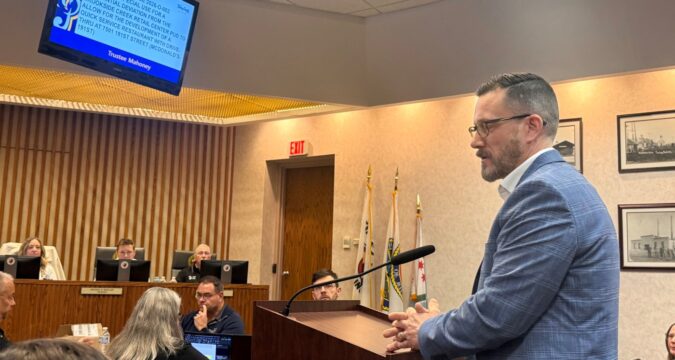
Dan Olsen, president of Upstream Design Group, the civil engineering firm behind the McDonald’s development, opposed the hour restrictions Tuesday night.
“We appreciate the thought that’s been put into this,” Olsen said. “Obviously our desire is to have the restrictions lifted and to allow the demands of the business to speak to the hours that are set for the business.”
Community Development Director Michael Coleman also said the master developer agreed to increase landscaping along the south property line. Officials also discussed enforcing fence installation at the December Plan Commission meeting.
The proposal will be up for final approval at the Village Board meeting at 6 p.m. on Feb. 3 at Tinley Park Village Hall, 16250 S. Oak Park Ave.
Gas and Wash
The other contentious proposal approved Tuesday allowed zoning changes for the Gas and Wash business on 191st Street to relocate to the southwest corner of Harlem and 191st Street.
The architect for the business, Chris Kalischefski, said Dec. 18 the gas station wanted to be on the corner, but the site was not available until now.
But Vargas, a resident of a nearby neighborhood, said at the Dec. 18 Plan Commission meeting she was concerned with vehicle traffic on her street and argued the development will increase traffic.
She said the neighborhood is opposed to 24-hour businesses nearby, and are concerned about noise and lighting.
The proposal passed the Plan Commission 3-2 Dec. 18.
awright@chicagotribune.com
https://www.chicagotribune.com/2026/01/21/tinley-park-developments-191st-street/
GARD unveils study on future of Northwest Indiana steelmaking
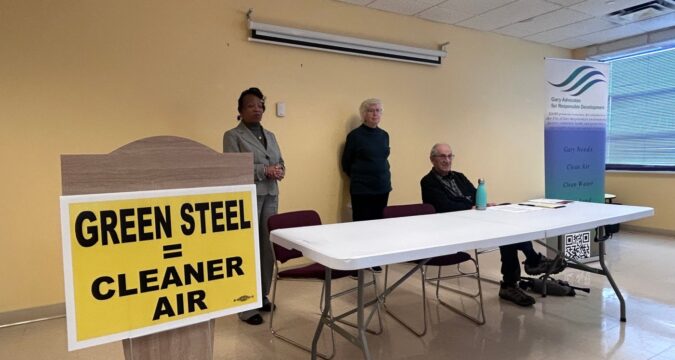
Gary Advocates for Responsible Development unveiled its new report on the future of steelmaking in Northwest Indiana, continuing to say that the region needs a greener process to ensure the industry’s long-term survival.
“This region was built on the steel mills,” said Jack Weinberg, a member of GARD and report author. “The people who live here are largely descendants of steelworkers. People have put up with the pollution because of the good jobs the steel mills provide. Now, we’re at a point in history where the steel industry in the United States is going to have to become cleaner and greener.”
The nearly 40-page report claims that the future of the region’s steelmaking is in jeopardy and says modernization would benefit the steel facilities and public health regionwide. Weinberg has wanted to complete the report since 2024, he said.
The report found that Northwest Indiana’s iron and steel mills are among the top emitters of fine particulate matter nationwide, according to its findings. Exposure to the pollutants can cause respiratory illness, cardiovascular disease, cancer risk and premature death, according to GARD’s report.
The American Lung Association, in April 2025, announced that Hoosiers are breathing some of the nation’s most polluted air, according to Post-Tribune archives. The organization gave Lake County failing grades in three categories: ozone pollution, 24-hour particle pollution and annual particle pollution. Porter County only received a passing grade for annual particle pollution.
The American Lung Association found that, in 2020, Indiana had a lung cancer rate of 72.5 per 100,000 people, with Lake County as one of the state’s counties with the highest cancer mortality rates. A 2016 report from the JAMA Network also found Gary as one of the five U.S. cities with the lowest life expectancy at one point.
Dr. Janet Seabrook, Gary’s health commissioner, attended GARD’s news conference and said the group is “near and dear” to her heart.
“The residents of Gary and the residents of Lake County should have clean, fresh air to breathe,” Seabook said. “The environment should be safe for them to work and play and raise their families.”
According to the report, GARD believes that direct reduction furnaces will one day replace blast furnaces. Weinberg believes that direct reduction is more efficient than blast furnaces, he said, and he thinks it can be used to create iron for steelmaking in Northwest Indiana.
According to the Association for Iron and Steel Technology, direct reduction creates sponge iron, which “is produced in a reactor by direct reduction of iron ore in solid form, utilizing natural gas as the reducing agent to produce pellets or briquettes.” Direct reduction cannot create steel.
Direct reduced iron, or sponge iron, is consumed by electric arc furnaces rather than blast furnaces, and instead uses pig iron, which is created at Gary Works. According to U.S. Steel’s website, the company has electric arc furnaces at a facility in Alabama and another in Arkansas.
U.S. Steel responded to GARD’s study in a Wednesday statement. Like GARD, U.S. Steel is committed to excellent environmental performance, the statement said, calling it the company’s primary focus, along with safety.
“We are investing at historic levels to secure the future of the facility and its jobs for generations to come by producing safer and more environmentally friendly steel,” the statement said. “And while the GARD study never directly says it, but what it’s really calling for is this: U.S. Steel should tear down the existing blast furnaces and steelmaking facilities at Gary Works and rebuild the entire site around a completely different technology — using (direct reduced iron) to make iron and (electric arc furnaces) to make steel.”
In the statement, the U.S. Steel spokesperson also said the study leaves out “the enormous cost of doing that,” saying GARD’s capital estimate is too low because direct reduction plants cannot make steel, and the company would have to build a new electric arc furnace-based steel shop “from the ground up.”
“On top of that, our mining operations would need major upgrades to produce the specific type and volume of iron ore pellets required for DRI and EAF steelmaking,” the statement said. “Those costs are not accounted for either. The study also overlooks a major issue: the availability and price of hydrogen, which will be needed for long-term efficient and environmental improvements. Right now, hydrogen at the scale required simply isn’t accessible or affordable.
“Once again, GARD has produced a ‘study’ that showcases its ignorance of the steel industry and steel pollution. Meanwhile, we are already investing billions of dollars at Gary Works and across our operations to modernize our facilities, improve the quality of the steel we produce, support thousands of good-paying jobs, and ensure we remain efficient, environmentally compliant and financially strong for the long term.”
The report also found that Northwest Indiana’s mills are the leading producers of high-performance flat-rolled steel, Weinberg said, which is steel in flat, rectangular sheets or strips and is used in various markets, including manufacturing, construction and agriculture.
Weinberg believes the market for high-quality flat-rolled steel is becoming more competitive as foreign companies are coming to the U.S. According to the report, Hyundai Steel has plans to build an integrated iron and steel mill in Louisiana, and South Korea’s POSCO is exploring a partnership with Cleveland-Cliffs.
As they move to the U.S., those companies might see an opportunity to become “major investors in the modernization of U.S. integrated iron and steel mills,” according to GARD. The organization calls on Nippon and U.S. Steel to do the same.
In September 2025, U.S. Steel announced that its board approved the next phase of the company’s capital investment plan, according to Post-Tribune archives. The plan includes a $200 million investment into Gary Works’ hot strip mill, part of Japanese-based Nippon Steel’s $11 billion investment.
A previous U.S. Securities and Exchange Commission filing said Nippon Steel plans to invest $3.1 billion in the Gary Works facility between 2025 and 2028. In 2026, the company plans to invest $900 million, followed by $800 million in 2027 and $1.1 billion in 2028.
In late 2024, a Nippon executive said Gary Works would receive about $1 billion, some of which would be dedicated to relining the facility’s blast furnace. GARD and other environmental groups have opposed the blast furnace relining since its announcement.
In October, U.S. Steel responded to a previous GARD study that focused on the health costs and community impact of steel mill pollutants. The group also supported direct reduction furnaces when presenting the previous study.
“U.S. Steel has robust systems and equipment in place (to) control the emissions involved in the steelmaking process and adhere to all environmental regulations,” the previous statement said. “At Gary Works, our processes and environmental control equipment and systems are monitored extensively by our environmental teams. Third parties are used for sampling water discharges and for opacity observations to ensure compliance with air and water regulations.
“Gary Works has achieved an environmental compliance rate exceeding 99%. Gary Works also produces Pig Iron, an important feedstock for U.S. Steel’s electric arc furnaces. Our more than 3,400 Gary Works employees put safety and environmental compliance first. We are proud of their work and the Northwest Indiana community we call home.”
Valerie Denny, another GARD member, said it’s urgent for region residents and leaders to start advocating for cleaner and greener iron and steelmaking processes.
“Our concern is many people in the region don’t understand that steel mills are in jeopardy,” Denny said. “We have to get out there and get people to really learn about this problem.”
mwilkins@chicagotribune.com

Twice Bitten, Thrice Shy: What Oil Majors Want Before Betting On Venezuela A Third Time
Twice Bitten, Thrice Shy: What Oil Majors Want Before Betting On Venezuela A Third Time
Authored by Kevin Stocklin via The Epoch Times,
President Donald Trump has encouraged American oil companies to reinvest $100 billion in Venezuela to spur energy production and to rescue Venezuelans from desperate poverty.
Oil companies, however, are taking stock of the decrepit state of Venezuela’s energy infrastructure after decades of communism, and seeing a number of critical impediments.
“We’re going to have our very large United States oil companies—the biggest anywhere in the world—go in, spend billions of dollars, fix the badly broken infrastructure,” Trump stated in a Jan. 11 press conference following a meeting with top oil executives.
Venezuela has the world’s largest known oil reserves, estimated by rating agency S&P at 300 billion barrels, which are located in a region along the Orinoco River called the Orinoco Belt. At its peak—and with investment and expertise from oil majors including Exxon Mobil, ConocoPhillips, Chevron, BP, Total, and Norway’s Statoil—Venezuela produced more than 3 million barrels per day and was America’s largest foreign supplier.
America’s gulf coast refineries were built to process the heavy sour crude from Venezuela, and they can refine it much more efficiently than the light crude produced from fracking. But trade with Venezuela slowed to a trickle after then-president Hugo Chavez seized the assets of western oil companies in 2007, leading to the imposition of U.S. sanctions. Since Venezuela’s wells and other equipment were nationalized, output collapsed by about 70 percent and is currently less than 1 million barrels per day, according to statistics website Worldometer.
Venezuela thus presents a massive opportunity for Western oil companies to rebuild what had once been a top global oil producer. But daunting problems remain.
“Commercially, the upside is long-life reserves, portfolio diversification, and service and infrastructure opportunities if the country becomes investable again,” Jason Isaac, CEO of the American Energy Institute, told The Epoch Times.
“But the investment case only works if companies can actually control operations, get paid, and move barrels transparently—otherwise the ‘gain’ is trapped capital and political risk.”
Venezuela Currently ‘Uninvestable’
On Jan. 9, Exxon Mobil CEO Darren Woods expressed little enthusiasm for an immediate return to Venezuela, stating in a meeting hosted by Trump at the White House that the country, in its current state, is “uninvestable.”
“We’ve had our assets seized there twice,” Woods said. “And so, you can imagine to re-enter a third time would require some pretty significant changes from what we’ve historically seen here and what is currently the state.”
In an aerial view, the Exxon Mobil Baytown Refinery is seen in Baytown, Texas, on Jan. 13, 2026. President Donald Trump has threatened to sideline Exxon Mobil from Venezuela’s energy market after expressing that he “didn’t like Exxon’s response,” while making a push for oil companies to begin investing there. Exxon remains interested and is prepared to send a team to assess the existing oil infrastructure. Brandon Bell/Getty Images
Patrick Pouyanne, CEO of Total, likewise said that he would consider investing in Venezuela again at some point, but it is “not high on my agenda.”
Venezuela first expropriated the assets of western oil companies in the 1970s and again in 2007. By contrast to many governments in the Middle East and Africa that had done the same, Venezuela refused to compensate oil companies for their losses, leading the companies to sue and win in U.S. and international courts, claiming damages of around $60 billion.
Oil companies will likely want these claims to be paid before putting new money into Venezuela, but the country has little means to do so. Oil production has dwindled to less than 1 million barrels per day and, even at that level, still comprise about two-thirds of the government’s entire budget. China has replaced the United States as the top importer of Venezuelan oil, currently buying an estimated 80 percent of it, but at a discount.
And while Venezuela faces tens of billions of dollars in claims from western oil companies, it is now indebted to China as well. According to the U.S.-China Economic and Security Review Commission, Chinese banks have at least $10 billion in outstanding loans to Venezuela.
Venezuelan Crude Expensive to Extract
Beyond these factors, there are also technical problems. Venezuela’s oil reserves, though abundant, are a particularly dense and sulfur-rich form of crude oil that requires a level of investment and expertise to extract and process that only the world’s largest companies can provide, experts say.
“Venezuela has very large reserves, but when we’re talking about the actual production of them, they’re very difficult to produce and very expensive to produce,” Kenny Stein, a policy expert at the Institute for Energy Research, told The Epoch Times.
Another issue for America’s oil companies is that the full extent of the damage to Venezuela’s infrastructure has yet to be assessed, and the cost of rebuilding it could go well beyond the $100 billion figure that has been estimated.
“The total investment required is not immediately clear, given the lack of transparency under the Chavez and Maduro regimes, but it is likely to be substantial and exceed initial estimates,” Ryan Yonk, senior fellow at the American Institute for Economic Research, told The Epoch Times. “Rebuilding the oil infrastructure is likely to be a long-term project spanning multiple years and potentially decades, rather than the short-term expectations some hold for rapid development and immediate effect.”
Experts say that equipment located in Venezuela has not only been neglected but pilfered as well.
“The infrastructure, the wells, the pipelines, the entire oil industry in Venezuela has been really stripped down to the bone and is barely functional,” Stein said. In addition to theft by government officials, he said, “employees of the state oil company have been stealing copper from their facilities to sell to feed their families.”
Oil companies will likely want government co-investment in some form to help pay for the reconstruction, Yonk said.
Another issue when deciding whether to invest in Venezuela is that Western oil companies must weigh it against the alternatives.
“They could go to Brazil or Guyana, or places in the United States, that are all less expensive to produce,” Stein said. “There would be faster production, they’re not as volatile, and you’re not as much at risk of losing everything.”
Aerial view of an oil well in eastern Monagas, in Maturin, Venezuela, on Feb. 13, 1998. Bertrand Parres/AFP via Getty Images
What It Will Take
For all these reasons, it will take significant changes for Venezuela to attract capital again, experts say.
“U.S. companies will not commit serious capital to Venezuela without a credible reset on rule of law,” Isaac said. “That means binding contract protections, enforceable dispute resolution, and a settlement framework for legacy expropriation and unpaid joint-venture debts.”
Oil companies will likely seek guarantees from the U.S. government that oil sanctions will not be reimposed, that whatever agreements they enter into will be honored, and that they can operate safely and repatriate whatever profits they may earn, he said.
“Without those conditions, any U.S. presence will stay limited to short-cycle, low-exposure activity,” Isaac said.
Exxon Mobil’s CEO stated that he is willing to take initial steps to help with Venezuela’s reconstruction “while these longer‑term issues are being worked.”
“We haven’t been in the country for almost 20 years,” Woods stated. “We think it’s absolutely critical in the short term that we get a technical team in place to assess the current state of the industry and the assets to understand what would be involved to help the people of Venezuela get production back on the market.”
If Exxon is invited by the Venezuelan regime and has security guarantees from the Trump administration, Woods said he is “ready to put a team on the ground.”
Chevron is the only U.S. oil major currently operating Venezuela, producing about 240,000 barrels per day in a joint venture with PDVSA, the country’s state-owned oil monopoly, though experts say much of that effort is simply to preserve the assets they already have in the Orinoco Belt.
“Chevron’s has continued to operate there, but basically doing the bare minimum to keep their wells from being ‘bricked,’” Stein said. “Because of the thickness and tar-like state of the oil, if you don’t keep it continually maintained and flowing at a minimum level, the well will be destroyed.”
Nonetheless, Chevron’s vice chairman Mark Nelson told Trump on Jan. 9 that he believed they could double their output in Venezuela immediately.
An incremental increase in Venezuela’s oil production is more likely than a rapid return to pre-Chavez levels, Isaac said, predicting that the country could reach approximately 1.3 million barrels per day within a couple years, and perhaps 2 million barrels per day within a decade.
President Donald Trump speaks during a meeting with US oil companies executives in the East Room of the White House in Washington, DC, on Jan. 9, 2026. Saul Loeb/AFP via Getty Images
Strategic and Economic Goals
Despite the hesitancy of oil majors to commit significant capital to Venezuela at this point, the Trump administration has stated its strategic interest in preventing China and other U.S. adversaries from stepping into the void.
During an interview with NBC’s Meet the Press, Secretary of State Marco Rubio said that Venezuela had become “a crossroads for the activities of all of our adversaries around the world.”
For Venezuelans, however, the riches of oil have been both a blessing and a curse.
Calling Venezuela “a case study in the perils of becoming a petrostate,” a 2018 study by the Council on Foreign Relations stated that “since it was discovered in the country in the 1920s, oil has taken Venezuela on an exhilarating but dangerous boom-and-bust ride that offers lessons for other resource-rich states.”
In what has been called “Dutch disease,” developing countries that suddenly get rich from the discovery of natural resources develop a singular dependence on those resources, leaving other sectors of the economy to languish while government corruption and theft proliferate, with little of the wealth ultimately going to benefit the citizens at large.
For this reason, some analysts say that the best solution for Venezuela is to establish a system of free markets, democratic traditions, stability, and the rule of law, similar to what Poland and Chile have done since emerging from authoritarian regimes. Key elements of Poland’s reforms included a legal system that protected property rights, political stability under a democratic system, privatization of state-owned companies, a stable currency, and a tax regime that allowed investors to earn a decent return.
“Under the ‘warm embrace of communism,’ [Poland] was an economic basket case,” the Committee to Unleash Prosperity, a nonprofit founded by free-market economists Arthur Laffer and Steve Moore, stated in an op-ed.
Having embraced democracy and free markets, Poland recently achieved GDP growth rates of about 4 percent per year, and is predicted to overtake the UK in GDP-per-capita by the end of this decade, they said.
Tyler Durden
Wed, 01/21/2026 – 17:00
Judge denies former Orland Park Mayor Keith Pekau’s attempt to dismiss order regarding his political blog
A Cook County judge Tuesday denied former Orland Park Mayor Keith Pekau’s request to end a court order instituted in August that required he remove confidential village information from his blog and social media and barred him from publishing other information, according to Pekau and the village.
Moreland in August granted the village a temporary restraining order barring Pekau from publishing “future statements disclosing the village’s attorney-client privileged communications and confidential non-public information contained in village personnel files,” and ordering he remove any publications of such information.
Judge Kate Moreland Dec. 12 dismissed the village’s requests to limit Pekau’s speech in relation to confidential documents the village claims Pekau brought with him after he lost his bid for reelection to Mayor Jim Dodge and left office in May. She also struck the village’s request for injunctive relief.
The village said in a news release Wednesday that it “remains committed to open, transparent and responsible governance and will continue to take appropriate legal action when necessary to protect the interests of the village and its residents.”
Pekau responded to the decision with a blog post maintaining the lawsuit is politically motivated and wastes taxpayer money. He called on the Village Board to publicly raise concerns about the lawsuit’s continuation.
“I’ve said this before: quiet objections behind closed doors are not enough,” the blog post said. “Only they can stop this — and only then will this madness end.”
The village’s complaint filed July 29 states that after leaving office, Pekau held onto village documents that include personnel records containing confidential information and that he “intentionally published and circulated” that information.
The confidential information in question includes “documentation divulging privileged attorney-client information” and “litigation case assessments and strategy,” according to the complaint.
The lawsuit was filed six days after the village sent Pekau a cease-and-desist letter demanding he return written records and destroy their electronic forms. Pekau “publicly represented that he intends to continue to disclose the village’s confidential information,” according to the complaint.
Pekau, in an affidavit filed by attorneys Aug. 4, said at the end of his term he turned over all village property in accordance with state law and did not disclosed information that was not already publicly available or would not have been available to the public under Illinois’ access laws.
He said he runs a political newsletter that discusses village business but does not disclose confidential information and, since leaving office, has not engaged in conversation with litigants involved in pending lawsuits or stated he will release confidential information.
“The purpose of my newsletter is to create open dialogue about community issues and to express views on what is best for our community,” the affidavit said.
ostevens@chicagotribune.com
https://www.chicagotribune.com/2026/01/21/judge-denies-orland-park-mayor-keith-pekau/

Immigration officers assert sweeping power to enter homes without a judge’s warrant, memo says
WASHINGTON — Federal immigration officers are asserting sweeping power to forcibly enter people’s homes without a judge’s warrant, according to an internal Immigration and Customs Enforcement memo obtained by The Associated Press, marking a sharp reversal of longstanding guidance meant to respect constitutional limits on government searches.
The memo authorizes ICE officers to use force to enter a residence based solely on a more narrow administrative warrant to arrest someone with a final order of removal, a move that advocates say collides with Fourth Amendment protections and upends years of advice given to immigrant communities.
The shift comes as the Trump administration dramatically expands immigration arrests nationwide, deploying thousands of officers under a mass deportation campaign that is already reshaping enforcement tactics in cities such as Minneapolis.
For years, immigrant advocates, legal aid groups and local governments have urged people not to open their doors to immigration agents unless they are shown a warrant signed by a judge. That guidance is rooted in Supreme Court rulings that generally prohibit law enforcement from entering a home without judicial approval. The ICE directive directly undercuts that advice at a time when arrests are accelerating under the administration’s immigration crackdown.
The memo itself has not been widely shared within the agency, according to a whistleblower complaint, but its contents have been used to train new ICE officers who are being deployed into cities and towns to implement the president’s immigration crackdown. New ICE hires and those still in training are being told to follow the memo’s guidance instead of written training materials that actually contradict the memo, according to the whistleblower disclosure.
It is unclear how broadly the directive has been applied in immigration enforcement operations. The Associated Press witnessed ICE officers ramming through the front door of the home of a Liberian man in Minneapolis on Jan. 11 with only an administrative warrant, wearing heavy tactical gear and with their rifles drawn.
The change is almost certain to meet legal challenges and stiff criticism from advocacy groups and immigrant-friendly state and local governments that have spent years successfully urging people not to open their doors unless ICE shows them a warrant signed by a judge.
The Associated Press obtained the memo and whistleblower complaint from an official in Congress, who shared it on condition of anonymity to discuss sensitive documents. The AP verified the authenticity of the accounts in the complaint.
The memo, signed by the acting director of ICE, Todd Lyons, and dated May 12, 2025, says: “Although the U.S. Department of Homeland Security (DHS) has not historically relied on administrative warrants alone to arrest aliens subject to final orders of removal in their place of residence, the DHS Office of the General Counsel has recently determined that the U.S. Constitution, the Immigration and Nationality Act, and the immigration regulations do not prohibit relying on administrative warrants for this purpose.”
The memo does not detail how that determination was made nor what its legal repercussions might be.
When asked about the memo, Homeland Security spokeswoman Tricia McLaughlin said in an emailed statement to the AP that everyone the department serves with an administrative warrant has already had “full due process and a final order of removal.”
She said the officers issuing those warrants have also found probable cause for the person’s arrest. She said the Supreme Court and Congress have “recognized the propriety of administrative warrants in cases of immigration enforcement,” without elaborating. McLaughlin did not respond to questions about whether ICE officers entered a person’s home since the memo was issued relying solely on an administrative warrant and if so, how often.
Recent arrests shine a light on tactics
Whistleblower Aid, a non-profit legal organization that assists workers exposing wrongdoings, said in the whistleblower complaint obtained by The Associated Press that it represents two anonymous U.S. government officials “disclosing a secretive – and seemingly unconstitutional – policy directive.”
A wave of recent high-profile arrests, many unfolding at private homes and businesses and captured on video, has shined a spotlight on immigration arrest tactics, including officers’ use of proper warrants.
Most immigration arrests are carried out under administrative warrants, internal documents issued by immigration authorities that authorize the arrest of a specific individual but do not permit officers to forcibly enter private homes or other non-public spaces without consent. Only warrants signed by judges carry that authority.
All law enforcement operations — including those conducted by ICE and Customs and Border Protection — are governed by the Fourth Amendment of the Constitution, which protects all people in the country from unreasonable searches and seizures.
People can legally refuse federal immigration agents entry into private property if the agents only have an administrative warrant, with some limited exceptions.
Federal agents this month rammed the door of the Minneapolis home of a Liberian man with a deportation order from 2023, who was then arrested. Documents reviewed by The AP revealed that the agents only had an administrative warrant — meaning there was no judge who authorized the raid on private property.
Memo shown to ‘select’ officials
The memo says ICE officers can forcibly enter homes and arrest immigrants using just a signed administrative warrant known as an I-205 if they have a final order of removal issued by an immigration judge, the Board of Immigration Appeals or a district judge or magistrate judge.
The memo says officers must first knock on the door and share who they are and why they’re at the residence. They’re limited in the hours they can go into the home — after 6 a.m. and before 10 p.m. The people inside must be given a “reasonable chance to act lawfully.” But if that doesn’t work, the memo says, they can use force to go in.
“Should the alien refuse admittance, ICE officers and agents should use only a necessary and reasonable amount of force to enter the alien’s residence, following proper notification of the officer or agent’s authority and intent to enter,” the memo reads.
The memo is addressed to all ICE personnel. But it has been shown only to “select DHS officials” who then shared it with some employees who were told to read it and return it, Whistleblower Aid wrote in the disclosure.
One of the two whistleblowers was allowed to view the memo only in the presence of a supervisor and then had to give it back. That person was not allowed to take notes. A whistleblower was able to access the document and lawfully disclose to Congress, Whistleblower Aid said.
Although the memo was issued in May, David Kligerman, senior vice president and special counsel at Whistleblower Aid, said it took time for its clients to find a “safe and legal path to disclose it to lawmakers and the American people.”
ICE officers are told to rely solely on administrative warrants, memo says
ICE has been rapidly hiring thousands of new deportation officers to carry out the president’s mass deportation agenda. They’re trained at the Federal Law Enforcement Training Center in Brunswick, Georgia.
During a visit there by The Associated Press in August, ICE officials said repeatedly that new officers were being trained to follow the Fourth Amendment.
But according to the whistleblowers’ account, newly hired ICE officers are being told they can rely solely on administrative warrants to enter homes to make arrests even though that conflicts with written Homeland Security training materials.
ICE officers often wait for hours for the person they’re hoping to arrest to come outside so they can make the arrest on the sidewalk or at the person’s work — public places where they are allowed to operate without the risk of infringing on the person’s Fourth Amendment rights.
Whistleblower Aid called the new policy a “complete break from the law” and said it undercuts the “Fourth Amendment and the rights it protects.”
https://www.chicagotribune.com/2026/01/21/immigration-officers-entering-homes-warrant/

Aurora looking to create hub for clean energy job training
The city of Aurora has announced it will be launching a new center that will offer job training in green energy-related fields through a partnership with two educational organizations.
Aurora’s CEJA Workforce Development Hub, set to be located in a currently unused city facility at 649 S. River St., will bring together the existing workforce development programs of the College of DuPage and the 548 Foundation. Both organizations are funded by the state to run clean energy-related job training programs, but those programs do not yet have a permanent location in Aurora.
“We’re excited to say we found an important alliance in the city of Aurora,” said the College of DuPage’s director of the Aurora CEJA Aurora Workforce Hub, Callie Matheny, at a launch event on Tuesday. “This is city government at work. They have been an extreme, fast-moving partner.”
The programs offered by the two organizations get their funding through the state Climate and Equitable Jobs Act, which also gives the Aurora center its name. The act was signed into law in 2021 and specifically notes Aurora as one of the 13 statewide locations to have such a job-training hub.
Mavis Bates — who is a Kane County Board member, chair of the local chapter of the Sierra Club and on the city’s Sustainable Aurora Advisory Board — called the newly-announced physical location of the Aurora CEJA Workforce Development Hub a “big fancy deal” when she spoke at Tuesday’s launch event.
“I was so excited five years ago when I saw that Aurora’s name was on the list,” she said during her speech. “At that time, I did not realize it was going to be five years before this day would finally happen.”
And although the city did host a “launch” event, Mayor John Laesch in his own speech was quick to point out that the day Mavis spoke about still hasn’t come yet. The leases for the College of DuPage and the 548 Foundation to rent out the building, formerly used by the city’s water and sewer division, have yet to pass the Aurora City Council.
If the Aurora City Council approves the leases at its meeting next Tuesday, they will go into effect on Feb. 1.
In a press release, city officials said the Aurora CEJA Workforce Development Hub will act as a magnet for living-wage job creation and innovative green job training.
Alison Lindburg, Aurora’s director of sustainability, noted in a speech at Tuesday’s launch event that her division is within the city’s economic development department in part because sustainability offers an opportunity for job creation. In Illinois, there’s over 132,000 people working jobs related to clean energy, which is more than the number of lawyers, web developers and real estate agents combined, she said.
Those jobs might include the installation of efficient lighting, connecting heat pumps and other efficient HVAC systems, completing energy audits of homes and commercial buildings, installing electric vehicle charging stations, solar panels and battery storage, and helping to modernize the energy grid, according to Lindburg.
The building set to hold the hub is planned to one day contain both classroom and work space. The classroom is set to be a “living laboratory,” Lindburg said, with its own HVAC system for students to work on and empty spaces in the walls for students to install insulation in.
“We’re lucky to have found a space that can provide for both classroom and workshop in one concise location,” Matheny said. “On a program management level, we’re super excited to have staff, students and all of our stuff in one place. It’s going to be a game changer.”
From the new physical hub in Aurora, the College of DuPage is set to run its seven-week entry-level CEJA Bridge Program, which earns students various certificates related to construction and first aid, Matheny told the Aurora City Council’s Committee of the Whole on Tuesday. After completing that training, students can then choose to go on to more advanced, job-specific training in solar installation, energy auditing and HVAC work, she said.
In total, the college has the capacity to run about six of these programs each year, according to Matheny. More information can be found at: www.cod.edu/academics/continuing-education/career-professional-training/climate-equitable-jobs.html
The planned Aurora hub is also planned to hold a training program from the 548 Foundation, which sets graduates up to become first-year apprentices in the Mid-America Carpenters Regional Council with training in construction and solar systems. Founder AJ Patton said at Tuesday’s launch event that his organization’s program offers $500 weekly stipends to its students to “earn while you learn,” helping to carry them through the training.
The 548 Foundation is open to partnership and doesn’t care about taking the credit, Patton said, so any who have ideas on how to create jobs or have job opportunities are encouraged to reach out. More information about the program can be found at: 548foundation.org
The College of DuPage is on the “workforce development” side of things, which means they are more specific to meeting the needs of local employers, while the 548 Foundation is more on the “climate works” side, which is more in-tune with what the unions would like to see, according to Matheny’s presentation to the Committee of the Whole on Tuesday. She said that both programs rely on Goodwill, which works to educate the community about the programs and guide interested people towards them.
Aurora is also actively looking for additional partners to further expand the CEJA Workforce Development Hub, the city’s press release about the launch event said.
Sustainability and living-wage job creating, particularly through green building, was a large part of Laesch’s campaign platform last year.
As a mayoral candidate, he told The Beacon-News that he would work to attract higher-paying jobs by “positioning Aurora for the green collar economy that’s coming,” at least in part by encouraging businesses that create innovative building materials to move to the city. Later, during his inauguration speech, Laesch spoke about partnering with the local CEJA Workforce Hub to help train students for that coming “green collar economy.”
The training is only the first step, Laesch said at Tuesday’s launch event. The next step will be creating the living wage jobs for Aurora residents, he said, and the city is working hard at finding ways to do that.
One way city officials are hoping to encourage the creation of green energy jobs is through a proposed Commercial Property Assessed Clean Energy financing program, commonly called C-PACE. Through the lending program, the owners of commercial properties can borrow at a fixed, low interest rate for renovation or new construction projects related to energy efficiency and similar types of things.
The ordinance allowing the Illinois Finance Authority to manage a C-PACE program from Aurora, alongside the leases for the new CEJA Workforce Development Hub, are set to go before the Aurora City Council at its meeting on Tuesday. Those items are likely to pass since they are all on the meeting’s consent agenda, which is typically reserved for routine or non-controversial items that are all approved with a single vote.
rsmith@chicagotribune.com

Left-Wing NGOs Plan “Economic Blackout” Across Minnesota As State Becomes Testbed For Revolution
Left-Wing NGOs Plan “Economic Blackout” Across Minnesota As State Becomes Testbed For Revolution
The color-revolution risk assessment we delivered to readers in August 2025 has since seen a timeline that has been accelerated, with Democratic Party-aligned dark-money funded NGOs, left-wing militant groups, and anti-Trump labor unions leveraging Minneapolis as a testbed for coordinated socialist resistance activity, including strike actions, boycotts, and engineered social unrest, all aimed at undermining President Trump’s legitimacy, authority, and governing capacity, with the end goal of regime change at the White House.
The assessment initially forecasted that selective resistance movements would begin to materialize in 2026, with mass resistance emerging in 2027-28 ahead of the presidential election. That timeline has since accelerated, as Marxist NGOs and unions are funneling personnel and resources into Minneapolis to fuel social unrest, with the hopes of impeding the federal government’s deportation operations targeting criminal illegal aliens. Remember, these illegals are either the Democratic Party’s current voting bloc or future voting bloc.
Spotted organizing tonight’s protests in Minneapolis: the literal Communist Party.
Here’s the pin they’re handing out to match the flags they’re waving. @realDailyWire pic.twitter.com/AWM0lPf8Yl
— Brecca Stoll (@breccastoll) January 10, 2026
Several weeks of protests following the fatal shooting of a left-wing legal observer by an ICE agent in Minneapolis are now evolving into what local media outlet Minnesota Reformer calls a “general strike” set to unfold on Friday. The outlet reports that “Minnesota’s unions, progressive faith leaders, and community activists” are organizing the strike, called “ICE Out of Minnesota: Day of Truth & Freedom.”
“It is time to suspend the normal order of business to demand immediate cessation of ICE actions in MN, accountability for federal agents who have caused loss of life and abuse to Minnesota residents, and call for Congress to immediately intervene,” ICE Out’s landing page says.
Again, this strike is unlikely to accomplish much on the ground beyond disrupting economic activity, but the objective for nonprofits stirring up their column of useful-idiot activists, some of whom are paid, alongside unions mobilizing their members, is an optics-driven informational war aimed at shifting public sentiment and influencing politicians on Capitol Hill.
Small businesses in Minnesota are proactively closing on Friday to support the economic blackout and stand in solidarity with those participating in the general strike. pic.twitter.com/n0PS9hszG9
— Karlyn Borysenko, anti-communist cult leader (@DrKarlynB) January 21, 2026
Think of this boots-on-the-ground effort as a small number of voices using a megaphone in an attempt to manufacture the appearance of widespread public outrage. The hope is that polls shift and force the White House to back down.
However, 2025 was the year when the nation learned (read here) how left-wing billionaire foundations – and even foreign adversaries – are funding NGO networks to undermine the nation to sow chaos and collapse the country from within.
There is already movement on the White House level, and even the Treasury (as revealed in Bessent-Rufo interview last week), that suggests the federal government will begin pressuring the entire nonprofit sector that should be helping the homeless and the poor, but has been hijacked by left-wing billionaires to wage a color revolution operation against Trump to derail the America First movement. These types of operations are what the CIA does overseas in third-world countries for regime changes – it’s just that this type of statecraft was inverted when Trump won in 2016.
Taking a look at the Facebook page for “ICE Out of Minnesota: Day of Truth & Freedom,” the event is listed as hosted by left-wing nonprofits and unions, including TakeAction Minnesota, Gender Justice, COPAL MN, 50501: Minnesota, ATU Local 1005, CTUL, Twin Cities Democratic Socialists, and nine other groups
Highly organized. These groups are part of the protest-industrial complex.
Alpha News’ Liz Collin provided a memo to the Minnesota Nurses Association members encouraging members to participate in Friday’s “statewide economic blackout.”
SUBMITTED: Letter from Minnesota Nurses Association urges union members to participate in “ICE Out of Minnesota: A Day of Truth and Freedom.”
It includes a “statewide economic blackout” and rally.
Nurse to @AlphaNews:
“MNA & SEIU are as bad as the teachers unions, we are… pic.twitter.com/GGyMepUIEX
— Liz Collin (@lizcollin) January 19, 2026
Escalations everywhere by left-wing militants.
We warned last September:
“Planning War Against Fascists” – Socialist Rifle Association Boasts 10,000 Members
Let’s not forget that CCP-linked communist billionaire Neville Roy Singham’s dark-money-funded NGOs have been involved in nationwide anti-ICE protests:
‘Comrade’ Singham Faces House Subpoena Over Alleged CCP-Linked NGO Network Fueling Anti-ICE Protests
This color revolution operation, which hides behind the nonprofit industry, is called the “invisible insurrection“… and this social unrest will broaden come spring.
Minneapolis (🔜 ALL “sanctuary” cities everywhere) running the Color Revolution playbook perfectly: provoke chaos, deploy ‘legal observers’ as shields, & launder radical activism through dark $ NGOs—all funded by Arabella & Soros-type networks we’ve exposed repeatedly. pic.twitter.com/U9B9rJcY0F
— Seamus Bruner (@seamusbruner) January 21, 2026
Just so readers are aware: once Democrats perfect the “Minneapolis experiment,” they will attempt to replicate it across every sanctuary city.
Tyler Durden
Wed, 01/21/2026 – 16:40

Iconic Coney Island hot dog hawker Nathan’s Famous is sold for $450 million
Nathan’s Famous, which opened as a 5-cent hot dog stand in Coney Island more than a century ago, has been sold to packaged meat giant Smithfield Foods in an all-cash $450 million deal, the companies announced Wednesday.
Smithfield, which has held rights to produce and sell Nathan’s products in the U.S. and Canada and at Sam’s Clubs in Mexico since 2014, will acquire all of Nathan’s outstanding shares for $102 each.
Like almost every food company, Nathan’s has been under significant inflationary pressure. Nathan’s sales costs of branded products rose 27% compared with last year in its most recent quarter, the company said in a filing with the U.S. Securities and Exchange Commission. There was a 20% increase in the average cost per pound of hot dogs, it said.
Nathan Handwerker opened the first Nathan’s hot dog stand on Coney Island in 1916 with a $300 loan, according to the company. After opening a handful of other locations around New York over the years, the Handwerker family sold the Nathan’s Famous business to investors in 1987. The franchise has continued to expand.
Nathan’s has an outsized cultural presence in the U.S. both because of its history and the famous, or infamous, hot dog-eating contest held at its flagship Coney Island shop, where contestants from around the world gather every July 4 to see who can down the most hot dogs in 10 minutes.
The restaurant sits on same lot where Handwerker opened his first hot dog stand.
American Joey Chestnut is the reigning Nathan’s hot dog-eating champion after eating 70.5 hot dogs and buns last year. Chestnut has won 17 of the last 19 events, setting a record in 2021 after wolfing down 76 hot dogs and buns.
While the first recorded hot dog-eating contest was held in 1972, Nathan’s says informal contests began the year the stand opened early in the 20th century. It says the 2025 contest was its 103rd.
Smithfield said Wednesday that the event, which has been televised on ESPN with a crowd estimated at 30,000 at Coney Island each year, will continue.
Smithfield said it expects to achieve annual savings of about $9 million within two years of closing the deal.
“As a long-time partner, Smithfield has demonstrated an outstanding commitment to investing in and growing our brand while maintaining the utmost quality and customer service standards,” said Nathan’s CEO Eric Gatoff.
Nathan’s board of directors, which own or control nearly 30% of the outstanding shares of Nathan’s Famous common stock, approved the buyout and agreed to recommend to its shareholders to vote in favor of the deal.
Smithfield, which also owns the Gwaltney bacon and Armour frozen meat brands, rang up more than a billion dollars in operating profit in 2024 on sales of $14.1 billion.
Smithfield shares were unchanged in midday trading Wednesday at $23.39.
In fiscal 2025, Nathan’s reported profit of $24 million on revenue approaching $150 million. It’s acquisition is expected to close in the first half of this year.
https://www.chicagotribune.com/2026/01/21/nathans-famous-hot-dogs-sold-smithfield/

ICE activity increases in Maine as anxiety grows in immigrant communities
PORTLAND, Maine — The Trump administration is now targeting its mass deportation campaign on Maine, a state with relatively few residents in the United States illegally but a notable presence of African refugees in its largest cities.
The Department of Homeland Security named the operation “Catch of the Day,” an apparent play on Maine’s seafood industry, just as it has done for other enforcement surges, like “Metro Surge” in Minnesota and “Midway Blitz” in Chicago.
Reports of a surge in immigration arrests have struck fear in immigrant communities of Portland and Lewiston and prompted backlash from Gov. Janet Mills and other Democrats, including a refusal to help ICE agents obscure the identity of their vehicles by issuing undercover license plates.
Citizens have formed networks to alert neighborhoods to the presence of ICE agents and bring food to immigrants in their homes, and Portland’s superintendent said the school district is developing an online learning plan for its students — more than half of whom aren’t white. Many businesses have posted signs saying ICE agents aren’t welcome.
“While we respect the law, we challenge the need for a paramilitary approach,” Portland Mayor Mark Dion said Wednesday at a news conference where he was joined by other local officials. “This council doesn’t stand apart from our immigrant communities, we stand with them.”
Portland and Lewiston have thousands of residents of African descent, including many from Somalia.
Somali immigration into Maine accelerated in the early 2000s, and the state now has one of the highest percentages of Somali residents in the country. Immigrants and asylum seekers from other countries followed.
Now the presence of Immigration and Customs Enforcement agents is causing great anxiety in Portland, said city council member Pious Ali, a native of Ghana.
“Our schools have seen about a quarter of immigrants not showing up,” Ali said, and many fear going to work as well: “There are immigrants who live here who work in our hospitals, they work in our schools, they work in our hotels, they are part of the economic engine of our community.”
ICE agents don’t need to spread trauma by smashing doors and windows, he said: “The federal government has the ability to contact these people without unleashing fear into our communities.”
Dozens of arrests
The enforcement action is arriving in Maine, a mostly rural state with about 1.4 million residents, as confrontations between ICE and demonstrators continue in Minnesota, where ICE is under scrutiny following an agent’s fatal shooting of Renee Good.
ICE didn’t respond to a request for comment Wednesday on the agency’s plans for Maine, where U.S. Department of Homeland Security said in a statement that increased enforcement began on Tuesday. “We have approximately 1,400 targets here in Maine,” Patricia Hyde, the ICE deputy assistant director, told Fox News.
“We have launched Operation Catch of the Day to target the worst of the worst criminal illegal aliens in the state. On the first day of operations, we arrested illegal aliens convicted of aggravated assault, false imprisonment, and endangering the welfare of a child,” said Homeland Security Assistant Secretary Tricia McLaughlin in a statement.
No new undercover license plates
Secretary of State Shenna Bellows, a longtime opponent of President Donald Trump, said state officials received a request from U.S. Customs and Border Protection for confidential, undercover Maine license plates and decided against issuing them. The licenses plates are used on unmarked vehicles and Bellows said she wants more assurance they will be used appropriately.
ICE’s use of license plates in other states has raised concerns: Illinois Secretary of State Alexi Giannoulias, a Democrat, issued a warning to ICE agents last year that swapping or altering license plates is illegal.
“These requests in light of rumors of ICE deployment to Maine and abuses of power in Minnesota and elsewhere raise concerns. We have not revoked existing plates but have paused issuance of new plates. We want to be assured that Maine plates will not be used for lawless purposes,” Bellows said.
Bellows has run afoul of Trump and his administration before. In 2023, she sought to remove his presidential candidacy from the state’s ballot, arguing that Trump had engaged in insurrection in violation of the 14th Amendment. More recently, she has refused to hand over the state’s voter rolls to the federal government.
Customs and Border Protection did not respond to a request seeking comment, but a top Maine Republican said withholding the undercover plates would jeopardize public safety.
“That really, one, puts us at odds as a state. Puts us at one end of an extreme that we really shouldn’t be on,” Senate Leader Trey Stewart said.
Maine’s top federal prosecutor, U.S. Attorney Andrew Benson joined Democrats in calling for any demonstrations in the state to remain peaceful and civil. Benson, a Trump appointee, warned people to stay out of the agents’ way or be prosecuted.
Mayor, governors speak out
Gov. Mills has pushed back, as have mayors, school district leaders and numerous community organizations. Mills said aggressive enforcement actions that undermine civil rights are “not welcome.”
Lewiston Mayor Carl Sheline said ICE enforcement has been causing “anxiety, fear or uncertainty” for many.
“There is no evidence of unchecked criminal activity in our community requiring a disproportionate presence of federal agents,” Dion said.
Schools, Democrats call for caution
Portland Public Schools, the largest and most diverse school district in the state, said in a statement Wednesday that it conducted a “lockout” at two schools to prevent anyone from entering the building during the school day Tuesday because of concerns about ICE activity nearby.
“It was quickly determined that there was no threat to our school communities and the lockouts were lifted within minutes. This is an understandably tense time in our community, as reports and rumors of immigration enforcement actions grow,” the district’s statement said.
Maine Democrats have condemned the ICE activity.
“The Trump administration has deployed ICE agents to Portland, Lewiston, and possibly other Maine communities. This is not about public safety. It is about fear, control, and political theater,” Devon Murphy-Anderson, executive director of the Maine Democratic Party, said in a statement Wednesday.
Rodrique Ngowi also contributed to this report.
https://www.chicagotribune.com/2026/01/21/ice-activity-maine/

Trial starts for man accused of strangling, shooting at woman
Prosecutors allege when Antoine Lyons got enraged over a Facebook message and “past issues,” he strangled his one-time girlfriend, slashed her hand, then forced her to jump out of a second-story apartment window while continuing to shoot.
Lyons, 40, of Gary, is charged with nine felonies, including attempted murder and one misdemeanor.
He has pleaded not guilty.
Lake County Deputy Prosecutor Amy Pullen told jurors the woman was “terrified” after Lyons threatened to kill her, pulled an AK-47 type gun from the sofa, then a second gun before strangling her with his belt. He swung a knife at her, cutting her hand heavily. She tried to use a chair to block him before battling a screen to jump from a window.
A SWAT team was called, but found the apartment empty.
She later got nine stitches.
“The evidence told the story,” Pullen said, noting the victim’s jacket and wig were found on the ground.
Defense lawyer Michael Lambert called it a “tall tale” — akin to a shiny, but empty Christmas present in a department store window. He told jurors to pay attention to the evidence.
Gary Police Officer Donald Briggs testified that when he responded to the scene, the woman was crying, emotional, and bleeding heavily from her hand.
Gary Police responded March 23, 2025, to an apartment complex on Malcolm X Drive for a domestic battery and shots fired call.
The woman told officers that she and a friend went to stay over at Lyon’s apartment. She and Lyons drank that evening and he has “used cocaine,” according to the affidavit.
She had been in the bedroom when he got enraged over the Facebook message and other issues. He repeatedly threatened to kill her, pointing the AK-47 weapon, then a handgun at her.
“I got something for you, (expletive),” he said when he removed his belt to strangle her, court records state.
After she jumped from the window, she ran from gunfire to a neighbor’s home. Officers later found bloodstains and four bullet casings nearby.
Lambert filed for a speedy trial in August.
mcolias@post-trib.com