Category: News

Demographics Deployed For Political Control
Demographics Deployed For Political Control
Authored by Jeffrey Tucker via The Epoch Times,
People are talking ever more about the possibility of civil war in the United States.
The scenes on the streets do not look good, to be sure. That said, we are nowhere near this point and certainly don’t have to be.
The trigger for the unfolding of events speaks to a tactic of control that unleashes resistance (and counterresistence) like no other.
If this issue is resolved in peace and within the rule of law, normalcy can be restored.
Let’s review some of the deeper history.
At the height of the Roman Empire, when conquering ever more territory was regarded as regime triumph, a strategy for control emerged that would long persist into the modern age. The military would urge Romanization of the conquered provinces. The aristocracy would flood provinces and towns, bringing language and technology and administrative leadership.
Roman citizens, often veterans of these wars, were settled with land grants and created loyal Roman outposts. Many modern European cities trace origins to these settlements. The tactic assured regional loyalty, lessened local resistance, and helped blunt the efficacy of independence movements.
The Spanish Empire took a similar approach in the Americas. Massive settler migration from Iberia led to the demographic replacement of indigenous populations. Spanish was imposed as the dominant language. Indigenous tongues were suppressed. Localized religions mutated to match priorities of the imperial faith.
So it was in the Soviet Union. After the archives opened following the fall of communism, scholars found proof of what they had long suspected. Hundreds of thousands of ethnic Russians were directed to migrate to the Baltic states following the 1940 annexation. The priorities were the same as the above examples: spread the Russian language, intermarry, and build and administer infrastructure. This weakened national identities and secured Russian holdings.
All of these are examples of what is called settler colonialism. It’s a tactic, often a brutal one because it touches the lives, languages, educations, and religion of everyone. It can often be pitiless toward the settled traditions that are being displaced.
The USA was born as an experiment in the same way via the British Empire. The English Court and its industrial partners had every intention of using the colonies for the empire’s own purposes, restricting trade and taxing its residents. It did not go so well. After 150 years of experience with freedom in the colonies, Americans developed a sense of independent identity that led to a war of independence that the colonies won.
It is true that the United States began as a nation of immigrants and has always been a welcoming country. The early Founding documents left the issue of citizenship to the states because people were citizens of their states. Following a horrible Civil War, the federal government took charge of determining citizenship, alongside a peculiar model of earning the right to vote. All people born within its borders were automatically granted citizenship rights.
Immigration became a source of controversy in the late 19th century with floods of new asylum seekers from Russia, Italy, Ireland, and elsewhere, thus taxing infrastructure and giving rise to ethnic and religious tensions. The immigration acts of 1921 and 1924 sought to settle those problems with a strong legal preference for European migration.
Forty years later, this prioritization was deemed discriminatory. The immigration act of 1965 reversed priorities and opened up the country to a wider range of newly arriving residents to become citizens.
Even with this change, the subject of immigration was regarded as a manageable domestic policy dispute, with people on all sides favoring this or that. The debates concerned economics, religion, and the issue of acculturation.
What was not in question was the idea of using demographics for purposes of political control. There seemed to be an established political rule in this country: These debates can be settled without resorting to old-world tactics of settler colonialism. No one overtly sought to use demographics to shore up political power.
Something changed dramatically following President Donald Trump’s first term. Many people in the upper echelons of power perceived Trump to be a unique threat, not just in his person but in what he represented. His movement crossed class barriers to tap into a sense of American identity itself, complete with nostalgia for old forms of freedom and independence.
At this point in the story, matters turn dark.
I will introduce this by telling of a visit to see my mother in Texas in the summer of 2020. I had expected the topic of conversation to turn entirely on the COVID-19 pandemic response and the lockdowns. I could hardly get anyone interested. At gatherings and meals, at church or at civic meetings, the only topic on anyone’s mind seemed to be the open southern border. They spoke about it with unusual fire and passion, as if a fundamental deal had been broken.
It was this, even more than the lockdowns, that concerned them, and why? Because they could feel themselves losing trust in the main mechanism that permits the people to exercise some control over the regime. If elections are compromised—they could see this coming—all is lost.
That experience was a revelation to me. I had not previously seen how much the shift in policy had affected their lives. It was causing huge burdens on educational infrastructure and hospital systems. There was a widespread perception that seemed to confirm what Trump had said on the campaign trail in 2015. This was not normal, legal immigration, but something else. Someone or something was using demographics for purposes of political manipulation. Now even the plebiscite was in question.
The election later that November did not allay the fears, as what looked like an in-person-voting landslide turned the other direction overnight thanks mostly to mail-in ballots. It had already evaporated in the system and now the very legitimacy of a nationwide election was in question. Regardless, Trump was declared the loser and Joe Biden the winner.
The subject of immigration and its political uses would only intensify over four years, as millions (10 million to 20 million) were allowed in, went on welfare, contributed to rising crime, and generally raised alarms about what was happening to American democracy.
The United States was founded to be a land governed by the people themselves: not a king or an aristocracy but by representatives elected by the people. The Founders set up such a system with great hope that it would last. Much of the credibility of such a system turns on a clear distinction between citizens and non-citizens. As welcoming as America is and always has been, a people’s government needs standards and enforcement for who can participate in elections and partake of public welfare.
These questions have become the burning issue of our time. We see this play out in Minnesota right now as protesters on the streets work to interfere with federal efforts to find and capture undocumented people let in under the lax rules of 2021–2024.
What appears to be a battle between federal enforcement and liberally minded protesters actually has a deeper root. The perception within the administration is that the immigration system had been weaponized (by an autopen president) for purposes of fastening down a particular brand of political control.
No American wants to live in a society in which federal enforcement officers come to their communities and demand papers from regular citizens. That seems incompatible with the ideals of this country. What’s also incompatible with American ideals is for a single political party to take a page out of the history books of Rome, Spain, and the Soviet Union and use people as tools in an effort to maintain political control.
This is the point at which immigration has more in common with invasion.
Sadly, these struggles are not going away anytime soon. They will likely expand to other blue states where voting patterns seem reliant on lax standards of voter eligibility. My friends, these tactics are playing with fire. When you mix generous welfare benefits, sketchy voting rights, and elections that turn on just a few percentage points, you have a highly volatile environment.
One can only hope for American liberty to survive these struggles. After that, there is no question that we need national consensus on citizenship and its meaning, lest the republic established by the Founders be lost forever. If we can get this one point settled, much of the rest will fall into place.
Tyler Durden
Thu, 01/22/2026 – 16:20
https://www.zerohedge.com/political/demographics-deployed-political-control

Federal officers detain a 5-year-old boy who a school official says was used as ‘bait’ in Minnesota immigration arrest
MINNEAPOLIS — A 5-year-old boy arriving home from preschool in Minnesota was taken by federal agents along with his father to a detention facility in Texas, school officials and the family’s lawyer said, making him the fourth student from his Minneapolis suburb to be detained by immigration officers in recent weeks.
Federal agents took Liam Conejo Ramos from a running car while it was in the family’s driveway on Tuesday afternoon, Columbia Heights Public Schools Superintendent Zena Stenvik said during a news conference Wednesday. The officers then told him to knock on the door to his home to see if other people were inside, “essentially using a 5-year-old as bait,” she said.
Stenvik said the family has an active asylum case and has not been ordered to leave the country.
“Why detain a 5-year-old?” she asked. “You cannot tell me that this child is going to be classified as a violent criminal.”
Department of Homeland Security spokesperson Tricia McLaughlin said in a statement that “ICE did NOT target a child.”
She said Immigration and Customs Enforcement was conducting an operation to arrest the child’s father, Adrian Alexander Conejo Arias, who McLaughlin said is from Ecuador and in the U.S. illegally. He fled on foot, “abandoning his child,” she said.
“For the child’s safety, one of our ICE officers remained with the child while the other officers apprehended Conejo Arias,” McLaughlin said, adding that parents are given the choice to be removed with their children or have them placed with a person of their choosing.
Stenvik said another adult who lives at the home was outside when the father and son were taken, but agents wouldn’t leave Liam with that person. DHS didn’t immediately respond to an email Thursday asking if Conejo Arias had asked to keep his son with him.
Liam and his father were being held in a family holding cell in Texas, Marc Prokosch, the family’s lawyer, said during the news conference.
“Every step of their immigration process has been doing what they’ve been asked to do,” Prokosch said of the family’s asylum claim. “So this is just cruelty.”
During a Thursday visit to Minneapolis where he met with local leaders, Vice President JD Vance said he heard the “terrible story” about Liam but later learned the boy was only detained, not arrested.
“Well, what are they supposed to do? Are they supposed to let a 5-year-old child freeze to death? Are they not supposed to arrest an illegal alien in the United States of America?” said Vance, noting that he’s the parent of a 5-year-old.
Vance wasn’t asked about why immigration officers allegedly wouldn’t leave the boy with the other adult who lives at the home and offered to take him.
Minnesota has become a major focus of immigration sweeps by DHS-led agencies. Greg Bovino, a U.S. Customs and Border Protection official who has been the face of the crackdowns in Minneapolis and other cities, said immigration officers have made about 3,000 arrests in Minnesota in the last six weeks.
Julia Decker, policy director at the Immigrant Law Center of Minnesota, said advocates have no way of knowing whether the government’s arrest numbers and descriptions of the people in custody are accurate.
Liam is the fourth student from Columbia Heights Public Schools who has been detained by ICE in recent weeks, said Stenvik. A 17-year-old student was taken Tuesday while heading to school, and a 10-year-old and a 17-year-old have also been taken, she said.
The district is made up of five schools and about 3,400 students from pre-K to 12th grade, according to its website. The majority of the students come from immigrant families, according to Stenvik.
She said they’ve noticed their attendance drop over the past two weeks, including one day where they had about one-third of their students out from school.
Ella Sullivan, Liam’s teacher, described him as “kind and loving.”
“His classmates miss him,” she said. “And all I want is for him to be safe and back here.”
Golden reported from Seattle. Associated Press reporter Kathy McCormack in Concord, New Hampshire, contributed to this story.
https://www.chicagotribune.com/2026/01/22/preschool-child-detained-minnesota/

U.S. Bank branch in Blue Island still closed after attempted robbery
Blue Island city officials said there was an attempted robbery of an armored truck at 9:45 a.m. Thursday outside of a U.S. Bank branch at 119th Street and Western Avenue.
Multiple people fled the scene and no one was in custody as of Thursday morning, said Blue Island City Administrator Thomas Wogan.
The bank closed Wednesday, and a bank employee said Thursday it remained closed. The bank manager declined to comment, and the company did not respond to requests for comment.
Wogan said the roads near the bank are open and were were not shut down as part of investigations.
The Federal Bureau of Investigation is leading the investigation in partnership with the Blue Island Police Department, according to a spokesperson with the FBI Chicago public affairs office.
The FBI spokesperson also said Thursday afternoon there was additional information for release.
Wogan said this is an active and ongoing investigation.
Wogan and FBI officials declined to comment about shots being fired during the robbery attempt.
There was a robbery of an armored vehicle at the same U.S. Bank branch in Blue Island in May 2025.
awright@chicagotribune.com
https://www.chicagotribune.com/2026/01/22/bank-branch-blue-island-attempted-robbery/

Baby, it’s gonna be polar vortex cold outside
Cold temperatures are not uncommon in January, but the extremes the Elgin-area will see Friday are downright dangerous.
Temperatures could drop as low as minus-14 and will be accompanied by wind chills that could bottom out at 35 degrees below zero, National Weather Service meteorologist Zachary Yack said. An extreme cold warning is in effect through noon Friday for Chicago and northeast, north-central, and central Illinois, he said.
Some area school districts — including District U-46 — have announced that classes are canceled Friday. The Kane County Judicial Center, Juvenile Justice Center Court and branch courts in Aurora, Carpentersville, and Elgin also will be closed, with some hearings to be done via Zoom.
The frigid air is coming from Siberia and the North Pole and moving into the Great Lakes region to create polar-like temperatures.
“A piece of (the polar vortex has broken) off and (will) meander southward into our area,” senior NWS meteorologist Gino Izzi said told the Chicago Tribune.
A polar vortex is a constant cold, low-pressure system of air that circulates counterclockwise around both of the Earth’s poles, acting like a wall that contains cold air. A jet stream is a band of strong wind that generally travels from west to east and acts as a boundary between cold, polar air and warmer air farther south.
A weak polar vortex can cause the jet stream to buckle, sending Arctic air from the North Pole southward, according to NWS.
With the temperatures that are predicted, 10 minutes of exposure can lead to frostbite, Yack said.
“This is not a good time to be outside at all. You have to look out for frostbite,” he said.
The city of Elgin’s warming shelter at First United Methodist Church, 216 Highland Ave., is opening an hour early at 7 p.m. and will remain open through Saturday morning, said Elgin Fire Chief Robb Cagann, who serves as the city’s emergency manager. All residents are urged to use it if needed, he said.
During the day, the Gail Borden Public Library downtown and at the Rakow Center branch on Bowes Road are available as warming centers, both opening at 9 a.m. and closing at 6 p.m. and 5 p.m. respectively on Friday and Saturday. Elgin Senior Services Associates’ office at 101 S. Grove Ave. is also open for those who need shelter from 8 a.m. to 4 p.m. weekdays.
Elgin firefighters and police officers can help residents on a case-by-case basis, Cagann said. If firefighters responding to an ambulance call discover someone doesn’t have heat, “we have resources to help those individuals,” he said.
“We have no Plan A or Plan B,” he said. “It is all dependent on the situation we are faced with at the time. We have a lot of resources at our disposal to bring in should we need to.”
The fire department is also diligent about making sure its fire engines and other vehicles are in working properly so they can respond to emergency calls during the cold snap, Cagann said.
Should there be a fire, mutual aid from other department is sought immediately so that firefighters can be rotated in and out to avoid long exposure to extreme temperatures, he said. The department’s Mobile Command Unit doubles as a warming shelter for firefighters and others at the scene, he said.
“The cold is like a hurricane. You know it’s coming. You have to plan well in advance,” Cagann said. “We always encourage residents to be proactive.”
The American Red Cross recommends gathering supplies in advance, like first aid kits and food, and making sure your home is ready for winter. Experts also recommend running a faucet slowly and steadily to prevent pipes from freezing and bursting.
Central Unit School District 301 and Community Unit School District 300 have announced their buildings will be closed Friday and students will be doing remote learning. A complete list of school closings can be found at emergencyclosingcenter.com.
Metra is reducing schedules on all of its lines and switching to a schedule similar to those on weekends, according to a news release. Travel times will increase due to speed restrictions to help minimize service disruptions and extra personnel will be deployed to address mechanical and track issues that might occur, officials said. More details on schedules can be found at metra.com.
Elgin Senior Services will not be delivering food boxes to seniors Friday because of the weather, according to Peggy Gomez, who manages the program. Participants have been notified, she said.
“We had to cancel because the food pantry is closed due to the weather. And all of my delivery drivers are seniors themselves. We will not put them at risk,” Gomez said.
Food for Greater Elgin’s food pantry at 1553 Commerce Drive also will be closed.
Anyone who must travel and needs help while on the tollway should call *999. The Illinois State Toll Highway Authority will have road patrols traveling constantly 24 hours a day to provide motorists with roadside assistance.
“We’re reminding customers to help us protect them by dialing *999 if they need roadside assistance and then remaining safely inside their vehicles until Tollway crews reach them. Exiting a vehicle before help arrives only makes a bad situation worse,” Illinois Tollway Executive Director Cassaundra Rouse said.
The extreme weather isn’t just dangerous to humans but for pets too. Kane County Animal Control advises pet owners to keep their animals indoors, limit outdoor exposure to 10 minutes maximum and cover short-haired dogs with a coat and booties, if they will tolerate them.
The Chicago area typically sees weather like this once or twice a year, Yack said. “This is not uncommon (for January), but it’s not an everyday type of occurrence either,” he said.
The last time similar temperatures occurred was Dec. 23, 2022, Yack said. Chicago’s coldest day on record was Jan. 20, 1985, when temps dropped to minus 27 and the wind chill felt like minus 57.
Gloria Casas is freelance reporter for The Courier-News.
https://www.chicagotribune.com/2026/01/22/elgin-weather-extreme-polar-school/

Homicide reported in Chicago Heights; cause of death not given
Michael Solomon, 36, was killed in Chicago Heights early Tuesday morning, according to the medical examiner’s office.
The Chicago Heights Police Department said in a news release officers responded to a call of a battery victim in the 1200 block of West End Avenue at about 1 a.m. Tuesday.
Solomon was taken to a hospital where he was pronounced dead, police said.
The medical examiner’s office listed Solomon’s manner of death as homicide, but the specific cause of death was listed as pending in the office’s report.
Police said the case is under investigation and asked anyone with information to call 708-756-6400.
The case is the second homicide in the south suburbs this year, according to the Daily Southtown’s tracking. The first, the Jan. 13 shooting death of Jadon Lewis, 22, also took place in Chicago Heights.
elewis@chicagotribune.com
https://www.chicagotribune.com/2026/01/22/homicide-chicago-heights-battery/
Reparations Are A Welfare Scheme And Would Have No Effect On Racial Wealth Gaps
Reparations Are A Welfare Scheme And Would Have No Effect On Racial Wealth Gaps
Authored by William L. Anderson via the Mises Institute,
Since the 1960s, when racial turmoil exploded in the United States, there have been reparations demands, with groups representing black Americans calling for massive wealth transfers from whites and other economically successful ethnic groups to account for black chattel slavery in the US and the policies of Jim Crow. For example, during their heyday in the 1960s, the Black Panthers in 1966 called for a number of measures, including reparations, to bring about what they saw as justice. They included:
We believe that the federal government is responsible and obligated to give every man employment or a guaranteed income. We believe that if the White American businessmen will not give full employment, then the means of production should be taken from the businessmen and placed in the community so that the people of the community can organize and employ all of its people and give a high standard of living.
We believe that this racist government has robbed us, and now we are demanding the overdue debt of forty acres and two mules. Forty acres and two mules were promised 100 years ago as restitution for slave labor and mass murder of Black people. We will accept the payment in currency which will be distributed to our many communities.
Nearly a half-century later, Ta-Nehisi Coates wrote “The Case for Reparations” for The Atlantic in which he chronicled more than a century of racial discrimination for American blacks, looking at the life of one man, Clyde Ross, who spent his early years in Mississippi, where lynchings were common and there was little legal protection for blacks:
When Clyde Ross was still a child, Mississippi authorities claimed his father owed $3,000 in back taxes. The elder Ross could not read. He did not have a lawyer. He did not know anyone at the local courthouse. He could not expect the police to be impartial. Effectively, the Ross family had no way to contest the claim and no protection under the law. The authorities seized the land. They seized the buggy. They took the cows, hogs, and mules. And so for the upkeep of separate but equal, the entire Ross family was reduced to sharecropping.
This was hardly unusual. In 2001, the Associated Press published a three-part investigation into the theft of black-owned land stretching back to the antebellum period. The series documented some 406 victims and 24,000 acres of land valued at tens of millions of dollars. The land was taken through means ranging from legal chicanery to terrorism. “Some of the land taken from black families has become a country club in Virginia,” the AP reported, as well as “oil fields in Mississippi” and “a baseball spring training facility in Florida.”
When Ross moved to Chicago, he and his family had to deal with “redlining” and other discriminatory practices that made home ownership more difficult for blacks than whites. Coates writes:
In Chicago and across the country, whites looking to achieve the American dream could rely on a legitimate credit system backed by the government. Blacks were herded into the sights of unscrupulous lenders who took them for money and for sport. “It was like people who like to go out and shoot lions in Africa. It was the same thrill,” a housing attorney told the historian Beryl Satter in her 2009 book, Family Properties. “The thrill of the chase and the kill.”
Interestingly, Coates does not present any specific plans or programs. Instead, he chronicles the examples of racial discrimination—which are many—and then says the logical outcome should be reparations in one form or another:
Broach the topic of reparations today and a barrage of questions inevitably follows: Who will be paid? How much will they be paid? Who will pay? But if the practicalities, not the justice, of reparations are the true sticking point, there has for some time been the beginnings of a solution. For the past 25 years, Congressman John Conyers Jr., who represents the Detroit area, has marked every session of Congress by introducing a bill calling for a congressional study of slavery and its lingering effects as well as recommendations for “appropriate remedies.”
A country curious about how reparations might actually work has an easy solution in Conyers’s bill, now called HR 40, the Commission to Study Reparation Proposals for African Americans Act. We would support this bill, submit the question to study, and then assess the possible solutions. But we are not interested.
Other groups have also called for reparations, including the NAACP, the National African American Reparations Commission (NAARC), and the evangelical magazine, Christianity Today. The NAARC has some semi-specific proposals, while CT keeps everything in the abstract realm. Indeed, Coates’s “easy solution” is actually very difficult precisely because the “practicalities” are difficult—and very expensive—to put into action.
That doesn’t mean that there haven’t been attempts to come up with reparations plans. Evanston, Illinois—a city just outside of Chicago—has a program meant to deal with redlining and other discriminatory measures the city took earlier in the 20th century, but it is limited in scope and has a specific funding source: taxes from legal cannabis sales:
To be eligible, a person has to be Black and prove they lived in the city between 1919 and 1969 — the period when state-sponsored segregation and redlining were rampant — or be a direct descendant of someone who did.
Those eligible receive checks up to $25,000 and other in-kind aid from the city government. There are plenty of arguments to make against this plan, to be sure, but at least it does not bust the city’s budget, and it is a good-faith attempt to deal with overt policies that unjustly hurt Evanston’s black residents. San Francisco, however, is another matter, as its city council recently laid out a plan to pay the city’s black residents $5 million apiece and provide down payments for buying homes. Although San Francisco never had Jim Crow laws and blacks there never faced the kind of discrimination that the city practiced against Chinese immigrants, the politicians there have hatched a plan that is so costly that it will never be able to be carried out.
Likewise, the State of California’s legislature has created a reparations task force and passed a number of bills to identify past discriminatory practices in the state and to compensate black residents. However, Gov. Gavin Newsom—who almost surely will run in the 2028 Democratic Primary for president—has vetoed five of these bills.
While racial discrimination has existed in California—as it did in most other places, especially during the 19th century and the Progressive Era—the state never had Jim Crow laws mandating racial segregation and discrimination. However, with California dominated politically by the left wing of the Democratic Party, its politicians are eager to engage in the kind of political theater on this subject that is guaranteed to leave the entire matter in the abstract realm.
What is meant by classifying this discussion as “abstract” is that politicians are coming up with grandiose proposals that are so costly that they never could be funded, even if they were justified. For example, Rep. Cori Bush from Missouri introduced a bill calling for $14 trillion in reparations payments, even though that number is close to half of what real GDP was in the US in 2025. The numbers are so out-of-sorts that they can never get out of the abstract realm because this country could never come up with the resources necessary to fund these schemes even if Americans actually agreed that reparations were justified.
Believers in reparations hold that these payments are necessary to deal with the very real wealth gaps between black and white Americans as a whole. Two years ago, the Brookings Institute reported that while overall wealth was rising, it was rising faster for whites than blacks:
According to the latest data from the Federal Reserve’s Survey of Consumer Finances, the nation’s racial wealth gap increased during the COVID-19 pandemic. Between 2019 and 2022, median wealth increased by $51,800, but the racial wealth gap increased by $49,950—adding up to a total difference of $240,120 in wealth between the median white household and the median Black household.
Yet, there is very little in any of the reparations schemes that would enable black Americans to build true generational wealth. Indeed, the adherents to reparations don’t even see the irony in the fact that they are blaming capitalism and private enterprise for racism and racial discrimination even while writers like Coates—no fan of capitalism himself—demonstrate how government agencies at every level in this country were responsible for throwing roadblocks in the way of black American advances.
Instead, they look to expanding the welfare system as the “solution” even though the welfare system itself has accelerated the wealth gaps as welfare programs expanded, something pointed out by Thomas Sowell in Vision of the Anointed. As Ryan McMaken wrote in 2020:
Today, the idea of reparations is geared toward the sorts of policy options that are now quite familiar: more spending on programs that resemble traditional welfare programs of recent decades. Kamala Harris, for example, supports more spending on health programs “as a form of reparations for slavery.”
This April 2020 report from the Brookings Institution suggests that reparations take the form of student loan forgiveness, free college tuition, and down payment grants for potential homeowners.
This has now become the standard policy formula for reparations. It’s not about payments to specific victims. It’s about increasing funding for the usual package of social programs around housing, cash transfers, and healthcare. In other words, in its form and administration, the “reparations state” is now indistinguishable from the “welfare state.”
Murray Rothbard himself raised the issue years ago about reparations, but his plan was based on natural law, natural justice, and building real wealth. He wrote:
One of the tragic aspects of the emancipation of the serfs in Russia in 1861 was that while the serfs gained their personal freedom, the land—their means of production and of life, their land was retained under the ownership of their feudal masters. The land should have gone to the serfs themselves, for under the homestead principle they had tilled the land and deserved its title. Furthermore, the serfs were entitled to a host of reparations from their masters for the centuries of oppression and exploitation. The fact that the land remained in the hands of the lords paved the way inexorably for the Bolshevik Revolution, since the revolution that had freed the serfs remained unfinished.
The same is true of the abolition of slavery in the United States. The slaves gained their freedom, it is true, but the land, the plantations that they had tilled and therefore deserved to own under the homestead principle, remained in the hands of their former masters. Furthermore, no reparations were granted the slaves for their oppression out of the hides of their masters. Hence the abolition of slavery remained unfinished, and the seeds of a new revolt have remained to intensify to the present day. Hence, the great importance of the shift in Negro demands from greater welfare handouts to “reparations”, reparations for the years of slavery and exploitation and for the failure to grant the Negroes their land, the failure to heed the Radical abolitionist’s call for “40 acres and a mule” to the former slaves. In many cases, moreover, the old plantations and the heirs and descendants of the former slaves can be identified, and the reparations can become highly specific indeed.
Unfortunately, Rothbard’s plan was not followed, nor would any present reparations program do much to increase real wealth in black communities. Instead, it would deteriorate into just another welfare program. The present push for reparations for black Americans is yet another scheme that has failed even before it could possibly come to fruition. Taxpayers would be forced to pay extra taxes—or the funding would come from borrowing and massive money creation by the Federal Reserve System—and the entire thing would deteriorate into the government either handing out checks or offering the usual substandard government services.
Yes, some recipients might invest or save their reparations checks, but most likely people would spend them quickly and then demand more to continue their higher-end lifestyles, something that we have seen with many people of all races who won significant amounts of money via a lottery. The reparations industry would no doubt come up with reasons as to why the system had to be expanded, and we would be back to square one.
No one has built wealth by being served by the nation’s welfare systems, so while any reparations package would result in large wealth transfers to black Americans from everyone else living here, those transfers would not translate into new, appreciable wealth. If anything, they would result in a negative-sum result and make things even worse than they were before.
Tyler Durden
Thu, 01/22/2026 – 15:40
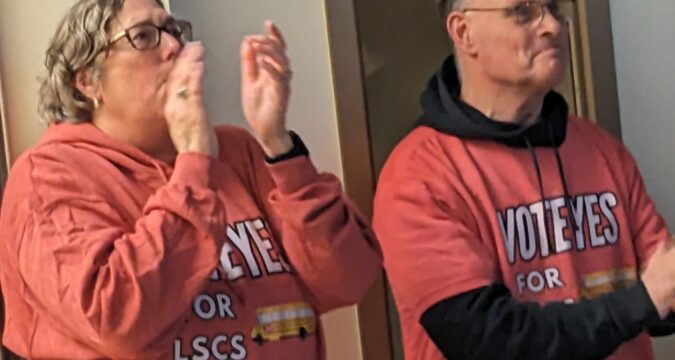
Lake Station school chief Cripliver retiring
Lake Station Superintendent Thomas Cripliver is retiring after guiding the school district for 11 years, capping a 41-year career as an educator.
The school board reluctantly accepted his resignation Wednesday night with board president David Wright and member Greg Tenorio voting “no.”
Cripliver’s retirement is effective at the end of the school year in June.
“I hope you understand what a difference you made for our community with all the work you’ve done,” said Tenorio.
Cripliver led the district through rocky budget years as enrollment declined and state tax dollars dwindled. The landlocked city has little industry to support its tax base, and many taxpayers are already at the top of their tax cap.
The district has lost at least $7.4 million in its levy because of tax caps since 2019.
Cripliver successfully led two property tax referendums, including an $11 million eight-year referendum in 2024. The first one passed in 2017.
In 2023, the referendum lost by 15 votes.
“Our students lost out,” said Cripliver on that election night. “I’m disappointed for our students.”
The failure to retain the referendum had an immediate consequence.
When school resumed in August 2024, students took elearning classes two days a week because the district couldn’t afford five days of bus transportation. It triggered parents, city officials, and community members to rally behind the district.
When the school board tried again in 2024, voters backed the referendum and full bus service resumed later in November.
“Without the support of the school board, nothing that I could have done was possible,” Cripliver said at Wednesday’s meeting.
“It really has been a true labor of love,” said Cripliver, who grew up in Lake Station and graduated from Edison High School. His first job was teaching for six years in Lake Station.
His career took him to districts in Elkhart, Rockford, Ill., and River Forest before returning to Lake Station.
He credited sixth-grade teacher Fred Calloway and high school government teacher James Cosgrove for influencing him to become an educator.
“It’s a privilege to come back to my school district, my hometown and school that did so much for me,” he said.
Assistant Superintendent Christine Pepa praised Cripliver’s leadership.
“We have been through a lot of challenges and some tremendous celebrations,” she said.
“Through your mentorship, not only am I a better administrator, I’m a better person. You deserve sunshine and tee times.”
The school board will now launch a search for its next superintendent. No details on the search were immediately available.
Carole Carlson is a freelance reporter for the Post-Tribune.
https://www.chicagotribune.com/2026/01/22/lake-station-school-chief-cripliver-retiring/

Key witness spends second day on witness stand in restaurant extortion case
On Nov. 25, 2024, security camera footage from Adolfo García’s unsuccessful oyster and martini bar Yours Truly showed García standing alone in the bar’s basement when a man in a long, grey coat and black baseball hat walked in, demanding his money back.
The man, who García knew as Angelino Escobar but whose real name is Jawad Fakroune, had already been angry with García over late payments on a series of loans he’d given him for several different restaurants around Chicago and the suburbs, all of which had gone under.
That night, Fakroune beat up García and told him he would kill him and his children if that’s what it took to recoup $1.5 million he said García owed him.
“Get my money,” he said. “Ready tomorrow. Or I (expletive) kill you …. I will hunt you down, man. Every day, every night. Believe that.”
Thursday was García’s second day on the witness stand as prosecutors kept building their argument that Fakroune’s alleged attack on García in Yours Truly and the phone and text exchanges that followed went way beyond a business partnership gone sour and instead constituted extortion.
Jurors, audience members, U.S. District Judge Manish Shah and a visibly emotional García spent the first hours of Thursday’s testimony watching the 20-minute confrontation between Fakroune and García, which began in the restaurant’s basement and wound in the kitchen where the two men circled a stainless steel table as Fakroune shouted questions and threats and García, holding his head from an earlier blow, begged him to “please just stop.”
At one point, Fakroune seemed to be aware that the restaurant’s security footage was capturing the confrontation as he stared straight into the camera. About a year later, federal authorities arrested him in Michigan City and charged him with two counts of extortion while posing as the son of a Colombian drug lord. He’s also facing a separate, pending federal case alleging tax evasion and wire fraud.
Fakroune, seated at the defense table in Shah’s 19th-floor courtroom, let out a heavy sigh and rubbed his face as the footage played. García spent much of the video crying as he watched it from the witness stand.
On the footage, he could be seen leaning against the table, holding his head as Fakroune had his last word.
“You better have it, man,” he said. “Tomorrow.”
Fakroune was then captured on camera walking out through the same bar where García had handed his assistant the check earlier that day.
García testified that he took Fakroune’s statements very seriously, driving around the Loop and South Loop and taking a butcher knife from his kitchen to put beside the bed that night.
In a phone call secretly taped by the FBI the next day, he told Fakroune he was trying to scare up cash to replace the $8,000 check he’d made out to Angelino Escobar, Fakroune’s alias, which had set off the confrontation in Yours Truly.
“I’m already a dead man walking by your standards, so (expletive) it,” he said.
“I hope you understand that,” Fakroune replied.
“I do, thank you,” García said. “You told me last night 9,000 (expletive) times.”
Fakroune told García he’d call him back in a few hours and expect that García had come up with the cash.
A few hours later, García called back to say it would have to be a check, made out to an LLC named 613 N. Wells, without the name Angelino Escobar attached to it.
“Your (expletive) check is ready to be picked up,” he said. “I never want to see you again in my life.”
Fakroune’s defense team has told the jury that while Fakroune’s actions toward García were ugly, bad behavior doesn’t equate to breaking federal law. Attorney Damon Cheronis said Tuesday that the confrontation in the kitchen of Yours Truly doesn’t merit an extortion conviction because Fakroune never extended Garciía a line of credit.
But as cross-examination began Thursday afternoon, Cheronis started by zeroing in on García’s difficult history in the city restaurant scene. García admitted on the stand Wednesday to being “an absolute failure” as a restaurant operator and to facing serious personal problems as he sank deeper and deeper into financial distress throughout his dealings with Fakroune.
“You had a reputation in the restaurant industry for being a bad operator … and for taking money from your partners,” Cheronis said. “Almost every business partner that you’ve worked with has called you a fraud.”
Cross-examination was set to continue Thursday afternoon.

Review: In ‘Eureka Day’ by TimeLine Theatre, time marches on for a funny vaccine comedy
If you recall COVID-era parent meetings at your (or your kids’) school with horror, you’ll find one fabulous, elongated scene in the play “Eureka Day” as cathartic as it is hilarious.
The Zoom sequence takes place as a hapless little board of a parent-run private school — a liberal, crunchy, Montessori-esque, Northern California kind of place — is trying to debate whether to close the school due to an outbreak of mumps. Some of the kids are vaccinated, some are not. (The play is set just before COVID, but also is a satire of behavior during that crisis.) They also debate whether to change the school admissions policy to ban the unvaccinated.
The board is adept at using progressive jargon like “holding space” and “feeling seen,” and insisting on no disposable flatware, but is hapless when it comes to making an actual difficult decision. The board members lose control of the meeting as parents in the “chat” section start to attack each other in increasingly intemperate and unhinged ways, taking advantage of how chat showcases the qualified and the ignorant alike. The playwright, Jonathan Spector, unspools the messages on a big screen even as you watch the panicked board scrunched around a laptop in horror. It’s a ruthless piece of satire and filled with one hard laugh after another. Frankly, it’s worth going to the show at the Broadway Playhouse just to see it.
“Eureka Day” is a very funny play in general, and this new production downtown from TimeLine Theatre is one of many in the nation this season. I enjoyed the show greatly on Broadway, where it was directed by Chicago’s Anna D. Shapiro in a production that was quite a bit subtler than the one on offer here.
The 100-minute comedy can best be described as a lampooning of virtual signaling, and of the clueless white liberal establishment that learned the words and signals of equity without really changing their behavior. This is not some DEI takedown; Spector knows the political leanings of the theater audience and he targets hypocrisy, not political issues. And of course, the play is set before the current age of Donald J. Trump, now the elephant in all these rooms.
This time around with “Eureka Day,” there is another problem, indicative, I think, of how fast the world changes.
The main conflict here is between those who believe in all vaccines and those with more skeptical approaches. But the anti-vaxxers approach this issue from the left, starting with a belief in holistic healing and a disdain for so-called Big Pharma. This is how it often used to be. Now, we associate vaccine skepticism with Robert F. Kennedy Jr., the United States Secretary of Health and Human Services, generally associated with the right. Frankly, that throws this play off quite a bit, as it leads the audience to be more confused about the character of Suzanne (Rebekah Ward), even though the play generally presents her views sympathetically and is critical of everyone else for their self-serving dismissal of them. I think director Lili-Anne Brown’s production ought to have actively countered that issue a bit more than is the case; “Eureka Day” is not supposed to have clear rights and wrongs, but is a takedown of how human selfishness can survive almost anything.
Rebekah Ward, PJ Powers, Gabrielle Lott-Rogers and Aurora Adachi-Winter in “Eureka Day” by TimeLine Theatre at the Broadway Playhouse. (Brett Beiner)
All that said, there are some very strong moments in the very lively first Chicago production of one of the sharpest Broadway plays of recent years, amusingly designed here by Collette Pollard on a set filled with children’s books (everyone prizes literacy, maybe over human compassion).
PJ Powers, playing the well-meaning leader of those who cannot be led, offers a carefully observed performance with farcical interludes. The rest of the ensemble (Aurora Adachi-Winter, Caroline Chu, Jürgen Hooper and the delightfully quizzical Gabrielle Lott-Rogers) show much skill in comic timing although the best moments come not when they lean into the gags and the shtick but into the very human challenges of doing your best for your kids in the most difficult of circumstances. The more recognizable the behavior, the better it works in this show.
“Eureka Day” (that’s the ironic name of the school) really is a deft observation of the perils of all kinds of shared governance and how the veneers of what people say in meetings are thin indeed. Underneath, it says, we all want what we want and are often willing to go to great lengths not to hear but to be heard ourselves.
Chris Jones is a Tribune critic.
cjones5@chicagotribune.com
Review: “Eureka Day” (3 stars)
When: Through Feb. 22
Where: Broadway Playhouse, 175 E. Chestnut Place
Running time: 1 hour, 40 minutes
Tickets: $30-$90 at timelinetheatre.com and www.broadwayinchicago.com
https://www.chicagotribune.com/2026/01/22/review-eureka-day-chicago/
2026 Looks Better For US Automakers Than Suppliers; Deutsche Bank
2026 Looks Better For US Automakers Than Suppliers; Deutsche Bank
Deutsche Bank is looking at U.S. autos heading into the new year with a growing sense of separation between winners and laggards. In a new 2026 outlook note, Edison Yu and his team argue that while global auto demand remains uneven and suppliers face a tougher volume backdrop, U.S. automakers are entering the year with clearer earnings momentum, helped by better mix, lower EV losses, and a renewed ability to lean into their most profitable internal-combustion vehicles.
At a high level, the bank is cautious on global production growth despite more optimistic industry forecasts. Deutsche Bank sees downside risks tied mainly to China, where changes to government trade-in subsidies are expected to hit lower-priced vehicles hardest. While North America and Europe may improve modestly, the team does not believe those regions can fully offset a potential slowdown in China. As a result, suppliers are likely to guide conservatively for 2026, particularly in the first half of the year, even though fourth-quarter results should generally meet or exceed expectations.
In contrast, the setup for U.S. automakers looks more favorable. Deutsche Bank expects both GM and Ford to deliver solid fourth-quarter results and to grow EBIT by roughly $1–2 billion year over year in 2026. The key driver is not higher unit volumes, but a shift in mix. With regulatory pressure easing, automakers no longer need to restrict production of high-margin trucks and SUVs to meet fleet-wide emissions targets. That flexibility allows them to stock dealerships with more profitable trims, improving margins even if overall sales volumes remain flat or modestly lower.
The pullback from aggressive EV expansion is another important theme. Both Ford and GM have taken multi-billion-dollar write-downs tied to EV programs and battery investments. Deutsche Bank views these moves as painful but necessary resets that reduce future losses, depreciation, and overhead. By clearing out what the bank refers to as “stranded assets,” both companies enter 2026 with a cleaner cost base and a much easier earnings comparison year over year.
For EV-focused companies, the conversation shifts away from near-term vehicle volumes and toward technology execution. Deutsche Bank expects muted underlying volume growth for Tesla and Rivian, with investor attention increasingly centered on autonomy, software, and what the team describes as “physical AI.” For Tesla, that means proving real-world progress in unsupervised full self-driving and robotaxi deployment before earning additional valuation credit. For Rivian, 2026 is framed as a critical year, with the R2 launch needing to demonstrate not just scale, but improving competitiveness in autonomy.
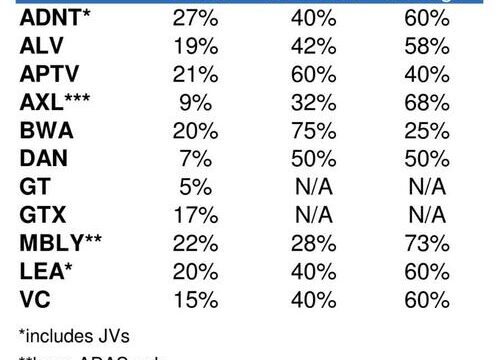
Suppliers face a more complicated picture. China stands out as the biggest wildcard, as revised subsidy rules disproportionately impact lower-priced vehicles and are expected to drive a year-over-year decline in passenger vehicle wholesales. While many global suppliers skew toward higher-end vehicles, which may help mix, Deutsche Bank still expects a net negative volume impact. BorgWarner is singled out as particularly exposed given its historical reliance on China for growth.
Another emerging risk is memory chips. The surge in AI data center demand has pulled wafer capacity away from automotive-grade DRAM, sending prices sharply higher. Deutsche Bank has not yet fully baked a DRAM-driven production hit into its forecasts, but flags it as a meaningful downside risk, especially for suppliers without strong inventory buffers or pricing protections. Some companies, like Aptiv, appear better insulated, while others may feel indirect pressure if vehicle production slows.
Stepping back, Deutsche Bank’s overarching message is that 2026 is shaping up to be less about selling more cars and more about selling the right ones, at the right margins, with tighter cost control. Automakers, particularly in the U.S., appear better positioned to navigate that environment than suppliers. ICE vehicles are once again doing the heavy lifting for profits, EV strategies are being reset to prioritize economics over ambition, and autonomy remains the long-term prize—but one that still requires proof.
Tyler Durden
Thu, 01/22/2026 – 15:20
https://www.zerohedge.com/markets/deutsche-bank-2026-looks-better-us-automakers-suppliers