
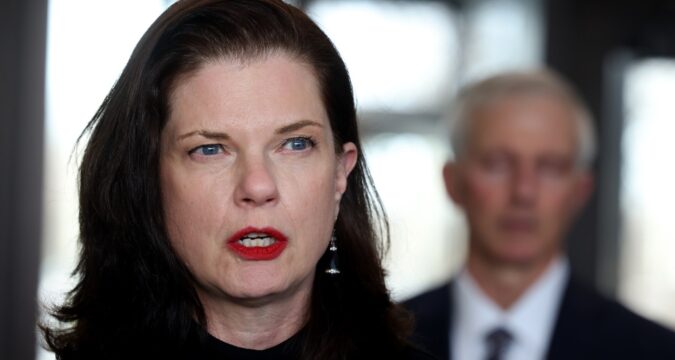
In 2025, Cook County began the year with a new state’s attorney and ended it with a new chief judge, ushering in another era for one of the largest court systems in the country.
Upon taking office in December 2024, State’s Attorney Eileen O’Neill Burke implemented policy changes that were cheered and criticized, including ordering prosecutors to automatically seek pretrial detention in certain circumstances and allowing police officers to bypass the office’s felony review process in some low-level gun-related felony cases.
By the end of the year, former Chief Judge Tim Evans’ nearly quarter-century reign heading the Cook County judiciary was ended when Judge Charles Beach defeated him in a secret-ballot election.
Evans’ historic eight terms as the first Black chief judge saw the county through reforms, changes and upheavals including the elimination of cash bail and the COVID-19 pandemic.
Well-liked among his judicial colleagues, Beach has pledged to improve communication among court stakeholders and increase transparency.
Charles Beach listens to speakers before being installed as the new chief judge of the Circuit Court of Cook County in a ceremony Dec. 1, 2025, at Chicago-Kent College of Law. (Brian Cassella/Chicago Tribune)
He takes the reins at a time when the court system faces a number of challenges, with his office overseeing the often-troubled Juvenile Temporary Detention Center and absorbing oversight for all electronic monitoring defendants.
With changes underway, here are some cases and issues to watch for in 2026:
Immigration protest cases
As Chicagoland was roiled this autumn by the Trump administration’s immigration crackdown, more than 100 people have landed in Cook County court facing protest-related charges.
The U.S. Immigration and Customs Enforcement facility in Broadview became a flashpoint for demonstrations opposing tactics by agents during Operation Midway Blitz, at times plunging into chaos and violence as federal agents deployed tear gas and other nonlethal measures into crowds of protesters.
That spurred a coalition of state and local authorities, including the Cook County sheriff’s office, Illinois State Police and the Broadview Police Department to set up command at the facility, with state officials saying the effort was meant to protect First Amendment-related activity.
Over the course of several months, the officers arrested at least 112 people, their crowd control tactics also eliciting criticism from protest groups.
Unlike the arrests initiated by immigration agents that have gone to federal court, these cases remain largely pending, and it remains to be seen how Burke’s office will resolve the matters.
In federal court, the cases have mostly gone uncharged or fallen apart when met with the scrutiny of the courtroom.
Most of the stateside arrests are misdemeanors, with police officers writing tickets and releasing people on scene.
A handful, though, have been charged with low-level felonies.
During an interview with the Tribune, Burke said the office is only just starting to see the cases in court and review each matter.
But she said the overall tactics of immigration agents in Chicago have made the job of policing and prosecuting more difficult.
“We’re having trouble getting victims and witnesses to come to court. When that happens, we don’t have a choice; we have to dismiss the case,” she said. “We would have to release a very violent predator into the community.”
Earl Wilson
In 2017, Cook County Judge Raymond Myles became the first Chicago-area judge to be shot and killed in more than three decades in a case that generated national news and a massive police investigation and stunned colleagues at the Leighton Criminal Court Building where he presided over cases for years.
Now, his alleged assailant is scheduled for one of the first major jury trials of the new year, slated to begin Jan. 12.
Myles rose early on April 10, 2017, at his West Chesterfield home on the Far South Side in order to hit the gym with his girlfriend before work, prosecutors said.
But as his girlfriend left the residence, she was confronted by a gunman who took her gym bag and shot her in the leg in an apparent robbery attempt, according to prosecutors.
Myles rushed outside and exchanged words with the attacker before he was shot and killed.
Family members console each other as Chicago police investigate the fatal shooting of Cook County Judge Raymond Myles in the 9400 block of South Forest Avenue on April 10, 2017. (Zbigniew Bzdak/Chicago Tribune)
The robbery was for naught in the end, prosecutors said at a 2017 bond hearing: After realizing the gym bag had no money, the gunman tossed it out the car window.
Earl Wilson, 54, is facing charges of murder and other felonies in the slaying. His co-defendant, Joshua Smith, pleaded guilty last year to armed robbery and was sentenced to 35 years in prison.
Nearly nine years since the killing, Wilson, barring any further delays, is finally set to face a jury, expressing frustration about the long wait in motions and court hearings.
In a handwritten motion filed in 2023, Wilson wrote: “Defendant requested for a speedy trial since being appointed counsel in 2017 and its now 2023 and nothing has been (done).”
Micheail Ward
The 2013 shooting death of Hadiya Pendleton, a 15-year-old honors student, spurred conversations about gun violence in Chicago that reached the highest echelons of the country when then-first lady Michelle Obama attended the teen’s funeral.
Pendleton, a majorette, had performed at President Barack Obama’s second inauguration days before she was killed.
Micheail Ward was convicted of first-degree murder and two counts of aggravated battery following a lengthy jury trial in 2018, but — despite an attempt by the Cook County state’s attorney’s office to salvage the conviction — an appeals court ordered a new trial, finding that the lead detectives continued to question him after he invoked his right to remain silent.
Now, prosecutors are back in court fighting for a conviction in the high-profile case, this time with significant headwinds.
The office no longer can present evidence of Ward’s confession.
And his attorneys are alleging misconduct on behalf of the detectives, which includes John Halloran, who has been accused of misconduct in multiple cases and worked under disgraced former police Cmdr. Jon Burge.
“Defendant also contends that the evidence presented against him, namely witness statements (virtually all of which were recanted) were false, fabricated, and a product of abuse, threats, and other forms of misconduct perpetrated by detectives John Halloran and Jose ‘Pepe’ Lopez,” a defense motion said.
https://www.chicagotribune.com/2026/01/02/courts-look-ahead-2026/


