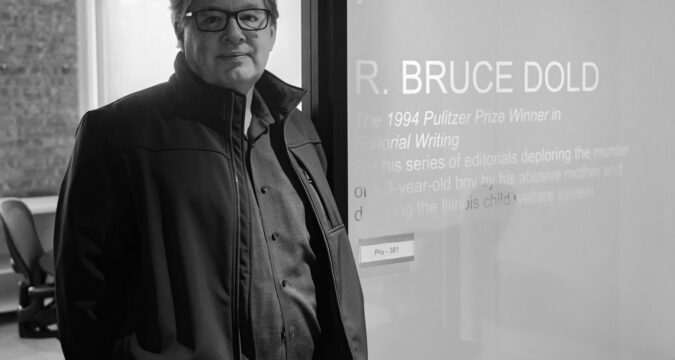
In 1999, R. Bruce Dold, then deputy editor of this page, participated in a self-reflective editorial board piece about constancy and change.
Anyone who knows anything about editorial boards, including this one, knows that is our perennial conundrum. Newspapers as old as ours depend on trust, which means they must speak with an eye on their own history and long-standing principles. But they can’t get struck in a rut. They can’t embrace every fad of short-term worth; but they also can’t act like the last Roman defending the flailing empire, lest time leave them behind and they find themselves shaking their collective fists at no one in particular.
Dold, who died Wednesday at the age of 70 after a storied Tribune career that saw him rise to editor and publisher (both at once), was, we are in a position to report with confidence, happiest when he was editorial page editor, working on prior editions of the page you are reading now.
He believed that post to be the best job at the paper he loved and where he spent his entire professional life, having first been lured into journalism by Watergate. Dold won a Pulitzer Prize for writing editorials and he was known as a gentle spirit, a gifted editor and a caring, capable boss by his colleagues both in our newsroom and on the editorial page; he was always quick to deflect any praise elsewhere.
But to take a fair measure of his decades on this page means understanding how well he navigated that constancy-change conundrum, not just within journalism, although the whiplash of working at the Tribune all those years would have felled lesser journalists in Dold’s positions, but also in the city, state and nation he covered.
In 1999, Dold was remarking on how much the news business had changed. He’d received, he wrote, an email from a man in County Antrim, Northern Ireland, and this missive had sparked an ongoing conversation about politics, “Irish and Chicagoish.”
“Using the internet,” Dold remarked, the man had read his work. “Over there in Antrim,” Dold wrote, “he cut and pasted my own words and tossed them at me: An attempted trans-oceanic high-tech ‘gotcha.’ That’s fair, that’s even fun. And that’s one of the new wonders of the business. Our reach and our ability to listen to readers here and around the world have grown immensely.”
Little did Dold know then where it all was going.
A year later he ascended to become editorial page editor and, as he did, he reminded readers of how little the Tribune had liked William Hale Thompson, the last Republican mayor of Chicago.
“For Chicago,” the editorial board had written in 1931, “Thompson has meant filth, corruption, obscenity, idiocy and bankruptcy. He has given the city an international reputation for moronic buffoonery, barbaric crime, triumphant hoodlumism, unchecked graft and a dejected citizenship.”
The 1931 board did not stop there: “It is unpleasant business to eject a skunk, but someone has to do it.”
Scott Stantis editorial cartoon for Friday, Dec. 5, 2025 on R. Bruce Dold. (Scott Stantis/For the Chicago Tribune)
We are still, on occasion, critical of our current mayor. But hardly in those terms, for, being an honorable and decent man who works hard and loves his city, he would not deserve any of them.
Dold, though, for all his nice-guy reputation, looked back admirably on the famous editorial taking down Thompson in protection of Chicago and its people. “In truth,” he wrote, “I imagine it was extremely pleasant business to write such a blunt epitaph for a corrupt mayor who was voted out of office in 1931 at the strong urging of this newspaper. It’s more than pleasant, it is tremendously satisfying to have this bully pulpit and put it to good use.”
He certainly put it to good use when the paper endorsed Barack Obama, then of Chicago, for president of the United States, another break with its Republican tradition, made in concert with the former Editor Ann Marie Lipinski. In fact, as we have looked back on his work over the last day or two, Dold put that bully pulpit to good use in one editorial after another.
That’s why Dold liked this job so much, even if he turned the focus, whenever he could, away from such inflammatory rhetoric and toward the moral obligation of a city and a state, especially when it came to the children in its care. “The editorial page has given me the satisfaction of knowing how newspapers can change lives,” he wrote in 1997. He did not miss his opportunity to do so in years that followed.
In 2007, during his tenure and following much work in the paper’s newsroom, this board changed its long-held position on the death penalty in Illinois, reversing the pro-death penalty positions articulated in 1869, 1952 and 1976, to name but three examples. “The evidence of mistakes, the evidence of arbitrary decisions, the sobering knowledge that government can’t provide certainty that the innocent will not be put to death — all that prompts this call for an end to capital punishment,” Dold’s board wrote. “It is time to stop killing in the people’s name.”
Under Dold, change won out over constancy. And, to our minds, rightly so.
“My wife, Eileen, is a writer and we have two teenage daughters, Megan and Kristen,” Dold wrote by way of introduction after he got the job he loved. They listen to Backstreet Boys; I listen to Basie. Our English springer spaniel is the tiebreaker: She’s named after Koko Taylor.”
He ended with this, a nod to constancy as well as change: “My work, almost always, is very pleasant business.”
So was reading his work. Not so pleasant is trying collectively to live up to his legacy.
Submit a letter, of no more than 400 words, to the editor here or email letters@chicagotribune.com.


