
In Steppenwolf Theatre’s “Amadeus,” running through January, Antonio Salieri is the villain. That play and its 1984 film adaptation repeated fictions that have tarred the composer’s reputation for centuries: that Salieri was unseated by Mozart as the composer du jour, became a bad sport about it, then yearned for the younger musician’s downfall — or worse.
For a taste of the real Salieri, head across town to Chicago Opera Theater’s production this weekend. “Falstaff, or the Three Pranks,” his 1799 opera with librettist Carlo Prospero Defranceschi, is one of many comic operas penned by this supposedly surly composer. Like many of those overlooked opuses, it’s a goofy delight, as was its Chicago premiere on Wednesday.
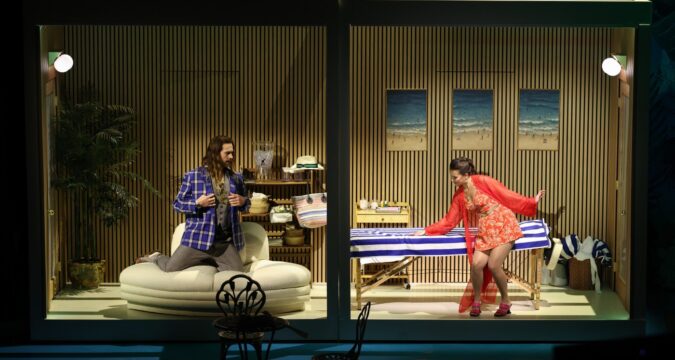
Director Robin Guarino transplants Shakespeare-via-Salieri’s farce to the “Windsor Resort,” a chi-chi, “White Lotus”-style hotel. Falstaff and his sidekick Bardolfo (bass-baritones Christian Pursell and Peter Morgan) are imagined as long-haired sleazes who hide out in the resort’s supply closet. Lothario that he is, Falstaff sets his sights on Mistress Ford and Mistress Slender (sopranos Vanessa Becerra and Tzytle Steinman), both of whom are on vacation with their husbands (tenor Andrew Morstein and baritone Laureano Quant).
Unfortunately for Falstaff, Mistresses Ford and Slender are also best friends. Together, they concoct ploys to undermine the creepy interloper, often with a cocktail in hand. Bardolfo, just as sick of Falstaff as all the rest, eventually joins in on the collusion, courting a resort housekeeper along the way (soprano Denis Vélez).
Two details stand out in this production. One is that Falstaff’s infamous weight becomes a non-issue. Beyond what’s already in the libretto, Guarino’s production doesn’t emphasize it. Nor does it try to cram Pursell — a trim guy — into a fat suit, or something else similarly wincing.
Purists may gripe that this isn’t really “Falstaff,” then. To me, it kept the narrative emphasis where it ought to be. Falstaff isn’t repulsive because he’s fat. He’s repulsive because he treats women like garbage, and expects them to love him for it.
Tzytle Steinman, from left, Christian Pursell and Vanessa Becerra perform in Chicago Opera Theater’s production of Antonio Salieri’s “Falstaff” at the Studebaker Theater. (John J. Kim/Chicago Tribune)
The second detail is the chemistry between the scheming Ford and Slender. This “Falstaff” is essentially a buddy comedy, and Becerra and Steinman play off one another exceptionally well. Becerra’s turn as the title role of last season’s “Leonora” was already a high bar, but she outdoes herself as Mrs. Ford, in a performance of infectious enthusiasm and firecracker vocal dazzle. Steinman is usually her lower partner in duets, together creating a gleaming composite instrument. On her own, she’s a gifted character soprano, able to warp her voice while retaining its essential luster.
Costuming the resort guests, Jessica Pabst’s designs deal a royal flush of one-percenter archetypes, from madras golf trousers to sweaters knotted over shoulders. The women leads are no exception, Slender leaning more Margaret Thatcher while Ford skews Kardashian.
Pursell was effortlessly assured as Falstaff, his voice focused, polished, and innately flexible. As a comic actor, he landed Falstaff’s slimy self-confidence perfectly, earning some of the evening’s biggest laughs — and there were many. With a baritone of vibrant immediacy, Quant, playing the easygoing Master Slender, likewise stood out among the cast, as he has in many a local booking.
Master Ford is Master Slender’s foil: jealous, short-fused, and bombastic. Morstein’s voice traversed the role’s huge leaps with ease and opened up most in balladic arias — like the Act 2 duet with Mrs. Ford, after all was forgiven. His Achilles heel, at least on Wednesday, were the role’s many fast and furious coloratura passages, which sometimes tumbled out of his grasp.
Of the principals, Betty makes the latest entry, only emerging as a key player in the opera’s second half. Vélez’s sparkling soprano and winsome stage presence more than made up for lost time. As Bardolfo, Morgan was the weaker of that particular pair, his bass-baritone more ponderous than hearty.
Set against a verdant leaf print backdrop, Andrew Boyce’s airy, modular set is the right balance between effective and manageable. (In the spirit of “She Who Dared,” scene changes are handled by chorus members dressed as hotel attendants — a simple but immersive touch.) Responsive, cool-toned lighting by Thomas Hase added extra depth to the action, toggling between onstage focal points.
Christian Pursell, center, performs in Chicago Opera Theater’s production of Antonio Salieri’s “Falstaff” at the Studebaker Theater. (John J. Kim/Chicago Tribune)
Meanwhile, conductor Christine Brandes led fluidly from the pit, with alert dynamics and a knack for quick fixes when singers fell out of step with the orchestra. The orchestra itself was less assured on opening night, its intonation faltering sporadically.
Where the production completely splats is in its supertitles. A slangy translation is one thing — and even here, Cori Ellison’s is sometimes strained. Needlessly inserting words just to better fit the staging, as though Italian is just “Peanuts” parent-babble one can superimpose their whims upon, is quite another. Hence why Beyoncé shows up in the supertitles at some point, and Falstaff apparently asks for a double shot of tequila despite singing about brandy and toast. Ay.
Once one gets past those bitter notes, this production is much like the Aperol spritzes Mmes. Ford and Slender guzzle poolside: fizzy, sweet and quite coiffable.
Hannah Edgar is a freelance critic.
Review: “Falstaff, ossia Le tre burle” (3 stars)
When: 3 p.m. Dec. 6-7
Where: Studebaker Theater in the Fine Arts Building, 410 S. Michigan Ave.
Tickets: $50-$150 at chicagooperatheater.org
https://www.chicagotribune.com/2025/12/04/review-falstaff-chicago-opera/


