
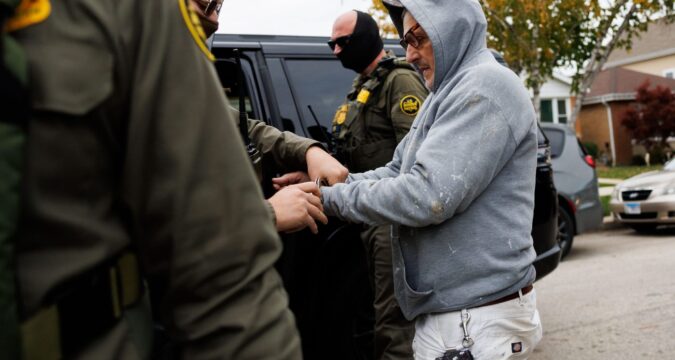
Newly released federal data shows that immigration agents booked in roughly 1,900 immigrants in the first half of Operation Midway Blitz – two-thirds of whom had no known criminal convictions or pending charges.
The latest data offers the first comprehensive look at the effects of the operation, and a Tribune analysis underscores the divide between the Trump administration’s stated goal – to target “the worst of the worst” – with the reality of controversial round-ups that typically snagged undocumented immigrants with no known rap sheets.
Of the 1,895 people detained by ICE, 1,271 lacked any criminal record. Another 343 people arrested had a pending criminal charge, while 281 had a criminal conviction. Of those with a criminal conviction, the vast majority of offenses were misdemeanors, traffic citations or non-violent felonies. Only 28 arrestees —1.5% — had been convicted of a violent felony or sex crime.
The Department of Homeland Security, which ran the operation, did not immediately respond to questions. It previously has argued that the Trump administration, while targeting dangerous “illegal aliens,” welcomed the arrest of anyone in the United States without legal status, no matter how otherwise-law-abiding they were.
The agency argued in a past news release that its efforts collectively helped lower crime as part of what it called “a historic win in the fight against violent criminal illegal alien crime.” The boast, however, ignored several consecutive years of decreases in Chicago’s violent crime.
The findings come from a Tribune analysis of updated U.S. Immigration and Customs Enforcement data obtained and shared Monday by the research group Deportation Data Project.
Unlike typical law enforcement agencies, ICE does not release complete lists of those arrested but the agency periodically has been forced to release raw data of its activities under an open records lawsuit. That data has helped document the dramatic escalation of enforcement efforts in Chicago and across the country, although it doesn’t list enough details to make precise measurements of specific enforcement actions.
The best window into local impacts of Operation Midway Blitz appears to come from tallying those undocumented immigrants booked into either of two Chicago area ICE facilities – a main temporary holding jail in west suburban Broadview, and an office in the South Loop. And those figures show 1,895 people booked into either facility between Sept. 8, the announced start of Operation Midway Blitz, and Oct. 15, the most recent data available.
Because some detainees were booked in multiple times, ICE recorded a total of 1,912 bookings in that period – a significant boost in the pace of detentions that steadily climbed to an average of nearly 70 a day by mid-October. That’s roughly double the arrest rate in early June, the most intense immigration enforcement period prior to Operation Midway Blitz.
Nearly all the bookings occurred in Broadview, under the shadow of regular, sometimes confrontational protests. The nondescript building – a way station with large holding cells meant for stays less than 12 hours – rarely saw more than a handful of bookings a day under the waning days of Biden administration. Since Trump regained the office, the facility at times has seen more than 100 people jammed there for days without beds, showers or hot food in ways sparking a federal lawsuit alleging inhumane conditions.
Still, those figures may not capture those arrested and booked into another facility outside the region. DHS has broadly defined the boundaries of Operation Midway Blitz, including arrests in northwest Indiana, for example. By DHS’ calculations, agents had surpassed 3,000 total arrests two months into the operation. The agency did not break down how many of those arrested lacked any rap sheets before their arrest.
https://www.chicagotribune.com/2025/12/01/operation-midway-blitz-criminal-record/


