Thanksgiving this year is a tale told through two sets of pictures.
The first is what we see in memes: a cornucopia overflowing with food and blessings. Tables filled with turkeys, yams, greens and cornbread. The concerns of the day are whether to call it “stuffing” or “dressing” and whether to watch football instead of a classic film.
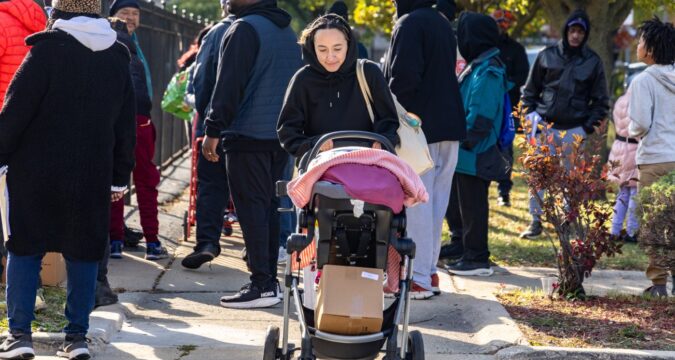
The other Thanksgiving is what we’ve been seeing at our food pantries and our houses of worship and on the pages of our newspapers: a flood of families plagued by need and desperation. Children and their parents filled with hunger and fear. The concerns of the day are not about entertainment or terminology, but on surviving the cold winter ahead.
Our faith traditions instruct about the primary moral imperative to feed those in need. In the Christian tradition, Matthew 25 advises that we must feed the hungry and do for those who have the least. In the Jewish world, our most celebrated feast, the Seder of Passover, opens with the injunction: Let all who are hungry come and eat! It is out of these commitments that we see the view on the ground from the hunger programs built out of our institutions.
St. Sabina Social Services has seen the numbers for its food pantry go through the roof. Over 300 people came through on three days last week alone, and it’s a struggle to keep the shelves packed. The pantry used to see around 155 people a day, and now the numbers are just about double. A few Saturdays ago, with 700 food boxes to give away, St. Sabina’s ran out and had to tell the remaining people in line there was nothing left.
The Sankofa Food Market at Trinity United Church of Christ is also witnessing a major increase: Demand has increased nearly threefold, from 150 to 200 families a week to 450 to 500. In further response to need, the market just adopted two elementary schools to provide meals for families that have been hit hard. Likewise, Live Free Illinois’ Community Health Resource Centers are also increasing their numbers and are now giving away over $10,000 in food each month.
There are four groups of people we are seeing coming for food. The first are those of low income who have always relied on food pantries. The second are immigrants who, especially in response to the cruel and lawbreaking Operation Midway Blitz, are afraid to go to work. The third is those who have lost jobs; this group is growing quickly. The last are first-time folks who have never visited a panty, but — with high prices in the supermarkets — feel they need to supplement what they are able to provide their families.
Of course, all of this is augmented by the devastating, intentional federal cuts to programs that fulfill the moral and religious injunction to provide food to the hungry.
From our perspectives in the pulpits and the pantries, Thanksgiving this year highlights the growing divide in America, the divide between those who have and those who have not. The One Big Beautiful Bill Act is increasing the already massive wealth gap in our nation, functioning as a reverse Robin Hood taking from the poor to redistribute to the rich, economists and academics say. Nowhere is this better seen than in cuts to the Supplemental Nutrition Assistance Program, which lead directly to the lines, the hunger, the deprivation that mar our season of gratitude.
Federal nutrition programs such as SNAP and the emergency food system work together to protect families from food insecurity. Around 1.8 million Illinoisans are fed through SNAP. In Illinois, you can have a full-time job and still be food-insecure; hundreds of thousands of Illinois workers rely on SNAP when minimum-wage income is not enough. However, with changes wrought by the wealth redistribution of President Donald Trump’s bill, 1 in 4 poor Illinoisans are in danger of losing SNAP benefits.
SNAP matters because, for every meal provided by a food pantry, SNAP provides nine! Our work in houses of worship to help feed our neighbors just can’t compete with federal efforts. Starting in October 2027, Illinois will have to fund a significant portion of SNAP benefits and could be required to pay over $700 million annually to maintain SNAP, or risk losing the program altogether. This doesn’t even capture the fact that SNAP’s exclusions of immigrants granted official humanitarian protections, along with intentionally draconian work requirements that will block access for others, will significantly reduce the number of people who can take advantage of the limited funding.
Hunger will be increasing in our communities at an unprecedented rate — due to human greed and indifference — between this Thanksgiving and the next.
If we are to live up to our calling, either as people compelled by our religious traditions or human beings moved by morality, then we each must do our part to feed the hungry and to remedy the problem of hunger in America.
Yes, this means volunteering at your local food pantry, be it at Sankofa, St. Sabina, the Greater Chicago Food Depository or any place that provides the food and dignity people deserve.
Yes, this means donating money to these food pantries.
And, yes, this means we must organize in our state and across America to elect out of office anyone who voted for the twisted One Big Beautiful Bill Act and usher back into Washington public servants who care less about their wealthy friends and donors and more about basic human needs and dignity.
When that day comes, it will truly be a day of Thanksgiving for all.
Chicago faith leaders Rabbi Seth Limmer, the Rev. Otis Moss III, the Rev. Ciera Bates-Chamberlain and the Rev. Michael Pfleger joined the Tribune’s opinion section in summer 2022 for a series of columns on potential solutions to Chicago’s chronic gun violence problem. The column continues on an occasional basis.
Submit a letter, of no more than 400 words, to the editor here or email letters@chicagotribune.com.
https://www.chicagotribune.com/2025/11/30/opinion-food-insecurity-chicago-st-sabina-sankofa-market/


