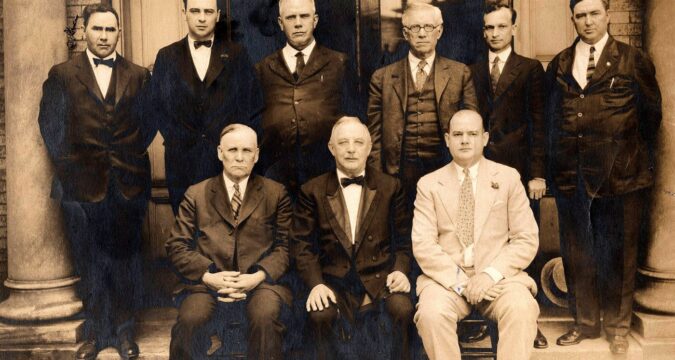
One hundred years ago, the Lutheran University Association purchased a struggling Valparaiso University and made it what it is today.
Mel Piehl, senior research professor in the humanities at VU, has researched the 166-year history of the university. For VU, 1925 was a big turning point.
The university was founded in 1859 by the Methodists as Valparaiso Male and Female College. That lasted until 1871, when the college’s charter and property were purchased by a group of Ohio educators led by Henry Baker Brown, Oliver Perry Kinsey and Samantha Baldwin, Piehl said.
It was a boom time for Northern Indiana Normal School, later renamed Valparaiso College and then Valparaiso University. By 1900, it was the second-largest college in the United States, after Harvard, with over 5,000 students.
Brown pushed VU’s presence into Chicago. In 1902, VU launched its own medical school near Cook County Hospital, the largest such institution in the region, Piehl said. It later became the Loyola School of Medicine.
In 1903, VU acquired the Chicago College of Dental Surgery from Lake Forest College. VU students could take their first two years of pre-medical or pre-dental courses in Valparaiso before transferring to Chicago. The law school and pharmacy school stayed in Valparaiso.
To give a sense of how important VU had become by the early 1900s, Piehl noted that the governors of Illinois and Wisconsin were both VU alumni. “Lowell Thomas was the most famous alumnus, but there were others.” Thomas, a pioneering radio journalist, famously covered British Colonel T.E. Lawrence, immortalized as Lawrence of Arabia, who aided the Arab revolt against Turkish rule in World War I.
World War I did to VU what the Civil War did to the Methodists’ Valparaiso Male and Female College, causing a sharp drop in enrollment. Contributing to the decline were Brown’s crippling stroke in 1912 and Kinsey’s retirement in 1919.
“They cycled through a couple of presidents” after Kinsey retired. Brown’s son didn’t know what to do, and “a charlatan from the east” didn’t help, Piehl said.
Valparaiso University students goof around in this 1929 photo. (Valparaiso University Archives & Special Collections/provided)
“The whole changing nature of higher education at that point” was moving from teaching the classics to accreditation commissions and a focus on research, Piehl said. A delegation from the North Central Accrediting Association visited campus and declared that despite VU’s “great work in the past,” its present wasn’t up to snuff.
Horace Evans was put in charge of rescuing the flailing university. He even got the Indiana General Assembly to consider turning it into a public university, but the governor vetoed it, Piehl said. “That’s when the Klan came in.”
KKK wanted VU
Piehl added historical context. “The early 1920s was when the Klan was flourishing,” Piehl said. Most members of the state legislature and many of the men who held statewide office were Ku Klux Klan members. The KKK was in its second iteration, succeeding the organization that had formed after the Civil War.
“They put out a big announcement that they were going to buy Valparaiso University and started negotiating with Brown and some of the board people,” Piehl said. VU would have become Ku Klux Klan University.
The July 1923 announcement was bluster, much like tweeting a decision to buy VU without first arranging the deal.
“As befitted the Klan, much of what happened in the next months was clouded in secrecy and mystery, and actual records of these dealings, as distinct from rumors and speculation, are few. But it appears that Evans, out of desperation or naivete or stupidity, did meet clandestinely with some Klan officials and a purchase price was agreed on,” Piehl wrote in his “Valparaiso Before the Lutherans” history of VU.
“Essentially, it was a fraud. They never had any real money,” Piehl said.
However, the announcement made national headlines. Editorial cartoons speculated on what the Klan Academy might be like. “They were going to have courses in white sheet making and things like that,” Piehl said. A New York newspaper published a cartoon that speculated on courses like “whipping” and “advanced tar and feathering.” The New Republic imagined a student lynching party returning to campus singing the new alma mater: “Land where the mob is boss/Land of the rope and toss/On every flaming cross/Let freedom ring.”
The Chicago Evening Post reported on July 26, 1923, “Klan officials say they will await the outcome of the negotiations at Valparaiso. In the event they do not obtain control of the institution, they say, a university will be established in the state that will be larger than either present state schools – Purdue and Indiana – in which the teaching of Americanism will be emphasized.”
That, too, was all talk and no action.
Public opinion was sharply against the KKK purchase. But VU’s financial situation was desperate.
“Valparaiso University, which at one time was said to have the largest student body in the United States, was virtually closed by a recent action of the board of directors of the Valparaiso Realty company, which owns the buildings and plant,” the Chicago Daily Tribune reported on July 16, 1923.
A day later, the Tribune reported that debts amounting to nearly $300,000 contracted during World War I wouldn’t force the university’s closure. Adjusted for inflation, that $300,000 would be nearly $5.7 million in 2025.
The (Valparaiso) Messenger reported on Aug. 6, 1923, that the VU board was to meet that afternoon to consider the Klan proposal and that it would likely be rejected.
Valparaíso University students clean up the campus behind Heimlich and Baldwin halls in this 1925 photo. (Valparaiso University Archives & Special Collections/provided)
The New York Times reported on Sept. 5, 1923, that the KKK plan was officially dead. Milton Elroad, editor of The Fiery Cross, a Klan publication, said the deal was off because VU’s charter and deeds prevented the sale to the KKK.
The downfall of the Indiana Klan itself came soon after.
Grand Dragon D.C. Stephenson was convicted the following year of raping and murdering his secretary Marge Oberholtzer on a train from Indianapolis to Chicago. “He was the power behind the throne and everything,” Piehl said.
Stephenson was naming names on his way out, spreading scandal throughout state government. “The Stephenson thing really collapsed the Indiana Klan,” Piehl said. “They hung around, but they were absolutely discredited.”
Lutherans to the rescue
By 1925, the university was on the verge of collapse when the Lutherans showed up. “The situation was dire,” Piehl said. This time, the threatened closing was real.
“It was sort of a last-minute deal in 1925 that they came in. Evans must have thought the Lord was speaking to him,” Piehl said. “They bought it in the summer of 1925 and opened it for business that fall.”
Lutherans were vehemently opposed to the KKK, which had threatened to shut down parochial schools in the United States. The Klan hated Catholics as well as Blacks.
After Catholics, Lutherans operated the second largest group of parochial schools. “It was kind of the first boost of Lutheran lay activity” to try to block the Klan’s attack, Piehl said. A 1925 Supreme Court case, Pierce v. Society of Sisters, upheld the legality of parochial education.
The Lutherans wanted a Lutheran university, primarily the Missouri Synod, in the Midwest. “They had been talking about building a university from scratch,” but here they saw a ready-made university they could take over, Piehl said.
Mildred Boger and fellow Valparaiso University students pose with a goat and wagon in this 1929 photo. (Valparaiso University Archives & Special Collections/provided)
Buying VU would cost a few hundred thousand dollars – millions in 2025, adjusted for inflation. “At the time, it was a substantial amount that they had to come up with,” Piehl said.
“It was really a big step up to purchase this,” he said. “These were the successful people” coming together to raise the necessary funds. Among them were a hardware chain owner, candy manufacturer, doctors, lawyers and a resort owner. “They were earnest, conservative, but they were also kind of the reforming wing of the Missouri Synod.”
The plan was to train people for Lutheran professions. “The strong emphasis was laity, to train people for regular work,” Piehl said.
The Lutheran University Association was formed to control VU and continues to do so today, 100 years later.
VU’s early Lutheran years
In 1926, 10,000 Lutherans from around the United States came to VU for the inauguration of VU’s first Lutheran president, William H.T. Dau.
“They had been largely immigrant outsiders, so this was their coming out,” Piehl said.
Valparaiso University’s first Lutheran president, William H.T. Dau. (Valparaiso University Archives & Special Collections/provided)
Dau was one of the well-known Lutheran scholars of the time, creating VU’s current motto, “Out of thy light we see light,” based on Psalm 36:9.
Dau brought in Lutheran faculty, but a lot of the previous employees were kept, too.
VU cleaned up the campus and earned the accreditation that had been denied a few years earlier.
In September 1929, VU planned to launch a big fundraising campaign. “Talk about a bad piece of timing,” Piehl said. The following month’s Wall Street crash launched the Great Depression, which lasted a decade.
“They had to struggle through the ‘30s for sure,” Piehl said. “Basically, everybody scrimped, pinched.” Students did work study to pay for their education.
Every single student requested financial aid. “It was hard times,” he said. Faculty missed paychecks at times.
The Works Progress Administration offered some student aid, which was good, because churches were also hit hard. Churches had traditionally helped pay for students’ education, but giving to churches had plummeted.
Toward the end of the 1930s, there was an uptick in enrollment. VU built Hilltop Gym, the Lutherans’ first building on campus and encroaching on what has since become the east campus, what we now think of as the main campus. Hilltop Gym has since been greatly expanded to become the Athletics Recreation Center.
The first basketball game in the new gym was against the University of Notre Dame. Afterwards, everyone marched through downtown to celebrate. “It was fairly dramatic for the time,” Piehl said.
The only remaining building from the pre-Lutheran era is Heritage Hall, which was gutted and rebuilt. Despite what many people think, its name isn’t an homage to tradition. It was named for VU’s first music professor, Richard Heritage, Piehl said.
VU went through a series of Lutheran presidents, first clergy, then lay presidents.
Jose Padilla is the first non-Lutheran president of the Lutheran era, Piehl said. Padilla is retiring at the end of the year; his replacement could be named as soon as this month.
There was a time when Lutheran students accounted for 80% to 90% of the student body, Piehl said. When Padilla took office, VU had more Catholic students than Lutherans.
President O.P. Kretzmann’s inaugural address on Oct. 6, 1940, says much about the Lutherans’ impact on what VU is today, Piehl said. “He really had this notion that you could simultaneously hold this deeper religious feeling and be open to the wider world.”
Padilla has repeatedly stressed the importance of servant leadership in addressing students and faculty.
VU’s mission statement still says to lead and serve in church and society, Piehl said, and not just for Lutherans.
“It’s obviously become far more diverse. You’ve got people from every kind of background,” he said. “There’s still the kind of atmosphere that this is a place of moral reflection.”
Doug Ross is a freelance reporter for the Post-Tribune.
https://www.chicagotribune.com/2025/11/16/valparaiso-university-marks-100-years-of-lutheran-control/


