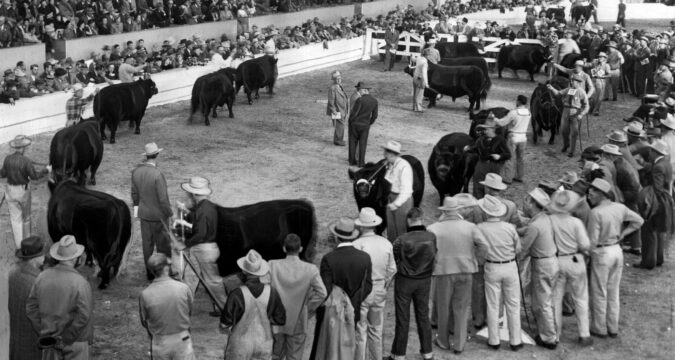
Carl Sandburg called the city “Hog butcher for the world” — and was awarded a $200 prize — for his 1914 poem “Chicago.”
For stock men and women, cowboys, college students and even 4-H Club kids, Chicago was the destination of top prizes for their pampered farm animals (which were then sold at auction for meat) from the United States and Canada. People from around the world gathered here every November or December for 75 years to attend the International Livestock Exposition — except for when it was canceled in 1914-15 due to a prevalence of foot and mouth disease.
Just after Thanksgiving in 1899, representatives from the Union Stock Yards, packing companies and live stock associations met to organize the first International Live Stock (yes, two words) Exposition with plans to host an inaugural show at Dexter Park Pavilion (next to the stockyards at 42nd and Halsted streets) the following December. The hope was to lure South American buyers away from the famous centuries-old Smithfield Market in London so they would buy meat from the United States — and namely Chicago — instead.
With the stock market booming, Chicago Tribune editorial cartoonist John T. McCutcheon imagined the sights and sounds of the crowd during the 26th annual International Live Stock Exposition for the newspaper’s front page on Dec. 1, 1925. (Chicago Tribune)
The Tribune noted, “the ‘circus’ features of former shows will have no place. An incidental feature of the exhibition will be the introduction of a sort of pure food show.”
A 10-point list proposed the exposition would include: a judged exhibition of cattle, hogs and sheep; a display of draft horses used for utility — not show; animal husbandry practices; the latest technology used in packing houses and government inspection of meats; appliances for transporting animals and meetings for breeders and stockmen’s associations.
The first exposition opened on Dec. 1, 1900, and more than $50,000 (or more than $1.6 million in today’s dollars) in prizes were awarded for cattle, swine and sheep. Nightly parades of animals, a fair for horses and hay, corn and grain shows soon became part of the annual festivities. By 1905, more than 550,000 people attended the weeklong convention. President Calvin Coolidge visited the exposition in 1924, and by 1928 the daily events were broadcast nationwide by NBC radio. A young couple who met at the event through 4-H married there in 1931. The exposition was also a boon to local merchants who welcomed the thousands of participants into their stores just before the holidays.
When the second-biggest fire in Chicago history destroyed the Pavilion and 90% of the Union Stock Yards in 1934, a replacement structure — the International Amphitheatre — was completed in fewer than six months so the exposition could open on time.
After the stockyards closed in 1971, the livestock show’s days were numbered. Lack of money and dwindling attendance forced its cancellation in 1976. The Amphitheatre, which hosted the 1968 Democratic National Convention and the Beatles’ first Chicago concert, was demolished in 1999.
Here’s a visual look back at highlights from the exposition’s glory days, handpicked from the Tribune’s archives.
Weigher Bernard Coyne checks Bernice Hayden and her 4-H steer Mickey Mischief on the scale on Dec. 2, 1939, at the International Live Stock Exposition in Chicago. (Burgess/Chicago Herald and Examiner)
Billy Nimmo, 20, from left, Stephen Mosher, 17, and Phillip Baylor, 16, from Cuba, Illinois, are part of the crop judging champion team at the International Live Stock Exposition in Chicago on Dec. 6, 1939. (Burgess/Chicago American)
A six-horse team that excites spectators nightly at the horse show, which is part of the international Live Stock Exposition in Chicago at the International Amphitheatre in 1939. The horses are exhibited by the Hawthorn Mellody Farms Dairy of Lake County. (Chicago Herald-American)
Jack Mariner, 15, of Prairie City, Illinois, sleeps with Oscar, a Southdown sheep, on Dec. 1, 1939, at the International Live Stock Exposition in Chicago. (Chicago American)
Judge Everett W. Norcross shows Mildred Ray of Kentucky, from left, Lavona Brezee of South Dakota and Wilma Jalmeland of South Dakota why this wheat was selected as the world’s best on Dec. 4, 1939, at the International Live Stock Exposition in Chicago. (Bob Rea/Chicago American)
Wilbert Holtkamp, of Salem, Iowa, with his Shorthorn steer named Lee at the International Live Stock Exposition in Chicago in 1939. (Chicago Tribune historical photo)
A woman washes an animal in preparation for the International Live Stock Exposition in Chicago in November 1939. (Chicago Herald and Examiner)
Sue White, 18, and her great big steer, both from Texas, receive top honor at the 54th annual International Live Stock Exposition on Dec. 1, 1953, in Chicago. White, of Big Spring, Texas, almost fainted as her 1,000-pound senior calf was named grand champion of the show. (Harold Borvig/Chicago American)
A big hug is given to Ellard Pfaelzer by Sue White, 18, after he bought her grand champion steer, Lone Star, in 1953 at the International Live Stock Exposition in Chicago. Pfaelzer made the purchase on behalf of Congress Hotel owner Albert Pick, left, who holds the champion ribbon. (Bill Allison/Chicago American)
Nancy Turner, of Champaign, who exhibited the previous year’s grand champion at the International Live Stock Exposition, makes a “V” for victory sign as she holds her black Angus steer, H.J., with which she hopes to repeat her victory in November 1956 in Chicago. Turner named this steer with the initials of the man who bought her prize winner last year. (Chicago American)
Outside the International Amphitheatre, animals are walked at night for exercise as part of the International Live Stock Exposition in Chicago in November 1973. (Frank Hanes/Chicago Today)
Want more vintage Chicago?
Become a Tribune subscriber: It’s just $1 for a 1-year digital subscription.
Thanks for reading!
Subscribe to the free Vintage Chicago Tribune newsletter, join our Chicagoland history Facebook group, stay current with Today in Chicago History and follow us on Instagram for more from Chicago’s past.
Have an idea for Vintage Chicago Tribune? Share it with Kori Rumore at krumore@chicagotribune.com.


