You can hear the sound upon entering the American Writers Museum. It is the sound of typewriters, that ancient writing instrument, being banged on by a bunch of first and second graders on a school field trip.
It was last Thursday and, as usual on most any school days, the museum was an active place, not only with kids but with a staff eager in anticipation of the opening of its latest exhibition.
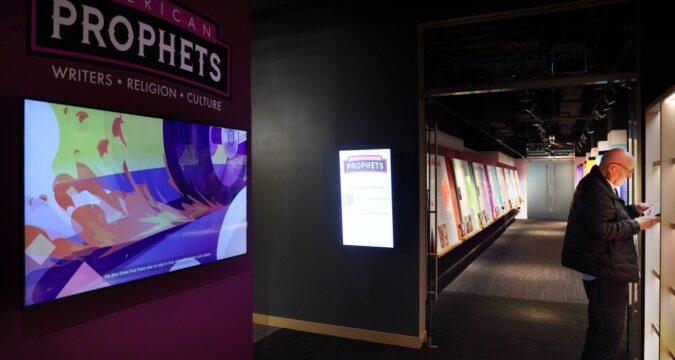
“American Prophets” opened Friday in one of the city’s youngest but also one of its most important places, an increasingly artful blend of information, entertainment and enlightenment.
It was born in 2009 when Malcolm O’Hagan, a successful engineer and businessman, was visiting his native Ireland and wandered into the Dublin Writers Museum. Soon discovering that the United States had no such institution — among the country’s estimated 35,000 museums, Chicago has more than a few, from the Art Institute to the Chicago Fed’s Money Museum — he began the work and raised the money that enabled his dream.
Dublin’s museum, crippled by COVID, closed in 2020, but the American Writers Museum opened in May 2017 in a second-floor space at 180 N. Michigan Ave. And there it is now, a flashy and interactive space, punctuated by touchscreens, games and other modern gizmos and a lot of books too.
The latest addition to its typewriters is one once used by Dr. Jack Kevorkian, the prominent advocate of physician-assisted suicide. Also new is Oscar Brown Jr. (singer, actor, poet, playwright, civil rights activist and if I may suggest one of his songs, “Brother Where Are Thou?”) in the form of a banner in a gathering of banners honoring local authors.
I was happy to see him last week as I wandered through “American Prophets” — he and his work are part of that too — with the museum’s president Carey Cranston, director Chris Burrow and manager of content and exhibits manager Nate King, seemingly pleased at the culmination of their two-year-long journey. Its full title is “American Prophets: Writers, Religion, and Culture” and is funded by a Lilly Endowment.
American Writers Museum president Carey Cranston, left, and content and exhibits manager Nate King are seen with their exhibit “American Prophets” at the American Writers Museum in Chicago on Nov. 20, 2025. (Terrence Antonio James/Chicago Tribune)
It is, like most all previous Writers Museum exhibits, handsomely, colorfully and creatively mounted. And inclusive as you might consider a display that includes both Malcolm X and Flannery O’Connor.
There is a space devoted to “Spirituality and Song,” fashioned as a diner booth and table jukebox which allows you to select and listen to such faith-inspired songs as Chance the Rapper’s “Blessings” and Patti Smith’s “Gloria.”
A display called “Spirituality & Song” is included in the exhibit “American Prophets” at the American Writers Museum on Nov. 20, 2025. (Terrence Antonio James/Chicago Tribune)
Yes, some of the writers are well known but you will also meet such folks as Brad Wagnon and Samira Ahmed, both lesser known but worth knowing.
Likely to be popular is “Holiness and Humor,” offering religion-themed film clips and bits of stand-up performances, including those from Mindy Kaling, Patton Oswalt, Hari Kondabolu and Joan Rivers.
You will taste such religions and belief systems as Agnosticism and Scientology, Indigenous spiritualities, Judaism, Scientology and Taoism, and more.
Books in the exhibit “American Prophets” are displayed at the American Writers Museum on Nov. 20, 2025. (Terrence Antonio James/Chicago Tribune)
What will surely be one of the most popular and surprising portions is devoted to actor/writer/film director and native Chicagoan Harold Ramis, most famous for directing “Groundhog Day” and not famous at all for being a practicing Buddhist.
Related Articles
‘Wizard of Oz’ collection goes on display at the Driehaus museum
Walking in the Loop? Look down. You may be passing new markers of city’s Race Riot of 1919.
Fedora man unmasked: Meet the teen behind the Louvre mystery photo
Aurora Public Art debuts “The Unbroken Thread: Native and Indigenous Art” showcase
The Rock & Roll Hall of Fame ceremony is this weekend. Who’s getting in, and who’s honoring them?
“Harold was Jewish, of course, so I do think that most people will be surprised by how much Buddhism was part of Harold’s life,” says former Sun-Times religion columnist Cathleen Falsani.
She was first contacted by Cranston two years ago and was hired as one of the exhibition’s consultants. She was happy to offer her expertise. She helped supply a replica of what is called “The 5-Minute Buddhist,” on a tri-folded piece of paper that, as Cranston told me, “Harold created to represent a Chinese restaurant menu and he would give it to friends.”
It contains this, from Thích Nhất Hạnh, a 20th century Vietnamese Thiền Buddhist monk, “The miracle is not to walk on water. The miracle is to walk on the green Earth, dwelling deeply in the present moment, feeling truly alive.”
Ramis was one of the people interviewed in Falsani’s 2006 book, “The God Factor: Inside the Spiritual Lives of Public People.” Ramis also told her something else: “He said what was perhaps his favorite plaudit in his storied career was from a Buddhist magazine that named ‘Groundhog Day’ the ‘best Buddhist film of the year.’”
You will leave “American Prophets” having experienced more than a few surprises. I grabbed, as anyone can, one of those Harold Ramis “menus,” which tells me “Man is supreme and responsible for his own thoughts, ideas, beliefs and actions.”
It’s impossible to speculate what you might feel after you leave the museum. For a while, as we battle the waves of Christmas commercialism, we might remember, those of us who believe, to celebrate the birth of Christ. Just a few blocks away, some fellow named Santa Claus was greeting kids at Macy’s so I wandered over to see what that was all about.
rkogan@chicagotribune.com
“American Prophets: Writers, Religion and Culture” runs through November 2026 at American Writers Museum, 180 N. Michigan Avenue, 2nd Floor; americanwritersmuseum.org
https://www.chicagotribune.com/2025/11/26/religion-exhibit-writers-museum/


