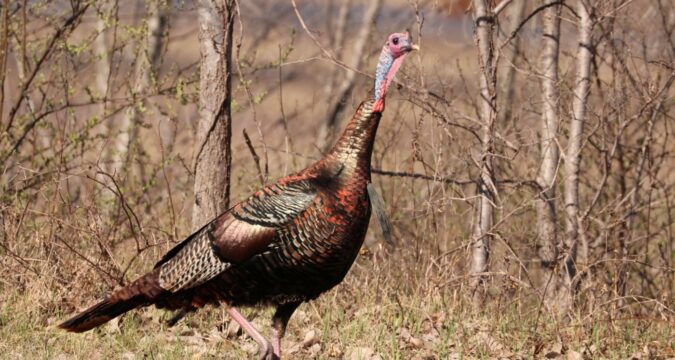
For Lake County residents living near forest preserves or other natural spaces, chances are they’ve spotted a flock of wild turkeys wandering around.
While they are as American as apple pie and inseparably intertwined with the Thanksgiving holiday, the famous fowls once almost disappeared from the region. Their resurgence, thanks to the Illinois Department of Natural Resources (IDNR), is still lauded decades later as a shining example of native species reintroduction.
As state officials explain, it’s a story of decades of arduous work, multi-state collaboration, rocket-propelled nets and river otters.
Luke Garver, wild turkey project manager for the IDNR, explained the history of the turkey reintroduction program.
Leading up to the 20th century, hundreds of years of habitat loss to agriculture and unregulated hunting decimated turkey populations in the region. Illinois’ turkey population was completely killed off, a type of local extinction known as “extirpation.”
“People had the idea that these natural resources would last forever,” Garver said.
A wild turkey in tall grasses in Illinois. An Illinois Department of Natural Resources official told the story of how rocket-propelled nets and otters helped bring the bird back to the state. (Illinois Department of Natural Resources)
But attitudes shifted in the 20th century, when it became clear there were “no turkeys left in the whole state.”
In the 1950s, the IDNR — then known as the Illinois Department of Conservation — was “hot off the heels” of a successful white-tailed deer reintroduction program, driven in part by one Jack Calhoun, an early forest biologist in Illinois, Garver said.
Attempts at turkey reintroduction began using pen-raised birds that were crosses between wild and domestic breeds. But after they were released into the wild, they proved unsuccessful. The turkeys weren’t fit for survival and didn’t reproduce. The effort was “pretty much a wash,” according to Garver.
Then, in the late 1950s, a new piece of technology was introduced to wildlife restoration that changed the game — the rocket-propelled net.
As the name implies, an explosive charge is put into a small iron rocket, which is attached to a large net and shot over wildlife. Other netting techniques, such as dropping it from above on unsuspecting birds, are just not as effective with the Eastern subspecies of turkey, Garver said, which are especially careful birds.
“Turkeys are a very wary animal,” he said.
It was a reliable way to capture wild birds, Garver said, which could then be moved from areas where populations were abundant to areas where they were nonexistent, like Illinois.
In 1959, Illinois set up an agreement with several other states in the region — Arkansas, Mississippi and West Virginia — to take their wild turkey populations and reintroduce them to Illinois.
However, the federal Lacey Act made it illegal to buy and sell wild animals, Garver said, and a workaround was needed. At the time, while Illinois needed turkeys, it had plenty of river otters, something the other states needed.
“We were flush with river otters,” he said. “Those states were looking to do a restoration of river otters. They said, ‘Hey, let’s trade.’”
Both the explosion-powered nets and native animal trades, while common back then, are less utilised today, Garver said, because of various safety and red-tape restrictions. Nets are now air-launched, he noted.
“It’s not quite as fast or as powerful as a rocket-propelled net, but we don’t have to handle explosives,” he said. “We’re relying on graduate students and technicians who are young people. If we can keep them out of harm’s way, we try to do that.”
Illinois’ reintroduction efforts began in the southern portion of the state, which had the regions of mature timber once believed to be necessary for turkey populations. But a later study has revealed they thrive in areas with a mix of open land and woodland, Garver said, which can be found throughout the state.
Efforts continued throughout the ’60s and ’70s, and for Northern Illinois in the early 1990s and 2000s. Today, turkeys can be found across the state and broader region once again, and Garver said he looks back on the program as part of the IDNR’s “golden era.”
“It was really successful,” he said. “It’s pretty remarkable how well these birds do when they’re given good habitat.”
John Burk, district biologist for the National Wild Turkey Federation, called it “one of the greatest wildlife management success stories in modern times.”
Turkey populations can vary over the years due to various factors, and both Garver and Burk said native populations often skyrocket after reintroduction before levelling out. But, generally, Illinois’ numbers are good, and Garver said he hopes they’ve approached an equilibrium.
Garver couldn’t give exact turkey numbers for Illinois, but said officials keep an eye on population trends through yearly public surveys — where residents are asked to report any turkey sightings during the summer months — as well as through hunting statistics.
Hunters are the “heroes of conservation,” Burk argued, helping fund conservation efforts through hunting licenses and taxes. An avid outdoorsman himself, he encouraged people to enjoy what he called one of his favorite wildlife species, whether by taking photos or hunting.
Looking at a map of release sites between 1959 and 2002, Garver expressed admiration at the amount of “hard and arduous work” the reintroduction required. With the IDNR marking 100 years in 2025, he reflected on its work today, balancing both the protection of natural resources like wild animals with the “social side,” ensuring that the general public can enjoy those resources, such as through hunting.
“I like to think if I could have a conversation with our predecessors a hundred years ago, they’d be proud of us,” Garver said.
https://www.chicagotribune.com/2025/11/25/turkeys-returned-to-illinois/


