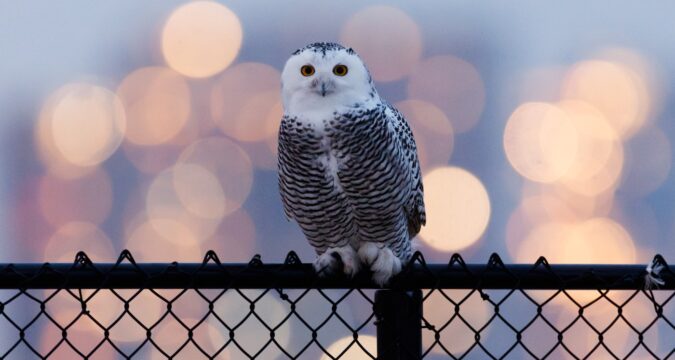
Over the weekend, hundreds of curious Chicagoans ventured to Lake Michigan beachfronts to witness a birding marvel: the early arrival of snowy owls.
Two snowy owls have been spotted at Montrose Point Bird Sanctuary and a third briefly at Rainbow Beach, according to the Chicago Ornithological Society.
These are earlier than usual in the season, said Edward Warden, president of the Chicago Ornithological Society.
The Arctic bird typically arrives in Chicago mid- to late December, Warden said. An unusually early arrival may signal an “irruption year,” a migratory boom when large numbers of snowy owls migrate south during the winter months.
“A lot of people are certainly speculating if this is going to be a big year or not based on how early (the snowy owls) are here,” Warden said.
But predicting an irruption year can be difficult, said Warden. The phenomenon can be caused by many ecological factors, including a successful breeding season in the Arctic tundra.
“(Irruptions) are one of those sort of mysteries of science we’re still trying to untangle,” Warden said. “It’s pretty much a case of, you know it when you’re in it.”
The last migratory boom of snowy owls in Chicago happened in winter 2017-2018, Warden recalled.
“That was a year where you could basically trip over snowy owls, they were so common,” he said. “People have been chasing that high ever since then. And so there’s a lot of questions about whether or not this is going to be a similar year.”
During the last irruption year, Chicago birder Tamima Itani witnessed a snowy owl for the first time at Montrose Beach.
“I was there for the entire day, and people kept coming and photographing it, and I kept thinking, ‘oh, my god, this is the most photographed owl in the world,” she said.
Itani, who is now a lead piping plover monitor at Montrose and bird conservationist, said the same effect is happening again this year, with onlookers flooding the birding sanctuary to see the Arctic birds.
She said the fact that there’s two snowy owls at Montrose this year also makes the sighting unusual. Snowy owls are a nomadic bird species, so seeing a pair together outside their breeding season is uncommon.
A snowy owl lands near Montrose Beach on Nov. 24, 2025, in Chicago. (Armando L. Sanchez/Chicago Tribune)
Chicago native and lifelong birder Maggie Warren has been frequenting Montrose since last week when she saw a posting about the snowy owls on a birding chat forum. Having never seen a snowy owl, Warren ran to Montrose and has been coming daily to observe the pair.
“Snowy owls are so magical,” Warren said. “It’s so much a part of the zeitgeist when you’re like, ‘I’m going to be a birder and I’m going to see a snowy owl.’ It’s such a quintessential type of bird.”
But with the snowy owl excitement drawing large numbers to Montrose, Itani is concerned by the effect crowds are having on the birds’ habitat and safety.
Related Articles
With expectations for snowy owl visits and breeding season for native birds ramping up, drone chase highlights dangers to owls
It’s snowy owl season, and there have been hundreds of sightings in Illinois — but it may take a little luck to spot one in Chicago
Snowy owl sightings on the rise — especially along Great Lakes shorelines: ‘It’s the stuff of mythology’
“These birds have traveled a long distance and are in a foreign environment to them,” Itani said. “Concrete, steel, glass, lots of people, that’s not something that they’re familiar with.”
Initially, the owls were staying at the protected beach, but due to the high volume of people and dogs, Itani said the owls have since moved out to the pier at Montrose.
“A lot of people may not understand that these birds need to rest and need to be able to be in a safe environment,” Itani said.
Itani’s also concerned about two peregrine falcons in the area that have been a threat to the snowy owls. She said crowd control is vital to ensuring these snowy owls can focus on their avian threats instead of humans and dogs.
As of Monday afternoon, the Chicago Park District had closed off a small section of the Montrose pier near the owls’ perch to guarantee a safe distance from humans. The Park District advised Chicagoans to stay at least 300 feet from the owls.
A snowy owl sits next to Lake Michigan near Montrose Beach on Nov. 24, 2025, in Chicago. (Armando L. Sanchez/Chicago Tribune)
Itani agreed that this early visit could be a sign of an irruption year for snowy owls, as well as for other bird species that are generally only seen every three to four years. These include the common redpolls, evening grosbeaks and pine siskins.
“From a birding standpoint, this is all very exciting, but we always like to make sure that the birds that come and visit us and stay in our midst are also safe,” Itani said.
With the rise in popularity of birding, more people will be coming out to witness birds such as the snowy owl. As of a 2024 U.S. Fish and Wildlife Service report, nearly 1 of every 3 U.S. adults engages in birding as a pastime.
But Warden said that unlike other bird species, snowy owls attract interest beyond just birding enthusiasts.
“Owls definitely transcend the birding community lines every year,” Warden said. “It doesn’t matter whether you were a birder or just a regular person, when snowy owls show up, people get super excited.”
Warden said it’s hard to predict where they’ll go next.
“Snowy owls are basically wanderers by nature, that’s what they do,” Warden said. “It’s very much wherever the wind takes them.”
Christiana Freitag is a freelancer.
https://www.chicagotribune.com/2025/11/25/snowy-owls-chicago-irruption/


