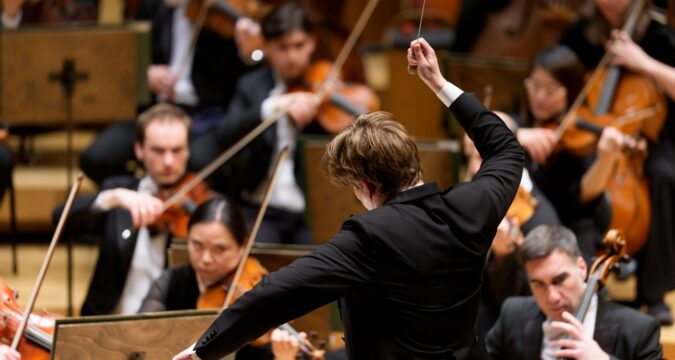
When Klaus Mäkelä formally succeeds music director emeritus Riccardo Muti at the Chicago Symphony next season, he’ll arrive here from Paris — the Orchestre de Paris, to be exact, which he leads through 2027.
Poetically, his CSO program this week brings together not just Stravinsky’s “The Rite of Spring” — which premiered in Paris and which Mäkelä has recorded and extensively toured with that orchestra — but music by Parisians who themselves looked lovingly towards the Americas. French composer Darius Milhaud cribbed Brazilian tunes in his sparkling “Le boeuf sur le Toit,” written to accompany the hijinks of a Charlie Chaplin silent film, and our own George Gershwin wrote “An American in Paris” after his jaunts through, and homesickness in, the City of Light.
Mäkelä and the CSO just returned from their own travels together, touring major halls on the East Coast. (That included Carnegie Hall in New York, right as the city was nearly shut down by a blizzard.) None of those concerts — ambitious in their own right, and derived from Mäkelä’s appearances with the orchestra so far this year — overlapped with Thursday’s complex, rhythm-driven program.
A daunting prospect for the orchestra? Certainly. But in a testament to their still-young relationship, the Mäkelä-CSO unit betrayed none of that difficulty — and, indeed, conquered it, with mold-shattering accounts of two repertoire standards.
For the first time, the CSO performed a new critical edition of “An American in Paris” by Mark Clague, a University of Michigan musicologist with a Chicago pedigree. Most notably, his version reverts the percussion’s taxi horns to the quirkier pitches Gershwin is thought to have intended. (There’s still another Chicago connection: Clague sleuthed this out thanks to a photograph of Gershwin and a Cincinnati Symphony musician posing with the horns. That musician is the father of recently retired CSO percussionist Jim Ross, who returned to Orchestra Hall as a guest musician for this concert.) Other instrumentation tweaks give the saxophone trio doublings and cut down on percussion writing, making some of the work’s climaxes leaner and more transparent.
I count myself among the believers in Clague’s edition. With Gershwin’s posthumous alterations stripped away, the sophistication and compositional audacity in “An American in Paris” get top billing, not the show-stopping bombast.
This was Mäkelä’s first outing on an American cornerstone with his new American orchestra. But the Finn-in-Paris conducted like he knew the score’s soul. Thursday’s performance had the wide-eyed rapture and insatiable hunger of someone trying to squeeze out twice as much life in half the time.
Mäkelä took much of the piece at a quick clip. But his slow tempos are just as thrilling as his fast ones. The score’s languid moments had the sweet ache and timeless drift only nostalgia can bring: the Ravel-like mist which envelops Scott Hostetler’s English horn, or Esteban Batallán’s yearning, hat-muted trumpet, over a stretchy saxophone accompaniment.
That’s not to say these bustling Parisian streets didn’t have some fender benders. Concertmaster Robert Chen’s intonation flailed in some solos, and percussionist Cynthia Yeh seemed to wrestle with the reimagined taxi horns on Thursday, whether due to Mäkelä’s brisk tempo or stiffer, less responsive new instruments. Still, this performance was gusty enough to snuff out those flaws and sweep you off your feet, as Mäkelä and the CSO do at their very best.
More of that “very best” followed, with Stravinsky’s “Rite.” The riot the ballet incited at its 1913 premiere is securely the stuff of music legend. The great irony, of course, is that “The Rite of Spring” is now an assured box-office hit — a far cry from its chaotic first outing in Paris.
But if a “Rite” can still shock and terrify in 2026, it’s this one. Principal bassoonist Keith Buncke’s opening solo let its first note hang longer than usual, unraveling time when it had scarcely just begun. The awakening woodwinds were startlingly, brazenly clear, as though Mäkelä had upped the saturation of each instrumental layer. Later, that intensity whetted into a feral point, the orchestra’s cry at once monstrous and multitudinous.
Stravinsky’s score became a means of expression, not its final word — the shape of the scream, the blueprint for our terror. And this “Rite” was not afraid to be ugly. In a stomach-churning effect at the beginning of the second half, the orchestra’s descending lines seemed to ooze out of the ensemble, like congealed blood.
The ending bars alone were enough to shock into stunned silence. Woodwinds shimmy up their range, a gesture Mäkelä ended on Thursday with a pinch. Then, with a gaping, stomach-dropping yowl, the “Rite” plummeted to an end. I left rattled and out of breath, as though the hall itself had caved into the Earth and I’d crawled from the wreckage.
“Le boeuf sur le Toit,” on the other hand, flirted with danger but also frequently surrendered to it. The piece’s vivacity cloaks its astonishing virtuosity — Milhaud wheels through all twelve major keys and most of the minor ones — and Mäkelä made an engrossing journey of what could otherwise be an episodic romp. But the same push-and-pull tempos that made it so sometimes eluded the orchestra, with some roughshod playing throughout.
Going from nail-biting to revelation in a single concert is quite the roller coaster, but it’s one Mäkelä rides often. On the other hand, high risk means high reward, and the freedom Mäkelä inspires on the podium is paying off in other ways. Where Muti’s CSO sounded burnished and reverent but often earth-bound, the ensemble sound is becoming gutsier, impassioned and, best of all, freshly inventive. An about-face that dramatic no doubt requires growing pains, so long as they’re just that: temporary.
Chicago Symphony’s next season: More Mäkelä, less new music and a bunch of Beethoven
In the meantime, Mäkelä continues to deliver on other pillars of the job. He recently tenured Tim Higgins, making the new principal trombonist his first end-to-end hire as music director designate, and has made other to-be-announced hires — including bass clarinetist Pavel Vinnitsky, a longtime orchestra sub whose solos across this week’s program are to be treasured. And Mäkelä’s thoughtful, ambitious programs — including a Boulez rarity and William Walton’s choral-orchestral mountain “Belshazzar’s Feast” — are highlights in an otherwise lukewarm 2026-27 season, unveiled earlier this week.
As already announced, Mäkelä will make his Ravinia debut this summer. Until then, it’s farewell for now, the promise of music to come echoing in his wake.
Program repeats 7:30 p.m. Friday; cso.org
Hannah Edgar is a freelance critic.
https://www.chicagotribune.com/2026/03/06/review-cso-makela-rite-spring/


