I spent decades covering Chicago’s “wars” — political ones at City Hall and the aftermath of gang violence on the city’s streets.
So when the news broke on Sunday morning that a joint Mexican-U.S. operation killed a major cartel boss, Nemesio Rubén Oseguera Cervantes, nicknamed “El Mencho,” not too far from our retirement enclave in Mexico, I didn’t reach for the smelling salts. I reached for perspective.
Mexico is a vibrant, colorful, complicated, wounded and resilient nation of 130 million people. It’s not a Netflix crime series. It’s not a State Department warning label. And it’s certainly not defined solely by the depravity of drug cartel men with rifles and armored SUVs.
Yes — the cartels are real. Their brutality is real. The recent killing that reverberated through parts of Jalisco, the state we winter in, is real. Violence tied to the notorious Jalisco New Generation Cartel is not something to shrug off.
When gunfire erupts and a public figure, police officer or journalist is targeted, the shock waves are felt not just locally but also internationally. Markets turn tremble. Travel plans are reconsidered. Cable news panels light up.
But here’s what I’ve learned after decades in journalism: Reacting is easy. Understanding is hard.
We’ve spent the last three winters in a safe, tranquil expat retirement community on Lake Chapala, 30 minutes south of Guadalajara, a reputed cartel stronghold that feels light-years away.
I wrote about the allure of our retirement community in a Tribune op-ed last year, blissfully unaware of the possible fallout after the killing of a major cartel boss.
So last Sunday, when the news broke, businesses started shutting their doors, and warnings went out to shelter in place, which was smart because the anticipated cartel reaction included bus, car and business torchings only a few miles away.
We hunkered down on Sunday and Monday, and early Tuesday, local government officials announced that after meetings with business leaders, the lockdown would be ending with a return to business as usual.
It almost felt scripted, but that’s another story for another day.
Our experience, coincidentally, was eerily similar to our youngest daughter’s two years ago when the arrest of drug kingpin Joaquín “El Chapo” Guzmán’s son, Ovidio Guzman Lopez, a few miles from their Mazatlan hotel sparked several days of retaliatory backlash that shut down the airport, businesses, bus service and local activities until an all-clear was declared five days later.
In both cases, we all hunkered down, stayed in touch with worried family and friends back home, and waited for the volatility to subside.
Chicagoans like us know something about living alongside violence without surrendering our civic identity. For years, national media caricatured our city as a war zone. They tallied homicides like baseball scores and ignored the neighborhoods, businesses, schools and cultural institutions that functioned every day despite the periodic nearby violence.
They never mentioned our lakefront at sunrise or the bustle of Pilsen and Bronzeville. They reduced a world-class city to a crime blotter.
Mexico gets the same treatment.
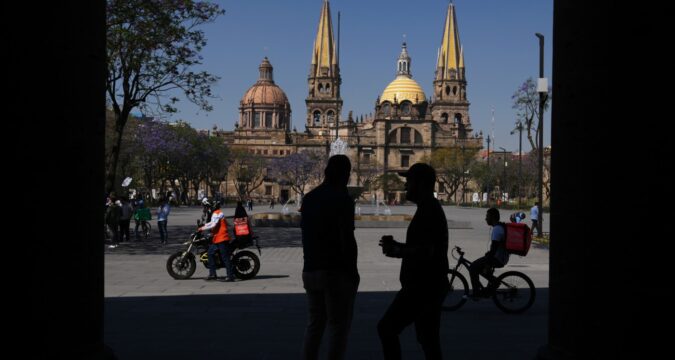
Turn on certain cable channels in the U.S., and you’d think all of Mexico is a lawless wasteland. But walk the streets of Chapala or Ajijic or our town, San Antonio Tlayacapan, on a Sunday afternoon, and you see something very different: families, entrepreneurs, retirees, artists and students, people eating, drinking, shopping and living their lives.
The bilateral relationship between the United States and Mexico is not incidental — it’s foundational. Our economies are braided together through the United States-Mexico-Canada Agreement. Supply chains run north and south every hour of every day. Chicago’s own commercial vitality depends in part on what moves through Mexican ports, factories and farms.
President Donald Trump’s tariffs and threats rattle the foundation, but the walls are strong.
And when violence flares, it’s not just Mexico’s problem. It’s ours. That doesn’t mean minimizing the danger. It means refusing to flatten a nation into a stereotype. Cartel power flourishes where corruption, poverty and demand intersect.
And let’s be honest: America’s appetite for drugs and American guns flowing south are part of that toxic equation. We are not innocent bystanders watching chaos from a safe distance. We are participants in a shared struggle.
What strikes me most, though, is the resilience of ordinary Mexicans. After an assassination or a burst of violence, there is fear, yes. But there is also a stubborn insistence on normalcy.
Shops reopen. Schools resume. Neighbors gather. It reminds me of Chicagoans after a horrific shooting or a brazen act of public corruption. We grumble, we mourn, we demand accountability — and then we carry on.
That’s not denial. It’s survival.
As a reporter and good government watchdog, I’ve always believed that sunlight is the best disinfectant. Mexico’s press corps operates under risks that would chill most American journalists, yet they continue to report, to expose, to question. That courage deserves acknowledgment.
So how do I feel about Mexico in the wake of nearby cartel violence?
Concerned, certainly. No one should be blasé about targeted killings or criminal organizations flexing their muscle. But I also feel admiration for a culture that predates our own republic, for communities that refuse to be defined by criminals and for a bilateral partnership that endures despite political theatrics on both sides of the border.
The easy narrative is fear. The responsible one is complexity.
If Chicago has taught me anything, it’s this: A place is never just its worst headlines. Mexico, like my hometown, is more than the violence that periodically scars it.
And it deserves to be seen and covered that way.
So the towns along Lake Chapala, where most winter days are sunny, dry and warm, have regained their mojo, and we’re back to living “la vida buena” — the good life — after a brief interruption that affects people and life everywhere without, in our case at least, precipitating a second thought about where and how to live out the winters of our retirement years.
Andy Shaw is a semi-retired Chicago journalist and good government watchdog who winters in Mexico.
Submit a letter, of no more than 400 words, to the editor here or email letters@chicagotribune.com.
https://www.chicagotribune.com/2026/02/27/opinion-mexico-el-mencho-violence-chicago/


