
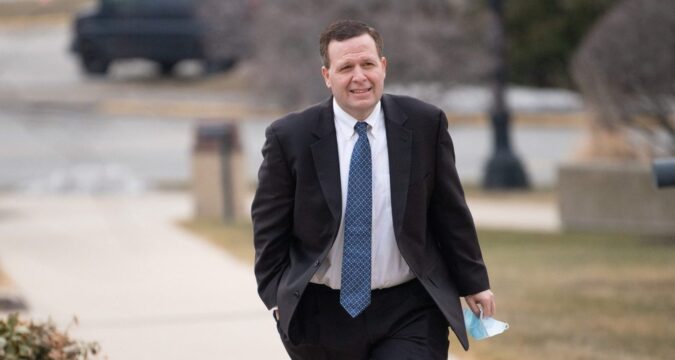
An Indiana state bill addressing gratuities that was drafted in response to the bribery case against former Portage Mayor James Snyder was amended and approved in the Senate to remove all language pertaining to gratuities.
The bill’s author — State Rep. Hal Slager, R-Schererville — said he will work in the final days of session to undo the amendment.
As filed, House Bill 1065 would have made it a Class A misdemeanor for a person to offer a payment to a public servant as a reward for an official act taken by the public servant or a public servant to solicit or accept a payment as a reward for performing an official act.
The bill also initially increased the penalty to a Level 6 felony if the fair market value of the reward is at least $750. The bill exempts a good or service that is subject to a reporting requirement or otherwise allowed under an applicable rule or code of ethics. It further exempts plaques, trophies, framed photos, lawful political contributions and wages.
Slager previously said he filed the bill to prevent the acceptance of a gratuity after Snyder was indicted and convicted of accepting a bribe.
“It’s not a good idea, under any circumstances, for a public official to accept a gratuity for doing their job,” Slager previously told the Post-Tribune. “We want to put an end to that … because we didn’t have that in our code.”
The House Courts and Criminal Code Committee amended the bill to include language from House Bill 1141, which would make commingling of a committee with personal funds up to $50,000 a class A misdemeanor.
When the bill was heard on second reading in the Senate on Monday, State Sen. Aaron Freeman, R-Indianapolis, proposed an amendment to remove all portions of the bill that pertain to gratuity, which means the bill only contains the language about commingling of a committee with personal funds.
A spokesman for Freeman did not respond to requests about why the bill was amended.
The bill passed the Senate on Tuesday, 47-1, with State Sen. Jean Leising, R-Oldenburg, voting against the bill. A spokesman for Leising said she voted against the bill “because someone had told her the bill was not legally well put together.”
Slager said Wednesday he filed a dissent motion against the way the bill was amended. But, Slager expressed surprise that Freeman, the chair of the Senate committee that the bill passed out of unanimously, removed the gratuity language.
“I’ve not had a chance to talk with him, but reports suggest some misunderstanding,” Slager said.
The bill passed the House in a 85-0 vote Feb. 2. The bill will be returned to the House for consideration because it was amended in the Senate.
A jury in U.S. District Court in Hammond found Snyder not guilty on the bribery charge involving a towing contract, and convicted him in two separate trials on a garbage truck bribery charge, a case that made its way to the U.S. Supreme Court. In June 2024, the justices ruled that the $13,000 payment Snyder received over a garbage truck contract was a gratuity, not a bribe, because the payment came after the contract and not before. The case was remanded to the lower courts.
Snyder’s conviction on the tax charge, which involved his personal business and not his duties as mayor at the time, remains unchallenged, and Snyder is scheduled to be sentenced on March 10 in Hammond’s U.S. District Courthouse, nearly a decade after he was originally indicted.
Snyder’s case was heard by the U.S. Supreme Court, which ruled that Indiana didn’t have a law against gratuity, so the court ruled in Snyder’s favor, Slager said.
“Everything pointed to the fact that, in fact, the giving of the gratuity was done so after the official act, not before, and that there was no evidence to suggest there was any arrangement in advance to participate that way,” Slager previously said.


