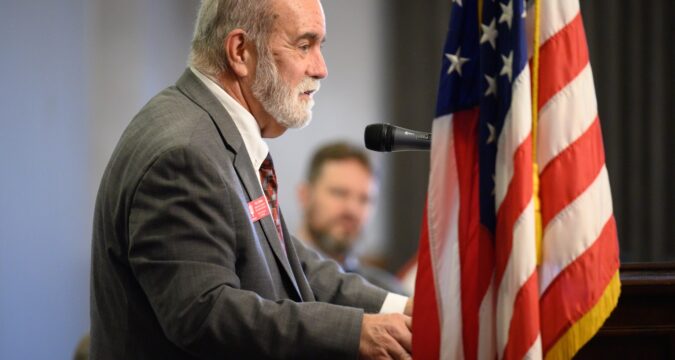
Northwest Indiana’s economy is thriving and its future looks bright, said Anthony Sindone, Visiting Clinical Associate Professor of Economic Development at IU Northwest.
When asked to give a letter grade, Sindone even gave next year’s economy an A-.
Ryan Brewer, Division Head and Associate Professor of Finance, IU Columbus, speaks during a Futurecast 2026 economic outlook event in Merrillville on Friday, Nov. 21, 2025. (Kyle Telechan/for the Post-Tribune)
“I’m an optimist. Instead of seeing the glass half full, I see the glass 60 percent full,” Sindone said.
Sindone spoke on a panel with three other economists at the Lake County Advancement Committee and Legacy Foundation’s annual economic outlook luncheon Friday in Hobart as part of Futurecast 2026.
Indiana University has presented economic forecasts around the state since 1972, normally making a stop in Northwest Indiana. The Futurecast is based on research from the Indiana Business Research Center.
Other speakers on the panel included Ryan Brewer, division head and associate professor of finance, Indiana University, Indianapolis-Columbus; Carol Rogers, Director of the Indiana Business Research Center, Kelley School of Business, Indiana University; and Timothy Slaper, research director at Indiana Business Research Center, Kelley School of Business, Indiana University. Micah Pollak, an Associate Dean and an Associate Professor of Economics at IUN, was the moderator
Carol Rogers, Director of the Indiana Business Research Center at the Kelley School of Business, speaks during a Futurecast 2026 economic outlook event in Merrillville on Friday, Nov. 21, 2025. (Kyle Telechan/for the Post-Tribune)
Since the downturn during the COVID pandemic, the GRP — or gross regional product — in Northwest Indiana between 2020 and 2023 has continued to grow approximately 37.6 percent. Per capita, the GRP grew by more than 37 percent over the same period.
“We’re doing better than the rest of the country,” Sindone said.
His forecast for the next five years — 2026-2030 — predicts GRP to grow by 2-3 percent annually, Sindone said, which will driven by transportation, logistics and advanced manufacturing.
In addition, employment growth will likely settle near 0.5-1 percent per year, with labor shortages expected in construction and healthcare.
Audience members applaud between panelists during a Futurecast 2026 economic outlook event in Merrillville on Friday, Nov. 21, 2025. (Kyle Telechan/for the Post-Tribune)
Household income will continue to rise slowly, supported by manufacturing wages and regional migration from Illinois.
Housing inventory will continue to grow if interest rates continue to ease after 2026; while affordability remains both a comparative advantage and a concern, he said.
So far in 2025, Northwest Indiana’s selling prices for houses averaged $295,765, with the median sale price at $260,000.
“Over the next five years, we project price growth to stabilize to approximately 3-4 percent annually,” he said.
Indiana Business Research Center research director Timothy Slaper speaks during a Futurecast 2026 economic outlook event in Merrillville on Friday, Nov. 21, 2025. (Kyle Telechan/for the Post-Tribune)
Sindone admitted that his predictions were incorrect in a previous housing study he did on the Northwest Indiana market.
In his previous study, he calculated only 32 percent of the people could afford the median cost of a house.
“I think I might be wrong when I did the study because I didn’t account for how many people own homes now. Sixty-five percent of people own or are buying their own home,” he said.
A majority of younger people, just getting out of college or school, can’t afford a house right away as has been the case even in previous generations, Sindone said.
“Do we have a housing shortage or do people want to buy a house and can’t because the price is too high for new entrants?” he said.
He added: “I was wrong in saying there was a shortage of houses. Perhaps we should consider having some patience,” he said.
Rogers, who grew up in the Chicago area, spoke of her love for the Northwest Indiana and greater Chicagoland.
“Lake Michigan is my home,” Rogers said.
Rogers termed the population in the middle, those 25-44, who are in a prime work age, with increased pressure to become consumers.
“We have a fascinating trend when people are living longer and the Baby Boomers aren’t giving up their houses, so the pressure is on developers to build more houses. Sometimes you feel you’re in a vortex,” she said.
Rogers questioned President Donald Trump’s recent proposal of 50-year mortgages.
“Most would be waiting to buy their houses in their 40s and they’d be 90 when they paid off their mortgages,” she said.
Rogers said unemployment rates have remained at around 4 percent, a figure she doesn’t see budging.
“Unemployment rates will remain relatively low. Really low is not good. Bumping closer to 5 percent is not bad. You want to have more than 0 percent applicants,” she said.
She said that when it comes to the economy, we are all Hoosiers, and experts are monitoring the economy daily whether it be when buying gasoline, going to the dentist or going to a hair stylist.
“We are all of us microcosms of the economy,” she said.
Slaper, who addressed the United States/International Outlook, said he has received a lot of questions about the impact of AI or artificial intelligence and data centers on the economy.
He referenced the Amazon AI data center opening in New Carlisle, Indiana.
“The price for the Amazon data center was $11 billion. That’s a chunk of change,” he said.
He said that AI will likely eliminate some jobs or put others at risk.
“Those in one field will have to migrate to other occupations,” he said.
AI or artificial intelligence will likely increase the income gap between the super wealthy, the middle class and those in the lower class.
At the end, Slaper echoed he wanted to provide good news and echo Sindone: “the U.S. economy is doing pretty well.”
Deborah Laverty is a freelance reporter for the Post-Tribune.
https://www.chicagotribune.com/2025/11/24/economic-experts-bullish-on-nwis-future/


