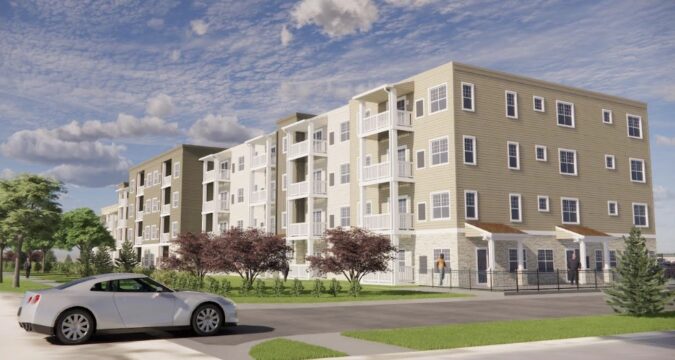
An affordable housing development in Batavia is continuing to move forward, securing additional approvals recently from the Batavia City Council.
Called the Residences at River Pointe, the proposal for the subsidized multi-family housing project is being brought forward by Fox River Affordable Housing, a nonprofit development entity of the Housing Authority of Elgin.
It’s set to be built at 400 S. River St., which the city of Batavia says is a former limestone quarry site.
The proposed development would include 72 units in total. Of those, 18 would be set aside for households earning at or below 30% of the area median income, or AMI. In addition, 38 units would be set aside for households earning at or below 60% of the area median income, and 16 for those earning at or below 80% of the AMI.
The project got its first green light from the council back in May, when the City Council promised to fund $1.2 million in land acquisition and engineering costs for the project using the city’s TIF, or tax increment financing, reserves. The total cost of the project is expected to be just over $24 million.
The TIF money that the developers plan to use is also to be paid back to the city, in a way. The city’s approval was conditional on the proposal being taxable, city staff said previously, and its proposed location is within the city’s TIF District 3, meaning it would generate TIF funding.
Essentially, a TIF district freezes the amount of property tax revenue each taxing body receives from an area at the point at which the TIF is instituted. The extra or “increment” taxes created by the development of the property go into a special fund used to pay for costs related to improving the area.
That promise of financial support from the city last year was part of the developer’s application for the Illinois Housing Development Authority’s Low Income Housing Tax Credit, which is expected to provide the project with a considerable portion of its total funding.
The Low Income Housing Tax Credit is a dollar-for-dollar federal tax credit, according to IHDA’s website, that helps move affordable housing projects forward. The maximum rent that can be charged on a property that receives this tax credit is 80% of the AMI — which is why there are no market-rate units in the proposed development. Rents are typically capped for a 30-year period in Illinois.
The project has since secured a commitment for tax credits by IHDA, the Housing Authority of Elgin’s Executive Director and Chief Executive Officer Martell Armstrong told The Beacon-News on Thursday. The tax credits are expected to be awarded after construction of the development has been completed and once the building is in service and has achieved its threshold occupancy goals.
The city held public hearings on Jan. 21 about the property, per city documents, and additional measures related to the development then came forward to the council for approval.
Fox River Affordable Housing Corporation has been developing throughout Kane County for years, Armstrong said at the city’s Feb. 10 Committee of the Whole meeting. This will be its second self-developed project, in addition to several co-developed ones.
The plan is for a four-story building with 72 units in total: 52 one-bedroom units, 17 two-bedroom units and three three-bedroom units, said Jon Ditter from Jon Steven Ditter Architect at the meeting.
The property is bordered by parks along the Fox River to the west, an industrial area to the south and single-family housing to the north and east, Ditter said.
He noted that some elements of the proposed development have been redesigned in light of feedback from the city’s Plan Commission, like making the color scheme more earthy in tone to fit in with the surrounding area. He said the building is set to have a patio and green space with a dog park, playground area and sport court.
At the Committee of the Whole meeting, council members asked some questions about the design, in particular the entrances for the building, requesting that there be an enhanced west-facing entrance and sidewalk access to River Street.
They also discussed other aspects of the project, like who would be the future tenants of the building.
Ald. Jim Fahrenbach, citing a lack of rental complexes in Batavia, noted previous mentions of the building offering preference for Batavia residents or employees of local businesses, and expressed his support for that.
Armstrong indicated that the Illinois Housing Development Authority allows for local preferences, and said that the developers plan to allow for that in the rental plan as much as possible.
In response to a question about the number of residents and potential of additional students to the school district, Armstrong noted that the majority are one-bedrooms and that that would limit the number of students. One-bedrooms typically hold up to two residents per unit, two bedrooms up to four residents and three bedrooms up to six people, he said.
And Ald. Kevin Malone said he shares “some skepticism on TIF funds” but thinks this is an “appropriate use” of them, and said that he wants the project to succeed.
The mayor was also supportive.
“There’s a lot of people who want to live in Batavia, already may be living here, but they want something like this,” Mayor Jeff Schielke said, pointing to the success of and demand for spots in the city’s Riverain Point Apartments, an apartment complex for seniors and those who are disabled.
Then, at the Feb. 16 City Council meeting, the city again addressed the project, and ultimately approved unanimously several measures related to it: one changing the property’s land use designation from industrial to residential, another changing the city’s zoning map to reclassify the property as multi-family residential housing and a third approving the preliminary/final plat for the development.
City documents included in the meeting agenda indicate that the project’s architect has revised plans to incorporate an updated entryway at both entrances along River Street and a sidewalk connection from the building to River Street. The plans also indicate that there will be bench seating at the entrances.
At the meeting, Malone said he was supportive of the updates to the building’s planned exterior, but hopes that the interior “can be equally welcoming.” And Ald. Alice Lohman was supportive of the benches that are part of the designs, inquiring about adding trees to offer shade for people who want to sit there.
And Ald. Alan Wolff reiterated his view as to what this project will add to Batavia.
“This is something that we desperately need in town and in this area,” Wolff said.
According to a 2023 statewide report from the Illinois Housing Development Authority on the Affordable Housing Planning and Appeal Act, Batavia’s share of affordable housing — defined as being within the means of homebuyers making 80% of the regional median household income or renters making 60% of the regional median household income, per the authority — was at 23.5%. That’s well above the 10% threshold that requires communities with low levels of affordable housing to submit a plan to the state as to how they’ll build out a diverse housing supply. In Kane County, for example, Campton Hills, Lily Lake and Geneva all fell below 10%, according to the report.
But the percentage of affordable housing stock in Batavia is still significantly lower than some of its surrounding cities, like Aurora and Elgin, whose affordable housing stock is each over 50%, according to the 2023 report.
Armstrong also spoke to the value he sees the project adding to Batavia in an email to The Beacon-News, saying he hopes the development will provide “an affordable alternative to the rent inflated, market driven dynamics for area residents that have been burdened by housing costs and have otherwise been locked out of opportunities of decent housing options to start their professional careers or to stabilize their respective households.”
But, though the approvals on Feb. 16 mark the latest step in the development’s coming to fruition, there are still more steps to come.
Armstrong said that the developer will be continuing to work with the city to obtain the permits it needs to move forward, and is continuing to finalize aspects of the site engineering, construction drawings and cost estimates. They also need to obtain state and local regulatory approvals, including an environmental review and a subsidy layering review, he said.
And, because the city intends to provide financial support for the project, there will be a redevelopment agreement coming to the City Council for approval in the future, City Administrator Laura Newman has said.
Armstrong said they are aiming to begin construction by July.
mmorrow@chicagotribune.com


