The NFL scouting combine is five days away, the next big event on the offseason roster-building calendar.
While the Chicago Bears brass will be getting a look at the top college prospects, the team also will be weighing that potential against possible veteran acquisitions on the free-agent and trade markets. Brad Biggs’ weekly Bears mailbag begins with questions about two such possibilities.
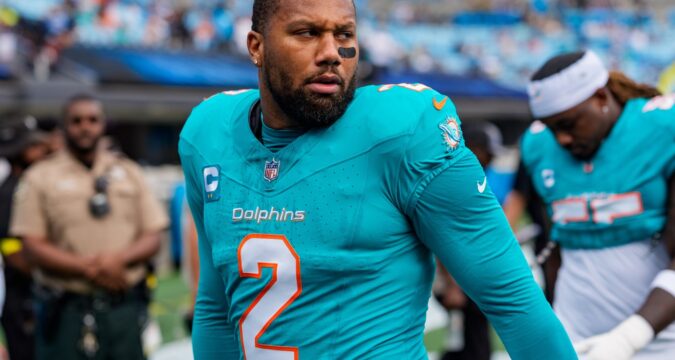
With Bradley Chubb being released, is he worth a serious look in your opinion? — @jm_455999
The Miami Dolphins got busy Monday with a handful of moves. They reportedly will release Chubb, and they announced wide receivers Tyreek Hill and Nick Westbrook-Ikhine and guard James Daniels, a former Bears second-round pick, are being released.
Chubb, the No. 5 pick in the 2018 draft by the Denver Broncos, was rumored to be available before the trade deadline last season, but Miami obviously didn’t get an offer it was willing to accept. He turns 30 in June, and the two-time Pro Bowl selection had 8½ sacks and 20 quarterback hits in 17 games in 2025.
Chicago Bears are raising season ticket prices by an average of 13.5% for 2026
Durability is one question mark for Chubb, who missed the entire 2024 season with a torn ACL and missed 12 games in 2019 with an ACL injury. He had 11 sacks in 16 games in 2023, so he totaled 19½ over his last two full seasons.
At 6-foot-4, 268 pounds, Chubb has the size to play defensive end in Dennis Allen’s scheme, but I view him as a complementary pass rusher at this point. Parting with Chubb, who was slated to earn $20.23 million this season, means the Dolphins couldn’t find a trade partner at that dollar amount.
In eight years in the league, including 2024, Chubb has been durable in only five seasons. He also was limited to seven games in 2021 because of ankle injuries. Maybe the Bears will poke around a little on Chubb, but I have to believe they think they can get 8½ sacks (or more) out of Austin Booker in 2026.
The more edge options there are in general, in both free agency and the draft, the better for the Bears. Yes, they need more juice off the edge. There’s no debating that. My hunch is it’s unlikely Chubb is a top-tier target for them, and they might lean into a good crop of edge defenders in the draft. Once the Dolphins officially terminate Chubb’s contract, he will be free to sign elsewhere and won’t have to wait until the new league year starts March 11.
The price to trade for Maxx Crosby could be so high that it would mean going all in for 2026 but create problems afterward. How do you see that? — @darkseith
For starters, I don’t really look at it that way. When a team has a coach and a quarterback in place that it believes highly in — and the Bears look like they fit those criteria — it should be in position to compete, at least in the conference, every year.
Honestly, it’s my opinion that the term “all in” is often misused. Are there examples of teams doing it? Sure. It can happen when a team has an older quarterback that it wants to gear up for one big, final run. You certainly see front offices that are under pressure to win making aggressive moves in a bid to achieve job security.
But I’m of the mindset that general manager Ryan Poles and coach Ben Johnson are attempting to lay a foundation for success at Halas Hall that will position the Bears to pursue a Lombardi Trophy over a multiple-season window during Caleb Williams’ prime years.
That’s probably not the answer some folks desire, especially those who swing back and forth on every clickbait headline out there. In no way does this preclude Poles from making an aggressive swing at some point — this year or in the near future — but a lot would have to line up and the Bears would have to feel like the foundation is in place.
Raiders defensive end Maxx Crosby chats with a referee during a game against the Broncos on Nov. 24, 2024, in Las Vegas. (L.E. Baskow/Las Vegas Review-Journal/TNS)
If the Las Vegas Raiders trade Crosby, it’s hard to say what the compensation package would need to be. Fox Sports’ Jay Glazer said at the beginning of the month that Crosby is done with the Raiders, and Glazer doesn’t swing and miss very often. Glazer also predicted a trade package would have to exceed what the Dallas Cowboys received from the Green Bay Packers for Micah Parsons: two first-round picks and veteran defensive tackle Kenny Clark.
I’m a little skeptical that Crosby, who will turn 29 in August and has missed seven games over the previous two seasons, would command that much in return. Parsons is 26. In 2018, the Bears traded two first-round picks, a third and a sixth for Khalil Mack, a second and a seventh. Mack was 27.
Could the Bears create cap space to add a player like Crosby? Sure. But it would require a series of uncomfortable decisions and moves. Everyone knows the team’s cap situation is snug right now, and it could be relatively snug again in 2027. The Bears currently have 29 players under contract for 2027 with $277.6 million in cap allocations, the seventh-highest figure in the league.
But peer ahead one more year to 2028, and only 12 players are under contract — nickel cornerback Kyler Gordon is the only one of the bunch not on a rookie deal — with $63.8 million in cap allocations, the second-lowest figure in the league. So the Bears will have plenty of space moving forward, provided they’re wise with resources. That’s why there’s no reason for a doom-and-gloom outlook when it comes to the team’s cap management.
Ultimately, I think Poles will consider all possibilities and likely lean toward keeping his valuable draft capital. For the Bears to have a longer runway when it comes to chasing a Super Bowl, they need more building blocks in terms of draft picks. It’s a mistake to think they can’t be highly competitive in 2026 if they don’t chase the biggest names available. They were one play away from reaching the NFC championship game this past season, and there has to be belief in the building that Williams and a host of other young players will be better and more dynamic in a second season under Johnson.
What to know about the Chicago Bears’ possible move from Soldier Field
Who has the best shot at taking the proverbial “next step” in 2026? — @brooklyncorn
One nice thing for the Bears is that a lot of answers to this question would make sense: tight end Colston Loveland, running back Kyle Monangai, defensive end Austin Booker and wide receivers Luther Burden III, Jahdae Walker and even Rome Odunze. Go ahead and throw in quarterback Caleb Williams, especially in terms of accuracy, and how about interior offensive lineman Luke Newman? The Bears were remarkably healthy at guard and center last season. If that can’t be replicated, they might need to lean on Newman more in Year 2 and they liked what he showed.
It’s unlikely all of the young players experience some big, expected increase in production this coming season, but even if only a handful of them shows that measure of growth, you’re looking at some guys who will be arrow up with expanding ceilings.
Why are fans so delusional in believing that the Bears are set at the running back position? Did they forget how bad this team was on short downs and goal-line runs? — @chitownledez
Bears running back Kyle Monangai (25) celebrates with quarterback Caleb Williams after Monangai made a 15-yard run in the divisional playoff game against the Rams on Jan. 18, 2026, at Soldier Field. (Eileen T. Meslar/Chicago Tribune)
There’s a difference between being “set” and having a backfield that’s more than good enough to execute a productive, efficient rushing offense. The Bears ranked third in the league in rushing and yards per carry last year.
I think recency bias — the divisional playoff loss to the Los Angeles Rams — probably clouds the view a little bit. The offense was not great in the low red zone, ranking tied for 16th in goal-to-go situations at 73.3%. That needs to improve and should with a young quarterback.
In the regular season, here’s how the Bears did running the ball on short downs:
Second-and-1: 10 rushes, eight first downs
Third-and-1: 24 rushes, 18 first downs
Third-and-2: Nine rushes, eight first downs
Fourth-and-1: Five rushes, two first downs
Fourth-and-2: One rush, one first down
And here’s how they did in the postseason:
Second-and-1: None
Third-and-1: Eight rushes, six first downs
Third-and-2: Two rushes, one first down
Fourth-and-1: Two rushes, one first down
When throwing the ball on fourth down in the playoffs, the Bears were 0-for-1 on fourth-and-1 and 1-for-3 on fourth-and-2.
Maybe the offense wasn’t great running the ball on third- and fourth-and-short, but I’d argue the overall numbers were solid. And if Caleb Williams, who is strong, shifty and fast, can be a little better in certain running situations, the numbers would improve a tick. I also think Kyle Monangai, in his second season, probably can improve a little bit in short-yardage situations.
Could Cole Kmet be on the trade block? Heard conflicting stories about him wanting a new start or wanting to stay. — @bears_dubz
Bears offensive coordinator Declan Doyle talks to tight ends Colston Loveland (84) and Cole Kmet (85) before a game against the Packers on Dec. 20, 2025, at Soldier Field. (Brian Cassella/Chicago Tribune)
I haven’t heard anything about Kmet wanting a fresh start elsewhere or anything of that nature. I think the local product is probably happy to remain with the Bears, especially now that they’re coming off a successful season.
Related Articles
Chicago Bears are raising season ticket prices by an average of 13.5% for 2026
What to know about the Chicago Bears’ possible move from Soldier Field
Win or lose, baiting the Chicago Bears could pay off for Portage. Here’s why.
NFL coaching and GM tracker: Ex-Chicago Bears coach John Fox joins Buffalo Bills as senior assistant
NFLPA must stop making ‘team report cards’ public after league wins grievance against players union
Kmet, who turns 27 on March 10, is in the prime of his career, and while he wasn’t as involved in the passing game this past season with the arrival of first-round pick Colston Loveland, that doesn’t mean his abilities have receded at all.
Kmet is signed through 2027. He has a $8.9 million base salary with a $1 million roster bonus (due the fifth day of the league year) and a $100,000 workout bonus for each of the next two seasons. So that’s $20 million total. His cap hit is $11.6 million for each season, and there’s no guaranteed money remaining in the deal.
I think an extension for Kmet would be likelier than the Bears trading him when you consider how significant tight ends are to Ben Johnson’s offense. The Bears could extend Kmet’s contract with a goal of reducing his cap figure for this season, but they also would have to see him being a significant part of the offense in 2028 and maybe 2029. I highly doubt Kmet would agree to an extension simply to reduce his cap hit. He would want that to be a worthwhile move because he likely would have a strong market if he entered free agency a year or even two years from now.
When do you expect the Bears to start making their first cuts and making space via restructures? — @sam_winks
Ryan Poles always has been mindful of doing right by players when he can. Keeping that in mind, my guess is once the Bears have a clear strategy for clearing some cap space, he will make any cuts — after exploring potential trades — sooner rather than later. That could be this week or next.
Linebacker Tremaine Edmunds looms as the likeliest veteran to be released, a move that would create $15 million in cap savings. It’s possible other veterans on smaller contracts could be caught up in a small purge, but that would depend on how much space the Bears want to clear and their plans for how to utilize it.
As far as restructuring contracts to create cap savings, that’s probably on an as-needed basis. The Bears will need to be cap-compliant by the first day of the new league year, March 11.
https://www.chicagotribune.com/2026/02/18/chicago-bears-mailbag-bradley-chubb-maxx-crosby/


