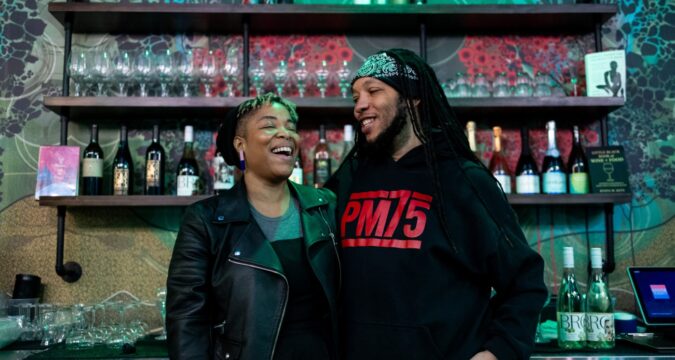
The arrival last October of a wine and charcuterie bar was an unexpected addition to the quiet stretch of low-lying brick storefronts in Park Manor, the historically Black, residential neighborhood of Chicago’s South Side.
But Park Manor 75, founded by Jacare Thomas and Charlette Stanton-Thomas, was “a much-needed third space” for the South Side, says Thomas. Not merely a wine bar, but a gathering place beyond work and home, centered on community, conversation and the joy of Black social life.
At Park Manor 75, there are no televisions for watching sports. Seating sprawls out openly from the bar and music is kept low, all efforts to encourage conversation and communion among neighbors and guests. Every wine on their menu — whether Champagne or a Sierra Foothills grenache — was produced by a Black winemaker or sourced by a Chicago-based Black négociant, the French term for a wine merchant.
The restaurant is anything but exclusionary. Park Manor 75 welcomes anyone, regardless of race, gender, age, or how they identify, says Thomas. But it is also intentionally corrective. In rejecting a traditionally Eurocentric wine culture that has long treated Black culture as peripheral, the wine bar reflects a broader shift underway in Chicago. As a city where nearly a third of residents identify as Black, Chicago is uniquely primed for the blossoming of a distinctly Black wine culture — one that’s creating new spaces, reframing how wine is discussed and sold, and redefining who belongs at the table.
Making Black wine visible
According to the Association of African American Vintners, less than 1% of American winemakers and winery owners are Black. Outside of labels backed by rappers, athletes or celebrities, “Black winemakers are pretty much unheard of,” says Thomas. Even when the quality of the wines is exceptional, he adds, Black producers often struggle to secure representation on distributor portfolios. It’s an absence that Park Manor 75 seeks to rectify.
“We’re putting Black brands at the forefront,” Thomas says, “because it’s important for us to be a point of reference.”
A few miles away in one of the South Side’s historic hubs of Black art and culture, Bronzeville Winery embodies a similar spirit. Since opening the wine bar in 2022, owners Cecilia Cuff and Eric Williams have cultivated a wine program that centers minority-, women- or LGBTQ+-owned producers. Bronzeville Winery, Cuff says, was “an opportunity for a new kind of cultural storytelling through wine,” one that reflects the lives of the community they serve.
Wine bars as a sanctuary
Cuff spent years designing hotels and resort concepts worldwide before opening her first restaurant in rural New Mexico. It was there, she says, that she realized the power of “hospitality — food, beverage and service — to repair broken communities.”
The chance to open Bronzeville Winery, a restaurant rooted in Bronzeville’s heritage, drew Cuff back to her hometown. She imagined the wine bar as not only a destination that could draw patrons from throughout Chicago to the South Side, but as “a sanctuary space” for the community, she says.
Bronzeville Winery is designed as a place where people from all walks of life can feel comfortable exploring wine, says Cuff, but in a way that’s also representative of the Black cultural experience. The Wine Collective at Bronzeville Winery, a monthly gathering where wine tasting intersects with history, culture and civic engagement, has become so popular that its membership has increased 50% year over year, she says.
Past events have paired wine with stories from the South Side, led by Shermann “Dilla” Thomas — the historian and social media figure whose Chicago walking tours are local legend. This month, members will convene for a wine and chocolate pairing by Kilwins, a Black female-owned chocolatier.
At Park Manor 75, a monthly series called Blaq Talk is presented as a collective for open dialogue. Recently, David Stovall, a professor of educational policy and African American studies at the University of Illinois Chicago, guided a conversation on engineered violence in the South Side. This month, Blaq Talk will spotlight local business owners reflecting on the realities of entrepreneurship, Thomas says.
Rewriting the language of wine
But building a more inclusive wine culture isn’t just about bottles or spaces. It’s also about the language — who has fluency to participate, and who decides what fluency sounds like.
Chicago-based wine educator and writer Kiana Keys understands that tension firsthand. The founder of Unpolished Grape, a wine blog and wine education resource, Key received a Diploma in Wines from the UK-based Wine and Spirit Education Trust in 2025 after years of formal wine study.
Despite already having a master’s degree in public management, the diploma program, completed while working full time and raising a family, was “by far the hardest thing I’ve ever had to do in my life,” Keys says.
The challenge wasn’t just mastering technical content, she says, but navigating cultural translation too. Because most wine education programs are rooted in European traditions, students must adapt not only to British phrases and essay structure, but a sensory framework built on references that may feel entirely foreign.
“There’s a dual consciousness required of many Black people studying wine,” Keys explains, “constant code-switching” between the language used in wine classes and the language spoken in their own communities.
When she leads tastings now, Keys moves deliberately between those worlds. “I use words I know my community knows,” language that’s often dismissed as informal, but is historically rich, uniquely nuanced and expressive.
The result isn’t simplification, but an expansion beyond the confines of traditional wine language. “Translating wine into a language that’s actually useful, human and enjoyable makes people so much more interested,” she says. After all, “wine is so much more multidimensional,” says Keys.
Who controls the list
A reclamation of wine culture is not only symbolic, but structural too, affecting which wines enter the marketplace, and ultimately which wines reach consumers at home or in restaurants. As the corporate wine director for DineAmic Hospitality, the Chicago-based group that operates 20 venues, Marsha Wright wields that kind of purchasing power at scale.
Like many Black leaders in Chicago’s wine industry, wine was Wright’s second career. After years in accounting at major CPA and law firms, her interest in wine blossomed from a casual interest into a calling. Her ascent in the industry was swift, though not frictionless.
“Being an African American female, people automatically assume that you don’t know anything about wine,” she says. Even today, “I still get those looks,” she says, with “people in disbelief that I’m the sommelier.” It’s an opportunity Wright says she relishes “because it’s a real mic-drop moment when they realize I know more about wine than anyone in the building.”
These biases extend beyond individual assumptions too, she says. Assumptions persist within the wine industry itself “that Black or brown customers don’t have the equity to purchase good wine, that they don’t know anything about wine, or that they only like sweet wines.”
But data increasingly contradicts those narratives. According to U.S. Census and Nielsen data, collective Black buying power in the United States has grown 2.4 times since 2000, reaching approximately $2.1 trillion, a scale of economic influence that extends deeply into lifestyle and beverage markets.
Nationally, Black wine culture has gained unprecedented visibility in recent decades, marked by increases in Black-owned wine brands, inclusive hospitality spaces, Black industry leaders and media figures. What was once dismissed as peripheral is increasingly harder to ignore.
Within that broader landscape, the vibrance of Black wine culture in Chicago is palpable, explains Cuff, with the city’s rapidly expanding ecosystem of Black sommeliers, educators, retailers and restaurateurs reflecting not only heightened demand but firmer infrastructure too.
The question is no longer whether Black wine culture exists, but perhaps, how decisively Chicago will continue to shape it.
Park Manor 75 is located at 600 E. 75th St.; more information at 773-919-3986 and parkmanor75.com.
Bronzeville Winery is located at 4420 S. Cottage Grove Ave.; more information at 872-244-7065 and bronzevillewinery.com.
Anna Lee Iijima is a freelance writer.
https://www.chicagotribune.com/2026/02/17/black-wine-visionaries-chicago/


