In a video message last August, Illinois’ senior senator, Dick Durbin, a self-described “kid from East St. Louis,” announced that after seven terms in the U.S. House of Representatives and five terms in the U.S. Senate, he was not seeking reelection. At least in that seat, previously held by Paul Simon, Durbin is the only senator many Illinoisans have known: He has the longest record of service of any U.S. senator in the state’s history.
Now Illinois primary voters have to choose his replacement.
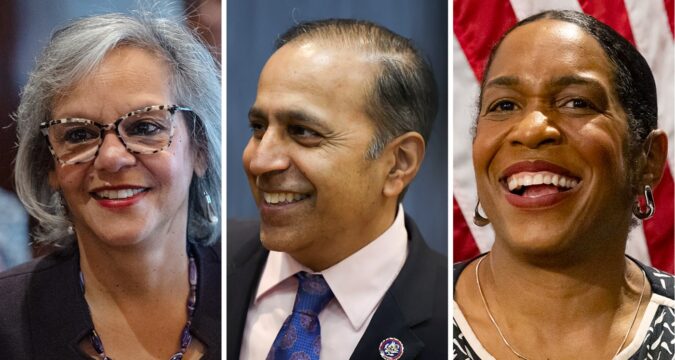
On the Democratic side of the ballot, the choice is between Illinois’ current lieutenant governor, Juliana Stratton, 60, a lawyer and former member of the Illinois House of Representatives. Stratton, a native of Chicago’s South Side, was the first Black woman to serve as lieutenant governor and her candidacy was introduced by the current governor, JB Pritzker, who waxed lyrical on her behalf last April: “Illinois deserves a United States Senator who knows how to fight for us. A senator who will never cower when the moment calls for courage.” The rhetorical support from Pritzker has been followed by millions of dollars in financial support from our billionaire governor.
But Stratton, a progressive, has some serious opposition.
Robin Kelly, 69, is a longtime Illinois politician who has a Ph.D. in political science from Northern Illinois University in DeKalb. Kelly spent three terms in the Illinois House before leaving to work for then-treasurer Alexi Giannoulias, now Illinois’ secretary of state and a presumptive leading candidate for mayor of Chicago, and then for Cook County Board President Toni Preckwinkle. In 2013, she was elected, with this board’s endorsement, to the U.S. House of Representatives, where she remains. We endorsed her reelection in 2024, citing her awareness of the need for economic development in Illinois’ 2nd Congressional District, the scourge of gun violence therein and her “successful efforts to turn Pullman into a national park, boosting tourism and economic development.” She noted some of those accomplishments, and other achievements in the House, when she spoke with us.
Anyone assessing the relative experience of these two women, both dedicated public servants, would have to conclude that Kelly’s resume had the greater heft. Kelly is highly qualified for this office. That said, when we met with Stratton, she pointed out to us that she was the only one of the three Democratic candidates in the primary who had “served in a statewide office.” That’s true; the others have represented specific districts, albeit on a federal level.
The third candidate is Subramanian Raja Krishnamoorthi, who likes to say, for obvious reasons, “just call me Raja.”
Aged 52, Krishnamoorthi is a member of the U.S. House from Illinois’ 8th District, who first assumed office in 2017. In 2024, we endorsed Krishnamoorthi — who was born in New Delhi and then moved with his family to Buffalo, New York, and later Peoria (where his father became a professor at Bradley University) — for a fifth term, which was not our first endorsement of this genial and talented politician.
We cited our admiration for his belief in education as the key to class mobility and his work as an “intellectually sophisticated member of the House Intelligence Committee.” We also declared him “a rising figure in national politics,” now yet more clearly the cast. And we described him as “a detail-oriented representative known for stellar service to his constituents and very much in tune with this nation’s problems and assets.”
This time around, we heard some rumblings from DuPage County that his willingness to show his face was perhaps not at the the same level, no doubt reflecting the many demands of his time as one of the Democratic Party’s most effective legislators.
Nonetheless, we remain very impressed with Raja.
“We need a government that will cultivate the American dream for everyone,” he told us when he spoke to us in recent days, noting his immigrant past and his belief in “the greatness of this country.” Krishnamoorthi placed particular emphasis in our conversation on education, saying there needed to be a modernization of the “skills-based educational system,” which we took to mean the community college system that prepares people for trades where job prospects remain buoyant.
He also spoke in detail about the health care crisis, which he described as a “five-alarm fire” likely to leave millions of Americans newly uninsured and, when we asked him about the future of the infamously divided Democratic Party, he answered with, “We have to return to our roots as the party of economic opportunity.” He argued that “the growing-a-business part gets ignored and that is where people want us to be.”
We strongly agree that this is the way forward for Democrats.
Kelly expressed some similar views in her conversation with us, especially when it came to criticizing the Trump administration’s actions over immigration enforcement, which all three candidates told us they abhorred. Kelly also talked with us about what she termed “the affordability crisis” and emphasized the cost of housing as a prime determinant thereof. She also cited her work on the House Energy and Commerce Committee as indicative of her experience as a legislator, and noted her support for improving the nation’s infrastructure and expanding renewal energy sources.
So how is a Democratic voter to sort through this race?
Ranking them from the progressive to the centrist wing of the party is reductive, we know, but there is no question that Stratton occupies the left lane and Kelly is just slightly to her right. Krishnamoorthi is running as more of a centrist Democrat (not that he likes that definition), a faction made up of those who say that the nation’s capitalism system is not something to be against, given the alternatives, and that economic growth raises the quality of people’s lives more than a focus on redistribution of wealth. Both Stratton and Kelly emphasize a wish for higher taxes on the wealthy, although they use common phrases like “pay their fair share,” as if there were consensus as to what the word “fair” means.
Stratton goes further with her support of a national $25 minimum wage, which she reasserted in her meeting with us. Our view is that such a cost increase would mean curtains for many small businesses.
Both Kelly and Krishnamoorthi told us they also supported an increase in the long-moribund minimum wage but they floated somewhere in the more reasonable range of $17, at least for now, perhaps with initially lower training wages.
Another interesting tell involves health care. Both Stratton and Kelly told us they supported “Medicare for All,” which is a familiar rallying cry among Democratic Party candidates this fall. But Krishnamoorthi cited something subtly different: He said he wanted to “enroll more people in Medicare.” When we asked for more detail, he basically argued for a gradual increase in the number of Americans enrolling, beginning with those aged earlier in their 60s than the government program’s current starting point. Americans at that stage just before retirement age are particularly vulnerable to losing their employer-provided insurance, just before they qualify for Medicare. That strikes us a smart first step more likely to win bipartisan support.
GOP U.S. Senate contenders Casey Chlebek, from left, Jeannie Evans and Don Tracy prepare for their debate on Feb. 11, 2026, at WLS-Ch. 7. (Josh Boland/Chicago Tribune)
Republican voters are choosing between six candidates who will have an outsize fall challenge in what generally is seen as a safe Democratic seat. The leading candidate, no bones about it, is former Illinois Republican Party Chair Don Tracy, 75, senior counsel at the law firm of Brown, Hay & Stephens. His credible rivals include Casey Chlebek, an immigrant from Czarny Dunajec, Poland, who went on to purse a career in information technology, and Jeannie Evans, 55, an energetic, Harvard-trained lawyer who, as a member of the Church of Jesus Christ of Latter-day Saints, says that her faith is her “cornerstone.” Evans, who has been involved in litigation against TikTok, is clearly a candidate of substance.
We liked her materials on AI: “I will … protect the rights of Americans to their own data and the content they create, which is the foundation of AI advancement, rather than allowing big tech to reap all the profits.” Amen to that.
R. Cary Capparelli, a Chicago businessman and perennial candidate; Pamela Denise Long, an occupational therapist; and Jimmy Lee Tillman II, a publisher, author and another perennial, also are in the race.
“The MAGA knives came out for Don Tracy, the chair of the Illinois Republican Party for more than three difficult years,” we wrote in June 2024 upon his departure under pressure from that role, “and they stabbed more fiercely than in May. We’re sorry to see this decent man go. We always found him to be thoughtful, reasonable and an independent thinker.”
There would, then, be a beautiful sense of irony if voters in the Republican primary righted that wrong.
Since we’re not endorsing in this race, we’ll leave things right there.
Submit a letter, of no more than 400 words, to the editor here or email letters@chicagotribune.com.


