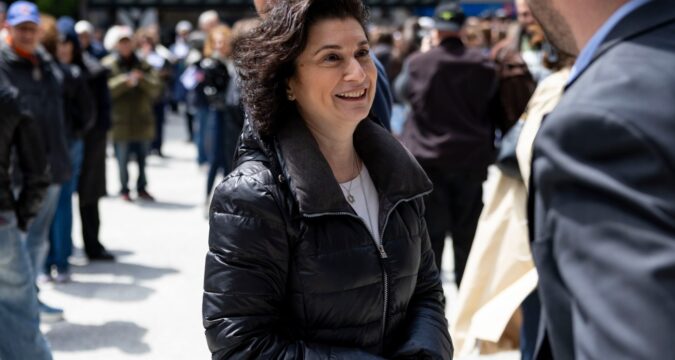
According to the story “Illinois 9th District race tests long Jewish legacy” (Feb. 8), Chicago Ald. Debra Silverstein, 50th, said she would be “very concerned if (the 9th Congressional District) wasn’t a Jewish seat.” She added, “Because the makeup of this district has a very large Jewish community that’s nuanced, I think it’s important that we have a Jewish representative that understands our needs firsthand.”
Perhaps Silverstein needs to check some population statistics. The article states that “nearly 12% of people living in the 9th District in 2024 were Jewish, according to a survey supported by the nonprofit Jewish Electorate Institute.” It also reports that according to “the Jewish United Fund’s 2020 Jewish Chicago population study, a cluster of near north suburbs, including Skokie and Evanston, was the only region in the Chicago area that saw a decline in the number of Jewish households in the 2010s.” On the other hand, 15% of people in the 9th District identify as Asian.
It doesn’t really make sense that the needs of Jewish households should be more important for a representative than the needs of other groups (88%) in the district .
I think candidate Hoan Huynh gives a truer picture of the 9th Congressional District, calling it “the Ellis Island of the Midwest.”
I think the needs of all the population groups in the 9th Congressional District need to be considered in choosing a representative, and I hope voters will do just that.
— Linda Hendelman, Chicago
Litmus test for candidate?
The article about the 9th Congressional District reports that the district is 12% Jewish, yet contains quotes such as the seat “has been held by a Jewish person for a very, very long time, and I feel very strongly that it should remain that way.”
Why is a district that is 88% not Jewish expected to be represented in perpetuity by a Jewish representative? Since when is belonging to a specific religion the litmus test for a political candidate in the U.S.? If another seat was held for generations by members of a specific faith or race, should that seat never be available to someone not of that group?
Clearly, that is not the constitutional expectation.
— Kevin Carsten, Morton Grove
Narrowing pluralism
Recent Tribune coverage of the Jewish political legacy in the 9th Congressional District describes a broader national tension — one that now hits closer to home as the Illinois Senate’s 9th District race between Rachel Ruttenberg and Patrick Hanley has also been framed through the lens of religion.
As Jewish women living and voting in Illinois elections, we shudder when we hear a legislative seat described as “a Jewish seat.” Yet, we have heard neighbors suggest that because this North Shore seat has been held by state Sen. Laura Fine, a Jewish woman, her successor should be someone of Jewish faith.
This sentiment should give voters pause. Democracy is strongest when representation is earned through ideas, character and commitment to public service. Elected office does not belong to one particular religious group. This thinking risks narrowing the pluralism that defines our state and our country.
Early endorsements from members of the Illinois Legislative Jewish Caucus signaled institutional support for Ruttenberg at the outset of the race. Financial backing soon followed: A political action committee associated with Jewish caucus leadership contributed tens of thousands of dollars to her campaign.
Endorsements and fundraising are features of American politics, but they can raise legitimate questions about independence. When institutional influence appears to align so quickly with identity, voters are right to ask whether leadership is being evaluated broadly enough.
Jewish tradition places extraordinary value on inquiry, debate and ethical reasoning. Our intellectual heritage is one of challenging assumptions and pursuing justice. Reducing political leadership to identity alone runs counter to those principles.
Hanley has attracted support from a wide coalition, support that appears grounded in outreach, experience and engagement.
Our concern is larger than any single candidate. When politics become a calculus of demographic succession, representation begins to feel inherited rather than earned.
Identity matters. But it should not determine support for public office. A healthy democracy chooses representatives by the strength of their judgment, not the simplicity of their labels.
— Jennifer Obel, Wilmette, and Caryn Fliegler, Northbrook
Reform in assessments
The Tribune Editorial Board’s endorsement of Fritz Kaegi (Feb. 8) overlooks the central issue driving Cook County’s property tax crisis: a persistent failure of governance inside the assessment system. The core structural problem is not partisanship or messaging. It is the absence of a legally required process to correct factual errors once they are proven.
Under current Illinois law, when an appeal shows that the assessor relied on incorrect square footage, a misclassified basement or attic, wrong building class or inaccurate comparable-property characteristics, only the tax bill for that single year is corrected. The underlying data remains unchanged. This is why taxpayers face the same battle every three years. The problem is not that appeals exist; it is that the system never learns from them.
During Kaegi’s tenure, homeowners experienced some of the sharpest and most uneven tax increases in decades, especially on the South and West sides where bills jumped dramatically in a single year. At the same time, countywide tax bills were delayed due to operational and technology failures that disrupted cash flow for households, school districts and local governments. These are measurable outcomes that reveal a breakdown in basic administrative oversight.
A modern, data-driven assessment system depends on accuracy, verification and correction. Yet Cook County still has no internal process to permanently update property records when errors are found, nor any requirement to review whether incorrect data affected comparable properties or neighboring homes. Without a true data-correction loop, assessments will continue to be unstable and unequal, regardless of who holds the office.
If Cook County is serious about fairness and modernization, the priority cannot simply be defending the status quo. It must be fixing the structural flaw that allows known errors to remain in circulation. Stability will come from leadership committed to accuracy, transparency and long-overdue governance reform.
— Tony Bonvolanta, Chicago
What do they stand for?
As I suffer from acute political ad fatigue, I have a message for the candidates in the upcoming primary: Please tell us more about what you stand for and less about who you stand against.
— Sheryl Slone Tarkoff, Chicago
Ready to hit mute button
With all the political ads on TV now, a candidate often says that the other candidate wastes money and he or she alone can fix the problem. The political party doesn’t matter; it’s always the other guy.
The real waste of money is the ads themselves. I don’t know about anybody else, but my finger is on the mute button whenever the program I’m watching is ready for a commercial break, especially news programs.
To Raja Krishnamoorthi, Laura Fine, Donna Miller, Brendan Reilly, Toni Preckwinkle, Darren Bailey and all the other pols putting these ads on TV: I am ready to mute you as soon as I can.
— Robert Sullivan, Orland Park
Alternative to 2 parties
A recent letter writer (“A new party for Americans,” Feb. 6) laments the lack of a third party. I used to vote for Libertarian Party candidates. There have been candidates from other parties over the years. They disappeared. I suspect that they were tired of being ignored by the voters. They may never return.
Voters should realize that they don’t have to settle for a Republican or a Democrat.
— William Capper, Morris, Illinois
Great leader for youths
Regarding the op-ed “In an age of anxiety and division, the arts are not an ‘extra,’ they’re a lifeline” (Feb. 10): Josephine Lee elevates others, especially young voices, because she is simply inspiring. She expects her choirs to be better than they ever thought they could be, and the sparkling results reward them, for a lifetime, as well as their audiences.
Two decades ago, I met Josephine at a Chicago Children’s Choir event. Enthralled, I invited Josephine and a musical colleague of hers to put on an evening of pops at my venue in tiny Toulon, Illinois. She didn’t disappoint; she never does.
At the piano, with her friend sharing the vocals, they wowed the small town audience that probably wasn’t used to Josephine’s level of soaring talent. Thanks, Josephine.
I think Josephine should lead Chicago Public Schools. We need inspiration, not more dumbing down of expectations.
— Jim Nowlan, Princeton, Illinois
Messages to take to heart
I read Josephine Lee’s op-ed about what arts participation does for children with a surge of hope. The demand for excellence that fosters belief in oneself, the unifying experience of expansive human understanding through sharing an art form with others of different backgrounds and cultures, the empathic exercise of appreciating the efforts of one’s peers, the breeding of respect for all those participating with one from peers to authorities, the cultivation of self-motivation that builds leadership character and the pursuit of goals transcending competition and awards — all these make arts participation a fundamental life education.
I profoundly know this from teaching classical ballet to young people for the past 30 years, and I’ve worked with Lee. My hope is that Lee’s messages are heard and taken to heart by educational policymakers in Chicago and everywhere.
— Daniel Duell, artistic director, Ballet Chicago
View of homeschooling
Thank you for the evenhanded article on the growth of homeschooling in Chicago (“‘Free the kids,’” Feb. 11).
My wife and I homeschooled all five of our children through high school. Among them, we’re proud to have toted up five bachelor’s degrees (information systems, education, engineering, applied science, music), five master’s degrees (library science, electrical engineering, microwave engineering, computer science, liberal arts) and a juris doctor.
Their degrees come from a wide variety of institutions: DeVry University, Maranatha Baptist University, Bob Jones University, San Jose State University, University of Wisconsin at Milwaukee, University of Massachusetts at Amherst, the Naval Postgraduate School, St. John’s College at Annapolis and Indiana University. Clearly, there’s no inherent problem with transitioning from homeschool to college!
I particularly appreciate what Angela Watson said: “(These states) have virtually no regulation or laws or requirements around homeschooling. Then, they try to go from that to the most restrictive laws in the nation.”
This is an accurate description of the failed Illinois legislation from last spring. Lawmakers’ intent seems not to protect homeschooled children but to protect public schools and those who profit from it. Even if that’s not their goal, it would certainly be their effect if they were to succeed.
Illinois has plenty of education problems to tackle. Homeschooling is emphatically not among them. Until the real problems are taken care of, Springfield needs to leave homeschoolers alone.
Thank you for not characterizing homeschoolers as counterculture, Bible-thumping, alt-right, child-abusing hermits. We’re just parents who want the best for our kids, know them best and are making the best choices possible. And our kids are just fine!
— David Vancina, Manhattan, Illinois
Insult to public school kids
The article on homeschooling is the most insidious I have ever seen on the Tribune’s front page and an insult not only to Chicago’s mayor but to the thousands of children in Chicago Public Schools!
Democracy and freedom can only exist in an intelligent, rational, conscientious and responsible society. Advocating for homeschooling is highly irresponsible, anti-democratic and prejudicial. Besides academic achievement, public schools foster social responsibility and behaviors, without which we cannot be united as a country.
Psychologists have found that COVID-19 isolation in education had negative effects on children’s socialization. There are some children who need to be homeschooled, but this is a minority of children.
Teacher training colleges and universities are responsible for providing skills and education to ensure that our teachers are equipped to reach the children they teach and equip them to be lifelong learners.
Researchers who focus on the role of education would never support a massive division of educational opportunities for children.
— Donna S. Davis, Woodstock
Submit a letter, of no more than 400 words, to the editor here or email letters@chicagotribune.com.
https://www.chicagotribune.com/2026/02/12/letters-021226-9th-congressional-district/


