If anyone doubts the size and scope of Black leadership talent in Chicago, then they were not present for our endorsement meetings in regard to the storied 2nd Congressional District. Although many of the candidates are not easy to differentiate on the issues of the day, they represent multiple generations and backgrounds.
The 2nd District has been a Democratic stronghold for decades. And the representative of its people, mostly located on much of Chicago’s Far South Side and in the city’s southern suburbs and exurbs, and extending south to Danville, has been an African American since 1980. After Robin Kelly announced she was running for Senate in lieu of seeking reelection, the seat became an open contest on the Democratic side, which is the only viable side.
One candidate has a very famous name: Jesse Jackson Jr., the 60-year-old son of Jesse Jackson, the famed civil rights leader and former presidential candidate.
The younger Jackson represented this district in the U.S. House from 1995 until 2012, when he announced his resignation. The following year, he admitted to violating federal law by using campaign funds to make personal purchases and pleaded guilty to one count of wire and mail fraud. He was sentenced to 30 months in federal prison and was released on March 26, 2015. Although he and his backers sought a pardon from President Joe Biden, Jackson did not receive one.
Some of his rivals have noted that former felons without such an illustrious name often struggle for employment, which is a fair point. But in our view, Jackson served his time, has eloquently made the case for his political redemption, and reflected on his mistakes. So to our minds, he has every right to run again. The issue of his ongoing political viability is one for voters to decide, but it is also a choice that we suggest be made with an eye on the fresh alternatives without personal baggage.
That said, Jackson’s visit with us served as a reminder that Jackson remains a formidable rhetorician and a passionate (actually, yet more passionate) defender of the people of his district and his own record, with an acute sense of the importance of economic investment in the 2nd, as typified by his support, then and now, for a new airport without its boundaries. Especially when challenged by less famous rivals, he became strikingly animated and leaned heavily on his previous congressional experience, not surprising to us but a smart mode of differentiation nevertheless. “We need a visionary economic plan that can connect the 2nd Congressional District to the global economy,” he told us. Amen to that.
“I bring 17 years of seniority to the process,” Jackson emphasized, adding: “Things have not been the same since I left.”
Logic demands that those voting for him will have to be in agreement. For our part, we feel that Jackson’s future service will best be performed outside Congress.
That leaves a multiplicity of other candidates to consider.
With a graduate degree from the University of Chicago, Adal Regis, 38, is the whip-smart son of Haitian immigrants and an avowedly progressive candidate who worked in Kelly’s office as well as that of former New York U.S. Rep. Nita Lowey. Regis touts endorsements from Democratic strategist and former Tribune reporter David Axelrod and the lawyer-pundit Van Jones. He told us that people are suffering in the 2nd District and that the wealth gap is widening. He said he supports Medicare for all and also spoke eloquently on the need to connect the 2nd District to the global economy. “Any effort to address public safety that does not factor in job creation and livable wages is likely to fail,” he noted, “as people must provide for their families and may take desperate measures otherwise.”
Willie Preston, 41, currently the state senator in Illinois’ 16th District and a feisty campaigner, talked with us about his real-life experience doing blue-collar jobs and also discussed some of the resentment he sensed in the district toward the funds spent on migrants rather than on those who have been here for many generations. He especially noted how many Blacks in the 2nd have cited the longtime understanding that police stations were not a place of refuge for them, even if they became one for recent arrivals. Preston is the maverick candidate who most eschews Democratic orthodoxy; we enjoyed his populist, free-thinking spirit, but he’d be a head-spinning departure for this district.
Robert Peters, 40, is another currently serving state senator (he represents the 13th District in Springfield), and he discussed his many progressive priorities with us, including his support for Medicare for all and his interest in fighting the wealth and death gaps, all too palpable in the district. “I strongly support a wealth tax and a tax on loans for the very wealthy,” he told us.
Peters, who is on the left of his party, has a compelling personal story: Born hard of hearing to a drug-addicted mother, he says what drove into politics was the sense that so many Americans were becoming isolated. He made much of the need for Congress to “have principles” and, in our meeting, emphasized the importance of vision.
Metropolitan Water Reclamation District Commissioner Yumeka Brown, 47, has many progressive positions. When she talked to us, she emphasized health care needs and the need to alleviate poverty. “Legislatively, I would focus on lowering everyday costs and raising economic security,” she told us. “That starts with making housing more affordable by expanding affordable housing supply and increasing federal investment in housing assistance and community development.”
Eric France, who runs a management consulting firm and has limited political experience, is one of several candidates in the primaries who are coming from the private sector and bringing that business-world experience to stack against longtime politicians. France also expressed concern about the economic health of the 2nd District, calling it “the forgotten stepchild.”
“I fix stuff,” France said, bluntly, implying a pragmatism he believed to be lacking in other candidates. He also noted that the disinvestment in this district “did not start with Donald Trump and it won’t end with Donald Trump.”
Also running are Patrick J. Keating, Toni C. Brown and Sidney Moore, whom we have judged to have not mounted substantial campaigns for this competitive seat.
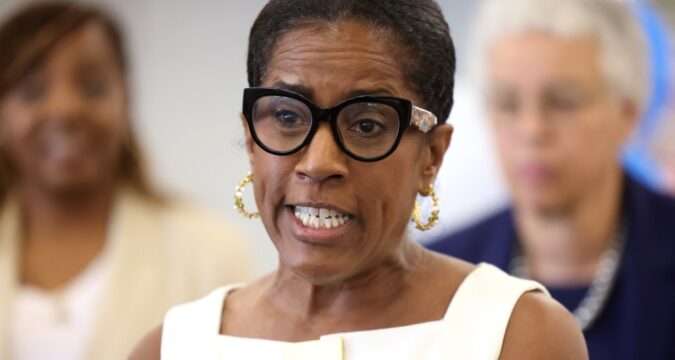
So while especially noting the longtime service of Jackson and the future-forward intellect we saw in Regis, along with much talent elsewhere, our endorsement in the 2nd goes to Donna Miller, currently serving as a Cook County commissioner, who we feel offers the best combination of experience and moderate, pragmatic points of view that will serve a district with multifarious needs.
“Illinois families have been paying the second-highest property tax rates in the nation,” she told us, describing that as “a significant factor in addressing my key priorities related to healthcare, affordability and seniors.” That burden was not something similarly emphasized by the other candidates in the race.
Many others running for this seat emphasized their support for substantial increases in the federal minimum wage, to $25 an hour and beyond. Miller, 60, had the guts to acknowledge that many of the small businesses in her district couldn’t survive increases at that level; she called for a baseline around $17 an hour with exceptions for jobs designed to offer young people training and experience.
Speaking of small businesses, Miller also spoke specifically about her plans to help them succeed, saying she planned “legislation that modernizes and simplifies small business tax provisions.”
On a separate subject, we found the way Miller discussed immigration to be carefully reasoned and well-informed, emphasizing her conviction that while the nation needs its immigration laws, “we must end racial profiling and ensure immigration enforcement upholds our Constitution and our values.” As the leading woman in this race, Miller also was careful to emphasize to us such issues as the importance of reproductive rights, similarly important to this board. We think she will be the smart choice of many of the women in the 2nd, although hardly confined there.
Readers should note that the only Republican on the ballot is Mike Noack. We will address his candidacy in the fall, although the 2nd District has not sent a Republican to Congress since the 1950s.
Donna Miller is endorsed.
Submit a letter, of no more than 400 words, to the editor here or email letters@chicagotribune.com.
https://www.chicagotribune.com/2026/02/10/editorial-donna-miller-for-2nd-congressional-district/


