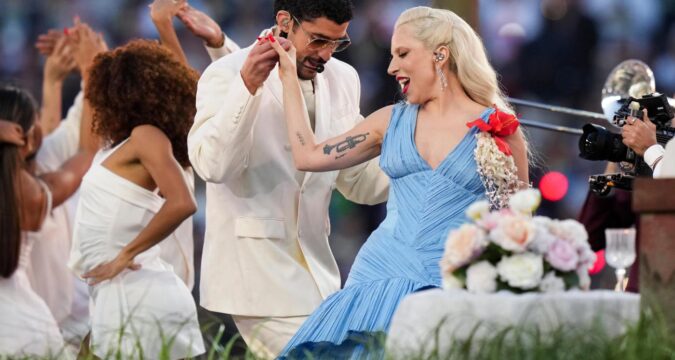
Let me be straight here and say I just finished watching Bad Bunny’s Super Bowl halftime show and since I’m supposed to write down a few thoughts, long story short: Holy smokes. How could you not swoon over that? I even felt a chill or two.
It was rousing, funny, surprisingly touching. Understand, I love Super Bowl halftime shows, but usually because they’re bonkers. For decades, they went beyond nuts. Until a few (Prince in 2007; Madonna in 2012; Beyoncé in 2013) transcended nuts. Bad Bunny’s was closer to a cultural moment, a paradigm shift, a reimagining of how much a halftime spectacle can resemble art. It was a love letter to home and a hand extended outward, inviting you to dance with him. No question, here was one of the more understandable halftimes.
In fact, while Kid Rock and his super friends were on Turning Point USA’s social media and YouTube channels playing an alternative halftime show in protest of the NFL handing its official halftime to a Spanish-speaking artist, Bad Bunny was professing, in both Spanish and English, the power of community, the meaning of togetherness.
But again, I love all halftime shows.
I can’t be trusted with such important opinions. Probably neither can you, and if you refused to watch because Bad Bunny sings in Spanish and you thought you wouldn’t understand what he was saying, let me raise you a Super Bowl halftime in 1970 starring Lionel Hampton on vibraphone, a recreation of the Battle of New Orleans (with a field of dead and dying soldiers) and the singing of Carol Channing. Indeed, one of the stranger Super Bowl halftime shows ever, exactly 40 years ago, the year the Chicago Bears destroyed my beloved Patriots by 36 points, was so creatively confusing, the folks of Up With People — pure uncut Super Bowl halftime kitsch — cuisinarted “Born in the U.S.A.” into a vanilla mash of Huey Lewis and Kenny Loggins, and then, whiplashing again, tacked on a note that the real star of the evening was Martin Luther King, Jr.
When it comes to Super Bowl halftimes, you can’t make this stuff up.
Mostly because it feels like they make this stuff up about 20 minutes before halftime.
See, Super Bowl halftimes are like those old Stefon sketches with Bill Hader on “Saturday Night Live,” squirreling together non-sequiturs and calling it a party. In 2011: The Black Eyed Peas, Slash and Usher. In 1995: Tony Bennett, the Miami Sound Machine and Indiana Jones. In 1988: Chubby Checker, the Rockettes and 88 grand pianos. Hell, the first Super Bowl halftime ever in 1967 starred men flying around in jetpacks, marching bands and 300 pigeons.
Bad Bunny’s performance, in comparison, did what smarter halftime shows do: Besides its over-the-moon spectacle, besides its veritable recreation of the entire island of Puerto Rico, besides the inevitable and literal fireworks, it was performed in a singular voice —not unlike what Prince did, or what Tom Petty managed in 2008 without dancers or conceptual flash.
Bad Bunny — and if you listened to his last few albums, you expected this— was mostly about music, and connections, and a familiar love gleaned from traditions. There really was no stage. There was, rather, a cast of hundreds, dancing together and spreading apart, among tall grasses, old men playing dominos, street vendors, a nail salon, utility workers dancing from their telephone poles, rows of brass horns and a full string section — the last led by Giancarlo Guerrero, the new conductor of Chicago’s Grant Park Music Festival, a Costa Rican native.
Think dizzying, but in the best of ways.
For those new to Bad Bunny, some context: His name stuck because of an old family photo, a picture of a young Benito Antonio Martinez Ocasio wearing a bunny costume, glowering. His music, holding a foot in the future and the past, is homage to Puerto Rican traditions, heavy on salsa, with notes of hip hop, big band, indie rock and reggaeton. It might not be your world, but it sounds like the world. And often, it erupts like a street party — despite his solemn singing voice coating everything in bittersweet, his phrasing alternating with dramatic gasps, as if so bereft he doesn’t notice the party behind him.
Some argue that he is the most popular recording artist in the world, and if so, I would bet that his secret is how casual and unpretentious his disparate mix sounds, how close to the ground it feels. As the New Yorker put it: “The bigger he gets, the more local he seems.” His series of concerts celebrating Puerto Rico last year became such an international event that Moody’s slightly raised its financial outlook for the island.
His halftime show was a kaleidoscopic extension of that triumph, a sunny snapshot of the island imported to the 50-yard line, largely removing anything like a traditional stage, spreading dancing and musicians outward and evenly, placing Bad Bunny at the center of a constant swirl of action.
What struck was how wholesome a Bad Bunny halftime could be. How could loud chunks of the audience have seemed threatened by this?
But then, as a bellwether of how slow we can be to embrace social change, one could do worse than watch the past 59 years of Super Bowl halftimes. For decades, it was a national toilet break. In the 1970s, during the heyday of Led Zeppelin and Earth, Wind & Fire, halftime was a bouillabaisse of marching bands and performers a decade or more past relevance. There were salutes to Duke Ellington and Old Hollywood.
The template for years of halftimes was cemented by an events director named Tommy Walker, the man behind the Main Street parade at Disneyland. Without intending, even as the Vietnam War lingered on and the national mood was grim, halftime became classic Americana, a telling mixture of self-parody and pride.
Nothing changed until the 1991 halftime, anchored by New Kids on the Block. Amazingly, that was the first halftime featuring a contemporary hitmaker, albeit inserted into Disney’s “It’s a Small World” theme.
The following year, Gloria Estefan was the halftime star.
The year after that, Michael Jackson.
And so on. Super Bowl halftime is now watched by an estimated 100 million people, far and away the most seen musical performance of the year, if not always the most remembered.
Bad Bunny’s Super Bowl halftime show in photos
Of course, since the 1990s, it hasn’t always been a smooth road. (Who told the Rolling Stones to play a new song? In 2006?) As the pageantry of Bad Bunny reminded, maybe the best way to approach a Super Bowl halftime is by blending the old-school with a lot of new. Dr. Dre and Eminem and Kendrick Lamar (2022) reworked the calcified revue halftime into a rousing survey of 2000s rap. Prince reached even further back for inspiration, finding room to include the Florida A&M University marching band.
Bad Bunny brought on Lady Gaga and Ricky Martin, seamlessly, without stopping to genuflect, the mood moving from sweaty to open-hearted, then finally, with Bad Bunny dancing off the field, singing into the camera, a furious insistence on decency itself. You don’t have to speak Spanish to know when someone is standing his ground.
Bad Bunny’s powder-weight name suggests a flash-in-the-pan, an artist-of-the-week; if you never heard of the guy until you heard he was playing halftime, perhaps the announcement sounded like disrespect of the always, ahem, dignified halftime tradition. But here was a performance of such joy, class and self-determination, it struck a louder note: This political moment will pass one day; Benito Antonio Martinez Ocasio will not.
cborrelli@chicagotribune.com
https://www.chicagotribune.com/2026/02/08/bad-bunny-super-bowl-review/


